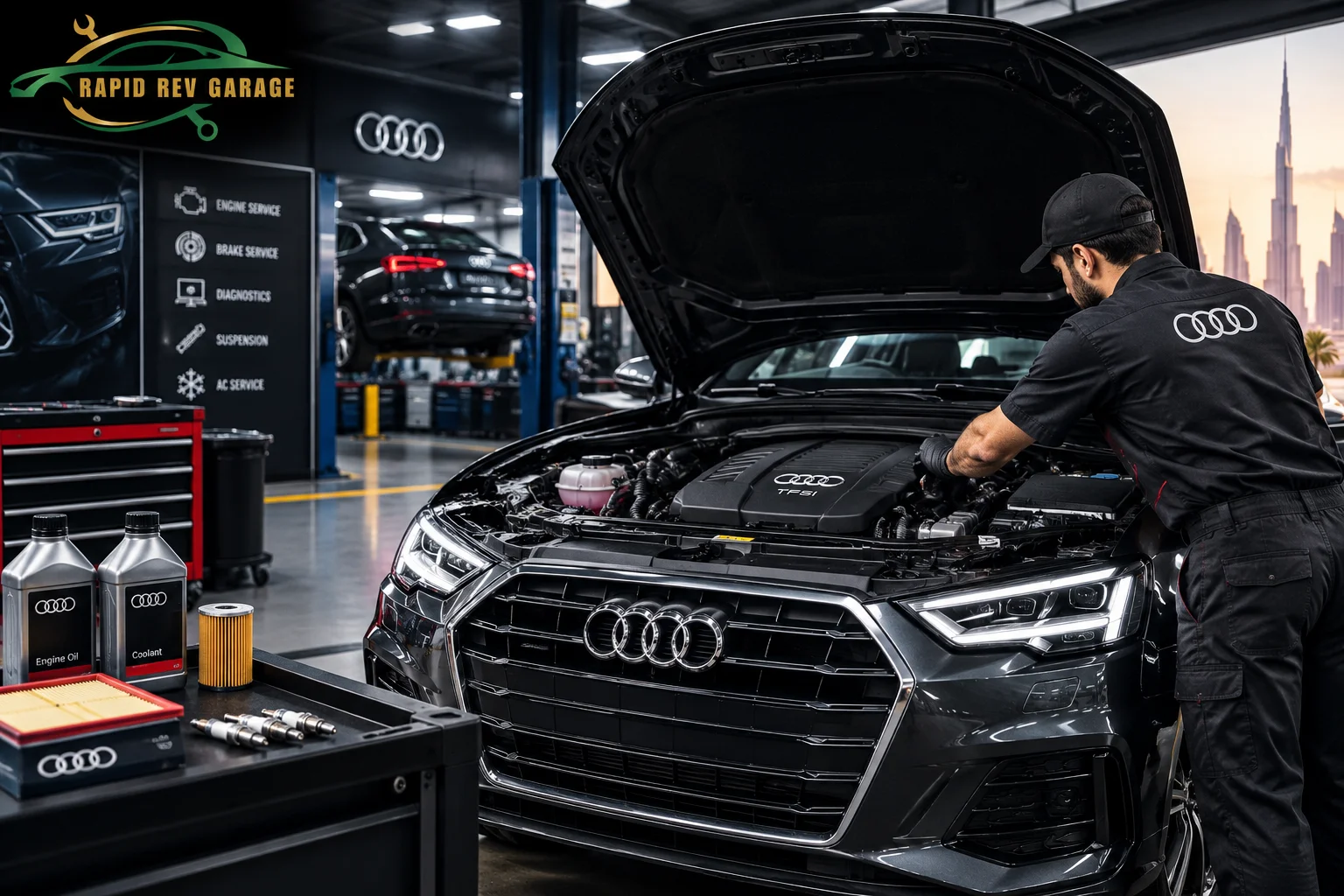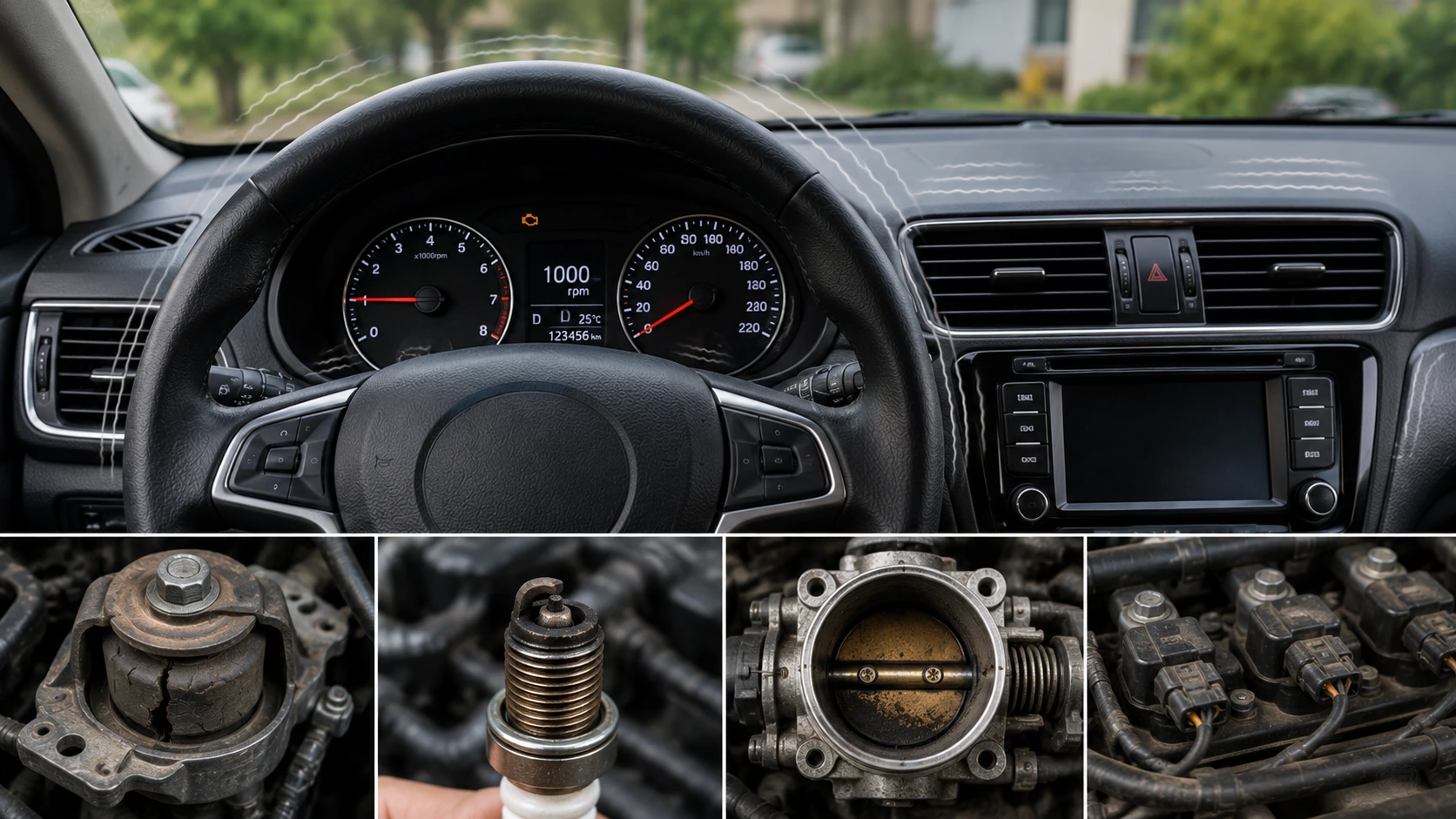
A car vibrating while idling — the shudder or shake that appears when the engine is running at standstill with no throttle applied — is one of the most common complaints at our Al Quoz workshop. Unlike acceleration vibration that points toward the driveline, car vibrating while idling specifically implicates the engine’s combustion balance, its mechanical mounting to the body, or the idle speed control system. Dubai’s stop-start driving pattern means the engine spends a significant portion of every journey at idle — in traffic, at signals, in drive-through queues — making an idle vibration a constant daily irritant rather than an occasional inconvenience.
At Rapid Rev Garage in Al Quoz, car vibrating while idling is diagnosed with live misfire data, an engine mount deflection test, and idle system assessment — confirming the cause before any repair is recommended.
Car Vibrating While Idling — Quick Verdict
A car vibrating while idling in Dubai is most commonly caused by one of five faults: worn spark plugs or failing ignition coils producing misfires on one or more cylinders that interrupt the smooth power delivery sequence at idle; failed engine or transmission mounts that no longer isolate the engine’s natural vibration from the body; a carbon-fouled throttle body causing an unstable idle speed that the engine management system cannot hold consistently; a vacuum leak allowing unmetered air into the intake and producing a lean mixture at idle; or an EGR valve fault causing combustion contamination at idle.
In Dubai’s stop-start heat, carbon accumulation on throttle bodies and ignition component wear both develop faster than European service intervals assume — making this vibration particularly common on vehicles between 60,000 and 120,000 km with no mid-interval maintenance.
Table of Contents
- How to Read the Idle Vibration Before Any Diagnosis
- Engine Misfires — The Most Direct Cause of Idle Shake
- Engine and Transmission Mount Failure at Idle
- Throttle Body Carbon and Unstable Idle
- Vacuum Leaks Causing Lean Idle
- EGR Valve Faults at Idle
- Why Dubai’s Conditions Produce Idle Vibration Earlier
- How We Confirm the Exact Cause at Rapid Rev Garage
- The Right Fix for Each Confirmed Cause
- What Happens If Idle Vibration Is Left Without Repair
- Is It Safe to Drive?
- How Long the Repair Takes
- What the Repair Costs in Dubai
- Preventing Idle Vibration in Dubai’s Conditions
- Why Rapid Rev Garage?
- FAQ
- Conclusion
How to Read the Idle Vibration Before Any Diagnosis
The rhythm, intensity, and conditions of the idle vibration — provides specific diagnostic information before any tools are connected.
A Rhythmic Shudder at a Specific Idle Speed
A rhythmic shudder that pulses at a specific frequency — often described as a shake that beats rather than buzzes — is almost always misfire-related. The misfire on one cylinder interrupts the firing sequence at each cycle, producing a shake that repeats at the engine’s firing frequency. The rhythm is the combustion cycle skipping.
A Constant Buzz or Vibration That Doesn’t Pulse
A constant, non-rhythmic vibration that buzzes rather than beats points toward an engine mount fault. A failed mount allows the engine’s inherent rotational imbalance — present in all engines — to transmit to the body without the isolation the mount provides. The vibration is constant because the engine always rotates, not because it is periodically misfiring.
Vibration That Changes When Switching to Neutral
On automatic transmissions, switching from Drive to Neutral at idle changes the load on the engine and transmission mounts. A the vibration that significantly improves when shifted to Neutral confirms a mount fault — the torque load change when engaging Drive exposes the failed mount’s inability to isolate the engine.
Vibration That Worsens in Hot Weather
A vibration that is absent or minimal when the engine is cold but appears or worsens as the engine reaches full operating temperature points toward a throttle body or idle control fault — heat changes the idle speed management system’s operating conditions. It may also indicate a temperature-sensitive ignition coil that misfires once hot.
Engine Misfires — The Most Direct Cause of Idle Shake
At idle, the engine fires each cylinder in a precise sequence that produces smooth, balanced power. When one cylinder misfires — fails to ignite its fuel charge correctly — the remaining cylinders continue firing but the missing power pulse from the misfiring cylinder creates an imbalance that shakes the entire powertrain.
Worn Spark Plugs
Spark plugs with worn electrodes require higher voltage to fire and produce a weaker, less consistent spark. At idle — where cylinder pressure is lower than at load — a worn plug may fire inconsistently, producing a partial or missed combustion event. The resulting car vibrating while idling is directly proportional to how many cylinders have worn plugs, and how much each plug has worn from specification.
Why Dubai Accelerates Plug Wear
Each engine start is a thermal event — the spark plug electrodes expand from ambient temperature to operating temperature and back to ambient when the vehicle is parked. In Dubai, where multiple short daily trips produce more start cycles per year and where ambient temperature swings between underground parking cool and peak underbonnet heat are significant, spark plug electrode erosion accumulates faster than European factory intervals anticipate. A plug scheduled for 60,000 km replacement in a European market may be producing idle vibration symptoms at 40,000–45,000 km in Dubai’s cycle-intensive driving.
Failing Ignition Coils
An ignition coil that is losing its dielectric integrity — from heat-induced insulation cracking or age — misfires intermittently at idle where the spark energy demand is highest relative to available coil charge time. A coil swap test — replacing the suspect coil with a known-good coil from another cylinder and observing whether the misfire moves to the new cylinder — confirms a coil fault before replacement. Our car mechanic team reads per-cylinder misfire counters on a live diagnostic scan before any plug or coil is replaced.
Engine and Transmission Mount Failure at Idle
Engine and transmission mounts are the rubber-and-metal components that connect the powertrain to the body while absorbing its vibration. A failed mount transmits the engine’s rotational vibration directly to the body — and this is felt most clearly at idle, where no road noise or driving vibration masks the engine’s own shake.
The Mount’s Role at Idle Specifically
Under acceleration, the mount is loaded by torque — and vibration from the mount tends to be masked by road and tyre noise. At idle in a stationary vehicle, road noise is absent and the only vibration source is the engine itself. A failed mount that was noticeable but survivable at highway speed produces an unmistakable car vibrating while idling at the traffic stop.
Hydraulic vs Rubber Mount Failure
Many modern vehicles use hydraulic engine mounts — rubber mounts filled with hydraulic fluid that provides additional damping. These mounts fail from fluid loss — a cracked rubber diaphragm allowing the hydraulic fluid to escape — or from internal chamber damage. A hydraulic mount that has lost its fluid produces a dramatically increased idle vibration because the hydraulic damping is gone. The failed mount often shows the telltale sign of hydraulic fluid weeping from its base. For any breakdown from engine mount failure producing a severe vibration, our roadside assistance covers Al Quoz and nearby Dubai areas.
Throttle Body Carbon and Unstable Idle
A carbon-coated throttle body bore produces an erratic idle speed — the idle air control system hunts for a stable position against carbon deposits on the throttle plate edges that change the effective bore area at small throttle openings.
How Unstable Idle Produces Vibration
The engine management system targets a specific idle RPM — typically 700–800 RPM on most petrol engines. A throttle body with carbon deposits causes the actual idle RPM to fluctuate around this target — dipping low, recovering, dipping again. This RPM fluctuation produces the characteristic car vibrating while idling pattern described as a hunting or surging idle, where the engine’s vibration changes rhythm as RPM rises and falls.
Dubai Stop-Start Driving and Carbon Rate
Every short trip that never sustains the combustion temperature required to burn off carbon deposits contributes to throttle body fouling. A Dubai vehicle doing multiple 10-minute school or mall runs per day accumulates throttle body carbon significantly faster than a vehicle doing sustained highway driving — because the sustained high-combustion-temperature phase that naturally cleans the bore is never reached. Our car service packages include throttle body condition inspection at every major service for vehicles with stop-start city driving histories.
Vacuum Leaks Causing Lean Idle
Every intake system component downstream of the mass airflow sensor must be airtight. Any crack, disconnected hose, or failed gasket allows unmetered air into the intake — air the ECU doesn’t know about and cannot compensate for correctly.
How Lean Mixture Produces Idle Shake
A vacuum leak allows more air into the combustion chamber than the calculated fuel injection event is designed to ignite. The result is a lean air-fuel mixture that burns less completely and produces a rough, uneven combustion event — felt as a car vibrating while idling that may be accompanied by a hissing sound from the leak location and a check engine light with lean fuel trim codes.
Dubai Heat Cracks Vacuum Hoses
The intake vacuum hoses and PCV hoses that run through the engine bay in Dubai’s heat are subjected to sustained temperatures that harden and crack rubber faster than European baselines assume. A hose that was supple and sealed correctly when the vehicle was three years old may have developed cracking at its connection points by year five or six in Dubai’s conditions.
EGR Valve Faults at Idle
The exhaust gas recirculation valve recirculates a portion of exhaust gases back into the intake to reduce combustion temperatures and NOx emissions. An EGR valve that is stuck open at idle introduces exhaust gas into the intake at a point where only clean air should be present.
How Open EGR at Idle Produces Vibration
Exhaust gas introduced at idle dilutes the air-fuel mixture with inert combustion products — reducing the mixture’s flammability and producing incomplete, uneven combustion events. The this EGR-related idle vibration is typically accompanied by a rough idle that worsens progressively from cold start, as the valve’s open position allows contamination to accumulate in the intake over each idle period.
Why Dubai’s Conditions Produce Idle Vibration Earlier
Dubai’s operating environment accelerates every cause of car vibrating while idling through specific mechanisms that European service intervals don’t account for.
Short Trips Maximise Cold-Start Cycles
Every cold start applies maximum thermal stress to spark plugs, ignition coils, and engine mount rubber — maximum electrode erosion rate, maximum coil temperature cycling, maximum mount rubber flexion under cold-oil high-viscosity conditions. A Dubai driver with three to four cold starts per day accumulates component wear at a rate that makes a 40,000 km European service interval inadequate for the same component in Dubai’s conditions.
Heat Degrades Mount Rubber and Coil Insulation Simultaneously
Both engine mount rubber and ignition coil insulation degrade from heat — and Dubai’s sustained underbonnet temperatures keep both materials at elevated temperature for more hours per year than any European climate produces. The degradation is not from a single heat event but from the accumulated hours at elevated temperature — which Dubai maximises through its combination of high ambient temperature and stop-start operation that prevents underbonnet cooling.
How We Confirm the Exact Cause at Rapid Rev Garage
The diagnostic sequence uses live data at idle — not guesswork from the symptom description alone.
Live Misfire Data at Idle
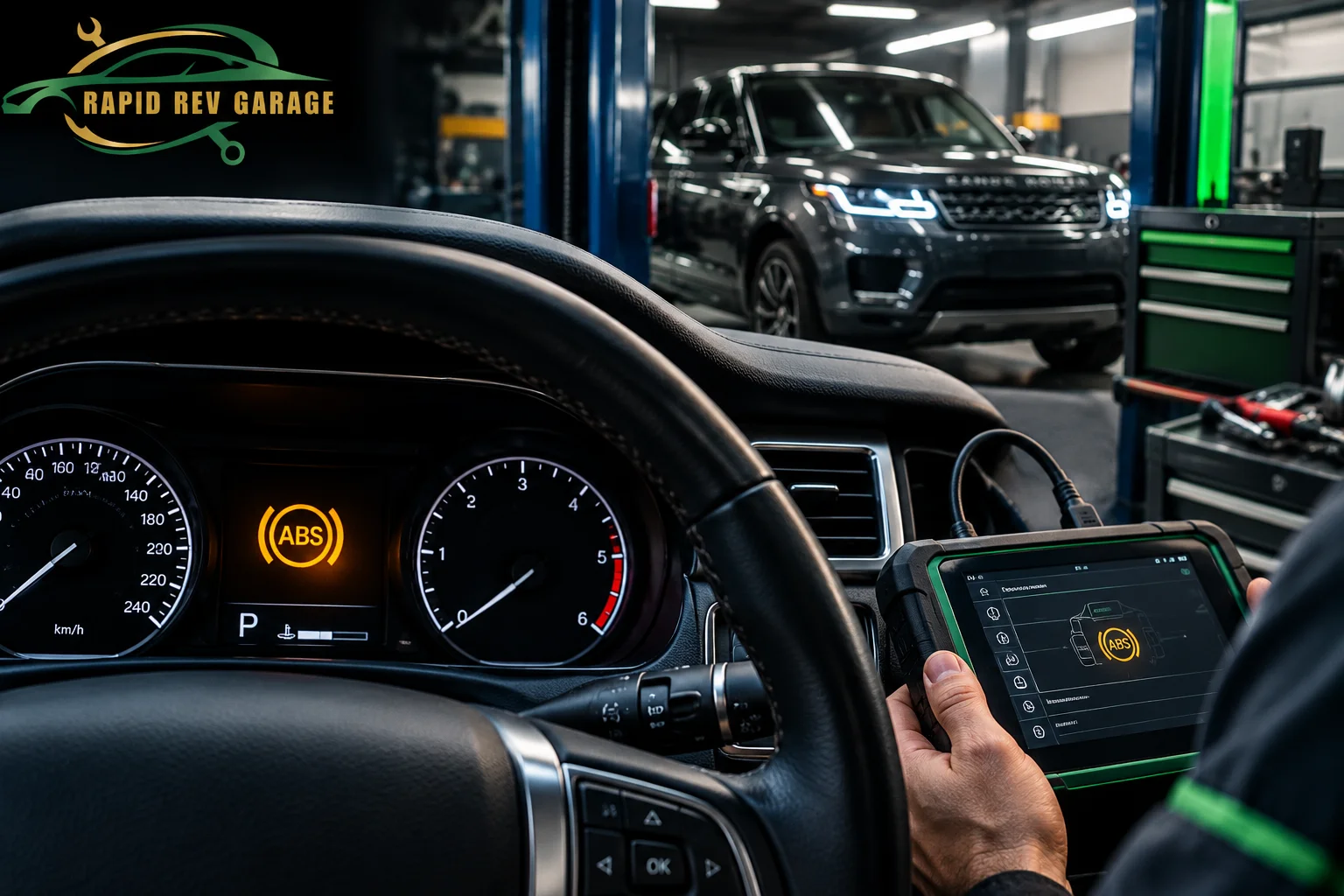
A diagnostic scan with per-cylinder misfire counters is run at idle. A cylinder accumulating misfires at a rate above the others identifies the specific cylinder — and therefore the specific plug or coil — at fault. A scan showing misfire distributed across all cylinders points toward a vacuum leak or throttle body issue rather than a single component fault.
Mount Deflection Test
With the vehicle in Drive and brakes applied, gentle throttle is applied while a technician observes powertrain movement from outside the vehicle. Engine movement significantly beyond the minimal rotation of healthy mounts confirms mount failure. The Neutral-to-Drive comparison is observed simultaneously — a car vibrating while idling that worsens in Drive confirms a mount fault.
Throttle Body Idle Stability Observation
Live RPM data is observed at idle for RPM fluctuation. A stable RPM with a rough idle is misfire or mount. A fluctuating RPM at idle confirms a throttle body, vacuum, or idle control fault — the engine management system is unable to hold its target.
The Right Fix for Each Confirmed Cause
The repair is matched to the specific cause confirmed by the misfire data, mount test, and idle RPM observation.
Spark Plug Replacement
All spark plugs are replaced with the correct specification for the engine — not a universal fit. On direct-injection engines, the plugs are also inspected for correct heat range — a plug of incorrect heat range accumulates carbon faster and produces the next misfiring cycle sooner. Post-replacement, the misfire counter is confirmed at zero during a road test.
Ignition Coil Replacement
The confirmed faulty coil — identified by the swap test — is replaced with a correct-specification unit. On higher-mileage vehicles where multiple coils are approaching similar service life, full set replacement prevents sequential coil failures within months of each other.
Engine Mount Replacement
Failed mounts are replaced with the correct specification for the vehicle. On vehicles with multiple failed mounts — common on higher-mileage Dubai vehicles — all failed mounts are replaced at the same visit. For any exterior repairs alongside engine work, our car painting team handles colour-matched work at the same visit.
Throttle Body Cleaning and Adaptation Reset
Professional throttle body cleaning removes carbon from the bore and plate surfaces. Post-cleaning, a throttle adaptation reset through the scan tool teaches the ECU the new clean bore dimensions — preventing the ECU from applying the carbon-compensating corrections it had learned, which would produce an incorrect rich idle on the freshly-cleaned system.
Vacuum Hose Replacement and Intake Inspection
Cracked or disconnected vacuum hoses are replaced. The intake manifold gasket and any other vacuum-connected components are inspected for integrity. Post-repair, live fuel trim data confirms the lean correction has resolved.
What Happens If Idle Vibration Is Left Without Repair
Idle vibration that is accepted and driven through follows a predictable and increasingly expensive progression.
Misfire Damage to the Catalytic Converter
Sustained misfires at idle allow unburned fuel to pass through the exhaust into the catalytic converter. The unburned fuel ignites in the converter, producing extreme localised temperatures that melt the converter’s substrate — a damage that is irreversible and produces a significantly more expensive repair than the ignition component that caused it.
Mount Failure Spreads to Adjacent Components
A failed engine mount that allows powertrain movement produces secondary contact with surrounding components — exhaust pipes, brake lines, shift cables — as the engine rocks beyond its designed travel range. The secondary contact damages these components progressively.
Is It Safe to Drive?
The urgency depends on the confirmed or suspected cause of the idle vibration.
Misfire — Drive to Workshop, Avoid Hard Acceleration
A misfire-producing car vibrating while idling is driveable for short careful distances. Avoid sustained hard acceleration that could push unburned fuel into the catalytic converter at a damaging rate.
Mount Failure — Book Today
A mount failure producing severe idle vibration with visible powertrain movement should be assessed the same day — secondary component contact from excessive engine movement can cause brake line damage in severe cases.
How Long the Repair Takes
Repair time depends on the confirmed cause — ignition component work is the fastest, mount replacement takes several hours.
Spark Plug and Coil Work
Full spark plug set replacement: one to two hours. Individual coil replacement: one to two hours.
Mount Replacement
Two to four hours depending on the number of mounts and engine access complexity.
Throttle Body Cleaning
90 minutes to two hours including adaptation reset and idle stability confirmation.
Vacuum System Repair
One to three hours depending on the number and location of affected hoses.
What the Repair Costs in Dubai
Cost depends on the confirmed cause from the diagnostic sequence.
Ignition and Throttle Work
Spark plug set replacement: AED 400–1,200 depending on vehicle and plug specification. Ignition coil replacement: AED 400–1,200 per coil. Throttle body cleaning: AED 350–700. Vacuum hose replacement: AED 200–600.
Mount Replacement
Single engine mount: AED 500–1,200. Full set: AED 1,500–3,500 depending on vehicle. A written quote follows the misfire data review and mount deflection test. Our mobile car mechanic covers Al Quoz and nearby Dubai areas for on-site idle vibration assessment.
Preventing Idle Vibration in Dubai’s Conditions
Two specific habits prevent the most common causes of idle vibration in Dubai.
Spark Plugs at Dubai-Appropriate Intervals
Replacing spark plugs at 40,000–45,000 km for Dubai city driving rather than the factory maximum prevents the accumulated electrode wear that eventually produces misfiring at idle. A fresh plug set is the most cost-effective prevention for misfire-related car vibrating while idling in Dubai’s short-trip environment.
Mount Inspection at Every Major Service
A physical mount deflection check at every major service identifies mounts developing failure before they produce the idle vibration symptom — allowing planned replacement rather than emergency diagnosis. Our garage near me location in Al Quoz serves drivers from Business Bay, Jumeirah, Barsha, Satwa, Downtown, and the Sheikh Zayed Road corridor.
Why Rapid Rev Garage?
When a this complaint arrives, the live misfire data tells us immediately whether the cause is combustion or mechanical — a cylinder accumulating misfires is an ignition or fuel delivery fault; zero misfires with significant vibration is a mount or throttle body fault. This distinction determines the entire diagnostic direction. We read the misfire data first, perform the mount deflection test second, and observe idle RPM stability third — before recommending any component for replacement.
FAQ — Car Vibrating While Idling
These are the questions most frequently asked about idle vibration at our Al Quoz workshop.
Why does my car only vibrate at idle and not while driving?
At idle, no road or tyre noise masks the engine's own vibration sources. A car vibrating while idling that disappears at speed does not mean the fault is absent at speed — it means driving noise is covering it. The fault is present at all times; idle is simply the condition where it is most perceptible.
Can bad fuel cause my car to vibrate at idle?
Yes — fuel with water contamination or incorrect octane produces inconsistent combustion that mimics the car vibrating while idling pattern of a misfire. If the vibration appeared specifically after a fuel fill from a new or unfamiliar station, fuel quality is a reasonable initial suspect.
My car shakes in Drive but is smooth in Neutral — what does that mean?
This is the clearest indicator of a failed engine or transmission mount. Engaging Drive applies torque load through the transmission to the mount — the mount that cannot isolate this load allows the engine to rock, producing the vibration that is absent in Neutral when the torque load is not applied.
Can air conditioning use cause idle vibration?
Yes — the AC compressor engagement adds a sudden load to the engine at idle, causing a brief RPM drop. On a vehicle with worn mounts or marginal ignition components, this load addition can expose a car vibrating while idling that is absent without the AC. The AC engagement itself is not the fault — it is revealing an existing weakness.
Is a vibrating idle dangerous to continue driving?
The drivability concern is misfire damage to the catalytic converter from sustained misfires at idle and under driving conditions. A mount failure producing severe movement risks secondary damage to surrounding components. Neither situation warrants unlimited deferral.
Conclusion
Car vibrating while idling in Dubai has five identifiable causes — misfires from worn plugs or failing coils, engine mount failure, throttle body carbon buildup, vacuum leaks, and EGR faults — each producing a slightly different vibration character and each confirmed by a specific diagnostic test. Dubai’s short-trip driving pattern and heat cycling accelerate all five causes faster than factory service intervals assume. Rapid Rev Garage in Al Quoz diagnoses every this idle vibration complaint with live misfire data, a mount deflection test, and idle RPM stability observation before recommending any repair.
Rapid Rev Garage is in Al Quoz, serving drivers across nearby Dubai areas — Business Bay, Jumeirah, Downtown, Barsha, Satwa, and the Sheikh Zayed Road corridor. Book your appointment on WhatsApp or find us on Google Maps.
Rapid Rev Garage — Car Vibrating While Idling | Al Quoz, Dubai