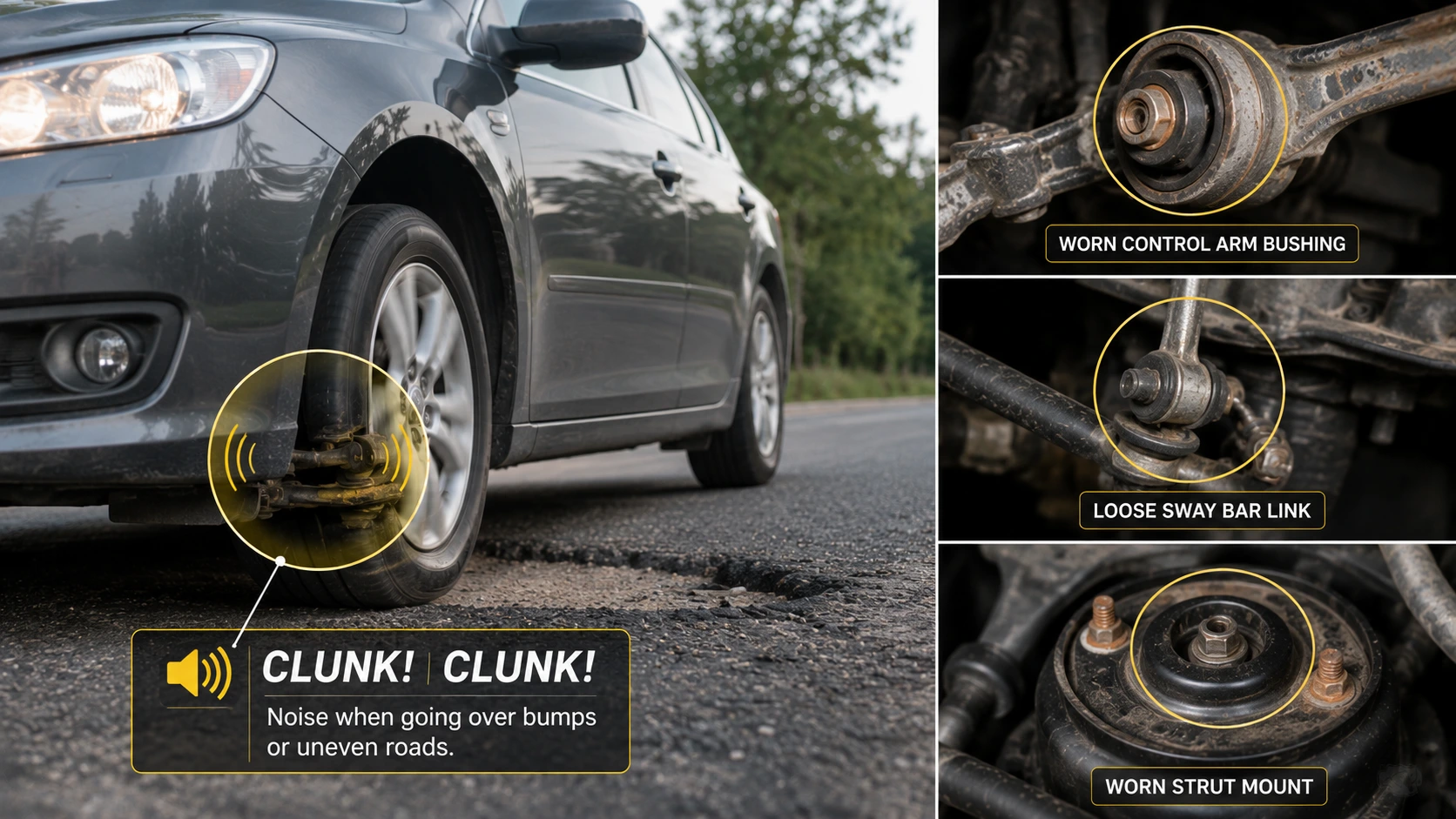
A car suspension making clunking noises — the metallic knocking or thudding that appears over speed bumps, road irregularities, or during cornering — is the suspension system communicating that one or more of its components has developed play or has lost the structural integrity it needs to manage wheel movement silently. In Dubai’s road environment, where speed bump density is among the highest of any major city and where heat degrades rubber bushings and joint grease faster than any temperate climate, car suspension making clunking noises is one of the most frequent workshop complaints — and one that warrants prompt investigation because the suspension’s job is to keep the tyre in consistent contact with the road.
At Rapid Rev Garage in Al Quoz, suspension clunking is diagnosed on a ramp with physical loading tests on each suspect component — not by sight alone.
Car Suspension Making Clunking Noises — Quick Verdict
A car suspension making clunking noises in Dubai is most commonly caused by worn ball joints that have developed play in their socket and knock when the wheel changes direction or hits a bump; worn sway bar end links or sway bar bushings that allow the sway bar to contact its mounting bracket when the body rolls; shock absorber top mount bearings or bump stops that are cracked or collapsed, allowing the shock shaft to move with insufficient damping at travel extremes; or lower control arm bushings that have split, allowing the arm to move beyond its designed travel range and produce a knock at the extreme of wheel movement. Each cause produces a specific clunk character that helps identify it before the ramp inspection.
Table of Contents
- Reading the Clunk Before Any Inspection
- Ball Joint Wear — The Most Urgent Suspension Clunk
- Sway Bar End Links and Bushings
- Shock Absorber Top Mount and Bump Stop Faults
- Control Arm Bushing Failure
- Steering Rack and Tie Rod Clunks
- Why Dubai Destroys Suspension Components Faster
- How We Locate Every Clunk Source at Rapid Rev Garage
- The Right Fix for Each Confirmed Cause
- What Happens If Suspension Clunking Is Left Without Repair
- Is It Safe to Keep Driving?
- How Long the Repair Takes
- What the Repair Costs in Dubai
- Preventing Suspension Noise in Dubai’s Conditions
- Why Rapid Rev Garage?
- FAQ
- Conclusion
Reading the Clunk Before Any Inspection
The specific conditions that produce a car suspension making clunking noises symptom narrow the possible causes significantly before any component is touched.
A Clunk Specifically Over Speed Bumps
A clunk that appears consistently over speed bumps but is absent on smooth road points to a component that is only loaded at the extremes of suspension travel — shock absorber bump stops, top mount bearings, or ball joints that only produce play when fully compressed or extended. Speed bumps produce the full-travel compression event that exposes components with play at travel extremes.
A Clunk Only During Cornering
A clunk specifically during cornering — turning into a roundabout, changing lane, or cornering on a slip road — implicates the sway bar system. Cornering produces lateral body roll that loads the sway bar end links and bushings. A worn end link or cracked sway bar bushing produces a clunk at each roll transition.
A Clunk When Braking or Accelerating
A clunk specifically during braking transitions — when the nose dips under braking — or under acceleration implicates a component that is loaded by the longitudinal pitch of the vehicle. Lower control arm bushings, strut mounts, and in some cases engine mounts produce clunks during braking and acceleration transitions rather than specifically over bumps.
A Clunk That Changes With Steering Input
A clunk that appears when turning the steering wheel at low speed — parking manoeuvres, tight U-turns — implicates the steering rack, tie rod ends, or ball joints that are loaded at steering angle. A clunk that moves from one side to the other depending on which direction is steered confirms a ball joint or tie rod end fault on the side that clunks when loaded.
Ball Joint Wear — The Most Urgent Suspension Clunk
Ball joints are the pivot points that connect the suspension control arms to the steering knuckle. They allow the wheel to move up and down with suspension travel while also allowing it to steer left and right. When a ball joint wears to the point of producing a car suspension making clunking noises symptom, the fault has progressed to a stage where the joint’s structural integrity is compromised.
Why Ball Joint Clunks Are a Safety Priority
A ball joint that has worn to the point of audible clunking has measurable play — the ball is not fully captured in its socket under all loading conditions. In extreme wear, the ball can separate from the socket entirely, causing the wheel to collapse outward and the vehicle to lose directional control. This is not a theoretical risk — ball joint separation is a documented cause of serious accidents.
The Clunk Character of Ball Joint Wear
A worn ball joint produces a sharp, metallic knock over bumps — typically a single clunk per suspension event rather than a continuous rattle. The clunk is directional — it comes from the corner with the worn joint — and worsens as the joint wears further. On front ball joints, the clunk is often accompanied by a subtle steering wander as the play in the joint allows the steering knuckle to shift position momentarily. Our car mechanic team performs a ball joint play test on the ramp with a pry bar before any component is condemned — because play felt by hand confirms wear beyond the acceptable tolerance.
Sway Bar End Links and Bushings
The sway bar connects the left and right suspension sides to reduce body roll during cornering. It is connected to each suspension lower arm by a short end link, and it runs through rubber bushings where it is mounted to the vehicle’s subframe.
End Link Wear Pattern
A worn sway bar end link has a ball-and-socket joint at each end — similar to a small ball joint. When the ball in the end link develops play, it produces a clunk specifically during lateral load — cornering, lane changes, or road camber transitions. The car suspension making clunking noises from a worn end link is typically a rhythmic knock that occurs in pairs — once as the body rolls into the corner and again as it rolls back. End links are among the most frequently worn suspension components in Dubai’s speed-bump-intensive environment.
Sway Bar Bushing Collapse
The sway bar bushings that hold the bar against the subframe allow the bar to rotate within the rubber as the suspension moves. A bushing that has hardened and cracked — from Dubai’s UV and heat exposure — prevents smooth rotation and produces a clunking or squeaking as the bar twists against the damaged rubber.
Shock Absorber Top Mount and Bump Stop Faults
The shock absorber top mount is the upper connection point between the shock and the vehicle’s body — typically containing a bearing that allows the shock to rotate with steering movement and a rubber element that absorbs vibration.
Top Mount Bearing Failure
A top mount bearing that has worn or seized produces a clunk when the steering is turned — particularly on front strut-type suspension systems. The clunk is a grinding or popping as the stuck bearing tries to rotate with the steering movement. This is commonly felt through the steering wheel as well as heard from the front suspension area.
Collapsed Bump Stop
The bump stop is the rubber block mounted on the shock shaft that prevents metal-to-metal contact at full suspension compression. A bump stop that has crumbled or collapsed — from age and heat degradation in Dubai’s conditions — allows the suspension to reach full compression and contact the shock body with a sharp metallic clunk over large bumps and speed bumps. The clunk is most prominent on the sharpest speed bumps — where suspension travel reaches its maximum. For any breakdown from a severe suspension fault, our roadside assistance covers Al Quoz and nearby Dubai areas.
Control Arm Bushing Failure
Control arm bushings are the rubber-and-metal inserts that mount the control arm to the vehicle’s subframe. They allow the arm to pivot as the suspension moves while absorbing vibration between the arm and the body.
Split Bushing Movement
A control arm bushing that has split — typically from heat hardening followed by cracking — allows the control arm to move in directions it was not designed to move. When the arm moves against the limits of the cracked bushing, it contacts the bushing housing and produces a thud or knock — the car suspension making clunking noises character of a split bushing is a heavier, duller knock compared to the sharp metallic click of a ball joint or end link.
Front vs Rear Bushing Noise Location
Front control arm bushing failure produces a clunk from the front suspension during braking and over bumps. Rear control arm bushing failure produces a clunk from the rear — sometimes confused with a boot or exhaust noise — specifically over bumps and during hard acceleration from a stop. Our car service packages include a control arm bushing visual inspection at every major service for vehicles over four years old.
Steering Rack and Tie Rod Clunks
The steering rack and its associated tie rod ends are not suspension components in the traditional sense, but they interact with the suspension at every steering input and their wear can produce what sounds like a car suspension making clunking noises symptom.
Tie Rod End Play
A worn tie rod end with play produces a clunk when the steering direction changes — the play allows the knuckle to move slightly before the tie rod takes up the load, producing a knock at each steering reversal. This clunk is most pronounced at parking speeds where full-lock turns are common.
Steering Rack Mount Looseness
A steering rack that has a loose mounting bolt — or whose mounting rubber has failed — can move on its mounts when steering inputs are applied, producing a thud from the rack’s movement. This is felt through the steering wheel as well as heard from the front of the vehicle.
Why Dubai Destroys Suspension Components Faster
Dubai’s road environment specifically accelerates every suspension wear mechanism.
Speed Bump Impact Frequency
The most direct cause of accelerated suspension wear in Dubai is the speed bump crossing frequency. A typical Dubai daily commute involves dozens of speed bump crossings. Each crossing at speed applies a high-energy compression event to the ball joints, bushings, and shock absorbers. The accumulated impact cycles per year on a Dubai vehicle far exceed what any European or North American service schedule was designed around.
UV and Heat Destroy Rubber Components
Rubber suspension components — bushings, bump stops, sway bar mounts — are rated for temperature ranges that Dubai’s sustained summer conditions push toward or beyond. The UV intensity at Dubai’s latitude degrades rubber polymer chains faster than any temperate market. A control arm bushing that would remain serviceable for ten years in the UK may begin cracking at year four or five in Dubai’s outdoor parking conditions.
Al Quoz Road Surface Wear
Commercial vehicles that service Al Quoz’s industrial area produce road surface degradation — potholes, surface cracking, expansion joint movement — that residential areas don’t experience to the same degree. Vehicles driven regularly in Al Quoz experience more severe road surface impacts per kilometre than residential-area vehicles, accelerating every suspension component’s wear cycle.
How We Locate Every Clunk Source at Rapid Rev Garage
The diagnostic sequence starts with a road test over the specific surface that produces the clunk.
Road Test Over the Specific Surface
The diagnostic road test is conducted over the road surface that produces the clunk — including a deliberate speed bump crossing at the appropriate speed. The clunk’s character, location, and road condition specificity are confirmed before ramp inspection.
Four-Corner Ramp Inspection With Physical Loading
Every suspension component is physically loaded on the ramp — ball joints checked with a pry bar, end links manually deflected, bushings inspected under load, shock absorbers pushed and pulled through their travel range. A component that produces movement beyond its specification during this loading test is confirmed as the clunk source. This is the only test that definitively identifies wear versus the visual appearance of acceptable components.
Steering Input Test on Ramp
The steering is turned while the wheel is off the ground to assess ball joint and tie rod play during rotation — and while the wheel is on the ground (under load) to replicate the actual loading condition that produces the clunk.
The Right Fix for Each Confirmed Cause
Each repair is matched to the component confirmed by physical loading tests — not by symptom description alone.
Ball Joint Replacement
Confirmed worn ball joints are replaced with the correct-specification units. Post-replacement, a four-wheel alignment is performed — because ball joint replacement changes the suspension geometry. Driving after ball joint replacement without an alignment produces tyre wear and handling changes from the geometry shift. For exterior repairs needed alongside suspension work, our car painting team handles colour-matched work at the same visit.
Sway Bar End Link and Bushing Replacement
Worn end links are replaced in pairs — replacing only the one that clunks leaves the opposite side at a similar wear stage where it will produce a clunk within months. Collapsed sway bar bushings are replaced with the correct-specification rubber or polyurethane units.
Top Mount Bearing and Bump Stop Replacement
Failed top mount bearings are replaced — on many strut platforms, the top mount is replaced as an assembly including the bearing, the rubber element, and the upper spring seat. Collapsed bump stops are replaced to restore correct travel limit protection.
Control Arm Bushing Replacement or Full Arm Replacement
Where individual bushing replacement is feasible, worn bushings are pressed out and new bushings of correct specification are pressed in. Where the bushing is integral to the control arm — not separately replaceable — or where the arm has associated damage, the full arm assembly is replaced.
What Happens If Suspension Clunking Is Left Without Repair
Suspension clunking left without investigation follows a specific and potentially serious progression.
Ball Joint Failure Risk Is Non-Negotiable
A ball joint producing a car suspension making clunking noises symptom will eventually separate — the question is when. Continued driving with a worn ball joint loads the joint on every bump and cornering input, accelerating wear toward the separation threshold. There is no predictable timeline — separation can occur at any point from the first clunk to several months later.
Secondary Tyre Wear From Geometry Change
A worn ball joint allows the wheel geometry to shift dynamically — as the joint’s play allows the knuckle to move under load, the tyre’s contact angle changes on every bump. This produces accelerated and uneven tyre wear — particularly inside edge wear that is often the first visible indicator of a worn ball joint before the clunk becomes obvious.
Is It Safe to Keep Driving?
The urgency depends on which component is producing the clunk.
Ball Joint Clunk — Urgent, Book Today
Any confirmed ball joint play producing a clunk warrants same-day booking. Do not drive long distances or at highway speed with a confirmed worn ball joint.
End Link and Bushing Clunk — Book This Week
A clunk confirmed as sway bar end link or bushing is not an immediate safety risk but should be addressed within the week — the handling stability reduction from a failed end link affects emergency manoeuvre capability.
Top Mount or Bump Stop — Book This Week
Not an immediate safety emergency, but a shock with a failed top mount produces unpredictable steering feel. Address within the week.
How Long the Repair Takes
Repair time depends on the confirmed component and whether alignment is required after replacement.
Ball Joint Replacement With Alignment
Three to five hours per axle including alignment.
End Link and Bushing Replacement
One to three hours depending on the number of components and access complexity.
Top Mount and Bump Stop
Two to three hours per corner.
Control Arm Bushing or Arm Replacement
Two to four hours per arm including alignment confirmation.
What the Repair Costs in Dubai
Cost depends on the confirmed cause and the number of components requiring replacement.
Ball Joint Work
Ball joint replacement per side: AED 600–1,800 including alignment. Full axle: AED 1,200–3,500.
Sway Bar and Bushing Work
End link replacement pair: AED 400–900. Sway bar bushing set: AED 300–700.
Top Mount and Control Arm
Top mount bearing replacement per corner: AED 500–1,200. Control arm bushing replacement: AED 400–1,000 per arm. Full control arm replacement: AED 800–2,500 per arm. A written quote follows the ramp inspection findings. Our mobile car mechanic covers Al Quoz and nearby Dubai areas for on-site clunk assessment before bringing the vehicle in for ramp inspection.
Preventing Suspension Noise in Dubai’s Conditions
Two habits prevent the most common causes of suspension clunking in Dubai.
Speed Bump Approach Speed
Crossing speed bumps at 10–15 km/h rather than at speed reduces the impact energy applied to ball joints, bushings, and shock absorbers per crossing. Across thousands of speed bump crossings per year in Dubai, this habit meaningfully extends suspension component service life.
Annual Suspension Ramp Inspection
An annual ramp inspection — physically loading each ball joint, end link, and bushing — identifies components beginning to wear before they produce the car suspension making clunking noises symptom. A component with beginning play replaced proactively costs less than the same component replaced after it has caused secondary alignment and tyre wear. Our garage near me location in Al Quoz serves drivers from Business Bay, Jumeirah, Barsha, Satwa, Downtown, and the Sheikh Zayed Road corridor.
Why Rapid Rev Garage?
We diagnose car suspension making clunking noises with physical loading tests — not visual inspection alone. A ball joint can appear intact and adequately greased while having play that only reveals itself under load. A sway bar end link can appear undamaged while its internal ball has developed movement. The pry bar test and deflection test under load at each component position is what distinguishes a component with acceptable wear from one that is producing the clunk — and that distinction is what prevents replacing good components alongside the faulty one.
FAQ — Car Suspension Making Clunking Noises
These are the questions most frequently asked at our Al Quoz workshop.
Why does my car clunk mainly over speed bumps and not on smooth road?
Speed bumps produce the full-compression suspension travel event that loads ball joints, bump stops, and top mounts at their travel extremes. A car suspension making clunking noises specifically over speed bumps implicates components that only produce play or contact at the extremes of travel rather than through the mid-range.
Can a loose wheel cause suspension clunking?
A loose wheel — insufficient torque on the wheel nuts — produces a clunking that changes with cornering direction and acceleration. It can be mistaken for a ball joint clunk. A wheel nut torque check takes two minutes and is always performed before any suspension component is suspected.
My car clunks on one side — do I replace both sides?
Ball joints and end links that are worn on one side are typically replaced in pairs — the opposite side has accumulated similar mileage and wear rate, and will produce a clunk within months of the first repair if not addressed simultaneously. Control arm bushings are typically replaced by axle rather than individually for the same reason.
Is suspension clunking worse in hot weather?
In Dubai, rubber components — bushings and bump stops — can become temporarily stiffer in extreme heat, which sometimes reduces clunking caused by collapsed rubber. But UV-hardened rubber cracks faster, which increases clunking over time. A car suspension making clunking noises that seems less prominent in winter but worsens in summer has a heat-related rubber degradation pattern.
Can a clunking suspension affect wheel alignment?
Yes — a worn ball joint allows the wheel geometry to shift dynamically, changing camber and toe under load. This affects both tyre wear and steering precision. After any ball joint or control arm replacement, alignment is confirmed before the vehicle is returned.
Conclusion
Car suspension making clunking noises in Dubai has specific, identifiable causes — ball joint wear, sway bar end link damage, shock absorber top mount failure, and control arm bushing collapse — each confirmed by physical loading tests on the ramp. Dubai’s speed bump density and heat-degraded rubber accelerate every suspension wear mechanism faster than any European service interval assumes. Rapid Rev Garage in Al Quoz physically loads every suspect component before any part is recommended — because visual inspection alone does not reveal the play that produces the car suspension making clunking noises pattern.
Rapid Rev Garage is in Al Quoz, serving drivers across nearby Dubai areas — Business Bay, Jumeirah, Downtown, Barsha, Satwa, and the Sheikh Zayed Road corridor. Book your appointment on WhatsApp or find us on Google Maps.
Rapid Rev Garage — Car Suspension Making Clunking Noises | Al Quoz, Dubai