A car hesitate before moving — a pause, a delay, or a momentary stumble between pressing the accelerator and the vehicle actually beginning to move — is one of those faults that most Dubai drivers notice immediately but often dismiss as a quirk of the car rather than a symptom worth investigating. A this is the vehicle communicating that something in the power delivery chain — the engine, the transmission, the fuel system, or the throttle control — is not responding with the promptness and smoothness it should. In Dubai’s stop-start traffic, where immediate and predictable acceleration from a standstill is required dozens of times per day, hesitation before moving is not just an annoyance — it is a daily driving safety concern.
At Rapid Rev Garage in Al Quoz, every such diagnosis begins with a road test that replicates the exact condition — cold start, warm engine, specific throttle input — because the hesitation’s timing tells us where in the system the delay is occurring.
Car Hesitate Before Moving — Quick Verdict
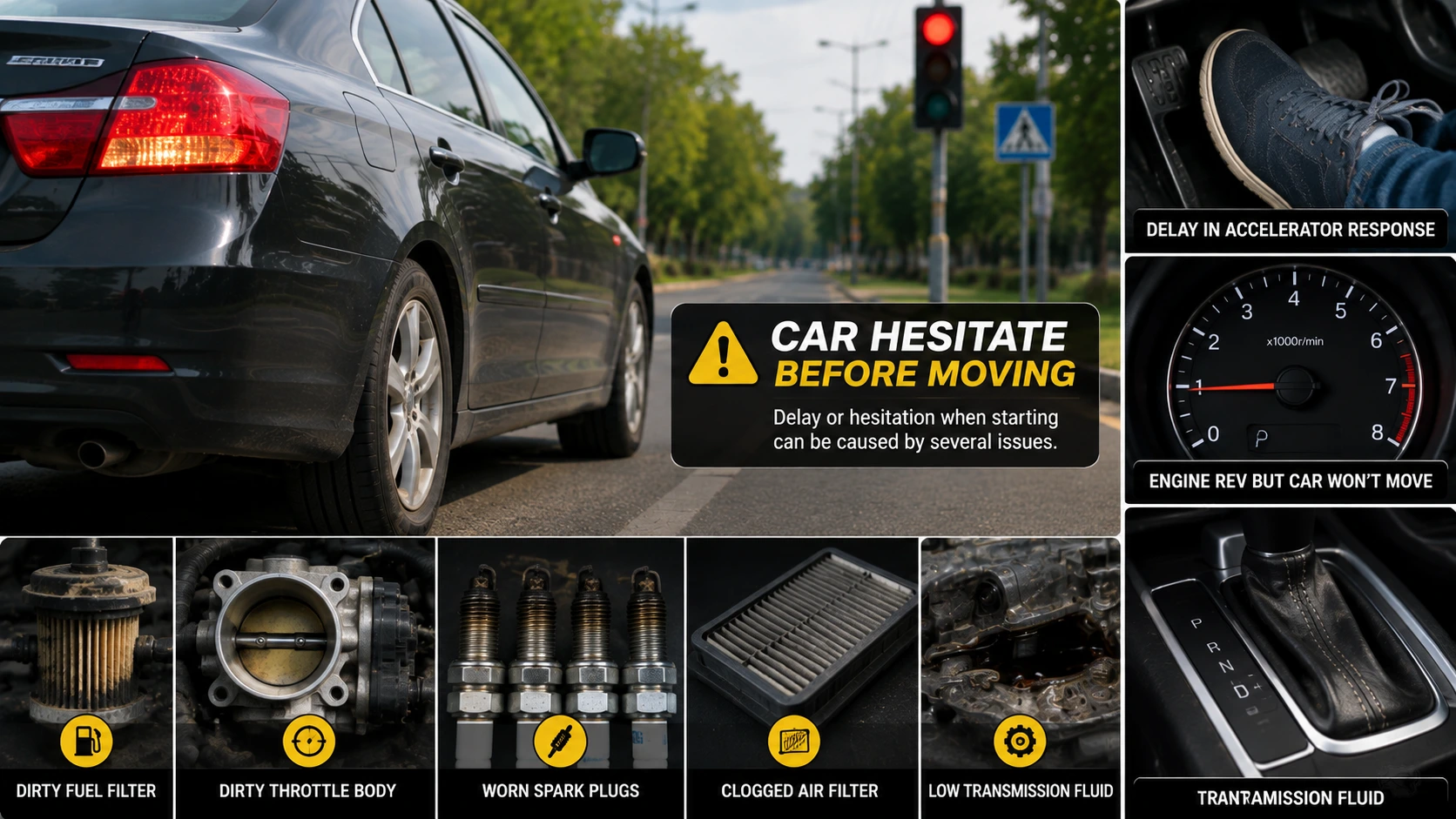
A car hesitate before moving in Dubai is most commonly caused by one of six faults: a transmission that is delayed in engaging drive from park or neutral — particularly common on automatics with degraded ATF; a throttle body coated in carbon that produces a flat spot at the first throttle opening from idle; a fuel system with insufficient pressure at startup from a weak pump or slow pressure rebuild after standing; an oxygen or MAF sensor providing incorrect data that causes the ECU to deliver a lean or incorrect mixture on initial acceleration; a torque converter that is slipping or not locking efficiently during initial drive engagement; or a drive-by-wire throttle system with a pedal position sensor fault that delays the command signal from the accelerator pedal to the throttle body. Each cause produces a distinct hesitation character — understanding that character is the first step in the diagnosis.
Table of Contents
- Reading the Hesitation — When It Appears and What It Feels Like
- Automatic Transmission Engagement Delay
- Throttle Body Carbon and First-Throttle Flat Spot
- Fuel System Pressure and Initial Acceleration Stumble
- Sensor Faults Producing Lean Initial Acceleration
- Torque Converter Faults in Automatic Vehicles
- Drive-By-Wire Throttle Pedal Sensor Delay
- Why Dubai’s Stop-Start Pattern Makes This Fault More Common
- How We Confirm the Exact Cause at Rapid Rev Garage
- The Right Fix for Each Confirmed Cause
- What Happens If Hesitation Before Moving Is Left Without Repair
- Is It Safe to Drive?
- How Long the Repair Takes
- What the Repair Costs in Dubai
- Preventing Hesitation Before Moving in Dubai
- Why Rapid Rev Garage?
- FAQ
- Conclusion
Reading the Hesitation — When It Appears and What It Feels Like
The specific conditions under which the car hesitate before moving pattern appears is the most important diagnostic information before any tool is connected.
Cold Start Hesitation Only
A hesitation that is present on the first move of the day — when the engine is cold — but resolves after a few minutes of driving points toward a fuel system, sensor, or transmission warm-up issue. Cold transmission fluid is significantly more viscous than warm fluid — a transmission with degraded ATF that is already at its limit of effective operation produces a noticeable engagement delay specifically when cold.
Hesitation Every Time the Car Stops and Restarts
A hesitation that appears every time the car comes to a standstill and then accelerates — in stop-start Dubai traffic, at every traffic signal — points toward a throttle body, sensor, or fuel pressure issue rather than a temperature-dependent fault. The consistent recurrence at every stop rules out a pure cold-start cause.
Hesitation With a Shudder or Vibration
A hesitation accompanied by a shudder or vibration during the moment of initial acceleration points toward the transmission — specifically the torque converter engagement or the clutch packs in the automatic transmission engaging unevenly. A smooth hesitation without shudder points toward a fuel delivery or throttle body fault.
Hesitation That Resolves With Higher Engine RPM
A car hesitate before moving pattern that resolves if the driver holds the engine at slightly higher RPM before releasing the brake — revving to 1,500 RPM before moving — points toward a fuel pressure or transmission engagement fault at idle conditions specifically. The higher RPM overcomes the fuel pressure or transmission pressure deficit that produces the hesitation at normal idle.
Automatic Transmission Engagement Delay
On automatic transmissions, the transition from Park or Neutral to Drive requires the transmission to fill the forward clutch pack with hydraulic pressure. This pressure build takes a fraction of a second on a correctly-functioning transmission with fresh ATF. A car hesitate before moving pattern from a degraded transmission produces a longer wait — the delay between selecting Drive and the car beginning to move.
Degraded Automatic Transmission Fluid
ATF degrades from heat and oxidation — losing its hydraulic viscosity, its friction modifier additive package, and its ability to build pressure quickly within the clutch packs. Degraded ATF in Dubai’s heat produces longer clutch engagement times, a longer car hesitate before moving delay, and eventually causes shuddering during engagement as the friction modifier depletion causes inconsistent clutch pack loading.
Dubai Heat and ATF Degradation Rate
ATF in Dubai’s stop-start heat operates at sustained temperatures above the range that European service schedules account for. An ATF that would provide adequate service for 60,000 km in a moderate climate may be significantly degraded at 40,000 km in Dubai’s conditions. A car hesitate before moving on a Dubai automatic with 45,000+ km and no ATF service is a classic presentation of this fault.
Low Transmission Fluid Level
A transmission that is low on ATF from a seal leak cannot build the clutch pack pressure required for prompt engagement — the fluid volume is insufficient to fill the clutch pack circuit at normal idle pump speed. The engagement delay is the transmission reaching the pressure threshold needed for clutch engagement with insufficient fluid. Our car mechanic team checks ATF level and condition before any other transmission assessment on every hesitation complaint.
Throttle Body Carbon and First-Throttle Flat Spot
A throttle body with carbon deposits on the bore edges and plate produces a specific type of initial acceleration hesitation — the flat spot that occurs specifically at the first throttle opening from idle.
Why the First Opening From Idle Is the Worst Point
At idle, the throttle plate is nearly closed — it is positioned at the edge of the carbon-coated bore. When the driver presses the accelerator, the plate begins to open and encounters the carbon deposit at the bore edges. The carbon effectively narrows the bore at the partially-open position, restricting airflow precisely when the engine is requesting its first increase in air for acceleration. The result is a stumble or flat spot at the moment of initial throttle application — the classic car hesitate before moving character of a throttle body fault.
Why Dubai Stop-Start Driving Creates More Carbon Faster
Every short trip that never reaches sustained high-combustion-temperature operation contributes carbon to the throttle bore. A Dubai vehicle doing multiple 10-minute school and mall runs per day accumulates throttle body carbon at a rate that sustained highway driving never produces — because the combustion temperature phase that naturally burns off deposits is rarely reached. For any breakdown from a severe hesitation fault, our roadside assistance covers Al Quoz and nearby Dubai areas.
Fuel System Pressure and Initial Acceleration Stumble
A fuel system that cannot maintain adequate rail pressure during the first moments of acceleration produces a car hesitate before moving pattern from insufficient fuel delivery at the exact moment maximum initial fuel flow is required.
Fuel Pressure Drop at Initial Acceleration
The fuel pump delivers pressurised fuel to the injector rail. At idle, fuel demand is low and a marginal pump maintains adequate pressure. At initial acceleration — the first throttle opening from idle — fuel demand spikes as the engine requests maximum instantaneous flow for the acceleration event. A weak pump that maintained adequate pressure at idle cannot meet this spike, and the rail pressure drops. The drop produces a lean stumble — the hesitation — before the pump recovers and normal acceleration resumes.
Pressure Loss After Standing
A vehicle that hesitates specifically on the first start of the day, then drives normally, may have a fuel pressure check valve fault. The check valve maintains fuel rail pressure after the engine is switched off. A failed check valve allows pressure to bleed back to the tank overnight. On the first start, the injectors fire into a zero-pressure rail — the hesitation continues until the pump rebuilds pressure. Subsequent warm starts don’t have the same issue because the rail hasn’t fully depressurised.
Sensor Faults Producing Lean Initial Acceleration
A sensor that is providing incorrect data at the moment of initial acceleration causes the ECU to deliver the wrong fuel quantity — typically lean — at the critical first throttle opening.
Mass Airflow Sensor Contamination
A MAF sensor contaminated with Dubai’s fine industrial dust reports a lower air mass than is actually entering the engine. The ECU calculates injection quantity from this false low reading and delivers insufficient fuel — a lean mixture that stumbles at initial acceleration but may recover quickly as the closed-loop oxygen sensor feedback compensates. The car hesitate before moving from a contaminated MAF sensor is typically a brief stumble rather than a prolonged delay.
Oxygen Sensor Slow Response
An oxygen sensor past its service life has a slower response time — it takes longer to detect the mixture change and report it to the ECU. During cold start or at the moment of initial acceleration, the ECU is in open-loop mode — it does not use oxygen sensor feedback and relies on calibrated sensor data instead. A slow oxygen sensor’s primary contribution to hesitation is in the transition from cold-start open-loop to warm closed-loop operation — it delays the stabilisation of the fuel mixture.
Torque Converter Faults in Automatic Vehicles
The torque converter is the fluid coupling between the engine and the automatic transmission. It transmits engine torque to the transmission through fluid dynamics rather than direct mechanical engagement — allowing the engine to idle without stalling while the transmission is in Drive. A car hesitate before moving from a torque converter fault produces a specific shuddering, slipping engagement character.
Torque Converter Clutch Fault
Modern torque converters have a lockup clutch that mechanically locks the converter at highway cruise speed to eliminate the efficiency loss of fluid coupling. A lockup clutch that is failing can produce an engagement shudder at low speeds when the converter is transitioning between unlocked and locked states. On some vehicles, this manifests as a shudder at very low speed before the converter settles into smooth engagement. Our car service packages include a transmission fluid condition check and a torque converter behaviour assessment at every major service for vehicles over 60,000 km.
Drive-By-Wire Throttle Pedal Sensor Delay
Modern vehicles with electronic throttle control have a pedal position sensor that converts the driver’s foot movement into an electrical signal sent to the throttle body motor. A fault in this sensor — internal friction, a broken return spring, or a calibration drift — can produce a delay in the throttle command at the moment of initial pedal depression.
The Lag Characteristic of a Pedal Sensor Fault
A pedal sensor with internal resistance produces a throttle command that is initially lower than the physical pedal position — the sensor output doesn’t fully represent the driver’s input until the pedal has moved far enough to overcome the sensor’s internal friction. The result is a hesitation that improves if the driver presses the accelerator more quickly rather than gently.
Why Dubai’s Stop-Start Pattern Makes This Fault More Common
Dubai’s specific driving pattern amplifies every cause of hesitation before moving.
Maximum Cold Starts Per Year
A Dubai driver with a school run, a mall trip, a work commute, and a gym stop makes four to six engine cold starts per day. Each cold start is a thermal cycle and a fuel system pressure build event. A fuel system or transmission that is marginal manages these infrequent starts adequately in lower-frequency markets but reaches its symptom threshold faster in Dubai’s high-cold-start-per-year pattern.
Short Trips Never Fully Warm the Transmission
A transmission that never reaches full operating temperature — because every trip is 10–15 minutes — accumulates water and fuel contamination in the ATF faster than a vehicle doing longer trips that fully heat-soak the transmission. The contamination degrades ATF faster than heat alone would, accelerating the engagement delay in Dubai’s short-trip dominant driving.
How We Confirm the Exact Cause at Rapid Rev Garage
The diagnostic sequence starts with the road test characterisation — smooth delay or shudder determines which system is investigated first.
Road Test at the Exact Hesitation Condition
The diagnostic road test specifically replicates the conditions the driver describes — cold start, warm restart, or every-stop hesitation. The hesitation character — smooth delay, shuddering, or stumbling — is observed during the test and narrows the cause category before any scan tool is connected.
Diagnostic Scan With Live Data at Throttle Application
A full diagnostic scan with live data is run during a simulated initial acceleration — watching throttle position, MAF output, fuel trim, injector pulse width, and transmission input/output speed data simultaneously. A fuel system fault shows as an injection pulse width drop at initial throttle. A transmission fault shows as a speed discrepancy between input and output during engagement. A sensor fault shows as incorrect data in the live stream.
ATF Condition and Level Assessment
ATF is checked for level, colour, and smell before any other transmission investigation. Dark, burnt-smelling ATF that is overdue for change is a significant finding that changes the repair recommendation regardless of what the scan data shows.
Fuel Pressure Test at Startup
A fuel pressure gauge measures the rail pressure at cold start and during the initial acceleration stumble. A pressure drop at the moment of the hesitation confirms a fuel delivery fault — distinguishing a pump fault from a sensor fault that produces the same hesitation character through a different mechanism.
The Right Fix for Each Confirmed Cause
Each repair is matched to the specific cause confirmed by the road test, scan data, and fuel pressure assessment.
ATF Drain and Refill or Full Flush
Degraded ATF is replaced with the correct specification fluid for the specific transmission — not a generic universal ATF. On vehicles with significant ATF degradation, a transmission flush removes degraded fluid from the torque converter and valve body — areas that a drain and refill does not fully exchange. Post-service, the engagement delay is confirmed improved during a road test.
Throttle Body Cleaning and Adaptation Reset
Carbon deposits are removed using a professional throttle body cleaning procedure. Post-cleaning, a throttle body adaptation reset through the scan tool teaches the ECU the clean bore dimensions — preventing the ECU from applying carbon-compensating corrections to the freshly-cleaned system that would produce an over-rich idle.
Fuel Pump or Check Valve Replacement
A confirmed weak fuel pump is replaced with a correct-specification unit. A failed check valve is replaced separately where it is accessible without pump removal — or as part of the pump assembly where it is integrated. For exterior repairs needed alongside any mechanical work, our car painting team handles colour-matched work at the same visit.
MAF Sensor Cleaning or Replacement
A contaminated MAF sensor is cleaned with dedicated MAF cleaner. Where the sensor has failed outright, replacement with the correct-specification sensor for the vehicle restores accurate air mass reporting. Post-replacement, fuel trim adaptation confirms the ECU is stabilising at correct fuelling.
Pedal Position Sensor Replacement
A confirmed pedal sensor fault is addressed with sensor replacement. Post-replacement, a scan tool output confirmation during slow pedal depression verifies the new sensor’s linearity before road testing.
What Happens If Hesitation Before Moving Is Left Without Repair
Hesitation before moving that is accepted and driven through follows a predictable and increasingly expensive progression.
Transmission Fault Progression
A car hesitate before moving from degraded ATF progresses from an engagement delay to a shudder, from a shudder to slip, and from slip to clutch pack damage if the degraded fluid is left in service. Each stage is more expensive to repair than the previous — and a clutch pack replacement that results from driving on degraded fluid is orders of magnitude more expensive than an ATF service.
Fuel System and Sensor Faults Worsen Gradually
A weak fuel pump that is producing hesitation before moving is approaching its end of life — the hesitation will progress to stalling or non-start as the pump’s output continues to decline. Acting at the hesitation stage prevents the non-start failure that would otherwise produce a breakdown event. Our mobile car mechanic covers Al Quoz and nearby Dubai areas for on-site hesitation diagnosis.
Is It Safe to Drive?
The urgency depends on the character of the hesitation and whether a shudder or warning light accompanies it.
Smooth Delay, No Shudder — Driveable, Book This Week
A hesitation that is a smooth delay without shuddering, stalling, or check engine light: driveable carefully for a few days. Book within the week.
Shuddering Hesitation or Accompanied by Check Engine Light — Book Today
A hesitation with shudder — indicating transmission clutch or torque converter involvement — or accompanied by a check engine light with stored codes: book the same day. Shudder indicates the fault has progressed beyond a fluid issue.
How Long the Repair Takes
Repair time depends on the confirmed cause — ATF service is the fastest, fuel pump replacement takes the most time.
ATF Service
Drain and refill: one to two hours. Full transmission flush: two to three hours.
Throttle Body Cleaning and Sensor Work
Throttle body cleaning with adaptation reset: 90 minutes to two hours. MAF or pedal sensor replacement: one to two hours.
Fuel Pump Replacement
Two to four hours depending on tank access on the specific vehicle.
What the Repair Costs in Dubai
Cost depends on the confirmed cause from the diagnostic assessment.
ATF and Throttle Work
ATF drain and refill: AED 400–900 depending on the transmission type and fluid specification. Transmission flush: AED 700–1,500. Throttle body cleaning: AED 350–700. MAF sensor replacement: AED 200–1,800 depending on vehicle.
Fuel System and Pedal Work
Fuel pump replacement: AED 800–2,500 depending on vehicle platform. Check valve replacement: AED 300–600. Pedal position sensor: AED 400–1,200. A written quote is provided after the road test, scan data, and fuel pressure test confirm the specific cause. Our garage near me location in Al Quoz serves drivers from Business Bay, Jumeirah, Barsha, Satwa, Downtown, and the Sheikh Zayed Road corridor.
Preventing Hesitation Before Moving in Dubai
Two maintenance habits prevent the most common causes of hesitation before moving in Dubai.
ATF at Dubai-Appropriate Intervals
Replacing ATF at 40,000–50,000 km for Dubai stop-start drivers — rather than the factory maximum interval — maintains the hydraulic pressure build that produces prompt, smooth transmission engagement. The ATF service cost is recovered many times over in the clutch pack life it preserves.
Throttle Body Inspection at Every Major Service
A throttle body carbon assessment at every major service catches accumulation before it produces the flat-spot hesitation that daily-drive performance forces the driver to notice. A clean throttle body on a Dubai vehicle requires inspection frequency that the factory schedule does not account for.
Why Rapid Rev Garage?
When a car hesitate before moving complaint arrives, the road test characterisation — smooth delay or shudder, cold only or every stop — tells us immediately whether to investigate the transmission first or the throttle body and fuel system first. A shuddering engagement delay goes to ATF and torque converter assessment. A smooth stumble at initial throttle goes to the throttle body, MAF, and fuel pressure tests. The road test character is the diagnostic shortcut that directs the investigation correctly on the first visit.
FAQ — Car Hesitate Before Moving
These are the questions most frequently asked about this fault at our Al Quoz workshop.
Why does my car hesitate more when it's cold?
Cold ATF is more viscous — it builds clutch pack pressure more slowly. Cold fuel systems have lower volatility. Cold sensors are outside their optimal calibration range. A hesitation that is worse when cold and improves after a few minutes confirms a temperature-dependent fault — typically ATF or fuel system pressure related.
My automatic car hesitates in Drive but not in Sport mode — why?
Sport mode on most automatics holds gears longer and commands higher line pressure in the transmission — which produces faster, firmer clutch pack engagement. A hesitation that disappears in Sport mode confirms a transmission engagement pressure fault — the higher commanded pressure in Sport mode overcomes the deficit that normal Drive mode cannot.
Can a dirty air filter cause hesitation before moving?
A severely restricted air filter reduces the air available for initial acceleration combustion — the engine stumbles because it cannot breathe adequately. The resulting car hesitate before moving pattern is typically a rougher, more pronounced stumble than a smooth transmission delay. Air filter inspection is part of the complete hesitation diagnosis.
Why did my car start hesitating after a fuel fill?
Fuel contamination — water in the fuel or an incorrect grade — can produce a hesitation that appears after a specific fill. Contaminated fuel produces inconsistent combustion at initial acceleration before the affected fuel is consumed and replaced by a subsequent fill.
Is a hesitation before moving always a transmission problem?
No — this fault is as commonly caused by throttle body carbon, fuel system pressure, or sensor issues as by transmission faults. The road test character and diagnostic scan together identify the specific system before any component is replaced.
Conclusion
A car hesitate before moving in Dubai has a specific cause in every case — degraded ATF delaying transmission engagement, throttle body carbon producing a first-throttle flat spot, weak fuel pump pressure, sensor inaccuracy causing lean initial acceleration, or torque converter fault producing shuddering engagement. Dubai’s short-trip stop-start pattern maximises both cold start frequency and ATF degradation rate — making this fault more common here than in any highway-dominated market. Rapid Rev Garage in Al Quoz diagnoses every car hesitate before moving complaint with a road test characterisation, live data scan, ATF assessment, and fuel pressure test before any repair is recommended.
Rapid Rev Garage is in Al Quoz, serving drivers across nearby Dubai areas — Business Bay, Jumeirah, Downtown, Barsha, Satwa, and the Sheikh Zayed Road corridor. Book your appointment on WhatsApp or find us on Google Maps.
Rapid Rev Garage — Car Hesitate Before Moving | Al Quoz, Dubai