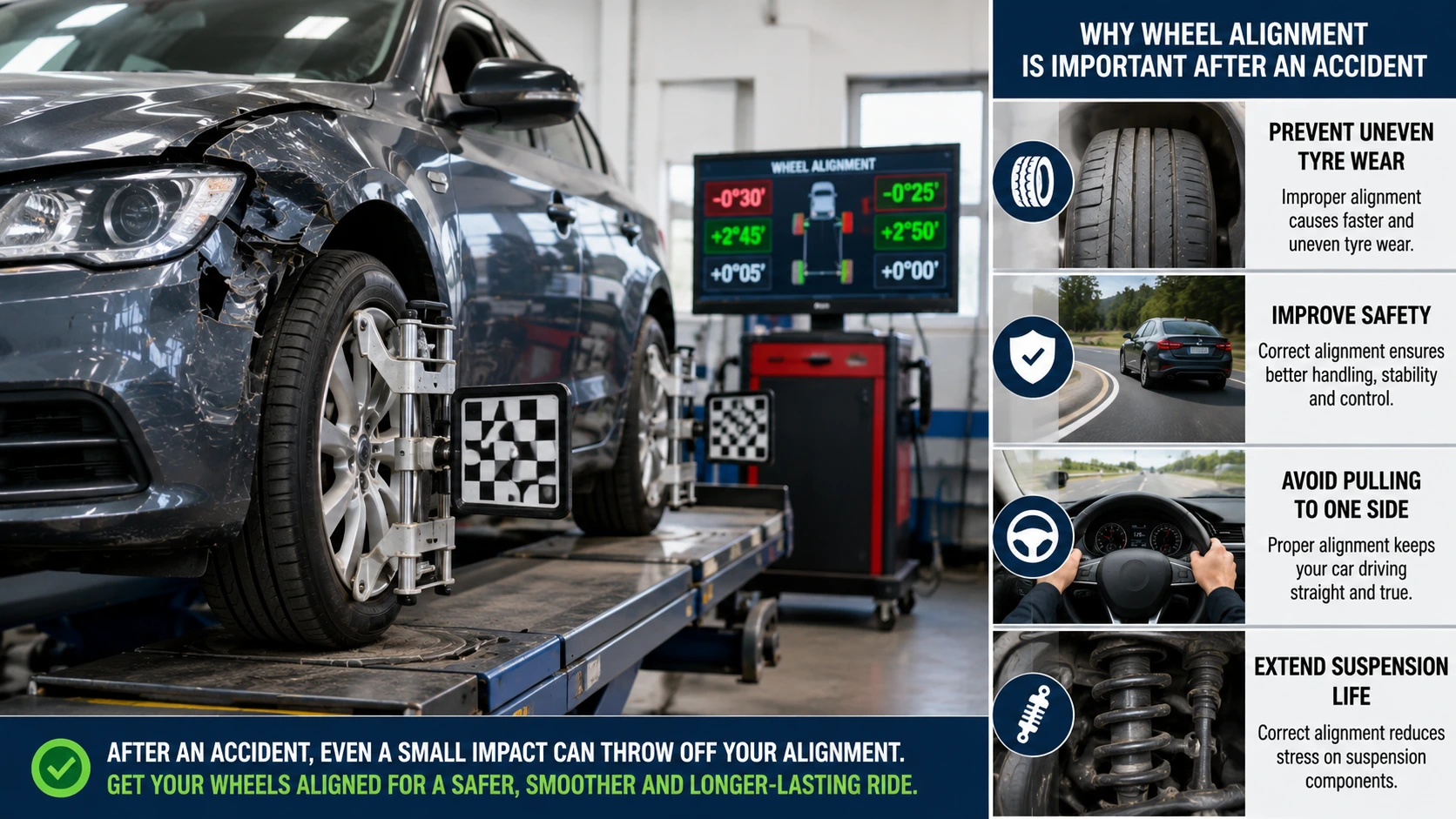
Wheel alignment important after an accident is a principle that most Dubai drivers are aware of — but fewer understand specifically why. An accident changes the geometry of the vehicle’s suspension and steering system by applying force to components that were precisely set at the factory. Even an impact that appears minor — a car park bump that barely marked the bumper, a pothole strike that bent nothing visibly, a kerb impact that caused a small tyre scuff — can shift alignment angles by amounts that produce tyre wear, handling changes, and reduced safety that accumulate over the thousands of kilometres driven before the next scheduled service.
At Rapid Rev Garage in Al Quoz, wheel alignment important after an accident is assessed as a four-wheel computerised measurement — not a visual inspection — because misalignment from an accident is frequently invisible without measurement equipment.
Wheel Alignment Important After an Accident — Quick Verdict
Wheel alignment important after an accident matters because impact forces travel through the wheel into the suspension and steering components, shifting the toe, camber, and caster angles that determine how the vehicle tracks, steers, and wears its tyres. A vehicle with post-accident misalignment may pull to one side, wear its tyres unevenly, require constant steering correction on straight roads, or handle less predictably in emergency situations — none of which are obvious until significant damage has already occurred. In Dubai, where the E11, E311, and E44 highways are the primary daily commute routes and tyre wear accumulates rapidly in the heat, post-accident misalignment produces consequences faster than in any cooler, lower-speed market. Understanding why wheel alignment is important after an accident — and acting on it promptly — prevents significantly higher repair costs from developing downstream.
Table of Contents
- How an Accident Disturbs Wheel Alignment
- The Three Alignment Angles and What Each Affects
- Why Small Impacts Cause Significant Misalignment
- The Consequences of Driving on Post-Accident Misalignment
- Why Visual Inspection Is Not Enough After an Accident
- What a Post-Accident Alignment Check Covers
- When to Get Alignment Checked After an Accident
- Common Dubai Accident Types and Their Alignment Impact
- How We Assess Post-Accident Alignment at Rapid Rev Garage
- The Right Repair — Alignment vs Component Replacement
- How Long the Alignment Check Takes
- What the Check Costs in Dubai
- Why Rapid Rev Garage?
- FAQ
- Conclusion
How an Accident Disturbs Wheel Alignment
The physics of how impact force travels through a vehicle explains why wheel alignment is important after an accident — even a minor one.
Force Transmission Through the Suspension
When a wheel strikes an object — a kerb, another vehicle, a pothole edge — the impact force is transmitted from the tyre contact patch through the wheel, into the hub, through the ball joints and tie rod ends, into the control arms, and finally into the subframe and body structure. Each of these components transmits the force while potentially absorbing some of it through deformation. A component that deforms — even by a fraction of a millimetre — changes the geometry of every alignment angle it contributes to.
Why Even Absorbed Forces Change Alignment
A component doesn’t need to visibly bend to produce misalignment. A ball joint whose housing shifts by 1mm under impact load changes the camber of the wheel it supports. A tie rod end whose ball moves to the edge of its socket changes the toe of the wheel it steers. A control arm that shifts slightly on its bushing changes the caster. These sub-millimetre changes produce alignment deviations that are measurable on a four-wheel alignment machine and significant in their driving consequences — even though no component appears damaged to the eye.
The Three Alignment Angles and What Each Affects
Understanding the three primary alignment angles makes it clear why wheel alignment important after an accident guidance applies regardless of which component was impacted.
Toe — The Straight-Ahead Tracking Angle
Toe is the angle at which the front and rear wheels point relative to the vehicle’s straight-ahead direction. Correct toe ensures the tyres roll in the direction of travel — neither toeing inward (toe-in) nor outward (toe-out) from the intended line. Post-accident toe misalignment produces the most immediately noticeable consequence: the vehicle pulls to one side and requires constant steering correction to maintain a straight path. It also produces the fastest tyre wear — a toe error of 3mm per side produces tyre scrubbing that wears the tread faster than a correctly-aligned vehicle.
Camber — The Vertical Tilt of the Wheel
Camber is the inward or outward tilt of the wheel when viewed from the front of the vehicle. Correct camber ensures the tyre’s contact patch is flat against the road surface under normal driving loads. Post-accident camber misalignment — typically from a bent control arm or a shifted strut — produces uneven contact patch loading that wears the inside or outside edge of the tyre faster than the centre, and reduces the tyre’s cornering grip by tilting the contact patch away from its optimal flat position.
Caster — The Steering Stability Angle
Caster is the forward or rearward tilt of the steering axis relative to vertical, viewed from the side of the vehicle. Correct caster provides the self-centring force that makes the vehicle naturally return to straight-ahead after a corner and feel stable and planted on the highway. Post-accident caster reduction — from a bent strut, a shifted strut mount, or a deformed chassis section — produces a vehicle that feels light and imprecise at the front end on the highway, requires more effort to maintain straight-ahead, and provides less self-centring force after lane changes. This is the alignment angle most commonly missed on visual inspection because it produces no visible abnormality. Our car mechanic team measures all three angles at all four corners as a standard post-accident alignment assessment — because an impact on one corner of the vehicle changes alignment at multiple corners through the connected suspension geometry.
Why Small Impacts Cause Significant Misalignment
The most common misconception about post-accident alignment is that only significant impacts — airbag-deploying collisions — require an alignment check. This underestimates how little force is required to shift alignment angles.
The Kerb Strike Example
A parking manoeuvre that clips a kerb at 10–15 km/h applies a lateral impact force to the front wheel that is transmitted directly to the tie rod end and lower ball joint. The tie rod end adjusts the toe angle — and a lateral force that shifts the tie rod end’s position by 1–2mm changes the toe enough to produce a directional pull on the highway and accelerated tyre wear. The wheel shows no visible damage, the tyre shows only a scuff, and the driver is unaware anything has changed — until the tyre wears unevenly over the next 5,000 km.
The Speed Bump High-Speed Strike
Crossing a speed bump at significantly above the recommended speed applies a vertical impact force to both front wheels simultaneously. The vertical impact is primarily a compression event — it loads the ball joints, strut bearings, and control arm bushings in the compression direction. A bump stop that bottoms out, a ball joint that impacts its travel limit, or a strut bearing that shifts under the load all change caster and camber simultaneously. This is why understanding why wheel alignment important after an accident or impact applies equally to road impact events as it does to vehicle-to-vehicle collisions.
The Rear-End Collision
A rear-end collision — even a low-speed one — applies longitudinal force to the rear subframe and rear suspension. On vehicles with independent rear suspension — which includes most modern saloons, SUVs, and crossovers on Dubai’s roads — this force can shift the rear toe and rear camber angles. Rear misalignment from a rear-end collision produces a vehicle that crabs (moves slightly sideways relative to its direction of travel) and wears its rear tyres unevenly — both consequences that are subtle initially and become significant over thousands of kilometres.
The Consequences of Driving on Post-Accident Misalignment
The consequences of ignoring wheel alignment important after an accident guidance compound progressively with every kilometre driven.
Tyre Wear — The Most Visible Downstream Cost
Misaligned tyres scrub against the road surface rather than rolling cleanly in the direction of travel. The scrubbing occurs at the inside or outside edge of the tyre — depending on the direction of misalignment — and reduces the tyre’s effective service life. A misalignment that produces 20% accelerated tyre wear costs the equivalent of replacing one tyre set early in every five sets driven on the misaligned vehicle. Over 60,000 km of typical Dubai highway commuting, this represents a significant unnecessary expenditure compared to the cost of a post-accident alignment check.
Fuel Economy Reduction
Misaligned tyres that are scrubbing rather than rolling cleanly produce higher rolling resistance. The engine must work harder to maintain speed — producing a measurable reduction in fuel economy that accumulates over every tank of fuel driven on the misaligned vehicle. In Dubai’s highway-dominant commuting pattern, where fuel consumption per kilometre is already elevated by the AC load, the additional fuel cost from alignment-induced rolling resistance is meaningful over a year.
Handling Changes That Affect Safety
A vehicle with post-accident misalignment handles differently from how the driver expects it to. The pulling to one side that requires constant steering correction means the driver’s hands are not in the neutral position during straight-line driving — reducing their readiness for emergency inputs. The reduced self-centring from caster loss means lane changes on the E11 feel less precise and require more deliberate steering return. For any breakdown from a post-accident suspension fault, our roadside assistance covers Al Quoz and nearby Dubai areas.
Why Visual Inspection Is Not Enough After an Accident
Many workshops offer a visual inspection after an accident and report “no alignment issues found.” A visual inspection of wheel and tyre positions cannot detect the sub-millimetre geometry changes that produce significant alignment consequences.
What Visual Inspection Misses
A wheel that is visually straight — appearing to point forward without obvious inward or outward lean — may have a toe error of 3mm, a camber error of 0.5°, or a caster reduction of 0.8° — all well outside specification and all producing driving consequences. These deviations are invisible to the eye at any practical inspection distance but are immediately identified and quantified on a computerised four-wheel alignment machine.
What the Machine Measures
A four-wheel computerised alignment machine measures the exact angle of each wheel at each corner simultaneously, compares each measurement against the manufacturer’s specification for the specific vehicle, and produces a printed report showing which angles are within specification and which require correction. This is the only reliable post-accident alignment assessment — it is what understanding why wheel alignment important after an accident actually means in practical terms.
What a Post-Accident Alignment Check Covers
A complete post-accident wheel alignment assessment at Rapid Rev Garage covers more than just measuring the alignment angles.
Four-Wheel Measurement at All Angles
All three primary alignment angles — confirming why wheel alignment important after an accident covers the full geometry picture — are measured at all four wheels. Many workshops only measure and correct front toe, leaving rear alignment and caster unassessed. A complete check confirms the full geometry picture, not just the most accessible angles.
Component Condition Assessment
The alignment measurement identifies geometry that is outside specification — but the alignment technician’s assessment identifies whether the misalignment is correctable by adjustment or whether it indicates a bent component that must be straightened or replaced before alignment can be accurately set. A bent control arm, for example, cannot be adjusted into correct alignment — it must be replaced. Attempting alignment correction on a bent component produces a reading that appears within specification at the time of measurement but shifts back to misalignment as soon as any road load is applied.
Comparison Against Pre-Accident Geometry
Where previous alignment records exist — from service history — the post-accident measurements are compared against the pre-accident values to quantify exactly how much each angle has shifted. This comparison is also useful for insurance documentation where the accident is being claimed. Our car service packages retain alignment records for every vehicle we have previously aligned — providing a documented pre-accident baseline.
When to Get Alignment Checked After an Accident
Timing is as important as the check itself — the earlier post-accident alignment is measured, the less tyre wear and fuel economy loss accumulates.
Immediately After Any Collision — Regardless of Apparent Damage
The principle that wheel alignment important after an accident applies regardless of the accident’s apparent severity. Understanding why wheel alignment important after an accident applies even to minor impacts: a vehicle that drives normally immediately after may have a misalignment that only becomes apparent as tyre wear develops over subsequent weeks. Getting the alignment checked before returning to normal driving confirms whether correction is needed and prevents the tyre wear and fuel economy consequences from accumulating.
After Any Significant Road Impact
A significant pothole strike, a kerb impact that is felt through the steering wheel, or a speed bump crossed at high speed — even without another vehicle involved — warrants an alignment check. These are road impact events that apply the same force transmission through the suspension that a vehicle collision does, through a different impact geometry.
Any Time These Symptoms Appear After an Accident
- Vehicle pulls to one side on a straight, level road
- Steering wheel is not centred when driving straight
- Uneven tyre wear appearing on one edge
- Steering feel has changed or feels less precise
- The vehicle feels different to drive on the highway
Any of these post-accident symptoms is a direct indicator that alignment has been disturbed and why alignment is important after an accident in practical driving terms.
Common Dubai Accident Types and Their Alignment Impact
Dubai’s most frequent accident scenarios each produce a characteristic alignment disturbance pattern.
Car Park Impacts
Car park impacts — the most frequent accident type in Dubai’s dense multi-storey car park environment — typically affect front or corner alignment. A front bumper impact with another vehicle or a pillar changes front toe and caster. A side impact on a front quarter panel affects camber on the impacted corner.
Speed Bump Overruns
High-speed speed bump crossings affect front caster and both front and rear camber symmetrically — the equal impact on both wheels tends to shift both sides similarly rather than producing the asymmetric pull of a one-sided impact.
Highway Lane Change Collisions
A side-swipe at highway speed on Sheikh Zayed Road or the E311 produces lateral forces on the impacted side that change camber and toe on the impacted corner — typically producing a pull toward the impacted side from the resulting toe-out. For exterior paint repair after any accident, our car painting team handles colour-matched repairs at the same visit as the alignment check.
How We Assess Post-Accident Alignment at Rapid Rev Garage
The post-accident assessment sequence confirms component integrity before placing the vehicle on the alignment rack.
Visual Pre-Inspection of All Suspension Components
Before placing the vehicle on the alignment rack, all suspension components on the impacted side are visually and physically inspected — ball joints, tie rod ends, control arms, struts, and subframe mounts. Any component with visible deformation or damage is identified before alignment is measured, because alignment cannot be accurately set on damaged components.
Four-Wheel Computerised Alignment Measurement
The vehicle is placed on the alignment rack with four-corner targets on all wheels. The system measures all alignment angles simultaneously and generates a before-correction report. This report is shown to the vehicle owner before any adjustment is made.
Correction or Component Replacement Recommendation
Where alignment angles are outside specification and no component damage prevents correction, the alignment is adjusted to the manufacturer’s specification. Where a bent component prevents correct alignment from being achieved through adjustment, the component replacement is recommended and documented before the alignment correction is attempted. Post-correction, a fresh measurement confirms all angles are within specification.
The Right Repair — Alignment vs Component Replacement
Not all post-accident misalignment is correctable by alignment adjustment alone.
When Alignment Adjustment Is Sufficient
Where the impact has shifted adjustable components — moved the tie rod end position, shifted the eccentric camber bolt, or changed the strut mounting position — alignment adjustment restores the correct geometry without any component replacement. This is the most common post-accident outcome for minor impacts.
When Component Replacement Is Required First
Where the impact has bent a control arm, cracked a knuckle, bent a strut, or deformed a subframe mounting point — the bent geometry cannot be set to specification by adjustment. The adjustment range is limited to the designed range of the adjustable components, which does not compensate for structural deformation. Replacing the bent component first, then aligning, is the correct sequence. Attempting alignment on a bent component produces a temporary reading within specification that shifts immediately back to misalignment under driving load. Our mobile car mechanic covers Al Quoz and nearby Dubai areas for on-site accident damage assessment before transporting the vehicle for alignment.
How Long the Alignment Check Takes
The post-accident assessment takes longer than a standard alignment because component inspection precedes measurement.
Standard Four-Wheel Alignment Check and Correction
60–90 minutes for a complete four-wheel measurement, correction where required, and post-correction verification measurement.
Post-Accident Check With Component Assessment
Add 30–60 minutes where suspension component inspection is required before alignment measurement — particularly for vehicles with visible body damage or confirmed suspension contact damage from the impact.
What the Check Costs in Dubai
Cost depends on whether the assessment requires component inspection alongside the alignment measurement and correction.
Four-Wheel Alignment Check and Correction
AED 200–400 for a standard four-wheel alignment including computerised measurement, correction, and post-correction verification. This is the complete cost for minor accidents where no component replacement is required.
Post-Accident Package Including Component Inspection
AED 300–600 including the alignment measurement, suspension component inspection, and correction. Where component replacement is required, the component cost is quoted separately after the inspection confirms the specific damaged parts. A written quote is always provided before any component replacement work begins. Our garage near me location in Al Quoz serves drivers from Business Bay, Jumeirah, Barsha, Satwa, Downtown, and the Sheikh Zayed Road corridor.
Why Rapid Rev Garage?
Wheel alignment important after an accident is not just a workshop recommendation — it is a practical protective measure against tyre wear, fuel economy reduction, handling change, and safety compromise that compound with every kilometre driven on a misaligned vehicle. We measure before correcting, show the before-correction report to every vehicle owner, identify bent components that cannot be corrected by adjustment alone, and produce a post-correction verification report that confirms every angle is within specification. A post-accident alignment check that produces a single printed report of before and after values is what the assessment should produce — not a verbal assurance that everything “looks fine.”
FAQ — Wheel Alignment Important After an Accident
These are the questions most frequently asked about post-accident alignment at our Al Quoz workshop.
How do I know if my alignment was affected by an accident?
The clearest indicators are: the vehicle pulls to one side on a straight road, the steering wheel is not centred when driving straight, or the vehicle's highway feel has changed. However, the absence of these symptoms does not confirm alignment is undisturbed — minor misalignment produces tyre wear and fuel economy changes before any handling symptom appears. A measurement is the only reliable confirmation.
Is wheel alignment always required after any accident?
A measurement is always recommended after any accident — even minor ones. Whether correction is required depends on what the measurement shows. A measurement that confirms all angles are within specification requires no correction and provides peace of mind. A measurement that reveals misalignment prevents the downstream consequences of driving on a disturbed geometry.
Can I get alignment done at any workshop or should I go to a specialist?
The quality of a wheel alignment important after an accident check depends entirely on the equipment, its calibration, and the technician's ability to identify whether misalignment is correctable by adjustment or indicates a bent component. A four-wheel computerised system with proper calibration and a technician who understands post-accident component assessment is what a post-accident alignment check requires.
My insurance covers the accident repair — does it cover alignment?
Alignment correction is a standard component of any insurance-covered accident repair where suspension components are involved. If the repair is being carried out under insurance, alignment should be included in the repair scope. If it is not listed, request its inclusion — a repair that replaces body panels without verifying suspension geometry is incomplete.
Can I just drive carefully until my next service and get alignment then?
Every kilometre driven on post-accident misalignment wears the tyres unevenly and accumulates fuel economy loss. A service interval of 8,000–10,000 km driven on a toe misalignment can wear 10–15% of a tyre's service life unnecessarily. The alignment check cost is recovered from tyre life alone in most cases.
Conclusion
Wheel alignment important after an accident is not a precautionary recommendation — it is a practical necessity based on the physics of how impact force travels through suspension geometry and the specific consequences of driving on disturbed alignment. Post-accident misalignment wears tyres, reduces fuel economy, changes handling, and reduces safety margins — consequences that compound with every kilometre. Rapid Rev Garage in Al Quoz performs a complete four-wheel computerised alignment assessment after every accident — measuring before correcting, identifying bent components that cannot be adjusted, and producing a verified post-correction report before the vehicle is returned.
Rapid Rev Garage is in Al Quoz, serving drivers across nearby Dubai areas — Business Bay, Jumeirah, Downtown, Barsha, Satwa, and the Sheikh Zayed Road corridor. Book your appointment on WhatsApp or find us on Google Maps.
Rapid Rev Garage — Wheel Alignment Important After an Accident | Al Quoz, Dubai