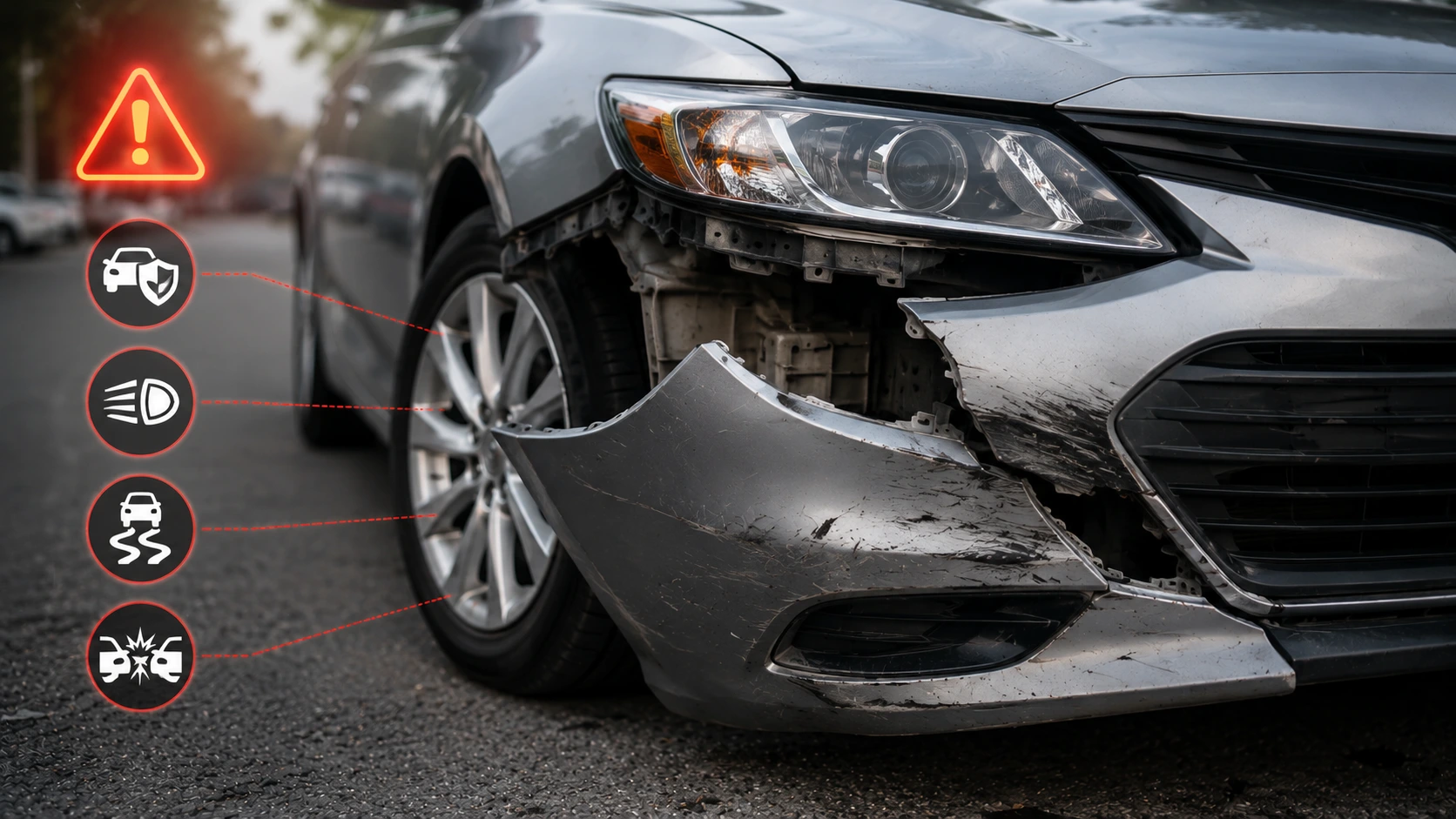
Yes — a damaged car bumper affect safety situation goes far beyond the visible scratch or crack. Most Dubai drivers treat a damaged bumper as a cosmetic problem. They postpone the repair because the car still drives fine and the damage doesn’t look serious.
What they don’t know is that a damaged bumper has already lost part of its ability to protect the vehicle in a subsequent impact. The bumper beam behind the fascia may be bent. The energy-absorbing foam between the beam and the fascia may be crushed. The sensors mounted in the bumper may be misaligned.
At Rapid Rev Garage in Al Quoz, every damaged car bumper affect safety case is assessed for structural and safety implications — not just the surface damage. A damaged car bumper affect safety finding changes the repair priority completely.
Damaged Car Bumper Affect Safety — Quick Answer
A damaged car bumper affects safety because the bumper is an engineered crash energy absorption system — not just a decorative cover. Behind the outer plastic fascia is a foam absorber and a steel or aluminium bumper beam. These components absorb and distribute impact energy to protect the passenger cabin and the vehicle’s structural crumple zones. When a bumper takes a significant hit, these components deform — and a deformed absorber or beam cannot absorb the next impact correctly.
Additionally, modern bumpers house radar sensors, parking sensors, and cameras that control active safety systems. Damage to the bumper misaligns these sensors, causing safety assistance features to give incorrect information or stop working entirely.
Table of Contents
- What a Car Bumper Actually Does in a Crash
- The Three Layers Behind the Bumper Fascia
- How a Previously Damaged Bumper Fails in the Next Impact
- Radar and Camera Sensors in the Bumper — What Gets Disrupted
- Parking Sensors After Bumper Damage
- How Dubai’s Car Park Environment Creates Repeated Bumper Damage
- Why Surface Damage Hides Structural Bumper Problems
- How We Assess Bumper Damage at Rapid Rev Garage
- The Services That Fix Every Layer of Bumper Damage
- What Does Bumper Repair Cost in Dubai?
- How Bumper Damage Affects Your Insurance Claim
- Why Rapid Rev Garage?
- FAQ
- Conclusion
What a Car Bumper Actually Does in a Crash
Understanding what a bumper does is essential to understanding how a damaged car bumper affect safety situation develops. It is to control how impact energy is absorbed and where it is directed.
In a low-speed impact — under 15 km/h — the bumper system is designed to absorb all the energy without transferring any to the vehicle’s structural components. The plastic fascia flexes. The foam absorber compresses. The steel beam deflects slightly. The passenger cabin and the engine bay experience no force.
In a higher-speed impact, the bumper absorbs the first portion of impact energy before the vehicle’s crumple zones engage. The sequence is engineered — bumper first, then crumple zone, then safety cell. Each stage absorbs energy and reduces the force reaching the passengers.
A damaged car bumper affect safety because it disrupts this engineered sequence. A beam that is already bent cannot absorb its designed portion of energy. A foam absorber that is already crushed has no remaining compression capacity. The force that should have been absorbed by the bumper travels further into the vehicle structure — reaching the crumple zones or the safety cell earlier than designed.
The Three Layers Behind the Bumper Fascia
The three layers behind the fascia are what make a damaged car bumper affect safety finding more serious than it looks. Behind it are two more structural layers.
The foam absorber. A block of energy-absorbing foam sits between the plastic fascia and the steel beam. It is the first line of energy absorption in a low-speed impact. The foam compresses under impact load and absorbs the kinetic energy. Once crushed, it cannot be reused — it has no elastic memory to return to its original shape.
The bumper beam. A steel or aluminium structural bar spans the full width of the vehicle behind the foam. It distributes impact load across the vehicle’s width and transfers any remaining energy to the crash rails that run back into the vehicle body. The beam is designed to deform in a controlled way during higher impacts.
The crash rails. Where the beam connects to the body, energy-absorbing crash rails are designed to crumple progressively. These are part of the vehicle’s main structure and are expensive to repair or replace.
A damaged car bumper affect safety result at the beam or foam level — without any visible damage to the outer fascia — is common after low-speed impacts. The fascia flexed and returned to shape. The foam and beam behind it took the full load and deformed permanently. Our car mechanic team removes the fascia on every significant bumper impact to inspect the foam and beam directly.
How a Previously Damaged Bumper Fails in the Next Impact
A bumper that has already absorbed one impact has reduced capacity for the next.
If the foam absorber was compressed in the first impact, it has less thickness to compress in the second. A foam absorber that was 80mm thick and is now 50mm after the first impact has 37% less energy absorption capacity.
If the beam was bent in the first impact and straightened or ignored, its metallurgical properties have changed at the bend point. Bent metal that has been worked has altered grain structure — it is weaker at the bend location than virgin metal of the same specification.
This is the accumulated damaged car bumper affect safety pattern — a vehicle with multiple unrepaired low-speed impacts of the foam and beam — common in Dubai’s car park-intensive environment — may have a bumper system operating at 50–60% of its designed energy absorption capacity. In the next impact, the energy that should be absorbed by the bumper reaches the crumple zones, the bonnet, the engine components, and ultimately the passenger cell earlier in the energy sequence.
This consequence is why a damaged car bumper affect safety finding must be properly repaired — not cosmetically covered.
Radar and Camera Sensors in the Bumper — What Gets Disrupted
Modern vehicles sold in Dubai — particularly from 2018 onward — have radar sensors mounted behind the front bumper. These sensors power the forward collision warning, automatic emergency braking, adaptive cruise control, and lane change assist systems.
The radar sensors work correctly only when they are pointed at the exact calibrated angle. A bumper impact that pushes the fascia inward by even 10–15mm can shift the radar sensor behind it. The sensor’s field of view moves. Objects that should be detected at 100 metres ahead are detected at 80 metres — or not at all.
A radar out of calibration doesn’t always trigger a fault light immediately. The system may continue operating but with reduced accuracy. The driver trusts the safety feature. The feature is no longer performing at its designed specification.
After any significant front bumper impact, radar sensors require physical inspection for mounting damage and electronic recalibration using manufacturer-specific calibration equipment. This is not optional — it is a safety verification step that confirms the sensor is still protecting the driver at its designed capability. For any body paint repairs alongside the bumper structural work, our car painting team handles colour-matched repainting at the same visit.
Parking Sensors After Bumper Damage
Parking sensors are simpler than radar units — they are ultrasonic transducers mounted in the bumper face. They emit a sound pulse and measure how long it takes to return to calculate distance to an obstacle.
A bumper impact that pushes a parking sensor inward, tilts it, or cracks its housing produces incorrect distance readings. A sensor that is pointing 10 degrees downward instead of horizontal detects the ground rather than the obstacle. The driver hears no proximity warning and reverses into the obstacle.
A parking sensor that has cracked internally may work intermittently — giving a correct reading one moment and no reading the next. This intermittent failure is more dangerous than a consistent failure because the driver cannot establish a reliable pattern of whether the sensor is working or not.
Physical inspection of each sensor position and an output test with a known obstacle at a measured distance confirms every parking sensor’s function after any rear bumper impact. For any roadside emergency following a bumper-related incident, our roadside assistance team covers Al Quoz and nearby Dubai areas.
How Dubai’s Car Park Environment Creates Repeated Bumper Damage
Dubai’s multi-storey car parks — dense bays, low lighting, high vehicle turnover — produce a high frequency of low-speed bumper contacts. Many of these contacts are not reported because the visible damage appears minor.
The result is that many Dubai vehicles have front or rear bumpers that have absorbed multiple low-speed impacts over their lifetime without any structural repair. Each impact compressed the foam slightly. Each impact may have bent the beam slightly. The cumulative effect is a bumper system with significantly reduced capacity — even though no single impact was severe enough to prompt an insurance claim.
This pattern is why a damaged car bumper affect safety check matters even without a single major accident even for vehicles that have never had a significant accident. Multiple minor impacts to the same bumper produce structural degradation that a single major impact would make obvious.
Why Surface Damage Hides Structural Bumper Problems
The plastic bumper fascia is designed to flex and return to shape. It is not a structural component — it is an aerodynamic and aesthetic cover for the structural components behind it.
This design means the fascia can look perfect while the foam and beam behind it are deformed. A bumper that flexes on impact and springs back to shape has absorbed no energy itself. All the energy went into the foam and beam.
A scuff or crack on the fascia is actually diagnostic information — it tells you the impact was hard enough to exceed the fascia’s flex capacity. A fascia with no visible damage after an impact that the driver felt clearly is almost certainly hiding foam compression or beam deformation.
This is why visual assessment of a bumper from outside the vehicle is inadequate. The fascia must be removed to assess the foam and beam condition directly. Our car service packages include a bumper structural check — fascia removal and beam inspection — after any reported significant impact.
How We Assess Bumper Damage at Rapid Rev Garage
Fascia removal and behind-fascia inspection. The plastic cover is removed. The foam absorber is inspected for compression — a foam that is visibly thinner or has a flattened area has absorbed an impact. The beam is inspected for deformation by measurement against a straight edge.
Sensor position and output test. Every radar sensor’s mounting bracket is inspected for deformation. Every parking sensor’s housing is inspected for cracking and its output is tested against a measured obstacle distance.
Radar recalibration where applicable. Where a radar sensor has been physically disturbed, a calibration procedure is performed using the manufacturer’s calibration target at the correct distance and angle. Post-calibration, the system’s detection range is confirmed.
Crash rail inspection. Where the beam damage is significant, the crash rails where the beam connects to the body are inspected. Crash rail deformation means the impact energy has already passed the bumper system and reached the main vehicle structure — requiring body straightening.
The Services That Fix Every Layer of Bumper Damage
Fascia repair or replacement. Surface damage repaired or the fascia replaced where the damage is beyond repair. AED 400–2,500 depending on the vehicle.
Foam absorber replacement. Compressed foam replaced with a new unit. AED 300–800. This is a frequently skipped repair in Dubai — a significant omission given that the foam’s function is the primary protection in low-speed impacts.
Bumper beam straightening or replacement. A mildly bent beam is straightened on a press. A significantly deformed beam is replaced with a correct-specification unit. AED 500–2,000.
Parking sensor replacement. A damaged sensor housing replaced. AED 150–500 per sensor.
Radar sensor replacement and recalibration. Damaged radar unit replaced and recalibrated using calibration equipment. AED 800–3,000 depending on the vehicle and sensor type. Our mobile car mechanic covers Al Quoz and nearby Dubai areas for an on-site initial bumper damage assessment.
What Does Bumper Repair Cost in Dubai?
| Service | Cost Range |
| Fascia repair or replacement | AED 400–2,500 |
| Foam absorber replacement | AED 300–800 |
| Bumper beam repair or replacement | AED 500–2,000 |
| Parking sensor replacement (per sensor) | AED 150–500 |
| Radar sensor replacement and calibration | AED 800–3,000 |
All costs confirmed after the behind-fascia structural inspection. Written quote before any work begins. Our garage near me in Al Quoz serves drivers from Business Bay, Jumeirah, Barsha, Satwa, Downtown, and the Sheikh Zayed Road corridor.
How Bumper Damage Affects Your Insurance Claim
Bumper damage documented at the time of an accident is covered under comprehensive insurance in Dubai. Structural damage — foam and beam — should be explicitly listed in the repair scope, not assumed to be included.
A repair that replaces only the fascia without the foam absorber or beam is an incomplete repair that an assessor or adjuster should not approve. If you are managing an insurance claim for bumper damage, confirm that the repair scope includes inspection and replacement of the foam absorber and beam where deformation is found — not just the cosmetic fascia.
Why Rapid Rev Garage?
Damaged car bumper affect safety is a finding that changes the repair priority — from cosmetic to structural. We remove the fascia on every significant bumper impact, inspect the foam and beam directly, and test every sensor for correct function before closing the repair.
A bumper that looks repaired from outside but has a crushed foam absorber and a misaligned radar sensor is not a safe repair. We don’t close a bumper repair until every layer has been confirmed.
FAQ — Damaged Car Bumper Affect Safety
Here are the questions Dubai drivers ask us most about bumper safety impact.
My bumper has a small crack but the sensors still work — is it really a safety issue?
A visible crack means the impact exceeded the fascia's flex capacity. The foam absorber behind the crack took load in that area. Inspect the foam before concluding the repair is only cosmetic. The sensors working after a minor impact doesn't confirm the radar is correctly calibrated — only a calibration test does that.
Do I have to replace the foam absorber after every impact?
Only if compression is confirmed. A light impact that left no mark on the foam is fine. An impact that left a flattened or indented area in the foam has used some of its energy absorption capacity. That area won't absorb the same energy again — replacement restores the full protection level.
My front assist or collision warning has been behaving differently since a front impact — what does that mean?
The radar sensor has likely been disturbed. The system is detecting objects at different distances or angles than calibrated. This is a direct safety system fault that requires sensor inspection and recalibration — not a warning to acknowledge and drive past.
Is it legal to drive with a damaged bumper in Dubai?
A bumper with a significant crack, a hanging section, or a missing piece may attract attention during a vehicle inspection (Tasjeel/Wasel). More importantly, a bumper hanging loose at highway speed is a hazard to other road users. Beyond legality, the safety system impact is the more pressing concern.
Can I park in a way that prevents rear bumper damage in Dubai?
Using parking sensors and reversing cameras correctly, parking with the nose toward the bay rather than reversing in where visibility is limited, and leaving slightly more space between vehicles — all reduce the frequency of low-speed rear bumper contacts in Dubai car parks.
Conclusion
A damaged car bumper affect safety situation shows up in three specific ways — reduced crash energy absorption from compressed foam or a bent beam, misaligned radar sensors that reduce the accuracy of active safety systems, and disabled parking sensors that remove proximity detection on low-speed manoeuvres. None of these are visible from outside the vehicle without removing the fascia.
Rapid Rev Garage in Al Quoz removes the fascia, inspects the foam and beam, tests and recalibrates every sensor, and confirms the full repair before returning any vehicle with bumper damage.
Rapid Rev Garage is in Al Quoz, serving Business Bay, Jumeirah, Downtown, Barsha, Satwa, and the Sheikh Zayed Road corridor. Book your appointment on WhatsApp or find us on Google Maps.
Rapid Rev Garage — Damaged Car Bumper Affect Safety | Al Quoz, Dubai