The effects of not changing transmission oil are progressive and expensive. Nothing breaks immediately. But every shift cycle — every gear change in Dubai’s stop-start traffic — deposits a little more heat, strips a little more friction modifier, and adds a little more debris to fluid that was already degraded from the last thousand kilometres. The damage is invisible and accumulating simultaneously.
At Rapid Rev Garage in Al Quoz, we see the effects of not changing transmission oil every week — transmissions that drivers assumed were fine until the day they stopped shifting. This guide explains exactly what happens, in what order, and at what cost.
Effects of Not Changing Transmission Oil — Quick Answer
The effects of not changing transmission oil follow a predictable sequence. First, the friction modifier additives deplete — clutch packs begin engaging more harshly with every shift. Then the anti-wear additives are consumed — gear surfaces and valve body components experience increased metal-to-metal contact. The fluid darkens from thermal oxidation and accumulates friction material debris, metal particles, and varnish deposits. This contamination blocks valve body passages and causes incorrect shift timing and pressure.
Clutch pack wear accelerates because the degraded fluid no longer cushions engagement correctly. Eventually the transmission slips under load, fails to select gears, or locks into limp mode. In Dubai, where stop-start traffic executes two to three times more shift cycles per kilometre than any European highway market, this entire sequence happens significantly faster than the manufacturer’s service interval assumes.
Table of Contents
- How Transmission Oil Protects the Gearbox
- Stage 1 — Friction Modifier Depletion and Harsh Shifts
- Stage 2 — Anti-Wear Additive Loss and Surface Damage
- Stage 3 — Thermal Oxidation and Fluid Darkening
- Stage 4 — Valve Body Contamination and Shift Faults
- Stage 5 — Clutch Pack Wear and Transmission Slip
- Stage 6 — Complete Transmission Failure
- Why Dubai’s Stop-Start Traffic Accelerates Every Stage
- The Cost Difference Between Service and Repair
- How We Assess Transmission Fluid Condition at Rapid Rev Garage
- What Does an ATF Service Cost in Dubai?
- Why Rapid Rev Garage?
- FAQ
- Conclusion
How Transmission Oil Protects the Gearbox
Automatic transmission fluid isn’t a simple lubricant. It performs four simultaneous functions inside the gearbox.
Hydraulic medium. Every gear change is executed by directing pressurised ATF to the correct clutch circuit. The fluid transmits the force that engages the gear.
Friction modifier. The clutch packs require a specific friction coefficient at engagement — the friction modifier additives in the ATF control this. Correct chemistry means a smooth, progressive engagement. Depleted chemistry means a grab or a slip.
Anti-wear agent. Gear surfaces, bearings, and valve body components all depend on ATF to carry an anti-wear film between metal surfaces.
Coolant. ATF absorbs heat from the clutch packs, gears, and torque converter and transfers it to the transmission cooler. Degraded ATF carries heat less efficiently.
When ATF is never changed, all four functions degrade simultaneously. The effects of not changing transmission oil are the cascading consequences of all four protections failing at once. Our car mechanic team checks ATF condition at every major service — colour, smell, and particle content — before any transmission complaint develops.
Stage 1 — Friction Modifier Depletion and Harsh Shifts
This is the first effect a driver notices. The transmission that was shifting smoothly begins producing slightly harsher gear changes — particularly on the 2nd-to-3rd shift in Dubai’s traffic.
Friction modifier additives are consumed by every clutch engagement event. Once the modifiers drop below the threshold that maintains smooth clutch engagement, the clutch pack grabs rather than progressively biting.
The driver feels this as a jerk or shudder on gear changes. It’s worse in Dubai’s stop-start traffic because more shifts are executed per kilometre than on any European highway.
Most drivers attribute this to the car’s age. It’s the first of the effects of not changing transmission oil — and at this stage, an ATF service still resolves the problem completely. Our car service packages include an ATF condition check and shift quality assessment at every major service.
Stage 2 — Anti-Wear Additive Loss and Surface Damage
As the friction modifiers deplete, the anti-wear additives follow. These additives form a sacrificial film on gear tooth faces, bearing races, and valve body components — absorbing contact stress that would otherwise be shared between metal surfaces directly.
Once depleted, the film thins. Under full-throttle acceleration — overtaking on the E611, merging at speed — the load on gear surfaces exceeds the film’s protection. Micro-pitting develops on the gear and bearing surfaces.
Micro-pitting is irreversible. This is one of the most costly effects of not changing transmission oil — damage that a fluid change at this stage can restore additive chemistry for, but can’t repair the pitted surfaces themselves. The damage generates debris that circulates through the fluid and acts as an abrasive on every surface it contacts — and the cascade begins.
Stage 3 — Thermal Oxidation and Fluid Darkening
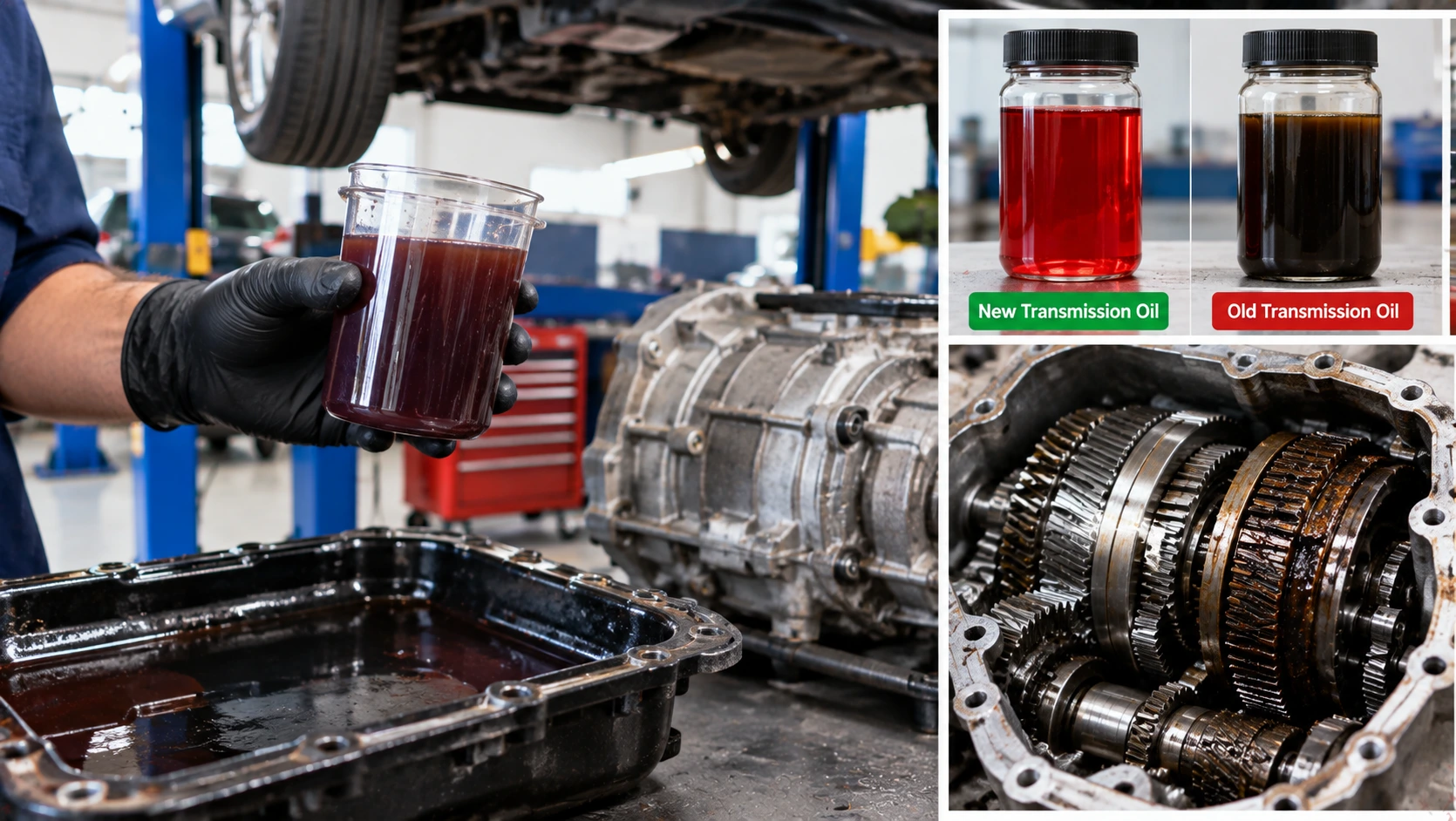
Fresh ATF is red or pink and translucent. As it accumulates heat cycles without replacement, the base oil oxidises. Oxidation products are acidic — they attack metal surfaces and degrade rubber seals. The fluid darkens from red to brown to black.
The burnt smell that accompanies very dark ATF indicates significant thermal oxidation. The fluid has been operating above its design temperature ceiling — common in Dubai’s stop-start traffic where the torque converter continuously slips and generates heat.
Burnt, dark ATF is also thinner at operating temperature than fresh fluid of the same specification. The hydraulic film on valve body components and clutch circuits thins — shift pressure and timing become less precise.
At this stage, the effects of not changing transmission oil are visible on the dipstick. For any roadside emergency from a transmission fault, our roadside assistance team covers Al Quoz and nearby Dubai areas.
Stage 4 — Valve Body Contamination and Shift Faults
The valve body is the transmission’s hydraulic control centre — a precision-machined block of aluminium with dozens of passages, valves, and solenoids that route ATF to the correct clutch circuit for each gear change.
As ATF degrades, three types of contamination accumulate in the valve body.
Varnish deposits. Oxidation byproducts form a lacquer-like coating on valve bore walls — restricting the movement of the spool valves that control hydraulic routing.
Friction material particles. Every harsh clutch engagement deposits microscopic friction disc material into the fluid. This accumulates in valve body passages.
Metal particles. Anti-wear additive depletion allows metal surfaces to contact and generate particles that circulate through the system.
The result is valve body passages that are partially blocked — shift solenoids that receive less fluid than they should — and gear changes that are late, rough, or incomplete. The driver notices gear changes that hesitate, hard shifts between specific gears, or gears skipped entirely.
At this stage, the effects of not changing transmission oil have moved beyond fluid chemistry into physical contamination. A simple ATF drain and refill may not be sufficient — a full transmission flush is required to remove contamination from the valve body and torque converter.
Stage 5 — Clutch Pack Wear and Transmission Slip
The clutch packs have now been operating through multiple stages of degraded fluid. Each harsh engagement from Stage 1 onwards has removed more friction material from the clutch disc surfaces than a smooth engagement with fresh fluid would have.
By Stage 5, the clutch pack friction material is thin enough to begin slipping under load. The driver notices engine revs rising without a proportional increase in vehicle speed — the classic transmission slip. It’s most noticeable on hard acceleration from a standstill or at the moment of kick-down from highway speed.
Transmission slip confirms clutch pack wear that an ATF service alone can’t repair. The clutch packs must be rebuilt or the transmission replaced. The cost difference between an ATF service and a clutch pack rebuild is typically AED 500–900 versus AED 3,500–8,000.
This is the stage at which the effects of not changing transmission oil produce their most significant financial impact. For exterior or bodywork alongside mechanical work, our car painting team handles colour-matched repairs at the same visit.
Stage 6 — Complete Transmission Failure
Without intervention at Stage 5, the clutch pack wear progresses to the point where the transmission can no longer hold the vehicle in any gear under load.
The transmission warning light illuminates. The gearbox may enter limp mode — locking into third gear to allow the driver to reach a workshop. Or it may fail completely — producing a thud, losing all drive, and requiring recovery.
Complete transmission failure from never changing the oil requires transmission rebuild or replacement. On most vehicles in Dubai’s market, this is AED 6,000–25,000. This is the end consequence of the effects of not changing transmission oil that were first detectable as a mild harsh shift years earlier.
Why Dubai’s Stop-Start Traffic Accelerates Every Stage
European ATF service intervals — typically 60,000 km — are designed for highway-dominated driving where the transmission executes 8–12 shift cycles per typical journey.
A Dubai city commute produces 60–80 shift cycles in 20 minutes. Five working days a week, 50 weeks a year — the Dubai vehicle executes two to three times more shift cycles per year than a European vehicle covering the same annual mileage.
Friction modifier depletion is cycle-dependent. In Dubai, the modifiers are depleted by 30,000–40,000 km of city driving — not 60,000 km. Every stage of the damage progression happens proportionally faster.
The sustained heat adds a compounding mechanism. Dubai’s summer stop-start conditions regularly push ATF temperatures to the upper limits of the fluid’s design range — accelerating Stage 3 significantly. Understanding how the effects of not changing transmission oil compound under these conditions is why Dubai-specific service intervals exist. Our mobile car mechanic covers Al Quoz and nearby Dubai areas for on-site ATF condition assessment.
The Cost Difference Between Service and Repair
| Intervention | Cost Range | Stage |
| ATF drain and refill | AED 500–900 | Before or at Stage 1 |
| Full ATF flush | AED 900–1,500 | Stage 3–4 |
| Solenoid replacement | AED 600–2,000 | Stage 4 |
| Valve body cleaning or replacement | AED 1,500–4,000 | Stage 4 |
| Clutch pack rebuild | AED 3,500–8,000 | Stage 5 |
| Full transmission rebuild or replacement | AED 6,000–25,000 | Stage 6 |
The cost ratio between an ATF service and a complete transmission replacement is approximately 1:25. For a vehicle doing Dubai city driving, an ATF service every 30,000–40,000 km prevents every stage beyond Stage 1 from developing.
How We Assess Transmission Fluid Condition at Rapid Rev Garage
Visual and olfactory check. ATF colour and smell on the dipstick or drain sample. Red to brown is moderate degradation. Brown to black with a burnt smell is Stage 3 or beyond.
Particle contamination test. A magnet drawn through the drain sample reveals metal particle content. Significant metal confirms Stage 2 or beyond has occurred.
Shift quality road test. Cold and hot shift quality assessed. Harsh shifts at cold temperature confirm Stage 1. Harsh shifts that worsen when hot confirm Stage 3–4.
Transmission module scan. Adaptive shift data and fault codes read. High correction values confirm the TCM has been compensating for clutch pack wear over an extended period. Our garage near me in Al Quoz serves drivers from Business Bay, Jumeirah, Barsha, Satwa, Downtown, and the Sheikh Zayed Road corridor.
What Does an ATF Service Cost in Dubai?
| Service | Cost Range |
| ATF drain and refill (correct spec) | AED 500–900 |
| Full transmission flush | AED 900–1,500 |
| ATF filter replacement (where applicable) | AED 200–600 |
Correct specification ATF — Toyota WS, ZF Lifeguard, Honda DW-1, or the manufacturer-specified equivalent — is used for every service. Universal fluids are not used.
Why Rapid Rev Garage?
The effects of not changing transmission oil are easy to prevent and expensive to repair. An ATF check at every service, a fluid change at Dubai-appropriate intervals of 30,000–40,000 km, and the correct specification fluid are all that’s required.
We assess ATF condition at every major service, document shift quality, scan the transmission module, and recommend the correct interval for the vehicle’s specific Dubai driving pattern.
FAQ — Effects of Not Changing Transmission Oil
Here are the questions Dubai drivers most commonly ask about transmission oil neglect.
How often should ATF be changed in Dubai?
Every 30,000–40,000 km for stop-start city driving. The manufacturer's 60,000 km interval assumes highway-dominated use with fewer shift cycles per kilometre. Dubai's traffic executes two to three times more shifts per kilometre — depleting friction modifiers significantly faster.
Can old transmission fluid cause slipping?
Yes — at Stage 5 of the degradation sequence. Friction modifier depletion from neglected ATF causes harsh clutch engagement that accelerates friction disc wear. Once the disc material is thin enough, the clutch slips under load. An ATF service at Stage 1 prevents this from ever developing.
Does dark ATF mean the transmission is damaged?
Dark ATF confirms thermal oxidation of the fluid — not necessarily component damage. Catching the fluid at dark-but-not-burnt confirms degradation before damage has occurred. A fluid change at this point is still preventive. Burnt-smelling black fluid suggests component damage is more likely.
Is a transmission flush better than a drain and refill?
A drain and refill replaces the fluid in the pan and filter. A flush also circulates fresh fluid through the torque converter and valve body — removing contamination the drain can't reach. Where contamination from neglected fluid is confirmed, a flush is the more complete service.
What are the first signs ATF needs changing?
Slightly harsher gear changes — particularly on 2nd-to-3rd — are the first sign. A brief hesitation before engaging drive from park is another. These appear before any warning light and before any scan shows a fault code. They're the Stage 1 signal that the friction modifiers are depleted.
Conclusion
The effects of not changing transmission oil progress through six stages — from harsh shifts to complete transmission failure — at a rate that Dubai’s stop-start traffic accelerates significantly beyond any European service interval’s assumption. The cost of each stage is an order of magnitude higher than the previous one.
Rapid Rev Garage in Al Quoz assesses ATF condition, documents shift quality, and services every transmission with the correct specification fluid at Dubai-appropriate intervals — preventing the cascade before it starts. Book your appointment on WhatsApp or find us on Google Maps.
Rapid Rev Garage — Effects of Not Changing Transmission Oil | Al Quoz, Dubai