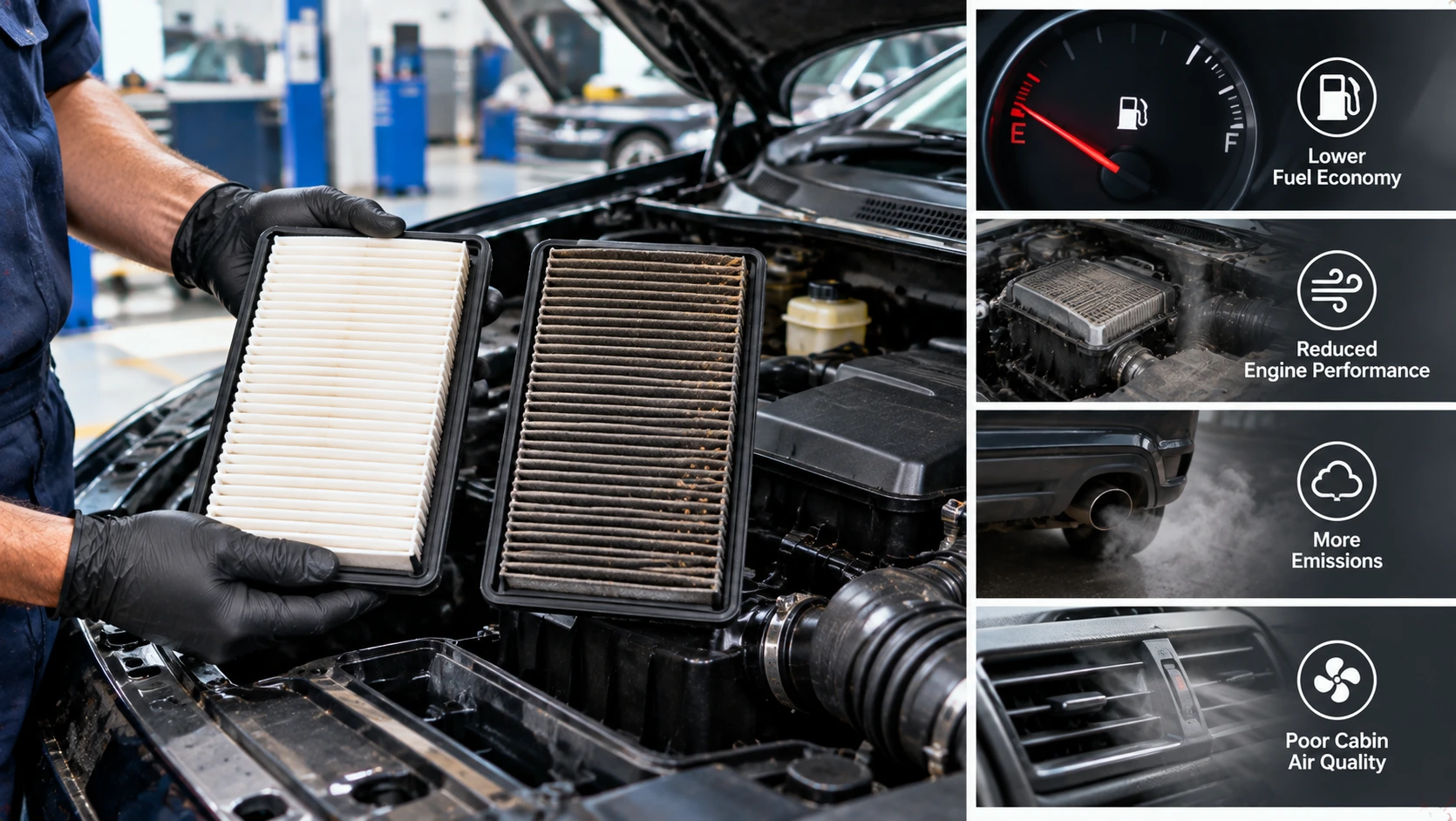
The effects of not replacing the air filter are gradual, invisible, and almost always misdiagnosed. No warning light comes on. No single symptom announces the problem clearly. Instead, fuel consumption creeps up, throttle response dulls, and the engine slowly works harder for the same result — until a blocked filter causes a fault that finally forces a workshop visit that costs far more than a filter replacement would have.
In Dubai, the effects of not replacing the air filter happen faster than anywhere else. The air filter on a car in Al Quoz’s industrial traffic doesn’t last the same 15,000–20,000 km it might manage in a European city. Fine sand particles — invisible in the air but real — load the filter’s paper medium far faster than the service schedule assumes.
Effects of Not Replacing the Air Filter — Quick Answer
The effects of not replacing the air filter follow a clear progression. A clogged filter restricts airflow into the engine — the combustion system that needs a precise air-to-fuel ratio to run correctly. Less air means the engine runs rich (too much fuel relative to air), which increases fuel consumption, deposits carbon on injectors and spark plugs, and reduces power output. As restriction increases, the mass airflow sensor reading drifts, the ECU struggles to compensate, and fault codes begin to appear.
In extreme cases, a fully blocked filter starves the engine of air entirely — causing rough running, misfires, or failure to start. In Dubai, sand and dust loading accelerates every stage of this progression. A filter that would last 20,000 km in Europe may be critically restricted at 10,000 km in Al Quoz conditions.
Table of Contents
- What the Air Filter Actually Does
- Stage 1 — Increased Fuel Consumption
- Stage 2 — Reduced Power and Sluggish Throttle
- Stage 3 — Carbon Deposits on Injectors and Spark Plugs
- Stage 4 — MAF Sensor Contamination and Fault Codes
- Stage 5 — Engine Misfires and Rough Running
- Stage 6 — Severe Restriction and Starting Failure
- Why Dubai’s Dust Accelerates Every Stage
- The Cost Difference Between Filter Replacement and Downstream Repairs
- How We Check Air Filter Condition at Rapid Rev Garage
- Why Rapid Rev Garage?
- FAQ
- Conclusion
What the Air Filter Actually Does
The engine needs air and fuel in a precise ratio — approximately 14.7 parts air to 1 part fuel at stoichiometric combustion. The air filter’s job is to supply that air while keeping out the particles that damage the cylinder walls, pistons, valves, and fuel injectors.
A new air filter flows air freely while trapping particles above a specific micron threshold. As the filter loads with particles, its flow resistance increases — less air reaches the intake manifold per engine cycle. The ECU detects the leaner condition via the mass airflow sensor and oxygen sensors, and it compensates by adjusting fuel delivery.
But the ECU’s correction range is finite. Once filter restriction exceeds the ECU’s ability to compensate, the combustion efficiency drops, deposits accumulate, and the faults that follow are the effects of not replacing the air filter — each one more expensive to resolve than the filter itself. Our car mechanic team checks air filter condition at every major service rather than relying on mileage intervals alone.
Stage 1 — Increased Fuel Consumption
This is the first measurable effect of a loading air filter and the one most drivers never attribute to the correct cause.
As the filter restricts airflow, the ECU detects less air than expected from the intake sensor readings. It adjusts the fuel delivery to compensate — in effect, the combustion mixture leans slightly, and the ECU enriches it. The engine is now burning slightly more fuel per cycle to produce the same power output it was producing before the filter began restricting.
The increase is gradual. A driver won’t notice the first 5% increase in consumption — it’s within normal variation. But a filter that’s been neglected for 20,000–25,000 km in Dubai conditions can add 10–15% to fuel consumption, noticeable as an extra petrol stop per week on a regular commute.
The effects of not replacing the air filter showed up on his fuel readings before any warning light appeared. A customer brought his Toyota Land Cruiser in for an unrelated fault last month. We checked the air filter during the inspection — it hadn’t been replaced in 22,000 km of Dubai city driving. The filter medium was dark grey and visibly restricted. After replacement and a short recalibration drive, his next tank fuel reading dropped by nearly 12%.
Stage 2 — Reduced Power and Sluggish Throttle
As restriction increases, the compensation range of the ECU begins to saturate. The engine simply can’t receive enough air for full combustion efficiency — even with maximum fuel delivery adjustment.
The driver notices this as a sluggish throttle response on acceleration. The engine that used to pull strongly from 60 km/h onto the E311 now hesitates and builds speed more slowly. Overtaking feels more laboured. The car still drives, but it doesn’t feel the way it did.
This is one of the effects of not replacing the air filter that most commonly gets misattributed. Drivers assume the car is ageing or the fuel quality has dropped. In reality, the engine hasn’t changed — its air supply has. Our car service packages include an air filter inspection and flow assessment at every major service precisely because the symptom is so easily confused with other faults.
Stage 3 — Carbon Deposits on Injectors and Spark Plugs
Running rich — too much fuel relative to air — causes incomplete combustion. Fuel that doesn’t burn fully leaves carbon deposits on the surfaces it contacts: injector tips, intake valves, combustion chamber walls, and spark plug electrodes.
Carbon on injector tips changes the spray pattern. Instead of a precise, atomised mist, the injector produces a degraded spray that doesn’t mix properly with air in the combustion chamber. Combustion efficiency drops further — creating a feedback loop where the blocked filter causes deposits, and the deposits amplify the combustion problem the blocked filter started.
Carbon on spark plug electrodes increases the gap’s electrical resistance. Ignition timing becomes less precise. Misfires under load become increasingly likely. On direct injection engines — common in modern Toyota, Nissan, BMW, and Mercedes models sold in the UAE — carbon deposits on intake valves are a known consequence of extended rich running and are expensive to clean properly.
At this stage, the effects of not replacing the air filter have moved beyond simple restriction into downstream component damage. Replacing the air filter is still the first priority — but the injectors and plugs may need attention alongside it. Addressing the carbon deposits without replacing the filter that caused them produces the same deposits again within months.
Stage 4 — MAF Sensor Contamination and Fault Codes
The effects of not replacing the air filter reach beyond the intake itself at Stage 4. The mass airflow sensor sits in the intake path, downstream of the air filter. Its job is to measure the volume and density of air entering the engine — data the ECU uses for every fuel delivery calculation.
A heavily loaded air filter allows fine particles to pass through weakened or overloaded filter media. These particles deposit on the MAF sensor’s hot wire element, insulating it from the airflow it’s trying to measure. The sensor underreads — it reports less air than is actually reaching the engine.
The ECU now receives incorrect data. Its fuel calculations are based on a false air reading. The result is a range of drivability faults — rough idle, hunting RPM at traffic lights, hesitation under load, and fuel consumption that worsens further.
Eventually the MAF drift produces fault codes: typically P0100–P0104 series codes on most platforms. The check engine light appears. Drivers bring the car in for the fault code — and if the air filter is replaced without also cleaning or replacing the contaminated MAF sensor, the fault code may clear but the drivability problems persist.
This is a common pattern. A Nissan Patrol came in with a check engine light and a P0102 code. A previous workshop had cleared the code twice without identifying the cause. We found the air filter hadn’t been replaced in over 30,000 km — it was dark and visibly restricted. The MAF sensor showed heavy contamination on the wire element. New filter, MAF sensor cleaned and calibrated, fault code cleared, road tested. No return.
Stage 5 — Engine Misfires and Rough Running
By Stage 5, the combination of restricted airflow, carbon deposits, and degraded spark plug performance produces active misfires — combustion events in one or more cylinders that don’t complete correctly.
Misfires register as P030X fault codes on the ECU. They cause rough running that the driver feels as a shudder or vibration at idle, particularly when the engine is under load in slow traffic. The engine may hunt RPM at a standstill — revs rising and falling slightly in a way that wasn’t present before.
Misfires from an air filter problem are usually multi-cylinder and load-dependent. They’re worst in slow stop-start traffic where the engine is at low RPM with the air conditioning load active — exactly Dubai’s daily commute conditions.
Unresolved misfires cause catalyst damage. The unburnt fuel that reaches the catalytic converter from each misfire event raises converter temperature and degrades the precious metal coating. Catalyst replacement on a modern UAE-market vehicle is AED 2,000–8,000 depending on the model. An air filter replacement costs AED 80–300.
Stage 6 — Severe Restriction and Starting Failure
A filter that reaches complete blockage — possible on vehicles left unserviced for extreme mileages in Dubai’s dust conditions — can restrict airflow to the point where the engine struggles to start cold. The cranking engine can’t draw enough air through the blocked medium to initiate combustion.
In less extreme cases, the vehicle starts but immediately stalls, or runs extremely roughly for the first few minutes of operation before the increased intake vacuum partially draws air around a compromised filter seal.
At this stage, the effects of not replacing the air filter have compounded into a genuine starting fault that requires diagnosis and repair rather than simple filter replacement.
Why Dubai’s Dust Accelerates Every Stage
The air filter’s service life is determined by the particulate load it processes — not by kilometres driven.
Dubai’s environment provides a particulate load that European filter service intervals don’t account for. Al Quoz’s industrial area, the desert dust that enters the city from Sharjah’s perimeter, construction activity on nearly every major road corridor, and the fine silica sand that the shamal wind carries in summer all contribute to an airborne particle environment that is categorically different from Stuttgart or London.
A filter that loads at 20,000 km in Munich may load at 8,000–12,000 km in Al Quoz summer conditions. Vehicles that park outdoors overnight accumulate additional particulate on the filter from ambient air movement through the intake system when the engine is switched off.
The practical consequence of ignoring the effects of not replacing the air filter in Dubai’s environment is accelerated — Dubai service intervals for air filters should be 10,000–12,000 km maximum — checked visually at every service and replaced whenever the medium shows more than moderate loading. Relying on the European or manufacturer interval in UAE conditions produces exactly the progression described above. For any roadside situation where a vehicle has stopped running from an air-related fault, our roadside assistance team covers Al Quoz and surrounding Dubai areas.
The Cost Difference Between Filter Replacement and Downstream Repairs
| Item | Cost Range |
| Air filter replacement | AED 80–300 |
| Spark plug replacement (4-cylinder) | AED 200–600 |
| Injector cleaning service | AED 400–800 |
| MAF sensor cleaning | AED 150–300 |
| MAF sensor replacement | AED 400–1,200 |
| Intake valve carbon cleaning | AED 800–2,500 |
| Catalytic converter replacement | AED 2,000–8,000 |
Every downstream repair in this table is a potential consequence of the effects of not replacing the air filter going unaddressed. An air filter that wasn’t replaced on schedule costs far more than itself. The cumulative repair cost for a vehicle that progressed through Stages 3–5 before the filter was replaced typically runs AED 1,500–4,000 in addition to the filter itself.
How We Check Air Filter Condition at Rapid Rev Garage
Visual inspection. The filter is removed and held up to light. A new filter allows light through the paper medium clearly. A filter at 50% life shows moderate darkening but still transmits light. A filter at end of life appears dark or black, often with visible dust cake on the surface, and transmits no light.
Restriction estimate. Experienced technicians can assess restriction severity by the feel of the filter medium and the depth of dust penetration into the paper folds — not just the surface.
MAF sensor check. On vehicles with a loading filter or extended service interval, the MAF sensor hot wire is inspected for contamination at the same time. A contaminated sensor alongside a new filter produces continued drivability faults.
Intake inspection. The intake tract between the filter housing and the throttle body is inspected for dust entry — evidence that the filter seal or housing has been compromised. Our mobile car mechanic covers Al Quoz and nearby Dubai areas for on-site filter checks when the vehicle can’t make it to the workshop.
Why Rapid Rev Garage?
The effects of not replacing the air filter compound in Dubai’s dust environment faster than any European service interval assumes. We check air filter condition by visual inspection at every major service — not just at the manufacturer’s mileage trigger.
When a filter replacement is due, we check the MAF sensor, inspect the intake tract, and assess whether the extended service interval has caused downstream deposits that need addressing alongside the filter. A filter swap that misses contaminated downstream components produces the same faults within weeks.
Need bodywork or paint touch-up alongside your filter service? Our car painting team handles stone chips and full panel repairs at the same visit. Book your appointment on WhatsApp — Rapid Rev Garage is in Al Quoz, serving Business Bay, Jumeirah, Downtown, Barsha, Satwa, and the Sheikh Zayed Road corridor. Find us on Google Maps. Our garage near me team is available for same-day filter services across Al Quoz.
FAQ — Effects of Not Replacing the Air Filter
Here are the questions Dubai drivers most commonly ask about air filter neglect.
How often should the air filter be replaced in Dubai?
Every 10,000–12,000 km for Dubai city driving, or at every major service, whichever comes first. Check it visually at every service interval regardless of mileage — a Dubai summer dust storm can load a filter significantly faster than the service interval suggests.
Can a dirty air filter cause the check engine light?
Yes — at Stage 4. A heavily loaded filter allows particles to contaminate the MAF sensor, which produces incorrect airflow readings. The ECU detects the fault and triggers a check engine light, typically with a P010X or P030X fault code series. Replacing the filter and cleaning the MAF sensor resolves the fault when caught before Stage 5.
Does a dirty air filter reduce fuel economy?
Yes — from Stage 1 onwards. Restricted airflow causes the ECU to enrich the fuel mixture to compensate for the reduced air signal. Fuel consumption increases by 5–15% depending on restriction severity. The increase is gradual and rarely noticed until it's already significant.
Will a dirty air filter cause misfires?
At Stage 5, yes. The combination of restricted airflow, carbon deposits on spark plugs from extended rich running, and degraded combustion efficiency produces load-dependent misfires that register as P030X codes and are felt as rough running in stop-start traffic.
Can I clean and reuse a paper air filter in Dubai?
No — a paper element air filter can't be cleaned effectively. Compressed air removes surface dust but drives particles deeper into the paper medium, where they increase restriction further. A filter that's been blow-cleaned has a shorter remaining service life than one that's simply been replaced. Paper filters are replaced, not serviced.
Conclusion
The effects of not replacing the air filter progress from increased fuel consumption to misfires to starting failure — and every downstream consequence costs more to resolve than the filter itself. In Dubai’s dust environment, this progression happens at half the mileage the manufacturer’s service schedule assumes.
Rapid Rev Garage checks air filter condition at every major service, inspects the MAF sensor alongside the filter on high-mileage vehicles, and uses the correct replacement filter specification for every engine variant. Book your appointment on WhatsApp or find us on Google Maps.
Rapid Rev Garage — Effects of Not Replacing the Air Filter | Al Quoz, Dubai