A car that won’t start on a Dubai morning isn’t just inconvenient — it’s a problem that cascades fast. Miss a meeting, lose a delivery, sit in 45°C heat waiting for a recovery truck that takes forty minutes to arrive. Electrical faults are responsible for more unplanned breakdowns in Dubai than most drivers realise, and the frustrating part is that most of them were developing quietly for weeks before they became a crisis.
Auto electrical services cover a wide range of vehicle systems — from something as straightforward as a dead battery to something as involved as a damaged wiring harness or a corrupted ECU. The common thread is that electrical faults rarely announce themselves clearly. A battery that tests fine on a basic voltage check can still fail to start the car on a hot afternoon. A wiring fault can cause symptoms in a completely unrelated system. An ECU issue can look like a mechanical problem until the right diagnostic equipment is used.
Getting proper auto electrical services in Dubai means finding a workshop that has the right diagnostic tools, actual experience with vehicle electrical architecture, and the patience to trace a fault properly rather than swap parts until something changes.
Auto Electrical Services in Dubai — Why Electrical Faults Are More Common Here
Dubai’s environment is genuinely harsh on vehicle electrical systems. This isn’t a generic observation — there are specific reasons why electrical faults occur at higher rates here than in cooler markets, and understanding them helps owners catch problems earlier.
Heat is the primary driver. Vehicle electrical components operate within designed temperature ranges. Sustained ambient temperatures above 40°C push battery chemistry, wiring insulation, relay contacts, and control unit solder joints beyond their comfortable operating range. A battery that would last five years in Europe often shows significant degradation at three years in Dubai. Wiring insulation that would stay flexible for a decade can become brittle and crack-prone in four or five years of UAE summers.
Vibration from Dubai’s roads accelerates connector wear. Speed bumps — hit repeatedly, at varying speeds, across the full vehicle weight — create sustained mechanical stress on electrical connectors, ground straps, and sensor wiring. Connectors that work themselves loose cause intermittent faults that are among the most difficult electrical problems to diagnose, because the fault disappears the moment the car is stationary and someone starts looking for it.
Short-trip city driving prevents batteries from reaching full charge. A car driven primarily on short runs — school drop-off, supermarket, office — never gives the alternator enough time to fully restore charge after each cold start. Over months, battery capacity degrades. The car starts fine on cool mornings and then refuses to start after sitting in a hot parking garage for six hours.
These are the conditions that make quality auto electrical services in Al Quoz worth knowing about before you need them, not after.
Auto Electrical Services — Battery Diagnosis and Replacement Done Properly
Battery problems account for a large proportion of auto electrical services callouts in Dubai. But battery issues are more nuanced than most owners realise, and “replace the battery” isn’t always the correct first step.
A proper battery diagnosis starts with a conductance test — not just a voltage reading. A battery sitting at 12.4 volts looks healthy on a basic meter. A conductance test measures the battery’s actual available current delivery, which degrades as the internal plate structure breaks down from heat cycling. A battery showing 58% health on a conductance test will start the car fine on a cool morning and fail to start it after six hours in a summer parking garage. Voltage alone doesn’t show this.
Beyond the battery itself, the charging system needs assessment. An alternator that’s under-charging — delivering 13.2 volts instead of the correct 14.2–14.7 volts — will drain a healthy battery over time. Fitting a new battery to a car with a weak alternator means the new battery starts degrading from the day it’s fitted. The alternator gets replaced a few months later anyway, and the new battery has already taken unnecessary damage.
On modern vehicles — particularly European makes common in Dubai — battery replacement isn’t always plug-and-play. BMW, Mercedes-Benz, Volkswagen Group, and Land Rover vehicles require battery registration after replacement. This involves coding the new battery’s specifications into the engine management and power management systems so the vehicle adjusts its charging strategy correctly. Fitting a new battery without registration on these vehicles leads to premature battery failure and charging system faults. A proper car mechanic with the correct diagnostic equipment handles this as part of the replacement — it’s not optional.
A Toyota Hilux came through recently with a persistent slow-crank complaint that three other workshops had attributed to the battery. Two batteries had been replaced in eighteen months. The actual fault: a corroded negative ground strap between the battery and chassis, creating resistance in the return path. Cleaned and replaced for AED 95. Third battery stayed healthy.
Wiring Faults — The Most Difficult Auto Electrical Problem to Diagnose
Of all the work that falls under auto electrical services, wiring faults are the most time-consuming to diagnose correctly — and the most commonly misdiagnosed.
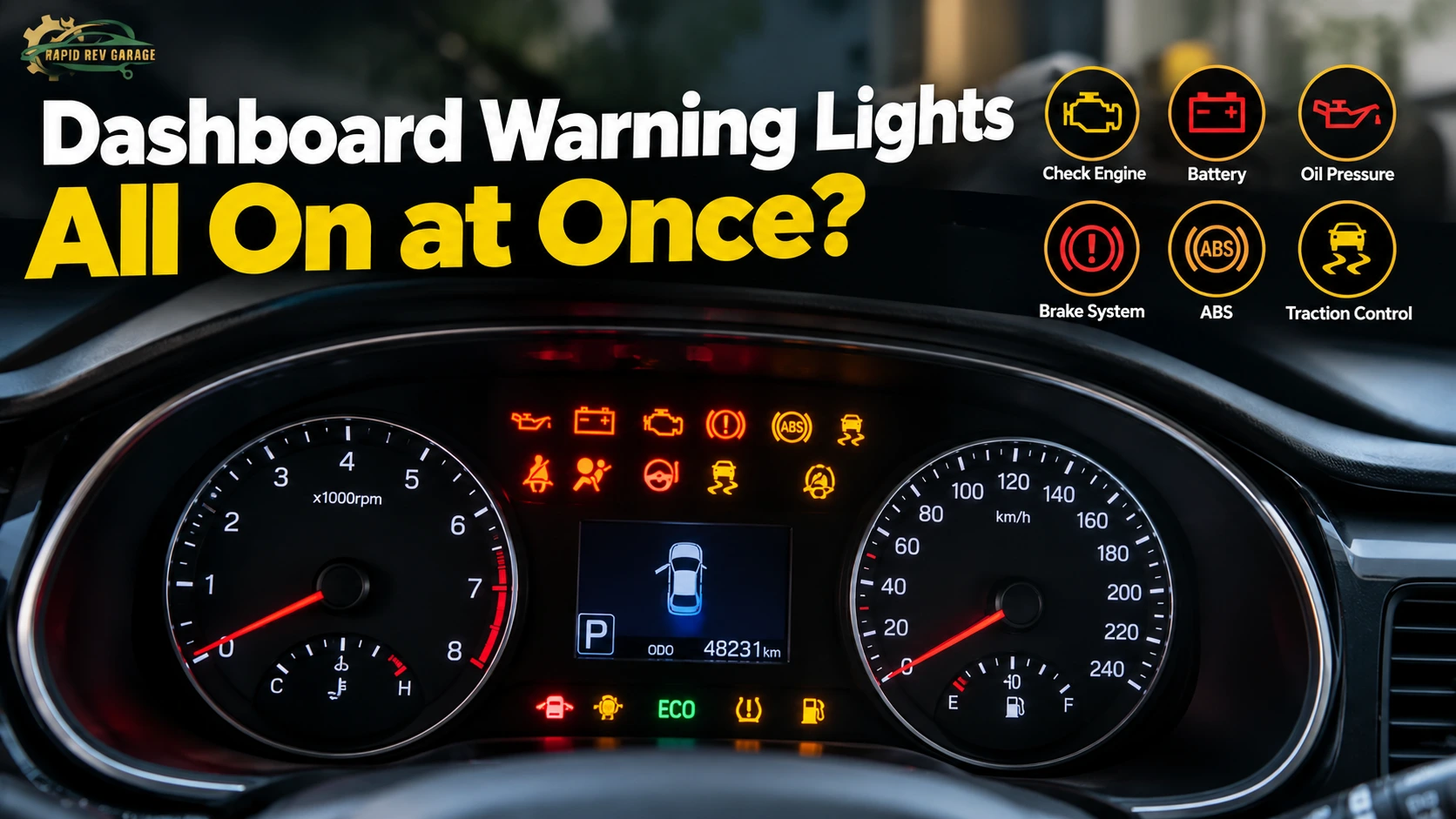
Modern vehicles have extensive wiring harnesses running through the entire car — under the bonnet, through the firewall, along the sill, into the doors, under the seats, to the rear lighting and sensors. A single damaged wire in the wrong place can create fault codes across multiple unrelated systems. An ABS fault, a stability control warning, and a gearbox hesitation all appearing together sometimes trace back to a single damaged ground wire near the rear axle.
The diagnostic approach matters enormously here. Scanning for fault codes is the starting point — but the codes tell you which system is affected, not what caused the fault. Tracing the cause requires reading wiring diagrams for that specific vehicle, identifying the circuits involved, testing continuity and resistance at multiple points, and physically inspecting the harness sections most likely to have suffered damage.
In Dubai, the most common wiring fault locations are:
Engine bay harnesses — heat cycling causes insulation to crack and harden over time. Wires that run close to exhaust manifolds or turbocharger housings are particularly vulnerable. Rodent damage is also more common than owners expect in Dubai — the engine bays of cars parked in outdoor lots attract rodents during cooler months.
Door harness flex points — the wiring that runs between the body and the door through the rubber boot flexes every time the door opens and closes. Over time, individual wires fatigue-crack at this point. Central locking failures, window faults, and mirror issues that work intermittently usually trace back here.
Underbody and chassis runs — less common in Dubai than in markets with road salt, but physical damage from speed bump impacts, incorrect jacking, or poorly fitted underbody protection causes wiring damage that shows up as intermittent and apparently random faults.
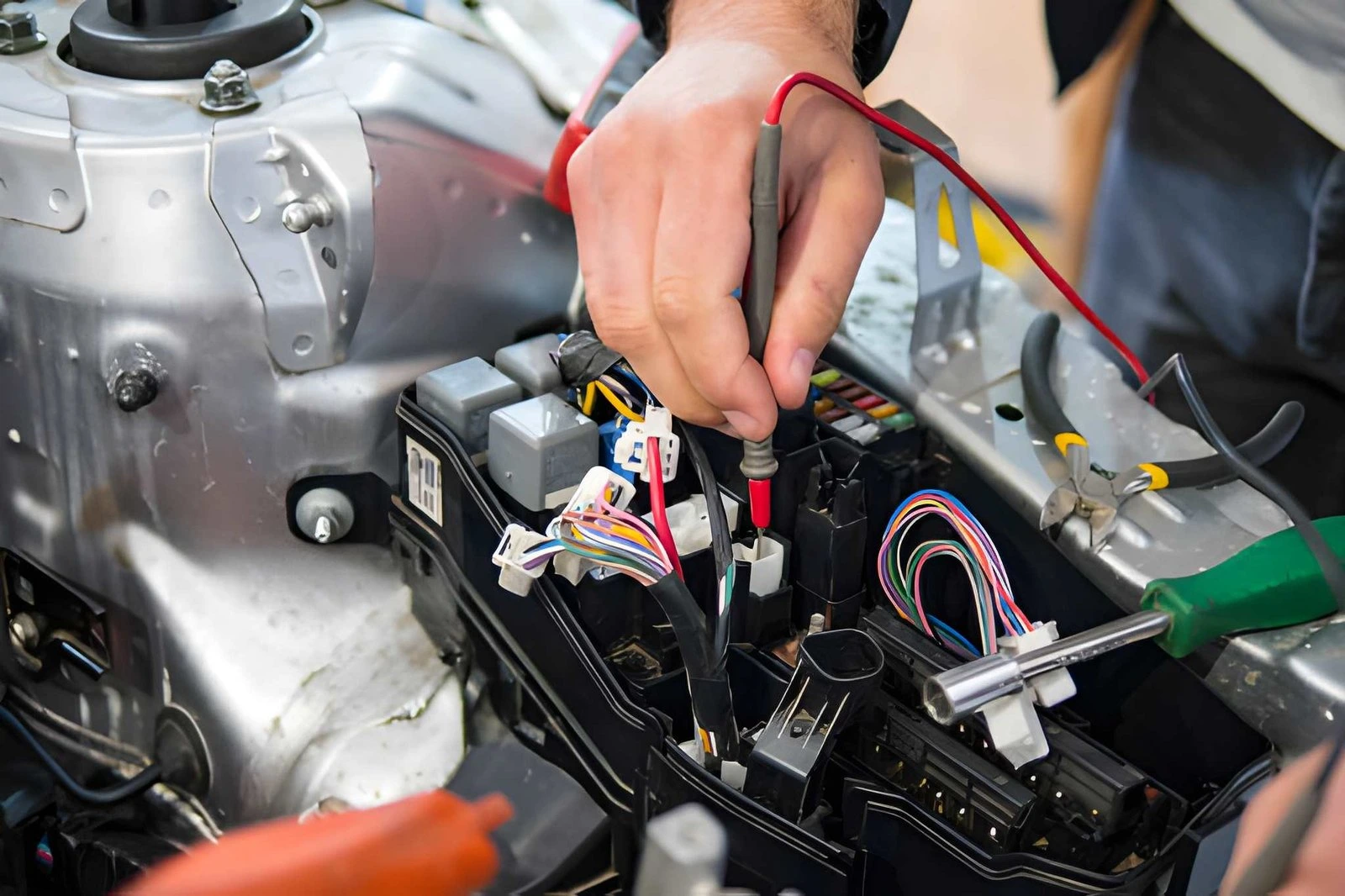
A quality auto electrical services diagnosis for a wiring fault requires time, proper wiring schematics, a good multimeter, and the discipline to trace the circuit rather than guess at components. It can’t be rushed without risk of misdiagnosis.
For situations where the fault leaves you stranded, a qualified mobile car mechanic can reach you on-site and handle many common electrical faults without needing a recovery truck — battery jumps, basic circuit checks, and minor wiring repairs that restore the car to a driveable state.
ECU and Control Unit Faults — When the Brain of the Car Has a Problem
ECU faults are the area of auto electrical services that generates the most unnecessary parts replacement in Dubai’s workshop market. Control units get replaced speculatively — often at significant cost — when the actual fault is somewhere else entirely.
A control unit fault code doesn’t mean the control unit has failed. It means the control unit logged a fault in the system it manages. That fault can be caused by a failed input sensor, a damaged wiring connection to the unit, a power supply issue, a software fault that requires a reflash rather than replacement, or — less commonly — an actual internal failure of the unit itself.
The correct diagnostic sequence for a suspected ECU fault: verify the fault code and its freeze frame data, check the power and ground supply to the control unit, inspect the wiring harness connector for corrosion or damage, check all input sensors for that circuit, and only after ruling out external causes consider whether the unit itself is faulty.
Specific ECU issues that come up regularly in Dubai’s market:
Software faults on high-mileage European vehicles — certain BMW, Mercedes-Benz, and Volkswagen Group models have known software issues that cause drivability symptoms. These are resolved by ECU reflashing or software updates, not hardware replacement. A proper auto electrical services workshop with manufacturer-level or equivalent software access can perform this. A basic workshop can’t.
ECU moisture ingress — less common but it happens. Control units mounted in the engine bay or under the floor can suffer moisture damage from pressure washing, flooding during heavy Dubai rain events, or failed seals. Internal corrosion causes intermittent or permanent faults. Sometimes recoverable with professional cleaning and drying. Sometimes not.
Immobiliser and key programming faults — lost or damaged keys, failed transponders, and immobiliser system faults that prevent engine start. These require manufacturer-level security access to resolve correctly. Not every workshop has this capability — ask specifically before booking.
An Audi A6 came in with a no-start condition after another workshop had already replaced the fuel pump and crankshaft position sensor chasing an intermobiliser fault code. Neither part was faulty. The actual issue was a failed immobiliser antenna ring around the ignition barrel — a AED 220 part. Total unnecessary spend before it reached us: AED 1,650.
For full auto electrical services including ECU diagnostics, a proper garage near me in Al Quoz needs manufacturer-compatible diagnostic software, not just a generic code reader.
Lighting, Sensors, and Ancillary Electrical Systems
Not every auto electrical services job involves a breakdown or a fault code. Some of the most common electrical work in Dubai workshops covers lighting systems, parking sensors, camera systems, and comfort electronics.
LED and xenon headlight faults — ballast failures on xenon systems are common on older European vehicles. LED matrix failures on newer models require careful diagnosis to distinguish between the LED module itself, the control unit, and the wiring supply. Incorrect headlight repair affects both safety and the RTA roadworthiness inspection.
Parking sensor and camera issues — sensor damage from minor impacts is extremely common in Dubai’s parking-heavy urban environment. Replacement sensors need to be matched to the vehicle’s system frequency and coded correctly — fitting a generic sensor that hasn’t been coded results in persistent warning messages and unreliable operation.
Air conditioning electrical faults — the AC system in a Dubai vehicle works harder than in almost any other market. Blend motor failures, evaporator temperature sensor faults, and compressor clutch relay issues all fall under auto electrical services and directly affect daily comfort in a city where the AC is effectively safety equipment from May through September.
For vehicles needing bodywork alongside electrical repairs, car painting and electrical work can be handled at the same visit — no need for separate appointments at different workshops.
When a breakdown happens before you can reach a workshop, proper roadside assistance ensures your car is recovered safely by someone who understands modern vehicle electrical systems and won’t make the fault worse during recovery.
A full car service visit is also the right time to request a complete electrical system health check — battery conductance, alternator output, ground strap condition, and a full control unit scan — catching developing faults before they strand you.
FAQ
Why does my car battery keep dying in Dubai even after replacement?
Usually a charging system fault — weak alternator, missing battery registration coding, or a parasitic drain from a faulty module drawing current with the ignition off.
Can wiring faults cause multiple unrelated warning lights at once?
Yes — a single damaged ground wire or corroded connector can trigger fault codes across several systems simultaneously.
How do I know if my ECU needs replacement or just a software update?
Proper diagnosis eliminates wiring and sensor faults first — many apparent ECU failures are software issues resolved by reflashing, not hardware replacement.
Does battery replacement on European cars require coding?
Yes — BMW, Mercedes-Benz, Volkswagen Group, and Land Rover vehicles require battery registration after replacement to prevent charging system faults and premature battery failure.
How long does a proper auto electrical diagnosis take?
Simple faults like battery and alternator checks take 30–45 minutes. Wiring fault tracing and ECU diagnosis can take 2–4 hours depending on complexity.
Conclusion
Electrical faults don’t fix themselves and they rarely stay contained — a minor battery drain becomes a no-start, an ignored wiring fault triggers cascading control unit errors, an ECU issue gets misdiagnosed and the wrong parts get replaced. Proper auto electrical services in Dubai means real diagnosis with the right equipment, not guesswork dressed up as expertise.
Rapid Rev Garage in Al Quoz handles battery diagnostics and replacement, wiring fault tracing, ECU diagnosis, and full electrical system health checks for all makes. Book your appointment on WhatsApp or find the workshop on Google Maps.