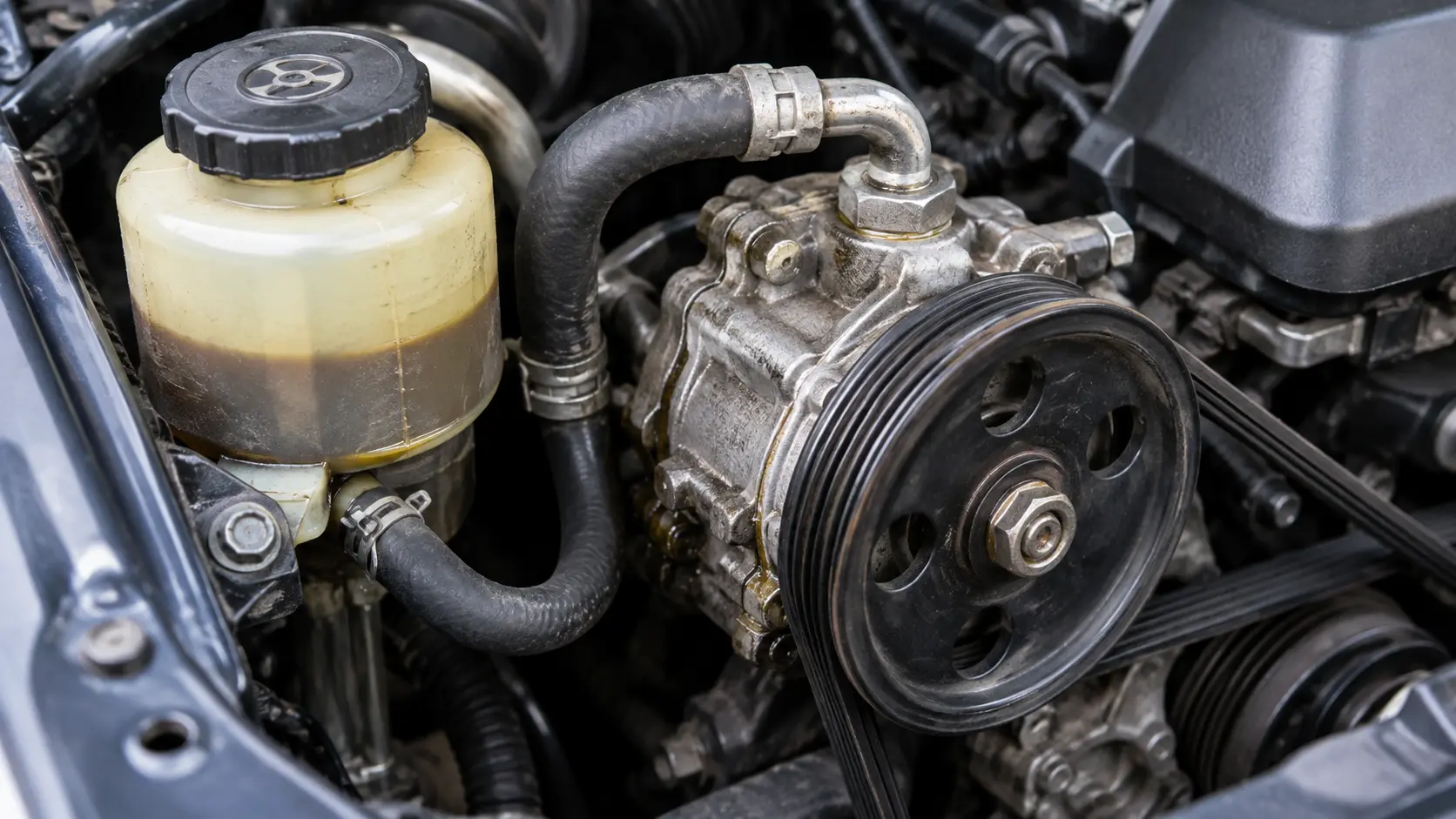
You turn the steering wheel to reverse into a space at a Mirdif villa and a loud whine comes from under the bonnet. The wheel feels heavier than usual, and on cold mornings the car squeals for a minute after starting. There is a reddish drip on the floor of the parking bay. These are common bad power steering pump symptoms, and they point to the pump that gives your steering its assistance.
On cars with hydraulic power steering, a pump driven by the engine belt pushes fluid under pressure to the steering rack or box. That pressure does most of the work when you turn the wheel. When the pump wears, leaks or runs low on fluid, the assistance fades and the pump starts to make noise.
This guide explains how the pump works, the signs it is failing, why Dubai heat and traffic wear it faster, how a workshop tests it and what the repair involves. It also explains which cars have no pump at all, because many newer models use electric steering instead.
Bad Power Steering Pump Symptoms: Quick Answer
The main bad power steering pump symptoms are a whine or groan when turning the wheel, steering that feels stiff or slow to respond, a squeal at start up or on full lock, steering that gets heavy at low speed, reddish brown fluid under the car, foamy or dark fluid in the reservoir and a steering wheel that jerks or kicks back while turning.
YourMechanic lists whining when turning, stiff steering, squealing at start up, groaning and a reddish brown puddle among the main signs. A technician checks the fluid level and condition, looks for leaks, checks the drive belt and measures pump pressure before deciding whether the pump, a hose or the steering rack is at fault.
Table of Contents
- How a Power Steering Pump Works
- Hydraulic, Electric and Electro Hydraulic Steering
- Why Power Steering Pumps Wear Faster in Dubai
- Whining or Groaning When Turning
- Heavy or Stiff Steering at Low Speed
- Squealing at Start Up or on Full Lock
- Steering That Jerks or Feels Uneven
- Red or Brown Fluid Under the Car
- Foamy, Dark or Burnt Smelling Fluid
- Noise and Heavy Steering on Hot Afternoons
- Faults That Look Like a Bad Power Steering Pump
- How a Workshop Tests a Power Steering Pump
- What Power Steering Pump Replacement Involves
- Can a Fluid Change Fix a Noisy Pump?
- Is It Safe to Drive With a Bad Power Steering Pump?
- Does My Car Even Have a Power Steering Pump?
- How Long Do Power Steering Pumps Last?
- Can a Bad Pump Damage the Steering Rack?
- How to Protect the Power Steering Pump
- FAQ
- Conclusion
How a Power Steering Pump Works
A hydraulic power steering system has four main parts: the pump, a fluid reservoir, high and low pressure hoses and the steering rack or steering box.
The pump is usually mounted on the front of the engine and driven by the accessory belt. Inside, a set of vanes spins in a housing and pushes fluid out under pressure. A relief valve inside the pump limits the maximum pressure.
When you turn the steering wheel, a valve in the rack sends that pressure to one side of a piston. The pressure pushes the rack in the direction you are turning, so you only need light effort at the wheel. When you drive straight, the fluid circulates at low pressure back to the reservoir.
Hydraulic, Electric and Electro Hydraulic Steering
Not every car has a power steering pump. Many newer cars use electric power steering, often called EPS. An electric motor on the steering column or rack gives the assistance, and there is no fluid or pump at all. Many recent saloons and small SUVs sold in the UAE use EPS.
Many larger SUVs and pickups still use hydraulic steering with a belt driven pump. Older Toyota Land Cruiser and Nissan Patrol models, for example, use hydraulic systems.
A few cars use electro hydraulic steering. These have a hydraulic rack, but the pump is driven by an electric motor rather than the engine belt.
The difference matters. If your car has EPS, steering problems come from the motor, sensors or wiring, not a pump. The last part of this guide explains how to check which type your car has.
Why Power Steering Pumps Wear Faster in Dubai
Heat is the biggest factor. Power steering fluid gets hot as it passes through the pump under pressure. On summer afternoons when the air passes 45°C, the engine bay runs very hot, and the fluid thins and breaks down faster. Thin, old fluid lubricates the pump vanes less well.
Parking manoeuvres load the pump hardest. Full lock turns in tight car parks in Downtown Dubai, Business Bay and Dubai Marina push the pump close to its maximum pressure. Holding the wheel at full lock makes the pump run against its relief valve, which creates more heat.
Leaks lead to low fluid. Heat hardens the rubber hoses and seals over time. A small leak lowers the fluid level, and the pump starts drawing air, which makes it noisy and wears it quickly.
Large tyres add load. Big SUVs common in Dubai, especially with wide aftermarket tyres, need more force to turn at low speed. That adds work for the pump.
Whining or Groaning When Turning
A whine when turning is the most common sign. YourMechanic notes that a whining noise while turning indicates something wrong with the power steering system, often a leak or low fluid.
The whine usually rises as you turn the wheel and is loudest at full lock. It often comes from the front of the engine, where the pump sits. YourMechanic also notes that groaning noises get worse as the pump continues to fail.
A whine can also come from the alternator or another belt driven part. If the noise changes when you turn the wheel, the pump is the likely source.
Heavy or Stiff Steering at Low Speed
YourMechanic lists steering that is slow to respond or stiff as a sign of a failing pump, especially with a whine. The car feels fine on the highway but takes much more effort to turn when parking.
Low speed is when the pump has the least speed and the steering needs the most force. A worn pump cannot build enough pressure at idle, so the steering feels heavy.
Some drivers notice the steering gets lighter when they rev the engine slightly while turning. That points strongly to a weak pump or low fluid.
Squealing at Start Up or on Full Lock
YourMechanic notes that a squeal is usually heard for about a minute after start up, and may also happen during sharp turns. It often comes from the drive belt slipping on the pump pulley.
A failing pump can be harder to turn, which makes the belt slip. A worn or glazed belt, or a weak belt tensioner, causes the same squeal.
On full lock, the pump works hardest and the belt load rises. A squeal at full lock that stops when you ease the wheel back slightly is a classic belt or pump sign.
Steering That Jerks or Feels Uneven
When the pump draws air or loses pressure in bursts, the steering assistance comes and goes. The wheel may feel light one moment and heavy the next, or jerk slightly as you turn.
Some drivers describe the steering as notchy or as if it is catching. It often gets worse when the fluid is low or foamy.
Uneven steering can also come from a worn steering rack or a sticking strut bearing. The guide on bad steering rack symptoms covers those faults.
Red or Brown Fluid Under the Car
YourMechanic lists a reddish brown puddle under the car as a sign of pump trouble. It notes that hoses, lines and the steering gear can also leak, so the source must be found.
Power steering fluid is often red, pink or amber when new and darker brown when old. Some cars use a green or clear fluid. The drip usually appears under the front of the engine bay.
Check the reservoir level with the engine off. A dropping level confirms a leak. YourMechanic links a crack in the pump housing or reservoir to this kind of puddle.
Foamy, Dark or Burnt Smelling Fluid
Healthy power steering fluid is clear and free of bubbles. Foam or bubbles mean air is getting in, usually from low fluid or a leak on the suction side of the pump.
Dark fluid with a burnt smell means the fluid has overheated. That often happens in hot weather, with heavy parking use, or when a failing pump or rack creates extra friction.
Fine metal particles in the fluid point to internal wear in the pump or rack. A technician checks the reservoir and filter screen for debris.
Noise and Heavy Steering on Hot Afternoons
Many drivers notice the whine and heavy steering are worse in the afternoon after a long drive. Hot fluid is thinner, so a worn pump leaks more pressure internally.
In Dubai, a car parked in an open lot in summer and then driven in slow traffic can push the fluid temperature high. The pump may sound fine in the morning and noisy by the evening.
Tell the workshop when the noise happens. A test done when the fluid is fully hot is more likely to show the fault.
Faults That Look Like a Bad Power Steering Pump
Several faults cause noise or heavy steering:
- Low fluid from a leak. A leaking hose, rack seal or reservoir lowers the level and makes the pump whine.
- Slipping or worn drive belt. This causes squeals and weak assistance.
- Blocked reservoir filter. Some reservoirs have a filter that clogs and starves the pump.
- Worn steering rack. Internal leaks in the rack cause heavy steering even with a good pump.
- Seized strut bearings or ball joints. These make steering heavy at low speed.
- Low tyre pressure. Soft front tyres make steering much heavier.
Checking the fluid level, belt and tyre pressures first rules out the simple causes.
How a Workshop Tests a Power Steering Pump
A trained car mechanic near you starts with a listening test, turning the wheel from lock to lock with the engine running and noting where the noise comes from.
Next, the fluid level and condition are checked. The technician looks for foam, dark colour, a burnt smell and metal particles. The hoses, pump body, reservoir and rack are checked for leaks.
The drive belt is inspected for cracks, glazing and correct tension. The belt tensioner is checked for wear.
The most reliable test is a pressure test. A gauge with a shut off valve is fitted between the pump and the high pressure hose. The technician measures the maximum pressure the pump can make and compares it with the maker’s figure.
A low reading points to a worn pump. A good pump reading with heavy steering points to the rack.
What Power Steering Pump Replacement Involves
The technician drains or siphons the old fluid, removes the drive belt and disconnects the high pressure and return hoses. The pump is unbolted and removed, and the pulley is moved to the new pump if needed.
The new pump is fitted with new seals or O rings, and the hoses are reconnected. The belt is refitted and tensioned correctly.
The system is then filled with the exact fluid the maker specifies. Some cars need ATF, some need a specific power steering fluid, and some need a low viscosity synthetic fluid. Using the wrong fluid can damage seals.
Air must be bled from the system. The technician turns the wheel slowly from lock to lock with the engine off and then running, topping up the fluid until no more bubbles appear. Some cars use a vacuum bleeding tool. The steering is then road tested for noise and feel.
If the old pump shed metal, the system may need a flush so the debris does not damage the new pump or the rack.
Can a Fluid Change Fix a Noisy Pump?
Sometimes. If the noise comes from old, thin or aerated fluid, a fluid change and a proper bleed can quieten the pump and improve the feel.
A fluid change will not fix worn vanes, a damaged bearing or a cracked housing. If the noise returns soon after fresh fluid, the pump needs replacing.
Many service books do not list a power steering fluid change, but in Dubai heat the fluid ages faster. Regular car maintenance that includes a fluid check catches dark or low fluid early.
Is It Safe to Drive With a Bad Power Steering Pump?
A noisy pump with normal steering effort can usually be driven to a workshop. The risk grows as the pump fails, because the steering can become very heavy without warning.
If the pump fails completely, the car can still be steered, but it needs much more effort, especially at low speed. That is dangerous in an emergency move or in tight traffic. A pump that seizes can also break the drive belt. On many cars, that same belt drives the alternator and water pump, so the battery can go flat and the engine can overheat.
If the steering suddenly becomes very heavy or the battery and temperature warnings come on together, stop as soon as it is safe. On a highway, turn on your hazard lights and move to the hard shoulder. Stopping in a live lane because of a breakdown brings a AED 1,000 fine and six black points under Article 98 of the UAE Federal Traffic Law. Once safe, call roadside assistance.
A car with a broken belt or seized pump should travel on a flatbed tow truck if the engine cannot run safely. If the car is at home and only whines, a mobile mechanic can check the fluid and belt before you drive it.
Does My Car Even Have a Power Steering Pump?
Open the bonnet and look for a small reservoir with a cap marked with a steering wheel symbol or the words power steering. If you find one, your car almost certainly has hydraulic steering with a pump.
If there is no reservoir and no pump on the engine, your car probably has electric power steering. On EPS cars, heavy steering usually comes with a warning light on the dashboard, often a steering wheel symbol with an exclamation mark.
EPS faults come from the motor, torque sensor, wiring or control unit. A trained auto electrical repair technician can read the steering codes with a scan tool. A weak battery or charging fault can also make EPS assistance drop.
How Long Do Power Steering Pumps Last?
There is no fixed life. Many pumps last over 150,000 km, while others fail much sooner. Heat, low fluid, old fluid and heavy parking use all shorten their life.
A pump that has run low on fluid for weeks usually wears quickly, because it has been drawing air. Fixing small leaks early is the best way to protect it.
Can a Bad Pump Damage the Steering Rack?
Yes. A failing pump can shed metal particles into the fluid. Those particles travel to the rack, where they wear the seals and the control valve.
Overheated fluid from a struggling pump also hardens the rack seals, which leads to leaks.
When a pump fails with metal in the fluid, a technician will often flush the system and check the rack for leaks at the same visit.
How to Protect the Power Steering Pump
Check the power steering fluid level every month on cars with hydraulic steering. Top up only with the fluid type in your owner’s manual.
Avoid holding the steering wheel at full lock for more than a few seconds. Back it off slightly once the wheel reaches its stop, which takes the pump off its relief valve.
Let the car roll slightly when turning the wheel in car parks, rather than turning it while completely stopped.
Keep the front tyres at the correct pressure. Soft tyres make the pump work harder.
If fluid has leaked onto the bumper or wheel arch from a hose and marked the paint, the stain can be treated through paint and panel repair once the leak is fixed.
A regular car service in Dubai should include a check of the fluid, hoses and drive belt. If you hear a whine when turning, take the car to a car garage near you that pressure tests the pump before replacing parts.
FAQ
Here are the questions Dubai drivers most often ask about power steering pumps.
What does a bad steering pump sound like?
It usually whines or groans when you turn the wheel, loudest at full lock. YourMechanic notes a squeal for about a minute after start up can also point to the pump or its belt.
Why is my steering heavy at low speed?
The usual causes are a worn pump that cannot build pressure at idle, low fluid from a leak or a slipping belt. On cars with electric steering, a motor, sensor or battery fault is more likely.
How do mechanics test a power steering pump?
They check the fluid level and condition, look for leaks, inspect the belt and fit a pressure gauge to measure the maximum pressure the pump makes against the maker's figure.
Can low power steering fluid damage the pump?
Yes. Low fluid makes the pump draw air, which causes whining and wears the vanes quickly. Fixing leaks and topping up with the correct fluid protects the pump.
Does every car have a power steering pump?
No. Many newer cars use electric power steering with a motor instead of a pump. If there is no power steering reservoir under the bonnet, your car probably has electric steering.
Conclusion
A bad power steering pump shows up as a whine or groan when turning, heavy steering at low speed, a squeal at start up, uneven steering feel, red or brown fluid under the car and foamy or dark fluid. Heat, parking manoeuvres, leaks and large tyres wear pumps faster in Dubai. A fluid check, a belt check and a pressure test confirm whether the pump, a hose or the rack is at fault.
Rapid Rev Garage is a full workshop open 24 hours at Al Khail Gate, 12th Street, Al Quoz Industrial Area 2, serving passenger cars across Al Quoz, Business Bay, Jumeirah, Al Barsha, Satwa, Downtown and the Sheikh Zayed Road corridor. Visit https://rapidrevgarage.com, send your car model and a short video of the steering noise on WhatsApp, or get directions on Google Maps.
Rapid Rev Garage | Bad Power Steering Pump Symptoms | Al Quoz, Dubai