You drive along Al Wasl Road and the steering has a small dead spot in the middle, where turning the wheel does nothing for a moment. Turning into a parking space at Dubai Hills Mall, the steering feels heavier one way than the other, and there is a knock from under the front of the car. The mechanic who changed your oil mentioned a wet patch near the front wheels. These are typical bad steering rack symptoms, and they come from the part that turns your wheels.
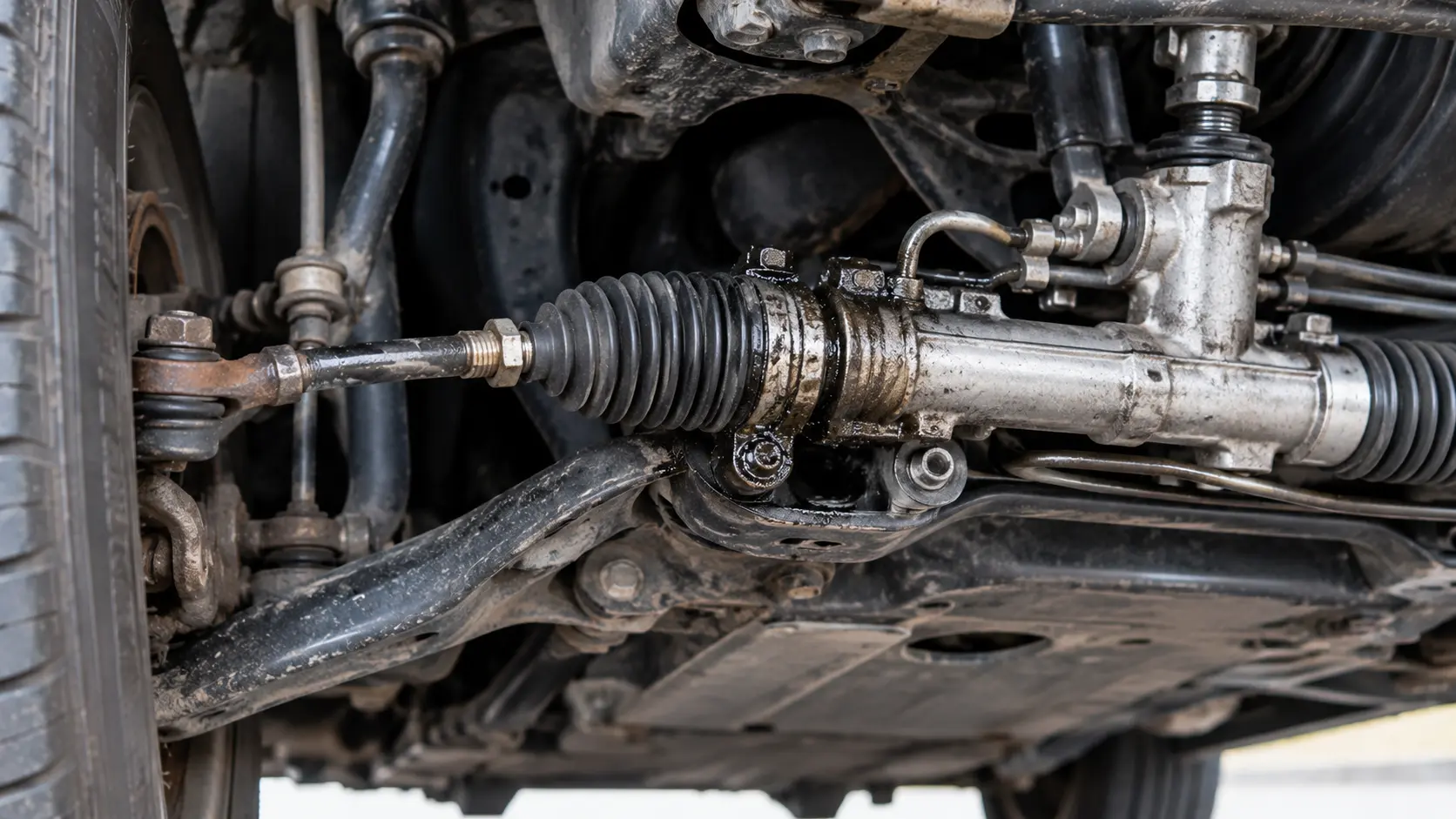
Most cars sold in the UAE use rack and pinion steering. When you turn the wheel, a small gear called the pinion moves a long toothed bar called the rack from side to side.
Tie rods at each end of the rack push and pull the front wheels. On hydraulic systems, pressurised fluid helps move the rack. On electric systems, a motor does the job.
This guide explains how the rack works, the signs it is failing, why Dubai conditions wear racks faster, how a workshop tests one and what the repair options are. It also covers the cheaper faults that feel like a bad rack.
Bad Steering Rack Symptoms: Quick Answer
The main bad steering rack symptoms are power steering fluid leaking near the front wheels, loose steering with free play or a dead spot in the centre, a knock or clunk through the wheel when turning, steering that is heavier in one direction, grinding or whining when turning, a wheel that does not return to centre and uneven tyre wear.
Breakerlink lists fluid leaks, a burning oil smell, noises when turning, dead spots and a wheel that will not return to centre among the signs. A technician checks the rack boots and seals for leaks, tests for play in the rack and its mounts, checks pump pressure on hydraulic systems and reads codes on electric racks.
Table of Contents
- How a Steering Rack Works
- Hydraulic and Electric Steering Racks
- Why Steering Racks Wear Faster in Dubai
- Power Steering Fluid Leaking Near the Wheels
- Loose Steering, Free Play and Dead Spots
- Knocking or Clunking When Turning
- Steering Heavier in One Direction
- Grinding, Creaking or Whining When Turning
- Steering Wheel Not Returning to Centre
- Burning Smell and Dirty Fluid
- Pulling and Uneven Tyre Wear
- Electric Steering Warning Lights
- Faults That Feel Like a Bad Steering Rack
- How a Workshop Tests a Steering Rack
- Repair, Reseal or Replace the Steering Rack?
- Is It Safe to Drive With a Bad Steering Rack?
- Will a Leaking Rack Fail the Vehicle Inspection?
- How Long Does a Steering Rack Last?
- Can a Kerb Strike Damage the Steering Rack?
- How to Protect the Steering Rack
- FAQ
- Conclusion
How a Steering Rack Works
The steering rack sits across the front of the car, usually bolted to the subframe behind the engine. The steering column connects the steering wheel to the pinion gear at one end of the rack.
When you turn the wheel, the pinion rotates and its teeth push the rack left or right. Inner tie rods screw onto each end of the rack, and outer tie rod ends connect to the steering arms on the wheels. Rubber bellows boots cover each end of the rack to keep dirt and water out.
The rack is held in place by rubber mounting bushes. A spring loaded yoke inside the rack presses the rack against the pinion to keep the gears in firm contact.
Hydraulic and Electric Steering Racks
On a hydraulic rack, the pinion housing contains a rotary valve. When you turn the wheel, the valve sends fluid from the power steering pump to one side of a piston inside the rack. That pressure pushes the rack and does most of the work. Seals on each side of the piston keep the pressure in.
Many larger SUVs and older models in the UAE, such as older Toyota Land Cruiser and Nissan Patrol models, use hydraulic steering. Some large SUVs use a steering box instead of a rack.
Many newer saloons and small SUVs use electric power steering. On some, the motor sits on the steering column. On others, it sits on the rack itself, driving it through a belt and ball screw. Electric racks have no fluid, so they cannot leak, but they can suffer from motor, sensor and internal wear faults.
Knowing which type your car has helps narrow down the symptoms. The guide on bad power steering pump symptoms explains how to check.
Why Steering Racks Wear Faster in Dubai
Heat ages seals and boots. The rack sits low behind the engine, close to the exhaust on many cars. On summer afternoons when the air passes 45°C, the rubber seals inside hydraulic racks and the boots outside harden and crack. Breakerlink lists low, old or contaminated fluid among the causes of wear, and hot fluid breaks down faster.
Parking loads are high. Full lock turns in tight basements across Downtown Dubai, Business Bay and Dubai Marina push the rack to the end of its travel many times a day. Turning the wheel while the car is stopped puts the most force through the rack teeth and mounts.
Kerbs and speed bumps cause sudden damage. Breakerlink notes that hitting a kerb or pothole can bend or break the rack or damage its gear teeth. A hard kerb strike while parking can bend a tie rod or push the rack off centre.
Sand gets in through torn boots. Fine desert dust and sand from building sites mix with grease on the rack bar once a boot splits. That grit wears the rack seals and the inner tie rod joints.
Power Steering Fluid Leaking Near the Wheels
A leak is the clearest sign of a failing hydraulic rack. Breakerlink suggests looking for red or pink fluid under the car, especially near the front wheels, and notes that slow leaks may only show when you check the fluid level.
Leaks often show inside the rack boots first. When the inner piston seals fail, fluid collects in the boots, which may swell or look wet. Leaks at the pinion end, near the steering column, often show as oily dirt around the valve housing.
A falling level in the power steering reservoir with no visible hose leak often points to the rack. Topping up keeps the pump alive, but it does not fix the seals.
Loose Steering, Free Play and Dead Spots
Breakerlink lists a steering wheel that feels loose or has dead spots among the signs of a faulty rack. A dead spot is a small zone, usually around the straight ahead position, where turning the wheel does nothing.
Free play happens when the rack and pinion teeth wear, the support yoke wears or the rack mounting bushes break down. On the highway, it feels like the car needs constant small corrections to hold its lane.
Loose steering also comes from worn tie rod ends, which are much cheaper to fix. The guide on bad tie rod ends symptoms explains how to tell them apart.
Knocking or Clunking When Turning
A knock through the steering wheel when turning at low speed, or when driving over rough roads, can point to a worn rack. The rack moves slightly in its housing or mounts before the wheels respond, and the movement makes a dull clunk.
Worn rack mounting bushes let the whole rack shift sideways when you turn. That often shows as a clunk when you change direction, such as during a three point turn.
A worn inner tie rod also knocks, and it is often replaced along with rack repairs, since it sits under the same boot.
Steering Heavier in One Direction
On a hydraulic rack, a worn seal on one side of the piston lets pressure leak past. The steering then feels heavy when turning that way and normal the other way.
Breakerlink notes that the steering may feel heavy or stuck. Heavy steering in both directions often points to the pump, a slipping belt or low fluid. Heavy steering in one direction more often points to the rack or its control valve.
On electric racks, uneven assistance can come from a faulty torque sensor or motor. Those faults often set a warning light.
Grinding, Creaking or Whining When Turning
Breakerlink lists grinding, creaking or whining when turning, especially at low speeds or at idle, among the signs. Grinding often comes from worn rack teeth or grit inside the rack. Whining usually points to the pump struggling against low fluid or an internal rack leak.
Creaking can come from dry rack bushes or from other parts such as strut bearings. The guide on bad strut mount symptoms covers that noise.
A noise that changes as you turn the wheel, with the car stationary or rolling slowly, helps a technician narrow down where it comes from.
Steering Wheel Not Returning to Centre
After a turn, the steering wheel should drift back toward centre on its own as you drive straight. Breakerlink lists a wheel that fails to return to centre as a sign of rack trouble.
A tight or binding rack resists that self centring force. Internal corrosion, a sticking control valve or a damaged rack bar can all cause it.
Steering that does not return can also come from seized strut bearings, binding ball joints or wrong alignment angles, so these are checked too.
Burning Smell and Dirty Fluid
Breakerlink notes that a burning oil smell can point to overheating power steering fluid caused by extra friction. A struggling rack forces the pump to work harder, which heats the fluid.
Breakerlink also lists dirty fluid as a sign. Dark fluid, fluid with particles or a dirty looking reservoir means the fluid has broken down or picked up wear debris from the rack or pump.
Leaking fluid can also drip onto the hot exhaust and smell of burning. Any burning smell from under the bonnet should be checked quickly.
Pulling and Uneven Tyre Wear
Breakerlink notes that a failing rack can cause pulling to one side and uneven tyre wear, because the car may sit at slightly different angles. A worn rack lets the wheels change direction under load, which scrubs the tyres.
Pulling on its own is more often an alignment or tyre pressure issue. It becomes more important when it comes with other steering symptoms such as leaks, play or noise.
An alignment check helps here. Brand specialists such as Kia wheel alignment services check for steering play before adjusting the angles, because setting alignment on a worn rack wastes money.
Electric Steering Warning Lights
On cars with an electric rack, faults often turn on a steering warning light, usually a steering wheel symbol with an exclamation mark. The steering may become very heavy as the system switches to a fail safe mode.
Common causes include a faulty torque sensor, a failing motor, worn internal gears or wiring problems. A weak battery or charging fault can also reduce assistance.
A scan tool that reads the steering module shows the fault code and live data, such as torque sensor readings and motor current.
Faults That Feel Like a Bad Steering Rack
Several faults cause similar symptoms:
- Worn tie rod ends. These cause loose steering and knocks, and are cheaper to replace.
- Failing power steering pump. This causes whining and heavy steering in both directions.
- Leaking hoses. A leaking pressure or return hose looks like a rack leak.
- Worn steering column joints. These cause play and knocks in the steering wheel.
- Seized strut bearings. These make steering heavy and stop it returning to centre.
- Low tyre pressure or poor alignment. These cause heavy steering and pulling.
Breakerlink notes that pulling is more meaningful when combined with other steering symptoms, since alignment or tyre pressure can also cause it.
How a Workshop Tests a Steering Rack
A trained car mechanic near you starts with a road test, checking for dead spots, play, noise, pulling and how well the wheel returns to centre.
On a lift, the technician inspects the rack boots and pinion housing for leaks. A boot full of fluid points to failed inner seals. The rack mounting bushes are checked for cracks.
With the wheels on the ground and the engine off, a helper rocks the steering wheel while the technician watches the rack, the tie rods and the column joints. Movement at the rack mounts or between the pinion and rack shows wear.
On hydraulic systems, the pump pressure is measured with a gauge. A good pump reading with heavy steering points to an internal rack leak. On electric racks, the technician reads the steering codes and checks the battery and charging voltage.
Repair, Reseal or Replace the Steering Rack?
There are three main options once a rack fault is confirmed.
Replace the tie rods and boots. If the rack itself is sound and only the inner tie rods or boots are worn, replacing those can fix loose steering and stop sand getting in.
Reseal or recondition the rack. On many hydraulic racks, a specialist can strip the rack, replace the seals and bushes and check the rack bar for damage. This often costs less than a new rack if the bar and pinion are not pitted or worn.
Replace the rack. A new or remanufactured rack is fitted when the teeth are worn, the bar is pitted or bent, or the rack is electric and cannot be repaired locally.
After any rack work, the system is refilled and bled on hydraulic cars, the steering angle sensor may need calibration and a wheel alignment is always needed. Breakerlink recommends checking alignment regularly, especially after suspension work.
Is It Safe to Drive With a Bad Steering Rack?
A slow leak or slight play is not usually an emergency, but it should be fixed soon. The risk grows as the rack wears, because steering problems can get worse without warning.
A rack that loses fluid quickly can leave the pump running dry, and the steering can become very heavy. An electric rack that switches to fail safe mode also becomes heavy. Either is dangerous in an emergency move.
If the steering suddenly becomes very heavy, very loose or jams, stop as soon as it is safe. On a highway, turn on your hazard lights and move to the hard shoulder. Stopping in a live lane because of a breakdown brings a AED 1,000 fine and six black points under Article 98 of the UAE Federal Traffic Law. Once safe, call roadside assistance.
A car with steering that does not work properly should travel on a flatbed tow truck. If the car is at home and you only see a small leak, a mobile mechanic can check the fluid level and boots before you drive it.
Will a Leaking Rack Fail the Vehicle Inspection?
A leaking rack, excess steering play or a torn boot can lead to a failed roadworthiness test. Testing centres check steering for free play, leaks and damaged joints.
Gulf News reported that almost 25 per cent of vehicles in Dubai failed the annual roadworthiness test in one year, with steering among the key test areas.
A vehicle inspection before your registration renewal, or before buying a used car, includes a steering check so you can fix problems before the official test.
How Long Does a Steering Rack Last?
Breakerlink gives a typical steering rack life of around 80,000 miles, about 130,000 km, and notes that it varies by vehicle type and driving habits.
In Dubai, heat, full lock parking and kerb strikes can shorten that figure. Cars that are serviced regularly, with healthy boots and clean fluid, often last longer.
Torn boots are the most common early warning. Replacing a split boot quickly can add years to the rack.
Can a Kerb Strike Damage the Steering Rack?
Yes. Breakerlink notes that hitting a kerb or pothole can bend or break the rack or damage its gear teeth. A hard strike can also bend a tie rod and push the steering off centre.
After a hard kerb strike, check whether the steering wheel is still straight when driving straight, and whether the car pulls or the steering feels different. Any change should be checked within a few days.
If the strike also scuffed an alloy wheel or bumper corner, that damage can be handled through paint and panel repair after the steering is checked.
How to Protect the Steering Rack
Avoid holding the steering wheel at full lock for more than a few seconds. Back it off slightly once it reaches the end.
Let the car roll slightly when turning the wheel in car parks, rather than turning it while the car is completely stopped.
Check the power steering fluid on hydraulic cars every month, and use only the fluid type in your owner’s manual. Breakerlink recommends having the fluid flushed and replaced according to the maker’s schedule.
Ask for the rack boots to be checked at every service. A split boot is cheap to replace compared with a damaged rack.
A regular car service in Dubai should include a steering check on the lift. If you notice play, leaks or heavy steering, take the car to a car garage near you that tests the pump, tie rods and rack before replacing the whole steering system.
FAQ
Here are the questions Dubai drivers most often ask about steering racks.
What are signs of a bad steering rack?
The main signs are fluid leaks near the front wheels, loose steering with dead spots, a knock when turning, heavier steering in one direction, grinding or whining and a wheel that does not return to centre
Can a steering rack leak be repaired?
Often, yes. Many hydraulic racks can be resealed by a specialist if the rack bar and pinion are not worn or pitted. A badly worn or damaged rack needs replacing.
How do mechanics test a steering rack?
They inspect the boots and pinion for leaks, watch for play while someone rocks the wheel, check the rack mounts and measure pump pressure. On electric racks, they read the steering codes.
Is a bad steering rack safe?
A slow leak or slight play is not an emergency, but it should be fixed soon. Stop driving if the steering becomes very heavy, very loose or starts to jam.
Does a new steering rack need alignment?
Yes. Replacing or removing the rack changes the toe angle of the front wheels. An alignment straight after the repair keeps the car straight and protects the tyres.
Conclusion
A bad steering rack shows up as fluid leaks near the front wheels, loose steering with dead spots, a knock when turning, steering that is heavier one way, grinding or whining, a wheel that does not return to centre and uneven tyre wear. Heat, full lock parking, kerb strikes and sand wear racks faster in Dubai. A leak check, a play test and a pump pressure test or code scan confirm the fault before the rack is resealed or replaced.
Rapid Rev Garage is a full workshop open 24 hours at Al Khail Gate, 12th Street, Al Quoz Industrial Area 2, serving passenger cars across Al Quoz, Business Bay, Jumeirah, Al Barsha, Satwa, Downtown and the Sheikh Zayed Road corridor. Visit https://rapidrevgarage.com, send your car model and a description of the steering feel on WhatsApp, or get directions on Google Maps.
Rapid Rev Garage | Bad Steering Rack Symptoms | Al Quoz, Dubai