A car that lives in Dubai gets a harder life than most. It sits in open car parks in Al Barsha or Business Bay through the summer, gets coated in fine sand after every windy day and goes through quick wash bays that drag that sand across the paint. Within a couple of years, the paint looks dull, the dashboard feels dry and the black trim has turned grey. The benefits of professional car detailing come from undoing that damage safely and protecting the car against the next round.
Detailing is not the same as a car wash. A wash removes surface dirt. Detailing cleans, corrects and protects each surface with the right products and methods: safe washing that does not scratch, decontamination, paint polishing to remove swirls, a protective layer such as wax, sealant or ceramic coating, and a deep clean and treatment of the interior.
This guide explains how heat, UV and sand damage a car in Dubai, what each detailing step does to protect it, what the protection options last and cost according to named market sources, and how detailing helps when you come to sell. It also explains what detailing cannot fix, so you know when a car needs bodywork instead.
Benefits of Professional Car Detailing: Quick Answer
The main benefits of professional car detailing in Dubai are safe removal of sand and dirt without scratching, removal of swirl marks and light oxidation, a protective layer against UV and heat, cleaner and fresher cabin air, protection for leather, plastics and dashboards, easier cleaning between visits and a car that looks better and sells more easily.
ArabWheels notes that extreme heat breaks down the clear coat and fine sand scratches paint. It lists car wax at about AED 100 to 300 lasting 1 to 3 months, and ceramic coating at about AED 1,500 to 5,000 lasting 2 to 5 years. Gulf News reports research showing an unshaded car’s cabin air can reach 70°C with dashboards near 100°C.
Table of Contents
- What Professional Detailing Includes
- How Dubai Heat Damages Paint
- How Sand and Dust Scratch Paint
- Safe Washing That Removes Sand Without Scratching
- Decontamination That Cleans Deeper Than a Wash
- Paint Correction That Removes Swirls and Dullness
- Wax, Sealant and Ceramic Coating Protection
- How UV and Heat Damage the Interior
- Interior Detailing That Protects the Cabin
- Cleaner AC Air and Fewer Smells
- Glass, Trim and Wheel Protection
- Engine Bay Cleaning and Early Fault Spotting
- How Detailing Helps Resale Value
- Paint Protection Film and Stone Chips on Highways
- How to Choose the Right Detailing Package
- How Long Does a Full Detail Take?
- What Detailing Cannot Fix
- How Often to Detail a Car in Dubai
- Can a Car Sitting Unused Need More Than Detailing?
- Keeping the Car Clean Between Detailing Visits
- FAQ
- Conclusion
What Professional Detailing Includes
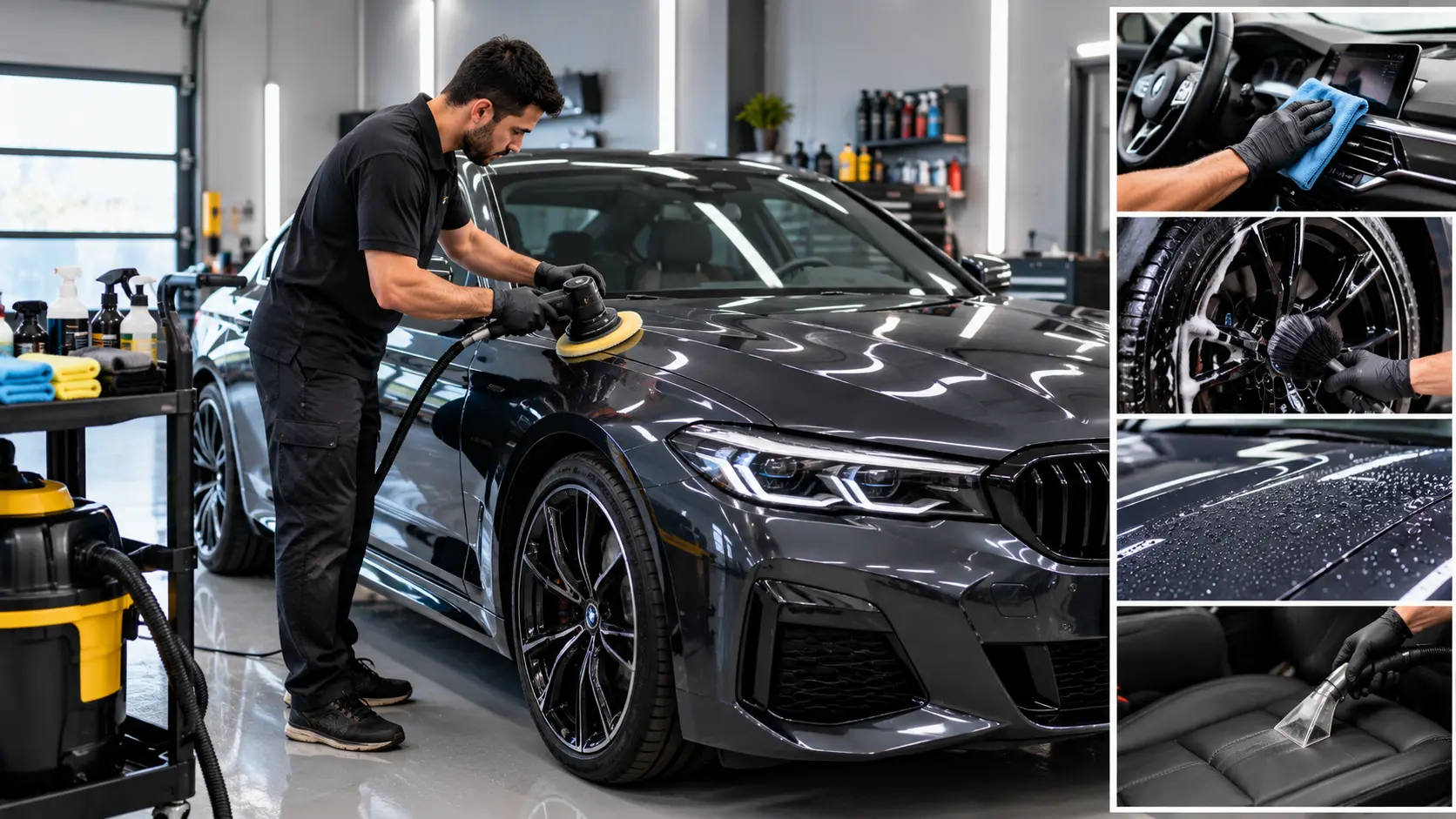
A full detail usually covers the exterior, the interior and often the engine bay. Exterior work includes a safe pre wash and hand wash, chemical and clay decontamination, drying, paint polishing, and a protective layer on the paint, glass, trim and wheels.
Interior work includes vacuuming, cleaning and conditioning leather, cleaning fabric seats and carpets, cleaning plastics and the dashboard, cleaning the glass inside, treating vents and removing smells.
Packages vary a lot. A basic detail might be a careful wash and interior clean. A full detail with paint correction and ceramic coating can take one to three days. A professional car detailing service should list exactly what each package includes.
How Dubai Heat Damages Paint
Car paint has a colour layer protected by a clear coat on top. The clear coat takes the brunt of the weather. ArabWheels notes that temperatures above 45°C can break down the clear coat and dull paint quickly.
UV light adds to the damage. ArabWheels explains that UV exposure and fine dust cause paint oxidation, which can make a car look older than it is. Oxidised paint looks flat and chalky, especially on red, black and dark blue cars.
Heat also affects protection. ArabWheels notes that wax melts or evaporates faster in high heat, leaving paint exposed. That is why protection that lasts in cooler countries may not last as long in Dubai.
How Sand and Dust Scratch Paint
ArabWheels describes fine sand as micro abrasives that scratch paint during washing and while driving. The damage is often fine circular scratches called swirl marks, which show up clearly in direct sun.
Most swirls are not caused by driving but by washing. Wiping a dusty car with a dry cloth, using a dirty sponge or going through brush wash bays drags sand across the clear coat. Each wash adds a few more scratches.
Dusty cars also tempt people to write in the dust or wipe it off with a hand. Those marks become visible scratches over time.
Safe Washing That Removes Sand Without Scratching
Professional detailing starts with removing as much sand as possible before anything touches the paint. A pre wash foam softens and lifts dirt, then a rinse washes most of it away.
The hand wash follows, often with two buckets, one for clean soapy water and one for rinsing the wash mitt, so sand is not dragged back onto the paint. Clean microfibre mitts and drying towels are used instead of sponges and chamois.
Wheels and tyres are cleaned with separate tools so brake dust does not reach the paint. This careful method is one of the biggest differences between detailing and a quick wash.
Decontamination That Cleans Deeper Than a Wash
Washing removes loose dirt but leaves bonded contamination. Tiny iron particles from brake dust, tar, tree sap and industrial fallout stick to the paint and make it feel rough.
Detailers use iron remover sprays that react with metal particles, tar removers and a clay bar or clay mitt. The clay glides over lubricated paint and pulls bonded particles out.
After decontamination, the paint feels smooth. That smooth surface is needed before polishing or applying protection, because a coating bonds poorly to dirty paint.
Paint Correction That Removes Swirls and Dullness
Paint correction uses a machine polisher and abrasive polish to remove a very thin layer of clear coat, levelling out swirl marks, light scratches and oxidation.
A single stage polish improves gloss and removes light swirls. A two stage or multi stage correction removes deeper marks for a near new finish. Detailers often measure paint thickness first with a gauge, so they know how much clear coat can be safely removed.
CarSwitch notes that removing minor smudges and scratches and getting a car polished can improve resale value in Dubai. Polishing cannot remove scratches that go through the clear coat. Those need paint and panel repair.
Wax, Sealant and Ceramic Coating Protection
After correction, the paint needs a protective layer. ArabWheels gives these figures for the UAE:
- Car wax lasts about 1 to 3 months and costs about AED 100 to 300.
- Ceramic coating lasts about 2 to 5 years and costs about AED 1,500 to 5,000.
Synthetic sealants sit between the two. They usually last longer than wax and cost less than a ceramic coating.
Ceramic coatings bond to the clear coat and form a hard, slick layer. They help resist UV, make the car easier to wash and reduce how much dust sticks. They do not make the paint scratch proof. Paint protection film, a clear plastic layer applied to the front bumper, bonnet and mirrors, gives physical protection against stone chips on highways such as Emirates Road.
How UV and Heat Damage the Interior
Gulf News reports that sunlight carries UV radiation that slowly changes the chemistry of plastics, leather, vinyl and fabric. Over months and years, dashboards lose colour, seat edges fade, trim dries out and small cracks appear.
Heat speeds this up. Gulf News reports research from the University of Baghdad showing an unshaded car’s cabin air reaching 70°C and dashboard temperatures approaching 100°C on clear summer days. Gulf News also notes that heat stresses adhesives and surface coatings.
In Dubai, cars parked outside at malls, offices and villas spend hours a day in these conditions for most of the year.
Interior Detailing That Protects the Cabin
Interior detailing cleans the surfaces and then treats them. Leather is cleaned with a pH balanced cleaner to remove sweat, body oils and dirt, then conditioned to keep it soft. Plastics and the dashboard are cleaned and treated with a UV protectant that leaves a matte, non greasy finish.
Fabric seats and carpets are vacuumed, shampooed and extracted to remove sand and stains. Sand trapped in carpets wears the fibres and seat rails over time.
Gulf News suggests other interior protection such as a reflective windscreen shade, ceramic window film and a fitted dashboard cover. Detailing works best alongside these habits. If seats are torn or worn through, a car upholstery service can repair or replace the covering.
Cleaner AC Air and Fewer Smells
Interior detailing usually includes cleaning the AC vents and treating smells. Some detailers also replace the cabin filter or use an anti bacterial treatment in the AC system.
In Dubai, the cabin filter catches large amounts of dust. When it clogs, airflow drops and the cabin can smell musty. A detail that includes the vents and filter leaves the cabin fresher.
If the smell comes back quickly or the AC cools poorly, the cause may be in the AC system itself, such as a damp evaporator or a blocked drain. The guide on bad AC evaporator symptoms explains those faults.
Glass, Trim and Wheel Protection
Detailing also covers the parts a wash misses. Glass is cleaned inside and out, and a water repellent coating can be applied to the windscreen to help wipers clear rain during rare storms.
Black plastic trim fades to grey in UV light. Trim restorers and coatings bring back the colour and slow future fading.
Wheels collect brake dust, which contains metal particles that can etch the finish. Detailers clean the wheels, including the inner barrels, and can apply a wheel coating that makes brake dust easier to remove.
Engine Bay Cleaning and Early Fault Spotting
Many detailing packages include a careful engine bay clean. Dust and sand are removed, plastics are dressed, and sensitive electrical parts are protected during cleaning.
A clean engine bay makes leaks easier to spot. Oil, coolant or power steering fluid on a clean surface stands out. If the detailer notices a leak, a cracked hose or a damaged belt, have it checked by a car mechanic near you before it becomes a breakdown.
Detailers should not use high pressure water on the engine bay. Water forced into connectors and the alternator can cause electrical faults.
How Detailing Helps Resale Value
Buyers judge a used car quickly. Dull paint, swirls, a cracked dashboard and stained seats all suggest a car that was not looked after, even when the engine is healthy.
CarSwitch notes that polishing and removing minor scratches can improve the resale value of a used car in Dubai. CarSwitch’s listings data from July 2026 also shows that cars with no documented service history sell for about 14 per cent less.
A detailed car photographs better for online listings and makes a stronger first impression at viewings. Combined with a full service history, it gives buyers fewer reasons to push the price down.
Paint Protection Film and Stone Chips on Highways
Ceramic coatings protect against UV and make washing easier, but they cannot stop stone chips. Long drives on Emirates Road, Sheikh Mohammed bin Zayed Road and the Dubai to Abu Dhabi highway throw up small stones and sand that chip the front of the car.
Paint protection film, often called PPF, is a clear urethane layer applied to the front bumper, bonnet, mirrors and door edges. It absorbs small impacts and many films have a top layer that self heals light scratches with heat.
Many owners combine PPF on the front with a ceramic coating on the rest of the car. A detailer can advise which panels are most at risk on your daily routes.
How to Choose the Right Detailing Package
Start with what the car needs. A newer car with good paint may only need a careful wash, decontamination and a sealant or coating. An older car with swirls and dull paint needs paint correction before any protection is applied.
Ask the detailer to inspect the paint in daylight or under strong lights and explain what will and will not come out. Ask what products will be used, how long the protection should last in UAE conditions and what aftercare is needed.
Ask whether the price includes the interior, the engine bay, glass coating and wheel coating, or whether those are extras. A clear list avoids surprises.
If the car has small dents from car park doors, ask whether they can be fixed before polishing. Paintless dent repair can often remove shallow dents without repainting, which makes the detail look far better.
How Long Does a Full Detail Take?
Time depends on the package and the car’s condition. A careful wash and interior clean may take a few hours. A full detail with decontamination, multi stage paint correction and a ceramic coating often takes one to three days.
Ceramic coatings need time to cure. Many products need the car kept dry and indoors for several hours after application, and some ask owners to avoid washing for about a week.
Ask the detailer for a realistic timeline before you book, so you can plan transport. Rushing correction or coating work in a hot, dusty bay is one of the most common reasons for a poor finish.
What Detailing Cannot Fix
Detailing improves the surface. It cannot fix damage that goes through the paint.
Scratches you can catch with a fingernail usually go through the clear coat. Dents, cracked bumpers, peeling clear coat and rust need bodywork. Badly faded or cracked dashboards may need replacing.
Detailing also cannot fix mechanical faults. A car that smells of burning oil or coolant needs a mechanical check, not just a cabin treatment.
A good detailer tells you honestly which marks will polish out and which need a body shop.
How Often to Detail a Car in Dubai
There is no single rule, but a common approach is a full detail once or twice a year, with lighter maintenance washes between visits. Cars parked outside, driven in dusty areas or used for long highway trips usually need more frequent care.
ArabWheels notes that wax only lasts about 1 to 3 months in UAE conditions, so waxed cars need topping up often. A ceramic coated car needs less frequent protection but still benefits from safe washes and an annual inspection.
Many owners book a detail before summer to protect the car through the hottest months, and again after summer to clean off the dust.
Can a Car Sitting Unused Need More Than Detailing?
Many Dubai residents travel for weeks in summer and leave their cars parked. When they return, the car is covered in dust, the battery may be flat and the tyres may have lost pressure.
A detail cleans off the dust safely. A flat battery or low tyres need a different kind of help. A mobile mechanic can check the battery and tyres at home, and if the car will not start at all, roadside assistance can jump start it or arrange recovery.
If the car breaks down on the way to a detailing appointment, move to the hard shoulder rather than stopping in a live lane. Stopping in a live lane because of a breakdown brings a AED 1,000 fine and six black points under Article 98 of the UAE Federal Traffic Law.
Keeping the Car Clean Between Detailing Visits
Avoid dry wiping dust off the paint. Rinse it first, then wash with a clean mitt.
Avoid automatic brush washes if you want to keep swirls away. Touchless washes or a hand wash with clean tools are safer.
Park in the shade or use a car cover where you can. Use a reflective windscreen shade, as Gulf News suggests, to protect the dashboard.
Wipe bird droppings and tree sap off quickly. In heat, they bake onto the paint and can etch the clear coat.
Book a regular car service in Dubai alongside your detailing schedule so the mechanical side of the car gets the same attention. Many owners book both at a car garage near you that offers detailing and servicing in one visit.
FAQ
Here are the questions Dubai drivers most often ask about professional detailing.
What is the difference between detailing and washing?
A wash removes surface dirt. Detailing cleans, decontaminates, polishes and protects each surface, inside and out, using safe methods that do not add scratches.
How long does ceramic coating last in Dubai?
ArabWheels lists ceramic coating at about 2 to 5 years in UAE conditions, depending on the product and care. Wax lasts about 1 to 3 months because heat breaks it down faster.
Can detailing remove scratches?
Paint correction removes swirl marks and light scratches in the clear coat. Scratches that catch a fingernail usually go through the clear coat and need paint and panel repair.
Does detailing protect the car interior?
Yes. Leather conditioners and UV protectants slow drying, fading and cracking. Gulf News reports dashboards can approach 100°C in a parked car, so protection matters in Dubai.
Is professional detailing worth it before selling?
Often, yes. CarSwitch notes that polishing and removing minor scratches can improve resale value. A clean, well presented car also photographs better for online listings.
Conclusion
The benefits of professional car detailing in Dubai come from safe sand removal, paint correction, a protective layer against UV and heat, and interior treatment that slows cracking and fading. Extreme heat, fine sand and cabin temperatures near 70°C make protection more valuable here than in cooler places. Regular detailing, plus good parking habits, keeps a car looking newer and easier to sell.
Rapid Rev Garage is a full workshop open 24 hours at Al Khail Gate, 12th Street, Al Quoz Industrial Area 2, serving passenger cars across Al Quoz, Business Bay, Jumeirah, Al Barsha, Satwa, Downtown and the Sheikh Zayed Road corridor. Visit https://rapidrevgarage.com, send your car model and photos of the paint on WhatsApp, or get directions on Google Maps.
Rapid Rev Garage | Benefits of Professional Car Detailing | Al Quoz, Dubai