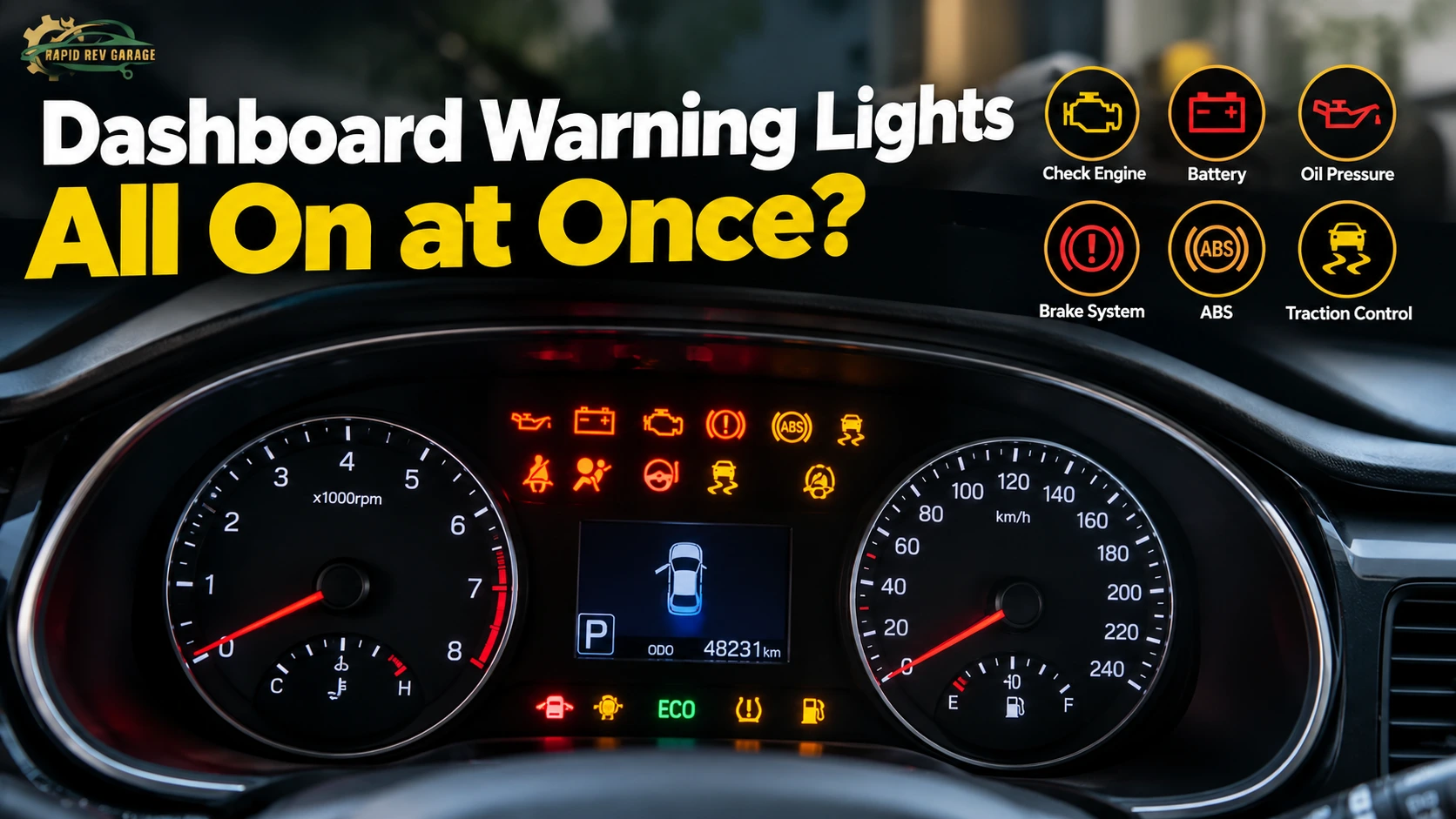
When a bunch of panel lights go off at the same time, it’s usually because of one problem. Low voltage from a weak battery or a broken alternator is the most common reason. For your car’s controls to work, they all need steady power. When the voltage drops, the units lose touch with each other, and each one turns on its own light. The same issue can also be caused by loose ground wires, broken wiring, or a shared sensor that doesn’t work. A full diagnostic scan reads every module’s saved codes and identifies the starting point. Rapid Rev Garage in Al Quoz is a full-service garage that is open 24 hours a day, seven days a week. It is a good place to start for the error of dashboard warning lights all on at once check in Dubai.
What It Means When Your Whole Dashboard Lights Up
You start the car, or you’re driving on Sheikh Zayed Road, and four or five lights come on at once. ABS, traction control, check engine, battery, maybe the airbag light too. It looks like the whole car is failing.
Most of the time it isn’t. Modern cars have many small computers called control modules. The engine, brakes, gearbox, and airbags each have one. They share data over a wiring network called the CAN bus.
When one part of that shared system goes wrong, every module that depends on it reports a problem. So five dashboard warning lights can come from a weak battery, a loose ground wire, or a broken sensor. Fix that one part and most of the lights go out together.
Signs That Point to One Shared Fault
Some clues tell you the lights share a single cause. Watch for these:
- The lights came on at the same moment, not one by one over several days.
- The engine cranks slowly or clicks when you start it.
- Headlights or the screen dim when the AC fan runs on high.
- The gauges flicker, or the speedometer drops to zero for a second.
- Lights appear on a cold start and go out after a few minutes of driving.
- The gearbox shifts roughly, or the steering feels heavy at the same time.
- The lights showed up right after a car wash, a battery change, or a jump-start.
Two or more of these signs usually mean an electrical problem, not five separate faults.
Common Reasons Several Dashboard Warning Lights Turn On Together
Each cause below can switch on many lights at once. They’re listed roughly in order of how often they show up.
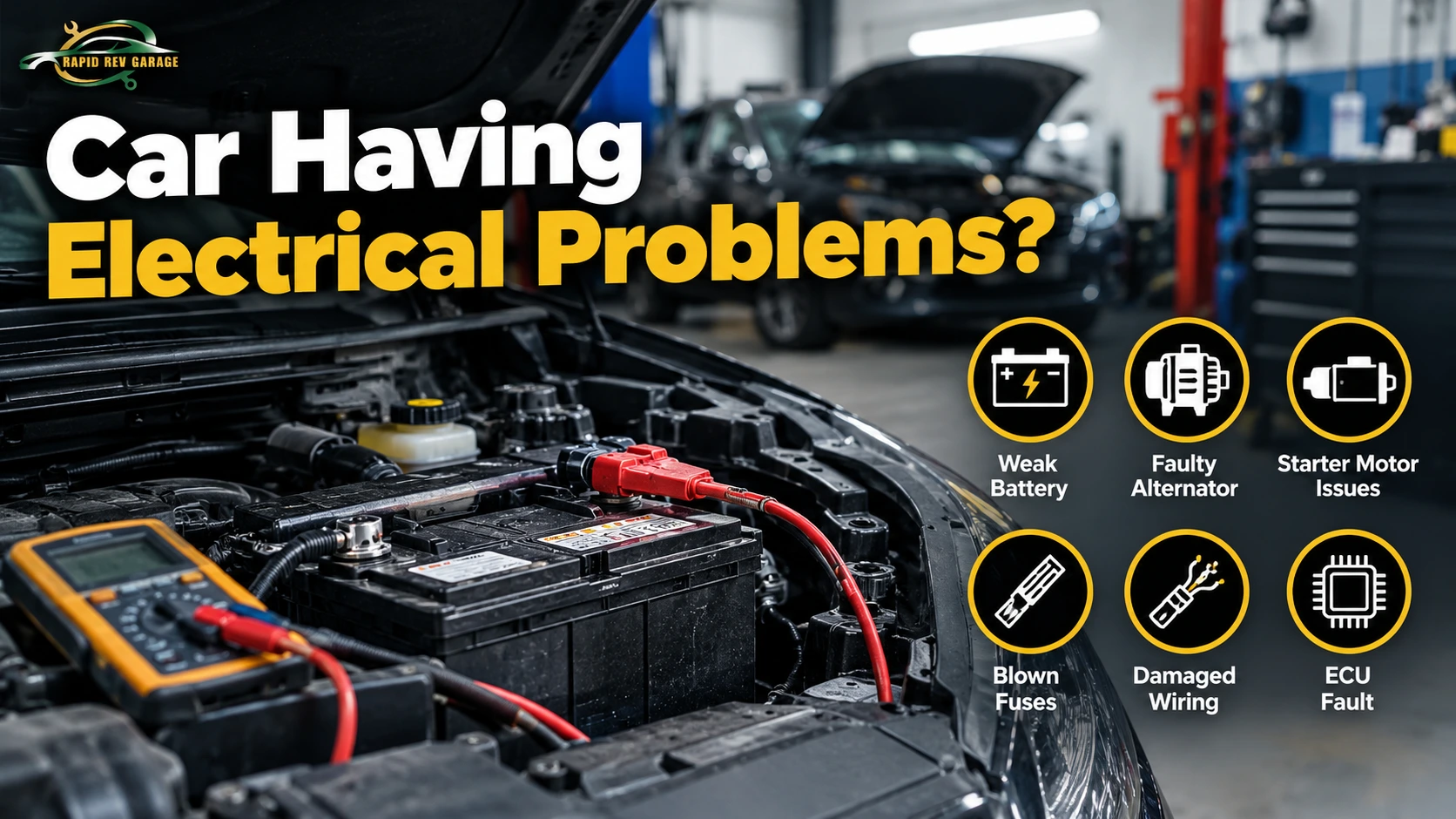
A Weak or Failing Battery
A battery that can’t hold steady voltage is the top cause. Most modules need around 12 volts to work properly. If voltage dips below about 11.5 volts while the engine cranks, some modules reset and store fault codes. Their lights then stay on. Dubai heat wears batteries out fast, so a two-year-old battery can already be weak.
An Alternator That Isn’t Charging
The alternator charges the battery while the engine runs. A healthy one puts out about 13.8 to 14.7 volts. When output falls below that, the car runs on battery power alone. Voltage then drops and modules start dropping out one after another. The battery light often comes on first, with ABS and power steering lights following within minutes. A worn or slipping drive belt can cause the same low charge.
Loose or Corroded Ground Wires
Every circuit needs a clear path back to the engine block or car body. These ground straps can come loose when going over speed bumps or rust when it’s wet outside. With a bad ground, voltage can fluctuate. The modules see that as a fault, so the lights turn on and off without a clear pattern.
One Sensor Feeding Several Systems
Some sensors send data to more than one module. A wheel speed sensor is the classic example. The ABS, traction control, and stability control all read it. When it fails or gets caked in dust, all three lights come on together. A faulty steering angle sensor can do the same thing.
Damaged Wiring or a CAN Bus Fault
If the data network itself has a problem, modules can’t talk to each other. A scan tool shows these as “U” codes, which mean lost communication. Rodents chewing wires, water in a connector, or a poorly fitted dashcam or LED kit can all cause it.
A Recent Battery Change or Jump-Start
Some cars show several lights after you disconnect the battery. The steering angle sensor, throttle body, or other settings may need a reset. A jump-start with cables on the wrong way, or a voltage spike, can also store codes. These lights often need a scan tool to clear and won’t go away on their own.
Water After a High-Pressure Car Wash
Pressure washers can force water into connectors and fuse boxes in the engine compartment. Wet terminals short out for a moment and set off a whole bunch of lights at once. Some will be obvious when everything dries up. Others leave rust, and the fault keeps coming back.
A Failing Control Module
The least likely reason is a dead control module. Age, heat, and water can all hurt it. Other lights can turn on when a module stops talking on the network. Shops usually rule out wires and power first because modules and programming cost a lot more to fix.
Light Pattern Decoder: Match Your Lights to the Likely Cause
The lights that appear together strongly hint at where the fault lies. Use this table as a starting guide only. A scan is the only way to confirm the cause.
| Lights you see together | Most likely cause | How urgent |
| Battery + ABS + power steering | Alternator not charging | Stop soon; the car may cut out |
| Check engine + ABS + traction on start-up, then they clear | Weak battery | Book a test this week |
| ABS + traction control + stability control | Wheel speed sensor | Drive with care; normal brakes still work |
| Many lights flickering on and off | Loose or corroded ground wire | Get it checked within a few days |
| Almost every light at once, gauges drop to zero | Wiring or CAN bus fault | Pull over and call for help |
| Several lights right after a battery change | Sensors need a reset | Low, but still needs a scan |
| Airbag light plus others after a car wash | Water in a connector | Moderate, airbags may not deploy |
What to Check in the First Five Minutes
You can learn a lot before you call anyone. These checks are safe for any driver to do.
- Note which lights are red and which are amber. Red means stop soon. Amber means book a check.
- Take a photo of the dashboard. Lights sometimes clear later, and the photo helps the mechanic.
- Look at the battery terminals if you can reach them. White or green crust points to a poor connection.
- Switch off the AC and any extra accessories. If the lights change, the charging system is struggling.
- Think about what happened just before. A car wash, a jump-start, a new accessory, or a deep pothole are all useful clues.
Don’t keep restarting the car to make the lights go away. Each weak start drains the battery a little more.
How a Workshop Finds the Real Fault Behind Many Lights
A good diagnosis follows a set order. The aim is to find the first fault, not to chase every light one by one.
Step 1: Full System Scan
The technician plugs a scanner into the OBD port and reads codes from every module. That covers the engine, ABS, airbag, transmission, and body modules. A cheap code reader from a parts shop often reads only the engine, so it misses half the picture. Proper car computer diagnostics in Dubai should always include all modules.
Step 2: Reading the Order of the Codes
Most codes include freeze-frame data or a timestamp. The first code usually indicates the root cause In most modules, low-voltage codes directly indicate the power supply.
Step 3: Battery and Charging Test
Make sure the battery can handle a load, not just the power. Even if the battery shows 12.6 volts when it’s not being used, it can still die. Then, the tech turns on the AC and lights and checks the alternator’s power at low and high revs.
Step 4: Ground and Wiring Checks
You can’t find secret resistance in the ground straps just by looking at them. You also need to do a voltage drop test. The tech carefully inspects the main links for water, rust, and loose pins.
Step 5: Sensor and Network Tests
The sensors and the data network will be tested next if the power is good. Live data shows if each wheel speed sensor is giving correct readings. A network test checks whether all modules communicate.
Step 6: Clear Codes and Road Test
Clear the codes, then road-test the car after the fix. A second scan shows no codes. Some dashboard warning lights come back a week later because you skipped this step.
How the Fault Gets Fixed and Which Services Help
The repair depends on what the tests find. These are the services that usually fix several warning lights at once:
- Car battery testing and replacement, when the battery fails its load test
- Alternator repair or replacement, plus a new drive belt if the old one slips
- Cleaning, tightening, or replacing ground straps
- Car sensor repair, such as a new wheel speed sensor or steering angle sensor
- Car electrical repair for chewed, burnt, or water-damaged wiring
- Sensor calibration and code clearing after any battery work
- Dashboard repair when the instrument cluster itself is faulty
- ECU programming or module replacement, only after everything else checks out
Ask to see the test results before replacing any part. A good mechanic will show you the failed load test or the low alternator reading on the meter. If a workshop wants to change a module before testing the battery and wiring, get a second opinion.
What Happens If You Ignore Several Warning Lights
Ignoring the lights rarely works out well. If an alternator fails, the battery will keep dying until the car stops, usually in traffic or on a highway. ABS and stability control can turn off even if their lights are on, which means the car could skid when you stop quickly. If you see an airbag light, it means the airbags might not deploy in a crash.
Small faults get bigger too. A link can melt if the ground is too loose. Low voltage stresses the modules constantly, and a dead module costs much more than a battery. It could cost a few hundred dirhams to find a mistake early on. If you leave it alone, it can reach nine thousand.
Is It Safe to Keep Driving With Multiple Lights On?
It depends on the light color and how the car feels. If only amber lights are on and the car drives normally, you can usually drive carefully to a workshop. Keep the AC low and avoid long trips. If you’re not sure where to go, a nearby garage can run the scan.
Pull over in a safe spot and stop if you notice any of these:
- A red battery, oil pressure, or temperature light
- A red brake warning light
- Steering that suddenly feels heavy, or a soft brake pedal.
- Gauges dropping to zero or the engine stuttering.
In these cases, don’t push on. Call roadside assistance and have the car moved to a workshop. A tow costs far less than a crash or a damaged engine.
How Long the Diagnosis and Repair Usually Take
Most of the time goes into finding the fault, not fixing it. A full diagnostic scan takes about 30 to 60 minutes. A battery test and replacement takes 20 to 40 minutes.
With the right parts, an alternator swap should take only two to four hours. Wheel speed sensors need to be changed every one to two hours. It might take four hours to two days to find a wire or ground fault.
Intermittent faults take the longest. The car may need a longer road test so the technician can catch the problem while it’s happening.
What Affects the Cost of Fixing Multiple Warning Lights in Dubai
The final bill depends on the root cause, your car model, and the parts you choose. Typical Dubai market ranges are:
- Car diagnostic scanning: AED 100 to 300
- Battery replacement: AED 300 to 900, more for AGM batteries in stop-start cars
- Alternator repair: AED 400 to 1,200, or AED 800 to 2,500 for a replacement
- Wheel speed sensor: AED 250 to 900 fitted
- Wiring repair: AED 200 to 1,500, based on how hard the fault is to reach
- Module repair or programming: AED 1,000 to 4,000 or more
German and luxury cars usually sit at the top of these ranges. OEM parts cost more than aftermarket or remanufactured ones. A remanufactured alternator with a warranty can save a good amount and still last well. Prices change, so ask for a written quote after the diagnosis.
Simple Habits That Stop Warning Lights Coming Back
Most repeat cases trace back to the battery and charging system, so start there. Get the battery tested every six months, once before summer and once after. The test takes a few minutes during a regular car service in Dubai.
In this climate, plan to replace the battery every 2 to 3 years, even if it still starts the car. Also have the drive belt and alternator checked at each major service.
A few other habits help:
- Ask car wash staff not to pressure-wash the engine bay.
- Use a proper auto electrical workshop to fit dashcams, LED lights and trackers.
- Don’t ignore a single amber light.
Many cases of several dashboard warning lights start as one small light that was left alone for weeks.
Why Dubai Cars Get Multiple Warning Lights More Often
Car dashboard warning lights in Dubai come on more often than in cooler cities, and the climate is the main reason. Heat speeds up the chemical wear inside a battery. In a 45°C summer, many batteries last only 2 to 3 years, compared with 4 to 5 years in milder places.
Traffic adds to the load. Long idling in stop-and-go traffic with the AC on full makes the alternator work hard at low engine speed.
Underground parking plays a part as well. Driving out of a cool basement into afternoon heat makes connectors expand and shrink every day. Over time, pins work loose.
The last big thing is dust. Sand gets stuck on the speed sensors and connectors inside the wheels. This is why ABS and traction lights show up together so often here. Many owners schedule a warning light check before summer for this reason.
Why Choose Rapid Rev Garage for Dashboard Warning Lights
If your car shows several warning lights at once, Rapid Rev Garage in Al Quoz is a strong choice for Dubai drivers. It has a few clear advantages that matter for this kind of fault.
Open 24 Hours as a Full Workshop
Warning lights don’t wait for business hours. The garage runs as a full workshop around the clock at Al Khail Gate, 12th Street, Al Quoz Industrial Area 2. Most 24-hour car services in Dubai are mobile roadside units. They can jump-start a battery, but they can’t lift the car, trace a wiring fault, or swap an alternator at the roadside. A car brought in at night can go straight into a workshop bay instead of waiting until morning.
A 5.0 Rating on Google
Reviews show how a workshop handles diagnosis and pricing in real life. The garage holds a 5.0 rating on Google, which puts it ahead of several well-known workshops in the area.
Passenger Cars Only
The workshop focuses on passenger cars and doesn’t take in trucks. Sedans, SUVs and 4x4s get full attention, which suits electrical faults that need patient testing.
Easy to Reach in Al Quoz
Al Quoz sits between Sheik Zayed Road and Al Khail Road. That makes it a short drive from Al Barsha, Business Bay, and Jumeirah. If you can’t drive the car, a tow truck or roadside assistance team can bring it straight in.
FAQs
Q1: Why are all my dashboard lights on?
Low voltage is the usual reason. A weak battery or failing alternator makes modules reset and store fault codes. A loose ground or wiring fault can do the same. A full scan shows which one it is.
Q2: Can a weak battery cause warning lights?
Yes. When you turn the engine on, voltage below about 11.5 volts can trigger the ABS, traction, airbag, and check engine lights at the same time. If the battery is to blame, a load test will show it.
Q3: Does a bad alternator turn on dashboard lights?
Yes. The battery light usually comes on first. ABS, steering, and other lights follow as voltage keeps dropping. Get it checked before the car stalls.
Q4: Is it safe to drive with the ABS light on?
Normal braking still works, but anti-lock and stability help may be off. Drive gently, leave extra space, and get the car checked soon.
Q5: Will disconnecting the battery clear warning lights?
Sometimes, but it only hides the problem. The fault returns, and the stored codes that help a mechanic find it get wiped. On some cars, disconnecting the battery creates new lights too.
Q6: Why do lights come on after a car wash?
Water from a pressure washer can get into connectors and fuse boxes. Some lights clear once everything dries. If they stay on, the connectors need cleaning and checking.
Q7: How much is a car diagnostic in Dubai?
A full diagnostic scan usually costs AED 100 to 300 in Dubai. The price depends on the car brand and how many systems need testing.
Related Services for Warning Light Problems
A warning light check often leads to other work on the same visit. These services cover the next steps:
- Car mechanic near me for general repairs found during the inspection
- Mobile car mechanic for battery tests and jump-starts where your car is parked
- Car painting near me if you want scratches or bodywork sorted while the car is in
- Car electrical repair, car battery replacement, dashboard repair, and ECU programming for deeper electrical faults
Book a Warning Light Check in Al Quoz
Several lights at once means your car needs a proper scan, not a guess. Rapid Rev Garage is open 24 hours in Al Quoz Industrial Area 2 and checks dashboard warning lights on all kinds of passenger cars. Send a photo of your dashboard on WhatsApp, call , or find the workshop on Google Maps. You can also see the full list of services at rapidrevgarage.com.