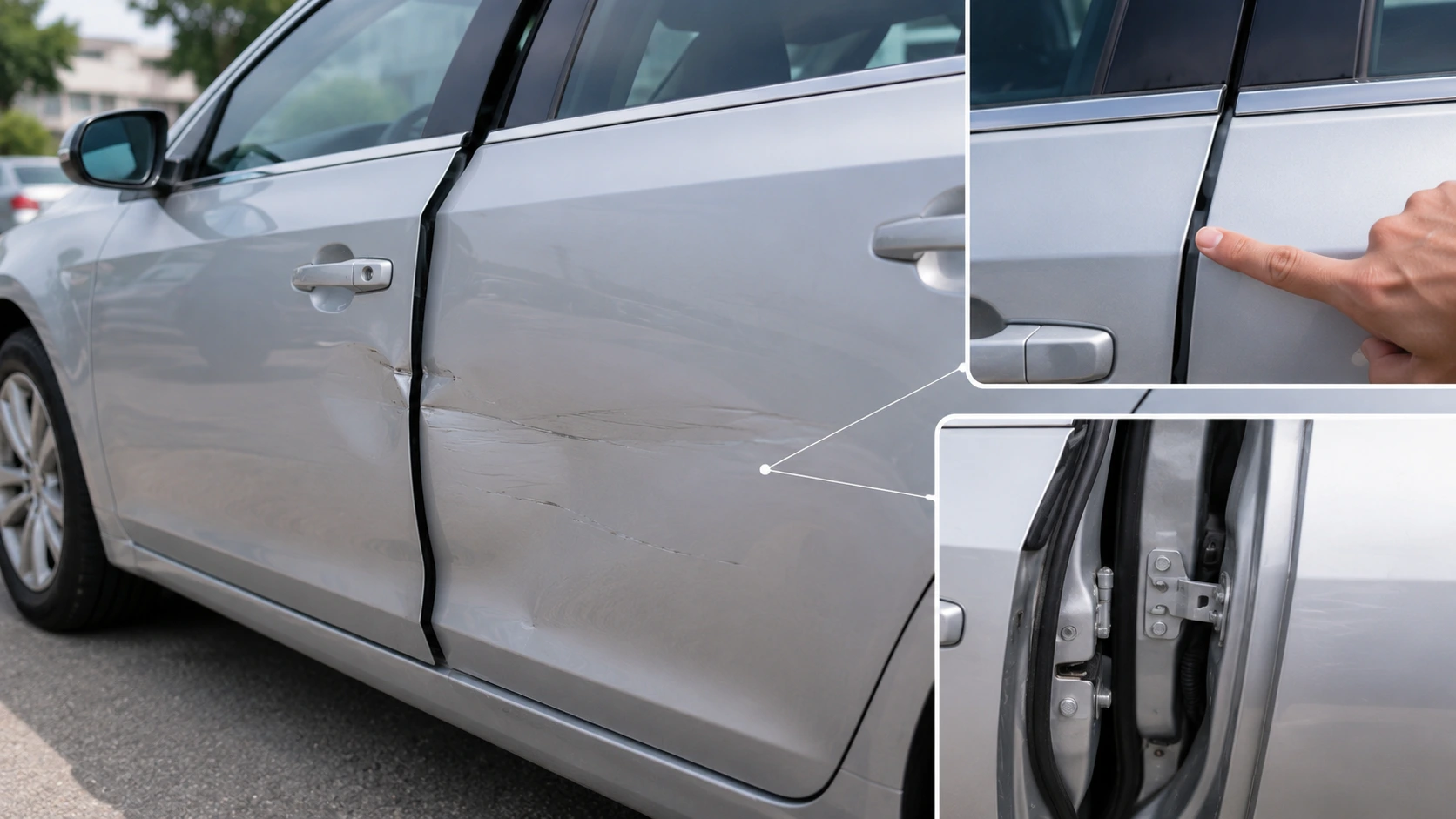
When a car door misaligned after a minor accident situation develops — the door no longer sits flush with the body, drops when opened, requires extra force to close, or leaves a visible gap that wasn’t there before — is a consequence of the impact redistributing stress through the door, hinge, or surrounding body structure in ways that are not always visible from outside the vehicle. Minor accidents are defined by their collision speed, not by their mechanical consequences — a low-speed car park impact that barely marks the bumper can still shift a door hinge or deform a hinge pillar enough to produce a misalignment that affects daily use.
At Rapid Rev Garage in Al Quoz, every car door misaligned after a minor accident case is assessed by identifying where in the hinge, striker, or body structure the misalignment is originating — because a door that appears misaligned at the striker point may have its actual fault at the hinge pillar, and adjusting the striker without addressing the hinge produces a temporary improvement that reverses within weeks.
Car Door Misaligned After a Minor Accident — Quick Verdict
A car door misaligned after a minor accident fault traces to one of four specific locations: the door hinge bolts have shifted under impact load, producing a door that sags or moves outward from its correct position; the hinge pillar — the structural body member the hinges bolt to — has been deformed by the impact, changing the hinge mounting geometry; the door itself has been bent at its internal frame, causing the door skin to no longer sit in the correct plane relative to the body; or the striker plate and latch position have been displaced, preventing the door from closing and latching in its correct position. Each fault requires a different repair — and some require body repair work before the door adjustment makes any lasting sense.
Table of Contents
- Why Minor Accidents Cause Door Misalignment
- Identifying Where the Misalignment Is Coming From
- Hinge Bolt Shift and Hinge Adjustment
- Hinge Pillar Deformation — The Hidden Structural Fault
- Door Frame Deformation and Door Shell Damage
- Striker Plate and Latch Misalignment
- How Safety Systems Are Affected by Door Misalignment
- How Dubai’s Accident Environment Produces This Fault
- How We Assess Every Misalignment at Rapid Rev Garage
- The Right Fix for Each Confirmed Fault Location
- What Happens If Misalignment Is Left Without Repair
- How Long the Repair Takes
- What the Repair Costs in Dubai
- Why Rapid Rev Garage?
- FAQ
- Conclusion
Why Minor Accidents Cause Door Misalignment
The mechanism behind a car door misaligned after a minor accident is often surprising to drivers who expect significant visible damage to accompany a significant functional change.
How Impact Force Travels Through Vehicle Structure
When a vehicle is struck — even at low speed — the impact energy travels through the body structure from the point of contact. A car park collision on the front quarter panel transfers energy through the front body section, the A-pillar, and the door hinge pillar — the structural members that the door hangs from. The hinge pillar does not need to visibly crumple to shift the geometry by the millimetres that produce noticeable door misalignment.
Why Door Hinges Are Particularly Sensitive
Door hinges are precision-mounted components — the alignment of a door across its perimeter gaps depends on hinge bolt positions that are set within fractions of a millimetre. An impact that moves a hinge bolt position by 1–2 mm produces a visible gap change at the door edge. A deformation of the hinge pillar of similar magnitude produces a gap change that no hinge adjustment can permanently correct — because the mounting surface itself is no longer in the correct geometry.
The Car Park Impact Pattern in Dubai
Dubai’s car park environment is the dominant reason a car door misaligned after a minor accident complaint is common here, poorly lit basement levels — produces a high frequency of low-speed door impacts, quarter panel strikes, and parking manoeuvre contacts. A car door misaligned after a minor accident in Dubai is most commonly the result of a car park incident where the collision speed was low enough not to deploy airbags or produce significant visible damage, but high enough to shift door-related structural geometry.
Identifying Where the Misalignment Is Coming From
Before any adjustment or repair is made, identifying the exact fault location prevents wasted work.
The Gap Assessment Test
With the door closed, the gaps around the door perimeter — top, bottom, front, and rear edges — are assessed against the manufacturer’s specified gap. A gap that is wider at the top and narrower at the bottom indicates the door is dropping at the hinge — a hinge sag fault. A gap that is even but the entire door has shifted outward from the body indicates hinge pillar deformation pushing the hinge points out of plane. A gap that is inconsistent and the door is difficult to close indicates a striker or latch position issue.
The Door Drop Test
Opening the door to its fully-open position and releasing it — observing whether the door drops under its own weight — confirms hinge wear or damage. A correctly mounted door on healthy hinges holds its position when released. A door that drops progressively when released has hinge wear or hinge bolt loosening that allows the door weight to rotate the hinge beyond its correct position.
The Closing Resistance Assessment
A door that requires extra force to close, or that produces a grinding or rubbing sound when closing, has either a striker misalignment — the latch is not meeting the striker in the correct position — or a door that is contacting the body seal in the wrong geometry and compressing it unevenly.
Hinge Bolt Shift and Hinge Adjustment
A door hinge is attached to both the hinge pillar and the door itself by bolts through slotted mounting holes. These slots allow hinge position adjustment — up, down, in, and out — to set the door gap correctly during factory assembly.
How an Impact Shifts Hinge Bolts
Under impact load, the forces on the hinge can exceed the clamping force of the hinge bolts — causing the hinge to rotate slightly in its slotted mounting holes. The bolts remain in place but the hinge body has shifted position within the range of the slot, moving the door to a new position that is no longer aligned with the body.
The Hinge Adjustment Repair
Where hinge bolt shift is the confirmed cause — with the hinge pillar confirmed intact and undamaged — the hinges are loosened, the door is repositioned to correct alignment, and the hinge bolts are retorqued to specification. This is the simplest door misalignment repair and produces lasting results when the hinge pillar is genuinely undamaged.
Hinge Replacement
Where the hinge itself has been bent — bent hinge leaves, cracked weld areas, or hinge pivot wear — the hinge is replaced. Adjusting a bent hinge produces a temporary alignment that shifts again under door use. Our car mechanic team assesses hinge condition before any adjustment is attempted — identifying bent or cracked hinge material that requires replacement rather than adjustment.
Hinge Pillar Deformation — The Hidden Structural Fault
The hinge pillar deformation is the most consequential and the most frequently missed cause of door misalignment after a minor accident.
What the Hinge Pillar Is and Why It Matters
The hinge pillar — the A-pillar for front doors, the B-pillar for rear doors — is a structural box section that forms the mounting surface for the door hinges. It is part of the vehicle’s safety structure — designed to resist intrusion in a side impact. When an impact deforms this pillar even slightly, the hinge mounting surface moves out of its designed plane, and the door that hangs from it no longer sits in the correct geometry relative to the body.
Why Hinge Adjustment Cannot Fix This
If the hinge pillar has deformed — even by 2–3 mm — and the hinges are simply repositioned to close the visible gap, the hinges are now set to accommodate the deformed pillar position. The door appears aligned, but the hinge pillar’s structural geometry is not restored. Any subsequent impact that stresses the pillar further produces immediate re-misalignment. And importantly, a deformed hinge pillar may not perform correctly in a subsequent side impact — its crush-zone behaviour is altered by the prior deformation.
Body Straightening Is the Correct Repair
Where hinge pillar deformation is confirmed — by measurement against the manufacturer’s body dimension specification — the correct repair is body straightening using a pulling jig to restore the pillar to specification dimensions. Hinge adjustment alone on a deformed pillar is not a structural repair. For colour-matched paintwork repair needed after body straightening, our car painting team handles the full paint correction at the same visit.
Door Frame Deformation and Door Shell Damage
An impact directly to the door — a car park pillar strike, a swinging adjacent door, or a direct collision on the door panel — can deform the door’s internal steel frame, changing the door’s overall shape.
How Internal Frame Deformation Shows
A door with internal frame deformation no longer sits flush with the surrounding body even when the hinges are correctly adjusted — because the door’s own shape has changed. The door skin may appear only slightly damaged, but the door frame behind the skin has bent at the impact point, twisting the door’s perimeter geometry. This produces uneven gaps that cannot be corrected by hinge adjustment because the door itself is no longer the correct shape.
Door Replacement vs Door Frame Repair
Minor internal frame deformation can be partially corrected by straightening the door shell on a door jig. Where the deformation is significant, door replacement with a correctly-specified door is the more reliable repair — ensuring the door seal geometry is correct for weatherproofing and structural integrity.
Striker Plate and Latch Misalignment
The striker is the metal pin mounted on the door pillar or B-pillar that the door latch engages when the door is closed. The latch is the mechanism in the door edge that captures the striker. When the door’s hinge position has changed, the latch no longer meets the striker at the correct height and depth — producing a door that requires extra force to close, doesn’t feel solidly latched, or bounces open on road vibration.
Striker Adjustment as a Secondary Correction
Where hinge adjustment has repositioned the door correctly and a slight striker misalignment remains as a secondary result, the striker position is adjusted within its slotted mounting to align with the repositioned latch. Striker adjustment is always a secondary step after hinge correction — not a standalone repair that substitutes for hinge and pillar assessment.
When the Latch Mechanism Itself Is Damaged
An impact that transfers force directly to the door edge — a strike on the door’s front or rear edge rather than the door face — can damage the latch mechanism internally. A damaged latch that intermittently fails to hold the striker should be replaced rather than adjusted. A door latch that fails to hold while driving is a safety issue — the door can open unexpectedly on road vibration or cornering. For any emergency assistance related to a door that cannot be secured, our roadside assistance covers Al Quoz and nearby Dubai areas.
How Safety Systems Are Affected by Door Misalignment
A misaligned door is not just a cosmetic or functional inconvenience — it has direct implications for vehicle safety systems.
Side Airbag Deployment Sensors
Many modern vehicles have side impact sensors mounted in the door or B-pillar that trigger side curtain and door-mounted airbags. A door that is no longer correctly seated against the body may change the gap-sensing or pressure-sensing readings that these sensors provide. A car door misaligned after a minor accident should be assessed for airbag sensor function alongside the mechanical alignment repair — particularly where the impact that caused the misalignment was a side impact.
Weather Seal Integrity
A misaligned door compresses its weather seal unevenly — areas of over-compression and areas of insufficient compression create paths for water and dust ingress. In Dubai’s occasional rain and sustained dust environment, a misaligned door produces cabin dust and water entry that was never present before the accident. Our car service packages include a door seal gap assessment after any reported minor impact.
How Dubai’s Accident Environment Produces This Fault
Dubai’s specific driving environment produces a high frequency of the low-speed impacts that cause door misalignment.
Car Park Density and Low-Speed Impacts
Dubai’s mall and residential car parks are among the most densely used in the world — vehicles entering and exiting in tight proximity with limited visibility. Low-speed contacts between vehicles, between vehicles and pillars, and door-to-door impacts when adjacent vehicles are too close are significantly more frequent than in lower-density parking environments.
Speed Bump and Kerb Geometry Impacts
Dubai’s roadside kerbing and speed bump profiles occasionally produce side impacts to vehicles approaching car parks or navigating tight urban street access — another source of low-force, structurally significant contacts that produce door misalignment without producing the visible panel damage that drivers expect to accompany structural change.
How We Assess Every Misalignment at Rapid Rev Garage
The assessment sequence measures before adjusting — gap pattern, pillar dimensions, and hinge condition all inform the repair plan.
Full Gap Measurement at All Door Perimeter Points
Every gap around the misaligned door is measured and compared against specification. The gap pattern — which edges are wider, which are narrower — identifies the fault type before any component is removed.
Hinge Pillar Dimension Measurement
The hinge pillar’s key dimensions are measured against the manufacturer’s specification using appropriate measuring tools. Any deviation beyond the manufacturer’s tolerance confirms pillar deformation and requires body straightening before hinge adjustment.
Hinge and Latch Physical Assessment
Hinge leaf condition, hinge pivot smoothness, and latch mechanism function are assessed physically. A bent hinge or damaged latch identified at this stage is scheduled for replacement rather than adjustment.
Post-Repair Gap and Seal Confirmation
After all adjustments and repairs, the full gap pattern is re-measured and the door seal compression is assessed around the full perimeter. A door that closes, seals, and latches correctly across the full gap specification is the completion criterion — not just a door that closes and the driver reports that it feels better.
The Right Fix for Each Confirmed Fault Location
Each repair is matched to the fault location confirmed by the gap pattern and pillar dimension assessment.
Hinge Adjustment for Bolt Shift
Hinges are loosened, door repositioned to correct gap specification, bolts retorqued. Completed in the same visit with gap confirmation.
Hinge Replacement for Bent Hinge Leaves
Damaged hinge replaced with correct-specification unit. Post-replacement gap adjustment and torque confirmation.
Body Straightening for Pillar Deformation
Hinge pillar pulled to specification dimensions on a body jig. Post-straightening hinge adjustment to final gap specification. Paint repair to any areas disturbed by the straightening process.
Striker and Latch Service
Striker repositioned to align with corrected latch position. Damaged latch mechanism replaced where confirmed as faulty.
What Happens If Misalignment Is Left Without Repair
Door misalignment left without repair produces specific and progressive consequences.
Water and Dust Ingress Through Seal Gap
A misaligned door with an uneven seal gap allows water during Dubai’s rare but significant rain events to enter the cabin — wetting the carpet underlay and contributing to the moisture-under-carpet problem described in the interior odour blog. Dust entry through the seal gap is continuous — adding to cabin dust accumulation that the AC filter cannot address because it is entering through the body structure.
Progressive Hinge Wear From Incorrect Load Distribution
A door sitting in an incorrect position places the hinge pivots and bolts under off-axis loading — the hinge is carrying the door’s weight at an angle rather than through its designed axis. This accelerates hinge wear, progressively worsening the misalignment over time. A 2 mm gap discrepancy this month becomes a 5 mm discrepancy in a year. Our mobile car mechanic covers Al Quoz and nearby Dubai areas for on-site door alignment assessment.
How Long the Repair Takes
Repair time depends on the confirmed fault location — hinge adjustment is the fastest, body straightening with paint repair takes the most time.
Hinge Adjustment Only
One to two hours including gap measurement and door operation confirmation.
Hinge Replacement With Adjustment
Two to four hours per hinge depending on the vehicle and hinge access.
Body Straightening With Hinge Adjustment
One to three days including pillar measurement, straightening, adjustment, and paint repair where required.
Full Door Replacement
One to two days including door fitting, hinge transfer or replacement, and gap and seal confirmation.
What the Repair Costs in Dubai
Cost depends on the confirmed fault location and the repair scope it requires.
Hinge and Adjustment Work
Hinge adjustment: AED 300–700. Hinge replacement per hinge: AED 500–1,500 depending on the vehicle and hinge specification.
Body Work
Hinge pillar straightening: AED 1,500–4,000 depending on the extent of deformation and vehicle platform. Door replacement (excluding paint): AED 1,500–5,000 depending on the vehicle and door complexity. Paint repair of affected panels: AED 600–2,000 depending on panel size and paint complexity. A written quote is provided after the full gap measurement and pillar dimension assessment confirms the specific fault location. Our garage near me location in Al Quoz serves drivers from Business Bay, Jumeirah, Barsha, Satwa, Downtown, and the Sheikh Zayed Road corridor.
Why Rapid Rev Garage?
When a car door misaligned after a minor accident is assessed, the hinge pillar dimension check is performed before any hinge adjustment is attempted. A hinge adjustment on a deformed pillar produces a temporary alignment — the door appears correct for weeks and then shifts again as the hinge settles into the deformed pillar geometry. Measuring the pillar first is what determines whether the repair is a 90-minute hinge adjustment or a two-day body straightening job. Getting this assessment right prevents the driver returning with the same misalignment after a repair that addressed the hinge but not the cause.
FAQ — Car Door Misaligned After a Minor Accident
These are the questions most frequently asked about door misalignment at our Al Quoz workshop.
Can a door misalignment fix itself over time?
No — door misalignment from impact-shifted hinges or deformed pillars does not self-correct. The gap discrepancy either remains stable or worsens progressively as hinge wear accumulates under incorrect loading. Address as soon as possible to prevent progressive deterioration.
Is a misaligned door a safety concern?
Yes — in two respects. A door that does not latch securely can open unexpectedly during driving. A deformed hinge pillar has altered structural geometry that may not perform correctly in a subsequent side impact. Both are safety matters beyond the cosmetic and functional inconvenience.
My door gap looks fine but the door is hard to close — what's wrong?
A door that appears visually aligned but requires extra effort to close has a striker misalignment — the latch is not meeting the striker at the correct position. This is often a secondary consequence of a hinge shift that is too small to produce a visible gap discrepancy but large enough to move the latch away from the striker's optimal engagement point.
Can I adjust my own car door hinges?
Hinge bolt access varies significantly by vehicle. On some vehicles the adjustment is straightforward with the correct tools. On others, significant trim removal and panel access is required. The risk of attempting adjustment without measuring the gap pattern first is setting the door to an incorrect position — requiring a second adjustment when the first doesn't achieve the correct result.
How do I know if my hinge pillar is damaged?
A visual inspection alone is insufficient — a hinge pillar can be deformed by millimetres that are invisible without measurement. The clearest indicators without measuring tools are: a gap discrepancy that cannot be corrected by hinge adjustment, a door that re-misaligns within weeks of a hinge adjustment, or visible creasing in the paint at the junction of the A-pillar and front wing.
Conclusion
A car door misaligned after a minor accident has a specific fault location — hinge bolt shift, hinge pillar deformation, door frame deformation, or striker misalignment — each requiring a different repair that ranges from a 90-minute hinge adjustment to a multi-day body straightening and paint repair. The hinge pillar dimension assessment before any adjustment work is the diagnostic step that determines which repair is actually needed. Rapid Rev Garage in Al Quoz measures the pillar and assesses the full gap pattern before touching any hinge bolt — ensuring the repair addresses the actual fault location rather than its most visible symptom.
Rapid Rev Garage is in Al Quoz, serving drivers across nearby Dubai areas — Business Bay, Jumeirah, Downtown, Barsha, Satwa, and the Sheikh Zayed Road corridor. Book your appointment on WhatsApp or find us on Google Maps.
Rapid Rev Garage — Car Door Misaligned After a Minor Accident | Al Quoz, Dubai