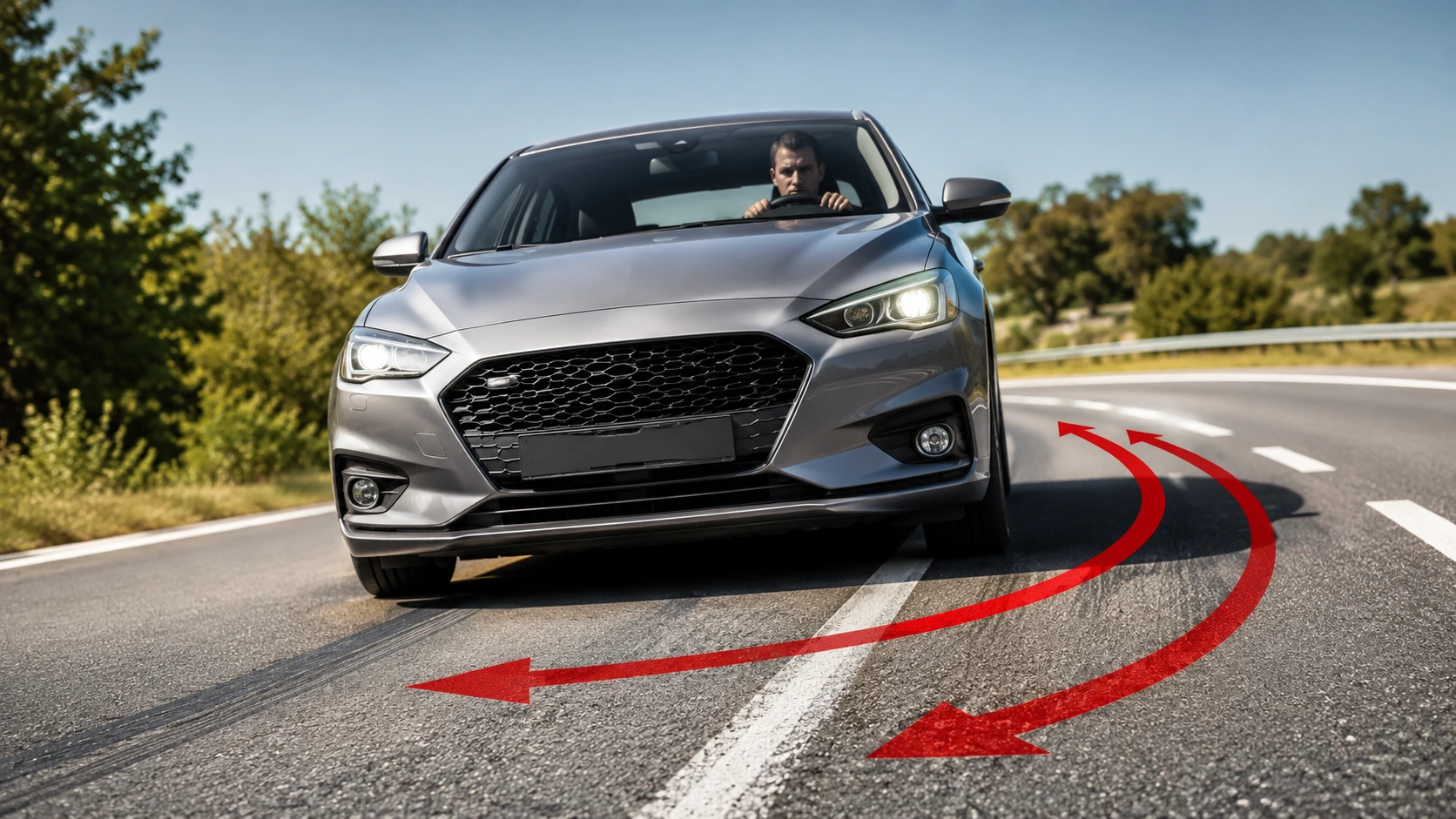
Car pull while braking — the steering wheel tugging to one side the moment you press the brake pedal — is one of those faults that feels minor at first. It isn’t. The pull is the car telling you that one side is braking harder than the other. In an emergency stop, that imbalance gets worse. The car doesn’t stop straight — it veers.
In Dubai’s stop-start traffic, you brake dozens of times per day. Every one of those stops is slightly uneven when you have a problem as your car pull while braking. Over time, that uneven braking also causes uneven tyre wear and additional stress on the suspension.
At Rapid Rev Garage in Al Quoz, this is one of the most common brake complaints we see. The cause is almost always in the brake system itself — and it’s almost always fixable in a single visit.
Car Pull While Braking — Quick Answer
A car pulls while braking because one side of the braking system is applying more force than the other. The most common causes are a stuck brake caliper that drags on one side, uneven brake pad wear where one pad has significantly less material than the other, a warped brake disc causing inconsistent contact, or a brake hose that has collapsed internally and restricts fluid flow to one caliper. Dubai’s heat accelerates all of these — rubber brake hoses degrade faster, brake fluid absorbs moisture sooner, and brake dust accumulates on calipers in the dusty Al Quoz environment.
Table of Contents
- Why Braking Imbalance Causes a Pull
- Stuck or Seized Brake Caliper — The Most Common Cause
- Uneven Brake Pad Wear Across the Axle
- Warped Brake Disc and Inconsistent Braking Force
- Collapsed Brake Hose Restricting Fluid to One Side
- How Contaminated Brake Fluid Makes Things Worse
- Why Dubai’s Conditions Accelerate This Problem
- How We Find the Exact Cause at Rapid Rev Garage
- The Services That Fix Car Pull While Braking
- What Does Brake Repair Cost in Dubai?
- Is It Safe to Keep Driving?
- How to Prevent Car Pull While Braking in Dubai
- Why Rapid Rev Garage?
- FAQ
- Conclusion
Why Braking Imbalance Causes a Pull
When you press the brake pedal, all four wheels should receive hydraulic pressure simultaneously. Each caliper squeezes its pad against the disc with equal force. The car slows in a straight line.
When one caliper applies more force — or one pad has more material — that side bites harder. The car rotates slightly toward the side with more braking force. You feel it as a pull through the steering wheel.
The harder you brake, the more obvious the pull. A gentle stop might feel fine. A firm stop on the highway reveals the imbalance immediately.
This is why car pull while braking gets more noticeable over time — the fault worsens as the imbalance grows. Our car mechanic team checks brake force balance on both front corners as the first step in every braking pull diagnosis.
Stuck or Seized Brake Caliper — The Most Common Cause
The brake caliper contains the pistons that push the brake pads against the disc. When the pistons retract fully after braking, the pad releases cleanly. When a piston is stuck — seized in the extended position — the pad stays partially pressed against the disc.
That side is always braking, even when you haven’t touched the pedal. When you do brake, it bites significantly harder than the opposite side.
A seized caliper also causes the brake disc and pad on that side to overheat. You might notice a burning smell after driving, or the wheel on that side feeling hotter than the others after a journey.
In Dubai, caliper pistons seize from two causes — brake dust accumulation from Al Quoz’s industrial environment, and corrosion from moisture-contaminated brake fluid attacking the piston seals from inside. Both are more severe here than in any European climate.
Uneven Brake Pad Wear Across the Axle
Both front brake pads should wear at roughly the same rate. When one wears significantly faster — from a partially stuck caliper, from incorrect pad installation, or from a pad that has reached its wear limit on one side — the two sides have different friction levels.
More pad material means more bite. The side with more pad pulls the car toward it when braking.
This type of car pull while braking is gradual. It develops over thousands of kilometres as the wear difference grows. Drivers often adapt their steering unconsciously to compensate — then bring the car in for something else and we find the brake imbalance during inspection.
Brake pads are always replaced in axle pairs. Replacing only the worn side leaves an imbalance between fresh and half-worn pads that recreates the pull immediately. Our car service packages include a brake pad thickness measurement at all four corners at every major service.
Warped Brake Disc and Inconsistent Braking Force
A warped brake disc doesn’t have a perfectly flat surface. As the disc rotates, the caliper encounters high spots and low spots. The braking force varies with every rotation.
A warped disc on one side causes that corner to apply inconsistent force — sometimes more, sometimes less — compared to the opposite side. The result is a pull that may also come with a pulsing sensation through the brake pedal.
Disc warping in Dubai happens primarily from thermal shock — a very hot disc being cooled suddenly by water on the road or a car wash shortly after driving. It also happens from extended hard braking on the highway that never allows the discs to cool between applications.
Minor warping is corrected by disc skimming — machining the surface flat. Significant warping requires disc replacement. For any exterior work needed alongside brake repairs, our car painting team handles colour-matched repairs at the same visit.
Collapsed Brake Hose Restricting Fluid to One Side
The brake hose connects the rigid metal brake line on the chassis to the caliper on the wheel — it flexes as the suspension moves. Inside the hose is a rubber lining.
When that rubber lining deteriorates — from age, heat, or moisture — it can collapse inward. This creates a one-way valve effect. Fluid gets to the caliper when you press the pedal. But it can’t return freely when you release it.
The result is a caliper that stays partially engaged after braking — similar to a seized caliper but from a completely different cause. The car pull while braking pattern from a collapsed hose is often intermittent at first, then becomes consistent as the collapse worsens.
Collapsed hoses are invisible from outside the vehicle. The hose looks fine. The internal collapse only shows up when the brake pressure is measured at the caliper before and after pedal release. This is one of the reasons a pressure-based diagnosis is more reliable than a visual inspection alone.
How Contaminated Brake Fluid Makes Things Worse
Brake fluid absorbs moisture from the air over time. In Dubai’s humidity — particularly during the inter-season months — this process is accelerated.
Moisture-contaminated fluid has a lower boiling point. Under heavy braking, it can partially vaporise — creating a compressible vapour bubble in the brake line. This reduces braking force on that line unevenly.
Contaminated fluid also corrodes caliper pistons and seals from the inside. This is the internal cause of caliper seizing — not dust from outside, but corrosion from within. Brake fluid should be replaced every two years in Dubai regardless of the distance driven. For any roadside emergency from a brake fault, our roadside assistance team covers Al Quoz and nearby Dubai areas 24 hours a day.
Why Dubai’s Conditions Accelerate This Problem
Dubai creates specific conditions that make brake faults develop faster than in cooler markets.
Heat. Sustained underbonnet temperatures degrade rubber caliper seals and brake hoses faster. A seal that lasts eight years in the UK lasts four to five years in Dubai’s summer conditions.
Dust. Al Quoz’s industrial environment loads brake dust and fine particulate onto caliper slides and pistons. This accumulation restricts the caliper’s ability to retract cleanly after braking.
Moisture absorption. Dubai’s humidity during the spring and autumn months is significant. Brake fluid left in service for more than two years absorbs enough moisture to cause internal caliper corrosion and reduced boiling point.
Short trips. Brakes that are applied frequently on short trips but never allowed to fully cool and clean themselves accumulate glazing on pads and discs faster than highway driving does.
How We Find the Exact Cause at Rapid Rev Garage
We diagnose car pull while braking with a structured inspection — not by replacing the most likely part and seeing if the pull goes away.
Road test to confirm the pull direction. We brake firmly from 60 km/h and confirm which direction the car pulls. Consistent pull to the left points to a right-side brake fault — the right side is applying more force and pulling the car toward it.
Wheel temperature check. After the road test, we use a thermal gauge on each wheel. A significantly hotter wheel confirms that side is overworking — dragging or applying more force than the opposite side.
Caliper piston retraction test. We measure how freely each caliper piston retracts after pressure is applied and released. A piston that doesn’t retract fully confirms a seized caliper or collapsed hose.
Brake hose pressure test. Hydraulic pressure is measured at the caliper on both sides before and after pedal release. A pressure difference between sides confirms a hose or caliper restriction.
Brake pad and disc measurement. Pad thickness at all four corners and disc surface runout are measured. Any significant difference between sides on the same axle confirms the source of the imbalance.
The Services That Fix Car Pull While Braking
Caliper service or replacement. A caliper with a partially seized piston is either rebuilt — new seals and pistons — or replaced with a new or quality-reconditioned unit. Calipers are always serviced or replaced in axle pairs where the opposite side shows early wear.
Brake pad replacement. Both pads on the axle are replaced simultaneously with correct-specification pads for the vehicle. Mismatched pads between sides recreate the pull.
Brake disc replacement or skimming. A warped disc is skimmed if sufficient material remains. A disc at or below minimum thickness is replaced. Discs are replaced in axle pairs.
Brake hose replacement. A collapsed hose is replaced with a new hose. This is a straightforward repair that takes under an hour per corner.
Brake fluid flush. Contaminated fluid is fully flushed and replaced with fresh fluid to the manufacturer’s specification. The system is bled to remove all air after the flush.
What Does Brake Repair Cost in Dubai?
| Service | Cost Range |
| Brake pad replacement (per axle) | AED 300–800 |
| Brake disc replacement (per axle) | AED 500–1,500 |
| Caliper rebuild | AED 400–900 per caliper |
| Caliper replacement | AED 600–1,800 per caliper |
| Brake hose replacement | AED 200–500 per corner |
| Brake fluid flush | AED 200–400 |
All costs are confirmed after the diagnostic inspection. No repair starts without your approval. Our mobile car mechanic covers Al Quoz and nearby Dubai areas for on-site brake assessment if you can’t bring the car in.
Is It Safe to Keep Driving?
A mild car pull while braking on gentle stops is driveable for short distances to a workshop. A severe pull that requires significant steering correction to stop straight is not safe for continued driving — particularly at highway speed where an emergency stop with severe pull is a serious accident risk.
If the pull appeared suddenly after previously straight braking, book the same day. Sudden onset usually means a caliper has seized or a hose has collapsed completely — both are significant brake faults.
How to Prevent Car Pull While Braking in Dubai
Brake fluid replacement every two years. This is the most preventive single service. Fresh fluid prevents internal caliper corrosion and maintains the correct boiling point.
Brake inspection at every major service. Pad thickness, disc condition, and caliper slide freedom should be checked every 10,000–15,000 km. Catching uneven wear early prevents it becoming a pull.
Avoid washing the car immediately after hard braking. Cold water on hot discs is the primary cause of disc warping in Dubai. Let the discs cool for 20–30 minutes after any sustained braking before washing.
Don’t ignore a burning smell after driving. A burning smell from one wheel after a normal drive is a dragging caliper — it means the pad is permanently partially engaged. Address it before it becomes a seized caliper and uneven pull. Our garage near me location in Al Quoz serves drivers from Business Bay, Jumeirah, Barsha, Satwa, Downtown, and the Sheikh Zayed Road corridor.
Why Rapid Rev Garage?
Car pull while braking has a specific cause on every vehicle — it’s not guesswork. We find it with a road test, thermal check, caliper retraction test, and brake hose pressure measurement before recommending any repair. That sequence tells us exactly which component is responsible and prevents replacing parts that aren’t the problem.
Every brake repair at Rapid Rev Garage is followed by a road test confirming straight, even braking before the car is returned.
FAQ — Car Pull While Braking
Here are the questions Dubai drivers ask us most about braking pull.
My car only pulls under heavy braking — is that less serious?
No. A pull that only appears under heavy braking means the imbalance is there but only becomes noticeable at higher brake pressures. In an emergency stop, high brake pressure is exactly what's applied. The pull will be severe when you need straight braking most.
Can wheel alignment cause a pull while braking?
Alignment affects straight-line driving and cornering. It can cause a pull at all times — not specifically during braking. A pull that only appears when you press the brake pedal is a brake system fault, not an alignment fault. If the car pulls at all times including while braking, both should be checked.
I replaced my brake pads recently — why is my car still pulling?
The most common reason is that the caliper on the pulling side was not serviced during the pad replacement. A partially seized caliper causes the new pads to wear unevenly within weeks, and the pull returns. Caliper condition should be assessed alongside every pad replacement.
Can a tyre cause a pull while braking?
A tyre with significantly different inflation pressure, a flat spot, or internal belt separation can cause a pull — but typically at all speeds, not specifically under braking. If the pull is exclusively during braking and disappears when not braking, the cause is in the brake system.
How long does brake repair take?
Brake pad and disc replacement: two to three hours per axle. Caliper rebuild or replacement: two to four hours per caliper. Brake hose replacement: one to two hours. Brake fluid flush: one hour. Most car pull while braking repairs are completed in a single visit.
Conclusion
Car pull while braking in Dubai is caused by braking imbalance — a stuck caliper, uneven pads, a warped disc, or a collapsed hose. Dubai’s heat and dust accelerate every one of these causes. Left alone, the pull worsens, tyre wear becomes uneven, and emergency braking becomes unsafe.
Rapid Rev Garage in Al Quoz diagnoses every car pull while braking complaint with a road test, thermal check, and caliper pressure assessment before recommending any repair.
Rapid Rev Garage is in Al Quoz, serving Business Bay, Jumeirah, Downtown, Barsha, Satwa, and the Sheikh Zayed Road corridor. Book your appointment on WhatsApp or find us on Google Maps.
Rapid Rev Garage — Car Pull While Braking | Al Quoz, Dubai