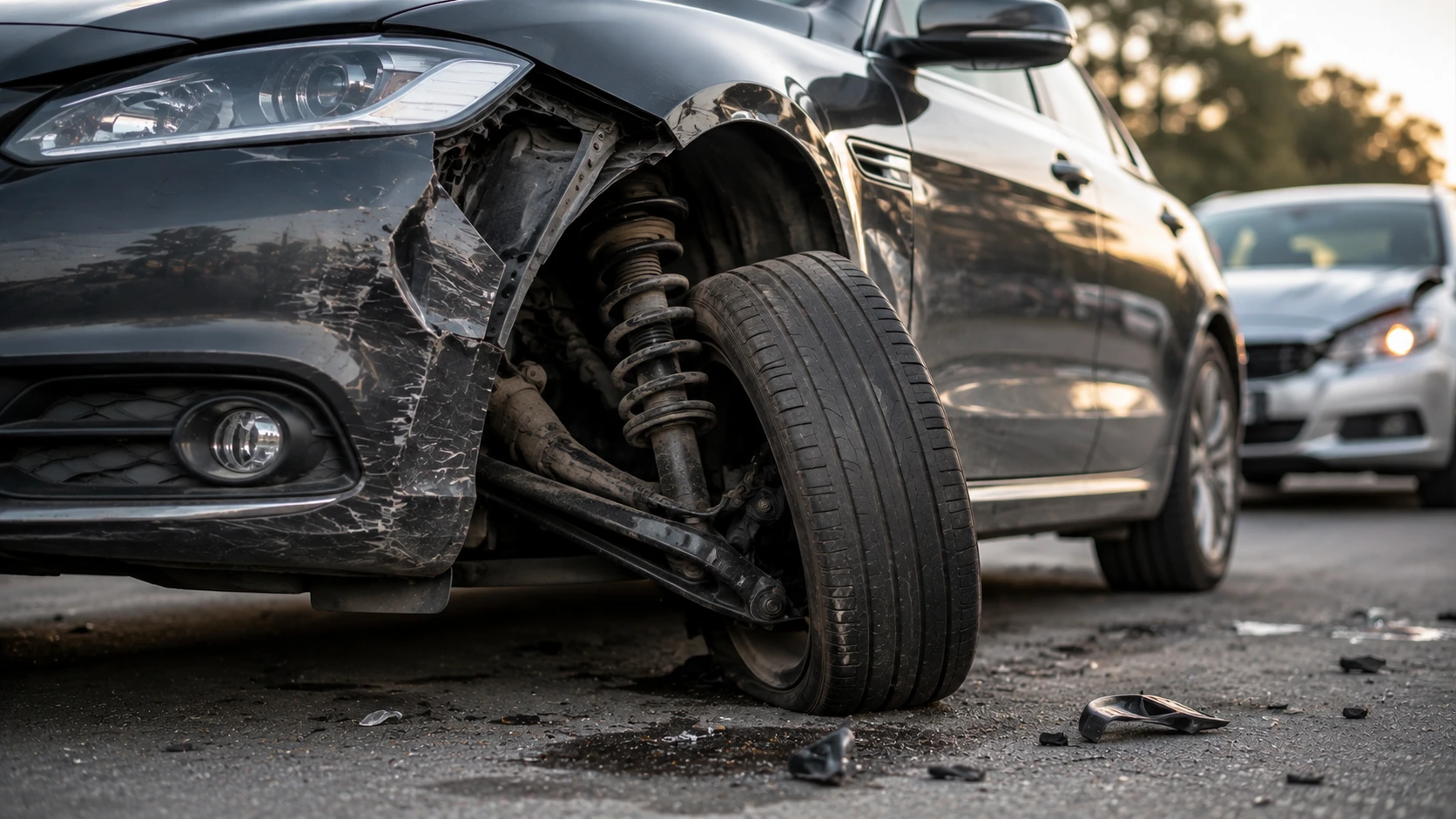
Yes — car suspension be damaged in a minor accident happens far more often than most drivers expect. This surprises people because the impact felt minor. The bumper got a scuff. The wheel looks fine. The car still drives.
But suspension damage from low-speed impacts is common precisely because suspension components sit close to the impact points. A front corner strike — the most frequent accident type in Dubai’s car parks — puts direct force into the wheel, through the hub, into the ball joint, control arm, and subframe. The outer damage might be a scratched bumper. The hidden damage might be a bent control arm and a shifted wheel alignment.
At Rapid Rev Garage in Al Quoz, we confirm that car suspension be damaged in a minor accident is one of our most consistent findings. The test is never the visible damage — it’s the measurement.
Car Suspension Be Damaged in a Minor Accident — Quick Answer
Car suspension be damaged in a minor accident — this happens without exception across all vehicle types. Low-speed impacts — car park contacts, kerb strikes, small pothole hits — apply concentrated force directly to suspension components. A bent lower control arm, a cracked ball joint, a shifted strut mount, or a damaged tie rod end can all result from an impact that barely marks the bumper. These faults may not produce an obvious handling problem immediately. They develop into tyre wear, steering pull, and handling instability over subsequent weeks. A post-accident suspension inspection is the only way to confirm whether the system is undamaged.
Table of Contents
- Why Low-Speed Impacts Cause More Suspension Damage Than Expected
- The Specific Components Most Often Damaged in Minor Accidents
- How a Bent Control Arm Changes Your Alignment Immediately
- Ball Joint and Tie Rod End Damage From Corner Impacts
- Strut and Shock Absorber Damage You Can’t See
- How Subframe Shifts Affect the Whole Front Suspension
- Warning Signs That Suspension Was Damaged in a Minor Accident
- How We Inspect Suspension After a Minor Accident
- The Services That Fix Post-Accident Suspension Damage
- What Does Post-Accident Suspension Repair Cost in Dubai?
- Is It Safe to Drive Before Getting It Checked?
- Why Rapid Rev Garage?
- FAQ
- Conclusion
Why Low-Speed Impacts Cause More Suspension Damage Than Expected
Suspension components are designed to absorb road forces — bumps, potholes, cornering loads. They’re built to handle forces applied vertically and laterally within a specific range.
What they’re not designed for is a sharp horizontal impact from another vehicle or a fixed object. A 15 km/h car park contact applies a short, concentrated force spike — very different from the distributed, controlled forces the suspension normally manages.
This is why car suspension be damaged in a minor accident at speeds that produce almost no visible body damage. The impact energy goes somewhere. If the bumper absorbs most of it, the body damage is contained. If the impact is at the wheel or corner of the vehicle, the energy goes straight into the suspension.
The wheel, tyre, and rim act as a transfer point. Force enters the tyre contact patch, travels through the rim, through the hub, and into the suspension geometry. A ball joint, a tie rod end, or a control arm at the end of that force path receives concentrated impact energy — even from a slow collision.
The Specific Components Most Often Damaged in Minor Accidents
These are the suspension components that show damage most frequently on post-accident inspections.
Lower control arm. The front lower control arm connects the hub to the subframe. A corner impact pushes the wheel backward or inward — directly loading the control arm in a direction it wasn’t designed to handle. Control arms bend at their weakest point — usually near the ball joint end. A bent arm is not always visible without measurement.
Ball joints. A ball joint that receives an angular impact load can crack its housing, damage its socket, or develop play that wasn’t there before the accident. A cracked ball joint housing is a safety-critical finding — it can separate without further warning.
Tie rod ends. A direct impact on the front wheel steers the force into the tie rod. Tie rod ends bend or develop play from lateral impact loads. A bent tie rod changes toe alignment immediately and also has separation risk if the thread is stressed.
Strut and strut mount. A strong front impact can bend the strut itself or crack the top mount that connects it to the body. A bent strut doesn’t always produce an obvious handling symptom — but it changes camber on the affected corner.
Wheel bearing. A lateral impact applies load to the wheel bearing in a direction it wasn’t designed for. A bearing that has been impact-loaded may function normally initially but develop noise and play within weeks as the pre-damaged race surfaces wear. Our car mechanic team physically loads every suspect component after a minor accident before confirming it is undamaged.
How a Bent Control Arm Changes Your Alignment Immediately
Wheel alignment is set assuming all suspension components are at their designed geometry. The control arm’s length, angle, and pivot point position all contribute to the wheel’s camber, caster, and toe.
A bent control arm changes the effective length or angle of the arm. This shifts the wheel to a position outside the alignment specification. The driver may notice a pull to one side, uneven tyre wear, or a steering wheel that isn’t centred when driving straight.
In some cases, the alignment change is small enough that the driver adapts to it unconsciously. They don’t notice the slight pull because they’re already compensating with a small steering input on every drive. The tyre wear accumulates over weeks. By the time it’s obvious, the inner edge of the tyre on the affected corner is significantly more worn than the rest.
Detecting that car suspension be damaged in a minor accident changed the geometry is done with a four-wheel alignment measurement — within minutes of putting the car on the alignment rack. Our car service packages include a post-accident alignment check for every vehicle that has had a significant impact.
Ball Joint and Tie Rod End Damage From Corner Impacts
Corner impacts — the kind that happen when a front corner of the vehicle catches a pillar or another car at an angle — apply combined lateral and forward force to the front wheel.
This combined force loads the ball joint and tie rod end simultaneously in their most vulnerable directions. Ball joints are designed to pivot within a cone of movement. A sharp lateral impact exceeds that cone and can crack the socket housing or distort the ball geometry.
A cracked ball joint socket is not always visible without removing the joint from the vehicle. A joint that looks intact externally might have internal cracking that reduces its load-bearing capacity significantly.
This safety argument confirms why car suspension be damaged in a minor accident in ways that affect structural integrity matters — not just alignment. A ball joint that appears to be holding correctly might separate on the next significant bump or emergency manoeuvre. For any post-accident emergency on the road, our roadside assistance team covers Al Quoz and nearby Dubai areas at any time.
Strut and Shock Absorber Damage You Can’t See
The front strut is a structural component — it supports the vehicle’s weight, guides wheel movement, and provides damping. On MacPherson strut suspension — used on most saloons and crossovers in Dubai — the strut is also the upper pivot point for the steering.
A strong front impact can bend the strut tube. A bent strut changes the wheel’s camber. It also changes the steering axis — the angle the wheel steers around. Both affect straight-line stability and tyre wear.
A bent strut is not visible from a standing inspection. The bend is often subtle — 2–3 degrees — not a dramatic visible lean. It shows up in the wheel alignment measurement as an out-of-specification camber reading that can’t be corrected by any adjustment.
The only fix for a bent strut is replacement. Attempting to align a vehicle with a bent strut produces a reading that appears within specification at the time of measurement but immediately returns to the incorrect geometry under driving load.
How Subframe Shifts Affect the Whole Front Suspension
The subframe is the structural chassis member that the front suspension components bolt to. It positions both lower control arm pivot points and, on many vehicles, the steering rack.
A significant front or corner impact can move the subframe on its mounting points. A shift of even 3–5mm changes the geometry of both front wheels simultaneously. The driver notices a car that pulls persistently to one side and has steering that doesn’t return to centre cleanly after a corner.
Subframe shifts are identified by chassis measurement — comparing actual subframe position against the manufacturer’s dimension specification. This requires a measuring system that references multiple body points simultaneously. Visual inspection cannot detect a subframe shift.
Where a shift is confirmed, the subframe must be returned to the correct position before alignment is set. Aligning a vehicle with a shifted subframe produces incorrect geometry that the alignment machine registers as correct — because the alignment machine measures the wheels relative to each other, not relative to the chassis.
Warning Signs That Suspension Was Damaged in a Minor Accident
Each of these symptoms confirms that car suspension be damaged in a minor accident has occurred. Any of these appearing after a collision warrants an inspection.
Pulling to one side. A persistent pull to one side on a straight, level road that wasn’t there before the accident indicates alignment change — almost always from a bent component, not just a geometry shift.
Vibration through the steering wheel. A new vibration appearing after an accident that wasn’t present before suggests a bent rim, a wheel out of balance from the impact, or a damaged wheel bearing.
Clunking or knocking from the affected corner. A new noise from the corner that received the impact suggests a damaged ball joint, a cracked strut mount, or a loose component.
Tyre wear appearing on one edge only. Rapid wear developing on the inner or outer edge of the tyre on the impacted corner confirms alignment change from a bent component.
Steering that doesn’t feel the same. A change in steering effort, steering feel, or return-to-centre behaviour after an accident suggests strut, steering rack, or tie rod damage.
How We Inspect Suspension After a Minor Accident
Visual inspection of the impacted corner. We look at every component visible from outside — the wheel, tyre, rim, strut, lower arm, and tie rod — for obvious deformation before the vehicle goes on the ramp.
Ramp inspection with physical loading. On the ramp, every ball joint, tie rod end, wheel bearing, and bushing on the affected axle is physically loaded with a pry bar and by hand. Any play confirmed beyond specification is flagged.
Chassis dimension measurement. Key reference points on the chassis and subframe are measured against the manufacturer’s specification. Any deviation is documented with the exact millimetre difference.
Four-wheel alignment measurement. Alignment at all four corners is measured. Out-of-specification readings that can’t be corrected by the available adjustment range confirm bent components rather than just a geometry shift.
Wheel runout measurement. The rim is checked for runout — a bent rim produces a wobble that shows up as vibration at highway speed and can also stress the wheel bearing.
The Services That Fix Post-Accident Suspension Damage
Control arm replacement. Bent control arm replaced with a correct-specification unit. Both the arm and its bushings are replaced simultaneously. Post-replacement, alignment is confirmed.
Ball joint replacement. Damaged ball joint replaced. Always followed by a four-wheel alignment because ball joint position affects camber and caster.
Tie rod end replacement. Bent or play-confirmed tie rod end replaced. Followed by a four-wheel alignment because tie rod end position sets toe.
Strut replacement. Bent strut replaced with a correct-specification strut. A new strut mount and bearing are fitted simultaneously.
Subframe repositioning. Shifted subframe returned to correct dimension on a body jig. Followed by alignment of both front wheels.
Wheel bearing replacement. Impact-damaged bearing replaced before it develops noise and further play. For any exterior paint damage on the impacted panels alongside the suspension repair, our car painting team handles colour-matched repairs at the same visit.
What Does Post-Accident Suspension Repair Cost in Dubai?
| Service | Cost Range |
| Control arm replacement | AED 600–2,000 per arm |
| Ball joint replacement | AED 500–1,500 per joint |
| Tie rod end replacement | AED 400–900 per side |
| Strut replacement | AED 700–2,000 per corner |
| Subframe repositioning | AED 1,500–4,000 |
| Wheel bearing replacement | AED 500–1,200 per corner |
| Four-wheel alignment | AED 200–400 |
All costs confirmed after the physical inspection and chassis measurement. A written quote is provided before any work begins. Our mobile car mechanic covers Al Quoz and nearby Dubai areas for an on-site post-accident initial assessment.
Is It Safe to Drive Before Getting It Checked?
When car suspension be damaged in a minor accident involves a ball joint or tie rod, highway driving is not safe until assessed. These components have separation risk — if a ball joint separates or a tie rod breaks while driving, the driver loses control of that wheel immediately.
Short, slow distances to a workshop are manageable if the car drives without obvious pulling or vibration. Anything more than that should wait for a proper assessment.
If a new clunking noise has appeared from the impacted corner, treat it as a safety-critical finding until confirmed otherwise. A clunk from a ball joint or strut mount means the component is moving beyond its designed range. Our garage near me in Al Quoz serves drivers from Business Bay, Jumeirah, Barsha, Satwa, Downtown, and the Sheikh Zayed Road corridor.
Why Rapid Rev Garage?
Car suspension be damaged in a minor accident in ways that aren’t visible from outside — and the only way to find them is a physical inspection with measurement. A visual check of the wheel and tyre is not enough.
We confirm whether car suspension be damaged in a minor accident has occurred by inspecting every component physically and measuring the chassis, and run a four-wheel alignment to confirm or rule out geometry change. If the suspension is undamaged, we tell you and show you the measurements that confirm it. If it’s damaged, we show you what was found and exactly what the repair involves before any work begins.
FAQ — Car Suspension Be Damaged in a Minor Accident
Here are the questions Dubai drivers ask us most about post-accident suspension damage.
Can a car park bump really damage my suspension?
Yes. Car park contacts — even at 10–15 km/h — apply a concentrated lateral force to the wheel and hub that goes directly into suspension components. A ball joint or tie rod end at the end of that force path receives the full impact load. The outer body damage may be minimal while the suspension component has taken a significant hit.
My car seems to drive fine after the accident — does that mean the suspension is okay?
Not necessarily. A bent control arm changes alignment but may not produce an obvious handling change immediately. A cracked ball joint housing may hold correctly until a subsequent impact. "Drives fine" confirms nothing — car suspension be damaged in a minor accident in ways that only develop into obvious problems over weeks.
How long after a minor accident should I get a suspension inspection?
Within a week ideally — before any developing tyre wear or alignment-related handling change becomes obvious. The earlier the inspection, the simpler the repair tends to be.
Does insurance cover suspension damage from a minor accident?
Comprehensive insurance covers suspension damage where it is documented as part of the accident. The damage assessment at the time of the claim should include suspension inspection findings alongside the body damage. If the suspension inspection was not done at the time of the claim, damage found later may not be covered under the same claim.
How do I know if my wheel bearing was damaged in the accident?
Impact-damaged wheel bearings often develop a humming or rumbling noise within two to four weeks as the damaged races begin to wear. The noise typically changes pitch when the steering is moved slightly left or right. If a humming sound develops from the corner that took the impact, book an inspection promptly.
Conclusion
That car suspension be damaged in a minor accident is confirmed by every post-accident inspection we conduct. The impact looks minor. The suspension damage is not.
A bent control arm, a cracked ball joint, a bent strut, or a shifted subframe all result from low-speed impacts that barely mark the body. The consequences appear over subsequent weeks as tyre wear, alignment pull, and handling changes.
Rapid Rev Garage in Al Quoz inspects every component on the impacted axle, measures the chassis against manufacturer specification, and confirms alignment before returning any post-accident vehicle.
Rapid Rev Garage is in Al Quoz, serving Business Bay, Jumeirah, Downtown, Barsha, Satwa, and the Sheikh Zayed Road corridor. Book your appointment on WhatsApp or find us on Google Maps.
Rapid Rev Garage — Car Suspension Be Damaged in a Minor Accident | Al Quoz, Dubai