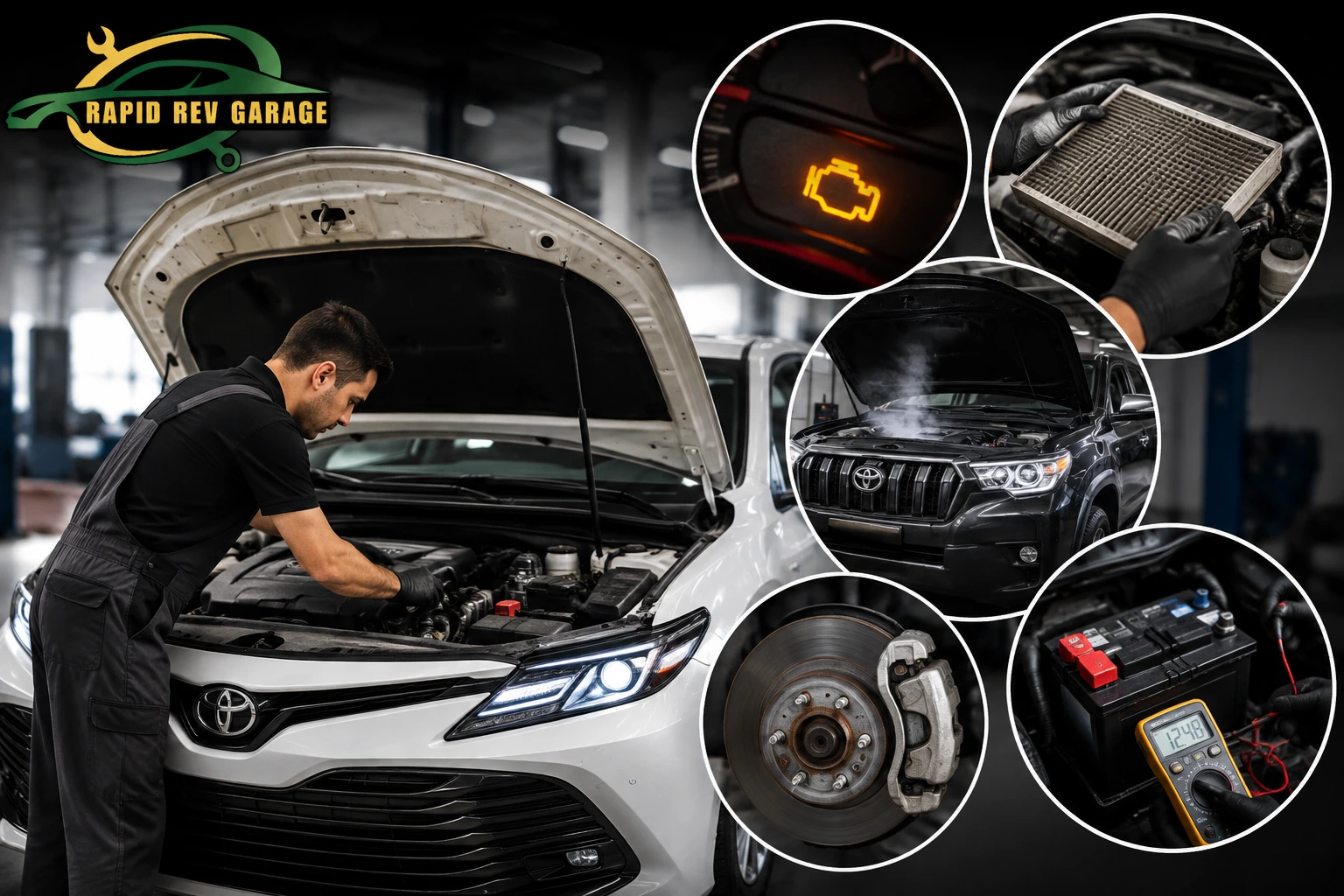
Toyota problems in Dubai show up in familiar patterns. Overheating. Weak air conditioning. Battery failure. Transmission trouble. Worn brakes. Suspension noise. Engine performance that just isn’t what it used to be.
The climate is the real culprit here. Extreme heat, dust, heavy traffic, short trips, and AC running non-stop all wear down the same handful of parts. In a milder climate, those parts would last years longer.
Watch for the early signs. A new noise. A warning light on the dash. Weaker acceleration. Gear shifts that feel harder than usual. A temperature gauge creeping up. AC that can’t quite keep up anymore.
Don’t ignore these. Act on them.
A proper diagnostic inspection is the only real way to know what’s going on. It tells you whether you’re dealing with routine maintenance or something bigger.
Stick to a qualified workshop. Follow Toyota’s recommended service schedule. Do both, and you’ll avoid most of the expensive breakdowns that catch other drivers off guard.
Table of Contents
- Problem Overview: Why Toyota Owners in Dubai Face Certain Issues
- Common Symptoms You Should Never Ignore
- What Causes These Toyota Problems?
- How Toyota Problems Are Diagnosed
- What Happens During the Repair Process?
- Risks of Ignoring Toyota Problems
- Can You Continue Driving?
- How Long Does Toyota Repair Take?
- What Determines Toyota Repair Costs?
- How to Prevent Toyota Problems
- Dubai-Specific Toyota Maintenance Advice
- Why Choose Rapid Rev Garage?
- Frequently Asked Questions
- Related Services
- Final Call-to-Action
Why Toyota Owners in Dubai Face Certain Issues
Toyotas have a reputation for being tough, and that reputation’s mostly earned. But durable doesn’t mean immune — like any car, a Toyota develops issues as parts age, fluids break down, and the mileage adds up.
Dubai’s environment adds its own layer on top of that. Summer heat gets genuinely extreme, traffic keeps cars crawling at low speeds for long stretches, the AC’s often running almost nonstop, and dust works its way into filters, cooling components, and electrical connections over time.
Some Toyota Problems in Dubai really are just normal wear catching up with the car. Others only become noticeable because the local climate pushes things along faster than they would elsewhere.
Common issues tend to include:
- Engine overheating
- Weak or ineffective AC
- Battery and charging problems
- Transmission hesitation or hard shifting
- Brake noise and reduced braking performance
- Suspension knocking and vibration.
- Engine oil consumption
- Check engine warning lights.
- Starting difficulties
- Electrical faults
- Cooling-system problems
- Poor fuel economy
The point isn’t just naming the symptom, though. It’s tracking down what’s actually causing it before a small, cheap fix turns into a much bigger repair.
Common Symptoms You Should Never Ignore
Most Toyota faults give some warning before they turn serious. Catching these early is usually what keeps Toyota Problems in Dubai from turning into an unexpected breakdown.
Engine-related symptoms
Keep an eye out for:
- Rough or unstable idling
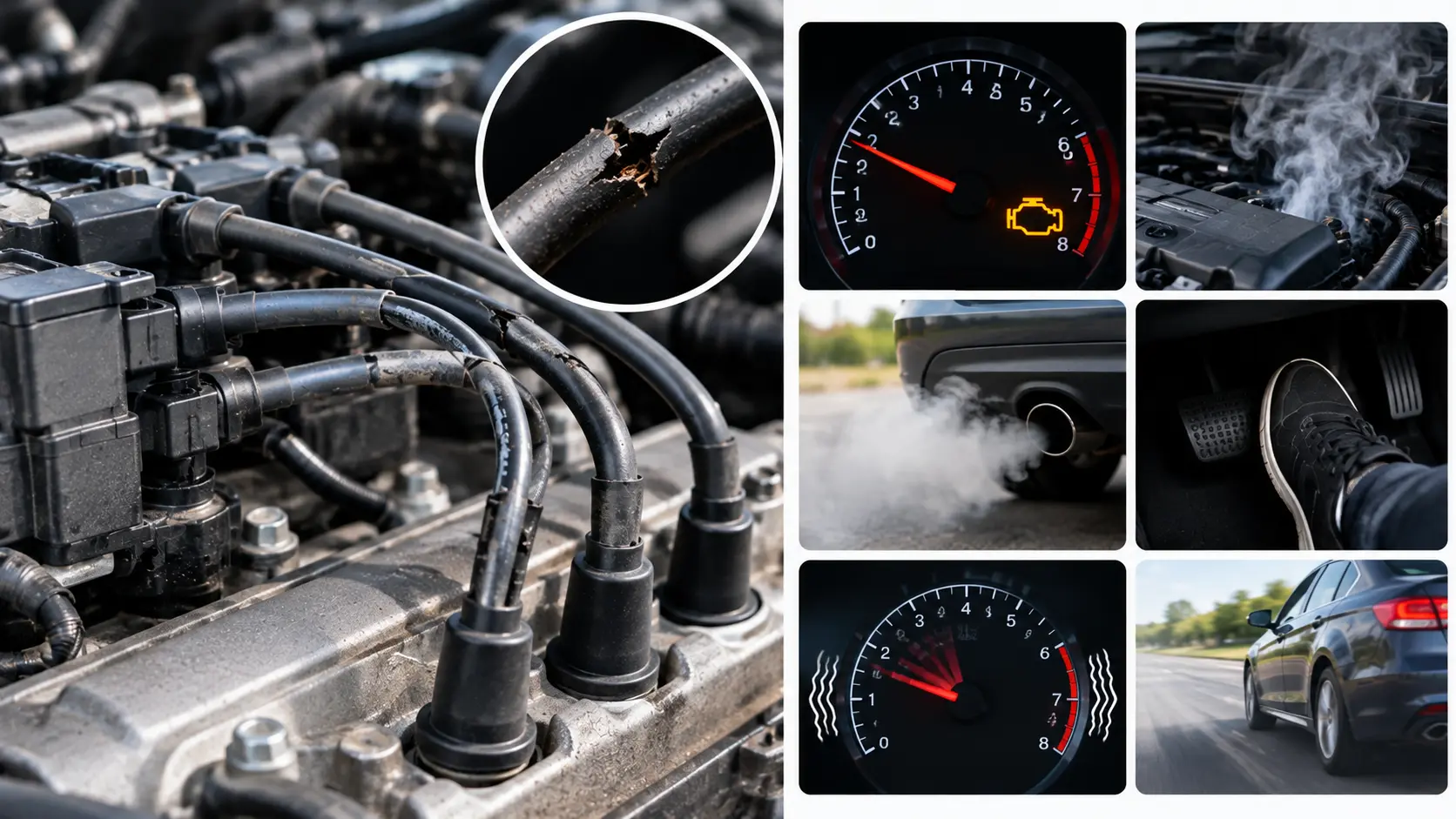
- Ticking, knocking, or rattling noises
- Reduced acceleration
- Excessive oil consumption
- Engine vibration
- Overheating
- Difficulty starting
- Check engine light
A car that suddenly loses power or starts overheating needs attention right away, not “when you get a chance.”
Transmission symptoms
Transmission trouble tends to show up as:
- Hard gear changes
- Delayed engagement
- Jerking when accelerating
- Slipping between gears
- Unusual whining or humming
- Difficulty selecting reverse
- Shaking during low-speed acceleration
Worth noting: these symptoms aren’t automatically the transmission’s fault. Low fluid, an electronic glitch, worn mounts, or even an engine issue can all mimic the same behavior.
AC and cooling symptoms
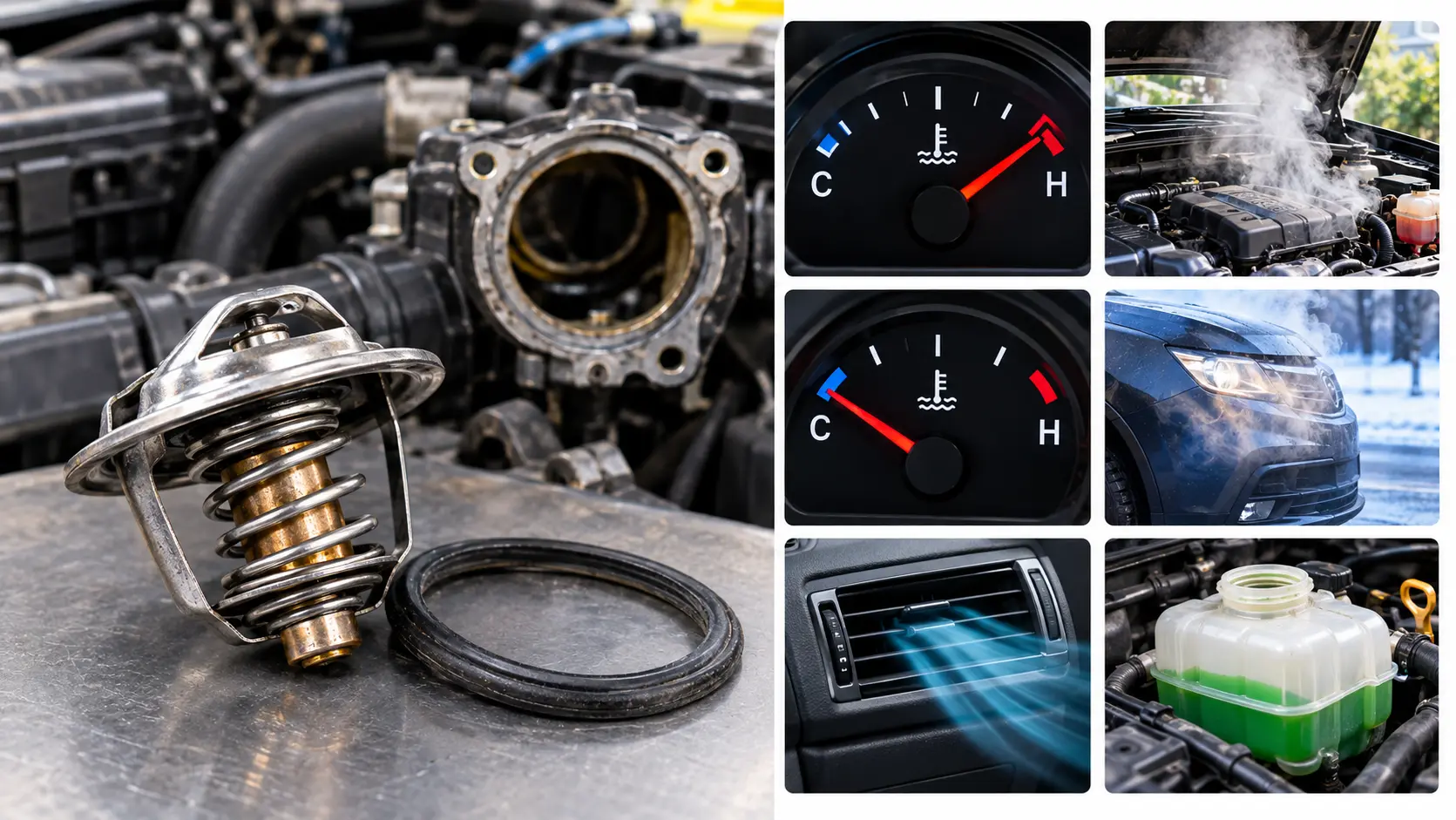
Dubai drivers run their ACs aggressively; therefore, cooling issues tend to be spotted quickly. Look for warm air, not cold, weak airflow, strange sounds from the compressor, uneven cooling, and performance that goes off sharply when the car’s stopped and idling.
What Causes These Toyota Problems?
There’s rarely just one reason behind Toyota Problems in Dubai. Age, mileage, how well it’s been maintained, driving conditions, and the specific model all play a part.
Extreme heat
High temperatures pile extra stress onto batteries, cooling systems, rubber parts, fluids, and the electrical system generally.
Heavy traffic
Constant stop-and-go driving builds up heat and puts extra demand on brakes, transmissions, cooling systems, and the AC.
Continuous AC operation
Running the AC for hours on end adds real load to the compressor, condenser, cooling fans, electrical system, and engine.
Dust and contamination
Dubai’s dust works its way into air filters, condensers, and airflow paths, and settles around components it really shouldn’t.
Delayed maintenance
Skipping oil changes, coolant checks, transmission servicing, brake inspections, or filter swaps lets small issues turn into expensive ones.
Normal component wear
Belts, hoses, brake parts, suspension components, batteries, mounts, and seals all eventually wear out, even on a Toyota that’s been well looked after.
How Toyota Problems in Dubai Are Diagnosed
Getting the diagnosis right is one of the most important parts of any repair, arguably more important than the repair itself.
A technician shouldn’t just swap a part because a warning light came on or a particular noise showed up. The actual cause needs to be confirmed first.
A typical inspection usually covers:
- Customer symptom assessment — asking when it happens: starting, acceleration, braking, idle, or highway speed.
- Visual inspection — checking for leaks, damaged wiring, worn parts, loose connections, and fluid condition.
- Computer diagnostics — pulling stored fault codes with a proper scanner for extra context.
- Fluid inspection — engine oil, coolant, brake fluid, and transmission fluid, depending on the symptoms.
- Mechanical testing — pressure, electrical, temperature, or mechanical checks on specific components.
- Road testing — driving the car, when it’s safe to, actually to reproduce the complaint.
For trickier Toyota Problems in Dubai, combining computer diagnostics with an actual physical inspection tends to be far more reliable than trusting fault codes on their own.
What Happens During the Repair Process?
Once the cause is confirmed, a good technician explains the recommended repair and separates what’s urgent from what can wait as preventative maintenance.
An overheating Toyota, for example, might need a full cooling-system inspection rather than just a new thermostat. A transmission shifting harshly might call for a fluid check, electronic diagnosis, or mechanical testing before anyone talks about major transmission work.
Depending on what’s found, repairs can involve:
- Component replacement
- Fluid or filter replacement
- Cooling-system repairs
- Battery or charging-system repair
- Brake component replacement
- Suspension repairs
- Electrical troubleshooting
- AC system repair
- Engine repairs
- Transmission servicing
A proper repair process also includes testing afterward to actually confirm the original symptom’s gone, not just assuming it is.
Risks of Ignoring Toyota Problems
Brushing off Toyota Problems in Dubai just because the car’s still running can end up costing a lot more down the line.
A small coolant leak can eventually lead to overheating. A worn brake component chips away at braking performance. A weak battery can leave you stranded at the worst possible time, and a transmission issue left alone can get considerably more expensive if you keep driving on it.
Some Toyota Problems in Dubai also get genuinely harder to diagnose once secondary components start getting affected too.
If a warning light comes on, a new noise shows up, or the car starts behaving differently, getting it looked at early is almost always the safer call.
Can You Continue Driving?
It really depends on what you’re dealing with.
Driving carefully to a workshop is usually fine if the issue’s minor and the car’s still safe to operate. But a few symptoms deserve to be treated as urgent, not “I’ll deal with it later.”
Stop driving and get help if you notice:
- Severe engine overheating
- Smoke or steam
- Major coolant or oil leakage
- Significant loss of braking ability
- Severe steering problems
- Sudden loss of engine power
- Strong burning smells
- Loud internal engine knocking.
- Serious transmission failure
- Multiple critical warning lights
If the Toyota genuinely isn’t safe to drive, roadside assistance is a smarter move than trying to nurse it to a workshop yourself.
How Long Does Toyota Repair Take?
How long it takes really comes down to what’s actually wrong and whether the parts are on hand.
Simple maintenance can be done in under an hour, while brake, battery, AC, suspension, or electrical work tends to take longer depending on the car and what the diagnosis turns up.
More involved engine or transmission repairs can eat up considerably more workshop time.
A good garage will usually give you a repair-time estimate once they’ve actually diagnosed the issue, rather than promising a completion time before they know what they’re dealing with.
What Determines Toyota Repair Costs?
Sorting out Toyota Problems in Dubai doesn’t come with one fixed price — a few things move the number around.
Vehicle model and year
A Corolla, Camry, RAV4, Land Cruiser, and Prado can all have very different parts costs and labor requirements.
Fault severity
A minor sensor or hose swap is obviously a different job from an engine or transmission repair.
Parts selection
Genuine, OEM, and aftermarket parts all come with their own price points and availability.
Diagnostic complexity
Electrical faults and intermittent issues can take much more diagnostic time than a straightforward mechanical fix.
Additional damage
A problem that’s been left too long can end up damaging other components along the way, which adds to the total bill.
The best move is always to ask for a clear diagnosis and an itemized estimate before signing off on anything major.
How to Prevent Toyota Problems
Staying ahead of maintenance matters even more for a car dealing with Toyota Problems in Dubai’s climate daily.
Stick to the manufacturer’s recommended schedule, and pay attention to how the car’s behaving between services too.
Worth doing regularly:
- Check engine oil regularly.
- Inspect coolant levels and cooling-system components.
- Replace air filters when required.
- Keep the AC system properly maintained.
- Check battery condition before summer.
- Inspect brake pads and discs regularly.
- Check tire pressure frequently.
- Inspect belts and hoses.
- Service the transmission according to the appropriate maintenance requirements.
- Respond promptly to warning lights.
- Do not ignore unusual noises or vibrations.
Catching things early through regular inspection is usually what keeps a developing issue from turning into a roadside emergency.
Dubai-Specific Toyota Maintenance Advice
Dubai’s climate genuinely deserves its own section when it comes to planning maintenance.
Through the hottest months, keep half an eye on the temperature gauge and make sure the cooling system’s actually doing its job. A healthy radiator, coolant system, thermostat, cooling fan, and water pump are all pulling their weight to keep engine temperature under control.
The AC needs attention too. If cooling performance’s been slipping gradually, don’t wait until it gives out entirely in the middle of peak summer.
Battery condition matters more here than most places — extreme heat shortens battery life noticeably, so a battery that’s starting to feel weak on startup deserves a proper test rather than repeated jump-starts.
Dust is the other local factor worth mentioning. Air filters and AC-related components are worth inspecting more often if the car regularly travels through dusty areas.
If you’re regularly searching for a garage near me because your Toyota keeps developing the same recurring issues, finding a workshop that actually understands Dubai’s driving conditions makes both diagnosis and prevention a lot easier.
Why Choose Rapid Rev Garage for Toyota Repair?
Rapid Rev Garage focuses on getting the diagnosis right rather than just swapping parts based on a guess. Toyota owners get a proper, systematic inspection covering the engine, transmission, electrical system, AC, brakes, suspension, and whatever else is relevant to the symptom.
The goal’s simple: find the actual cause, explain what repair it actually needs, and help you understand what has to be handled now versus what can reasonably wait.
That kind of experienced, methodical approach makes a real difference when a Toyota’s showing an intermittent fault, several warning lights at once, an odd noise, or a problem that’s already been “fixed” once without the symptom actually going away.
Frequently Asked Questions
Q1: What are the most common Toyota problems in Dubai?
Toyota Problems in Dubai commonly include AC trouble, battery failure, overheating, transmission concerns, brake wear, suspension problems, electrical faults, oil consumption, and general engine performance issues.
Q2: Does Dubai’s heat cause Toyota problems?
Extreme heat adds real stress to batteries, cooling systems, AC components, fluids, rubber parts, and the electrical system. Staying on top of maintenance goes a long way toward reducing heat-related failures.
Q3: How often should I service my Toyota in Dubai?
Stick to the maintenance schedule for your specific Toyota model and engine. Driving conditions, mileage, age, and how the car’s actually used can all shift what’s appropriate.
Q4: Why is my Toyota overheating in Dubai?
Possible causes include low coolant, a cooling-system leak, radiator trouble, a faulty thermostat, water-pump issues, a failing cooling fan, or another engine-related fault. Proper diagnosis is really the only way to know which one it is.
Q5: Can I drive my Toyota with the check engine light on?
If it’s steady and the car’s driving normally, book a diagnostic inspection when you reasonably can. A flashing light, severe shaking, major power loss, or other serious symptoms deserve more urgency than that.
Q6: When should I call roadside assistance?
Consider calling if your Toyota can’t be driven safely—overheating, a serious electrical failure, a breakdown, major tire damage, or anything else that’s left the car immobilized.
Related Services
If your Toyota’s showing signs of a mechanical or electrical problem, these services may be relevant:
- Toyota engine diagnostics
- Engine repair
- Toyota AC repair
- Battery replacement
- Car electrical repair
- Transmission repair
- Brake repair
- Suspension repair
- Cooling-system repair
- Car diagnostics
- Car maintenance
- Roadside assistance
- Car recovery
For broader repair information and maintenance guidance, Rapid Rev Garage can also point you toward the right kind of professional inspection for your car.
Conclusion
Don’t let a little Toyota problem escalate into a big breakdown. Overheating, poor air conditioning, battery problems, gearbox hesitation, warning lights, an odd noise, or something completely different- a competent diagnostic is what actually pinpoints the reason before it causes additional damage.
If you are experiencing any of these issues with your Toyota, contact Rapid Rev Garage for an inspection and repair estimate. And if it’s too dangerous to drive, call roadside assistance, rather than risking more damage or yourself.
Getting a Toyota problem diagnosed right is a whole lot easier to cure than one left to fester – get it looked at before a tiny problem becomes a costly one.