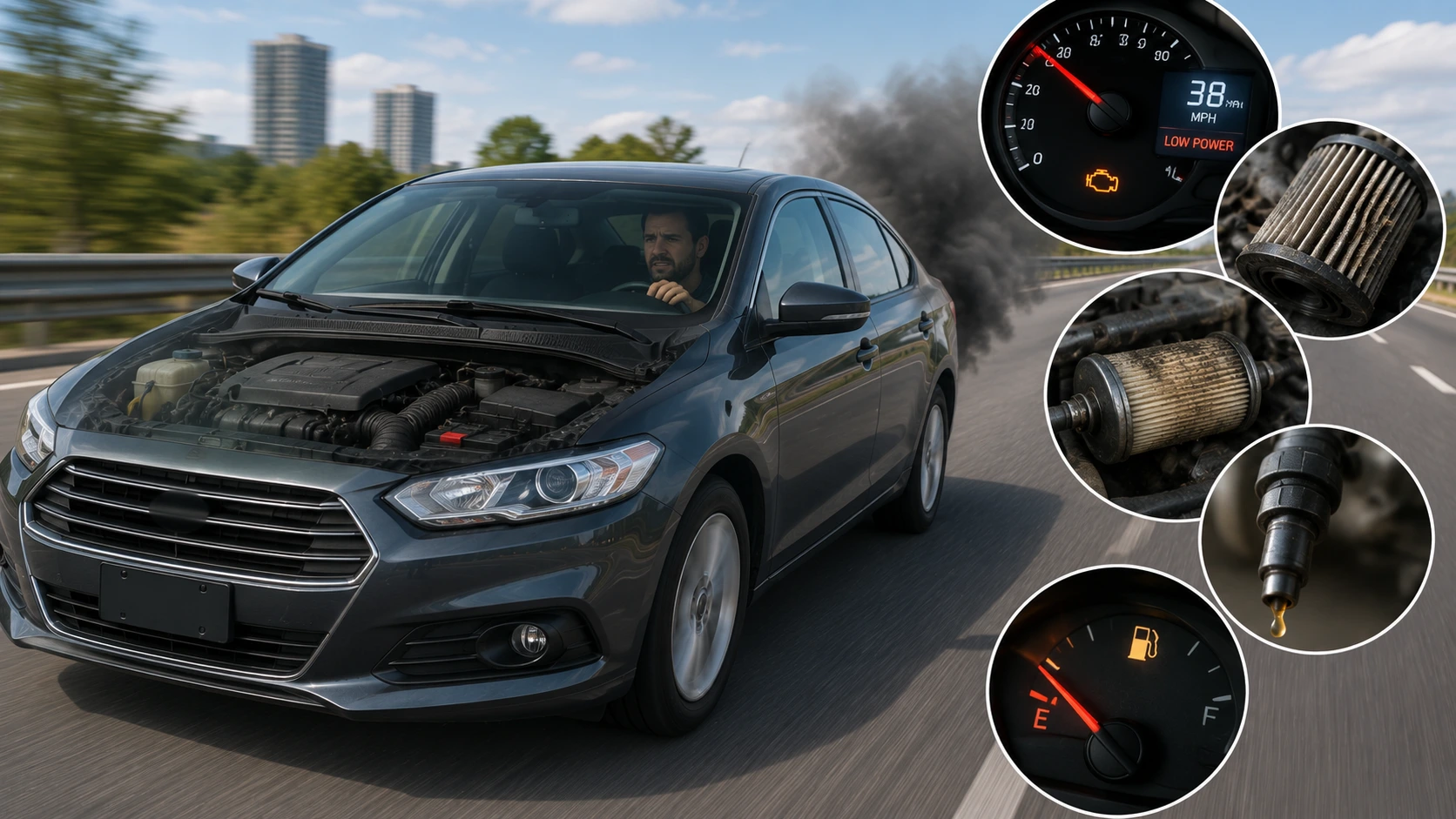
An engine losing power — the car that accelerates sluggishly, struggles on hills, can’t maintain highway speed, or delivers noticeably less response than it used to — is one of the more frustrating faults to experience because it rarely announces itself dramatically. Power loss is usually gradual: the engine that was responsive six months ago has become increasingly lethargic, and the driver has adapted to it so slowly that the true extent of the decline only becomes apparent when the car fails to keep pace with traffic on Sheikh Zayed Road or struggles to merge at speed.
At Rapid Rev Garage in Al Quoz, power loss is diagnosed with live data under load — not at idle — because most power loss causes only fully manifest when the engine is working hard.
Engine Losing Power — Quick Verdict
Engine losing power in Dubai is most commonly caused by one of six faults: a clogged air filter reducing combustion air, a failing fuel pump or clogged fuel filter delivering insufficient fuel pressure under load, a turbocharger losing boost pressure from a boost leak, worn seals, or a failing actuator, a mass airflow sensor contaminated with dust providing incorrect air data, spark plugs or ignition coils past their service life producing incomplete combustion, or a compression fault from worn piston rings or valve seat recession reducing the engine’s ability to generate useful work. In Dubai’s heat, dust, and stop-start conditions, air filter clogging and MAF sensor contamination are the most frequent causes — both directly connected to the fine particulate environment of Al Quoz. Turbo boost loss is the second most common category on turbocharged vehicles.
Table of Contents
- What Power Loss Actually Feels Like — Recognising the Pattern
- Air Intake Faults — The First Place to Look
- Fuel Delivery Failures Under Load
- Turbocharger Boost Loss — The Dubai Performance Thief
- Ignition System Causes of Power Loss
- Compression Faults — When the Engine Itself Has Worn
- Sensor and Engine Management Causes
- Why Dubai Creates Engine Losing Power Faster
- How We Find the Actual Cause at Rapid Rev Garage
- The Right Fix for Each Confirmed Cause
- What Happens If Power Loss Is Left Without Repair
- Is It Safe to Drive With Reduced Power?
- How Long the Repair Takes
- What the Repair Costs in Dubai
- Preventing Power Loss in Dubai
- Why Rapid Rev Garage?
- FAQ
- Conclusion
What Power Loss Actually Feels Like — Recognising the Pattern
Before any diagnosis, understanding exactly how the power loss presents helps identify which system is failing.
Gradual Loss Across All Driving Conditions
Power loss that has developed gradually over thousands of kilometres and is present in all driving conditions — acceleration, highway cruise, hill climbing — points toward a mechanical fault that has developed progressively. Compression loss from ring wear, gradual turbocharger deterioration, or progressive air filter clogging all produce this pattern.
Loss Only Under High Load — Fine at Light Throttle
Power loss that is absent at light throttle but appears under hard acceleration or highway load specifically points toward a fault that only limits output at maximum demand — a boost leak that only opens under pressure, a fuel pump that delivers adequately at low demand but fails under full-load fuel requirement, or an ignition coil that manages low-demand combustion but misfires under high-load conditions.
Sudden Loss That Appeared at a Specific Moment
Power that disappeared suddenly — during a specific drive rather than gradually over time — points toward an acute fault rather than progressive wear. A turbo actuator that has failed, an ignition coil that has stopped working entirely, a mass airflow sensor that has developed a sudden fault, or a vacuum line that has cracked under pressure all produce sudden rather than gradual power loss.
Power Loss With a Warning Light
An engine losing power symptom accompanied by a check engine light has fault codes stored that identify the cause or contributing system. A power loss with no warning light is a fault that has not yet crossed the ECU’s threshold for code generation — but both warrant investigation through the same diagnostic process.
Air Intake Faults — The First Place to Look
Air intake faults account for the highest proportion of engine losing power complaints in Dubai — and are the fastest to resolve.
Clogged Air Filter
A severely restricted engine air filter is the most common, most easily fixed, and most Dubai-specific cause of engine power loss. The air filter prevents particulate from reaching the engine — and in Al Quoz’s industrial dust environment, it clogs significantly faster than in any clean-air residential environment. A filter that has reached 60–70% blockage visibly restricts the airflow the engine needs for full-load combustion, directly reducing the maximum power available.
The Simple Check
An air filter inspection takes 30 seconds — remove the filter and hold it to the light. A filter where light passes freely through the media is adequate. A filter where minimal light passes and the face is dark grey to black is providing significant airflow restriction. This check costs nothing and resolves the most common power loss cause immediately on replacement.
Collapsed Air Intake Duct
The flexible duct between the air filter housing and the throttle body can collapse partially from the suction the engine creates at high load. A duct with a crack, a loose connection, or a soft spot in its wall that collapses under full throttle suction produces power loss exclusively under high load — the engine is losing combustion air precisely when demand is highest. Our car mechanic team inspects the full intake tract — filter, duct, and inlet connection — before any other investigation when power loss is the complaint.
Fuel Delivery Failures Under Load
Fuel delivery faults only reveal themselves under the high flow demand of full-throttle acceleration.
Failing Fuel Pump
The fuel pump delivers pressurised fuel from the tank to the fuel rail. A pump that is weakening delivers adequate fuel flow at light throttle but cannot maintain pressure under the higher flow demand of full-load acceleration. The driver experiences this as a power loss or stumble specifically under hard acceleration that may partially recover at lighter throttle.
The Fuel Pressure Test Under Load
A fuel pressure gauge installed in the fuel system and read during a full-throttle acceleration road test reveals whether pressure holds steady or drops under load. A pressure drop under full throttle confirms pump weakness — and the test distinguishes a pump fault from a fuelling sensor fault that produces the same symptom.
Clogged Fuel Filter
A clogged fuel filter restricts fuel flow to the injectors and produces the same symptoms as a failing pump — adequate flow at light load, insufficient flow at maximum demand. Fuel filter replacement is the lower-cost first step when fuel delivery restriction is suspected.
Turbocharger Boost Loss — The Dubai Performance Thief
The turbocharger compresses intake air, increasing the mass of air available for combustion and multiplying the engine’s potential power output. Any fault that reduces the boost pressure the turbocharger delivers directly reduces the engine’s power output proportionally.
Boost Leaks
A split intercooler hose, a cracked boost pipe, a poorly-seated clamp, or a failed boost solenoid diaphragm allows pressurised air to escape before reaching the engine. The boost gauge — where fitted — reads lower than normal, and the power loss is most pronounced at higher engine speeds where boost pressure is highest.
The Smoke Test for Boost Leaks
A boost leak test introduces low-pressure smoke or air into the intake tract to find the specific leak point. All leaks — including small ones that are barely audible at idle — produce visible smoke at their location. This test identifies the specific pipe or connection requiring repair before any components are replaced.
Worn Turbocharger Seals
A turbocharger with worn shaft seals allows oil to enter the intake air stream — visible as blue smoke from the exhaust alongside the power loss — and allows air to bypass the compressor wheel, reducing boost output. Shaft play from worn bearings reduces compressor efficiency alongside the seal fault.
Variable Geometry Turbocharger (VGT) Actuator Fault
Many current diesel and some petrol turbocharged engines use variable geometry turbines that change the blade angle to optimise boost at different engine speeds. A VGT actuator that has seized from carbon deposits or mechanical failure prevents the turbocharger from developing full boost under load. A diagnostic scan reads the VGT position and target discrepancy that confirms this fault. For any breakdown from a severe power loss, our roadside assistance covers Al Quoz and nearby Dubai areas.
Ignition System Causes of Power Loss
Ignition system wear reduces combustion efficiency on affected cylinders, directly reducing total power output.
Worn Spark Plugs
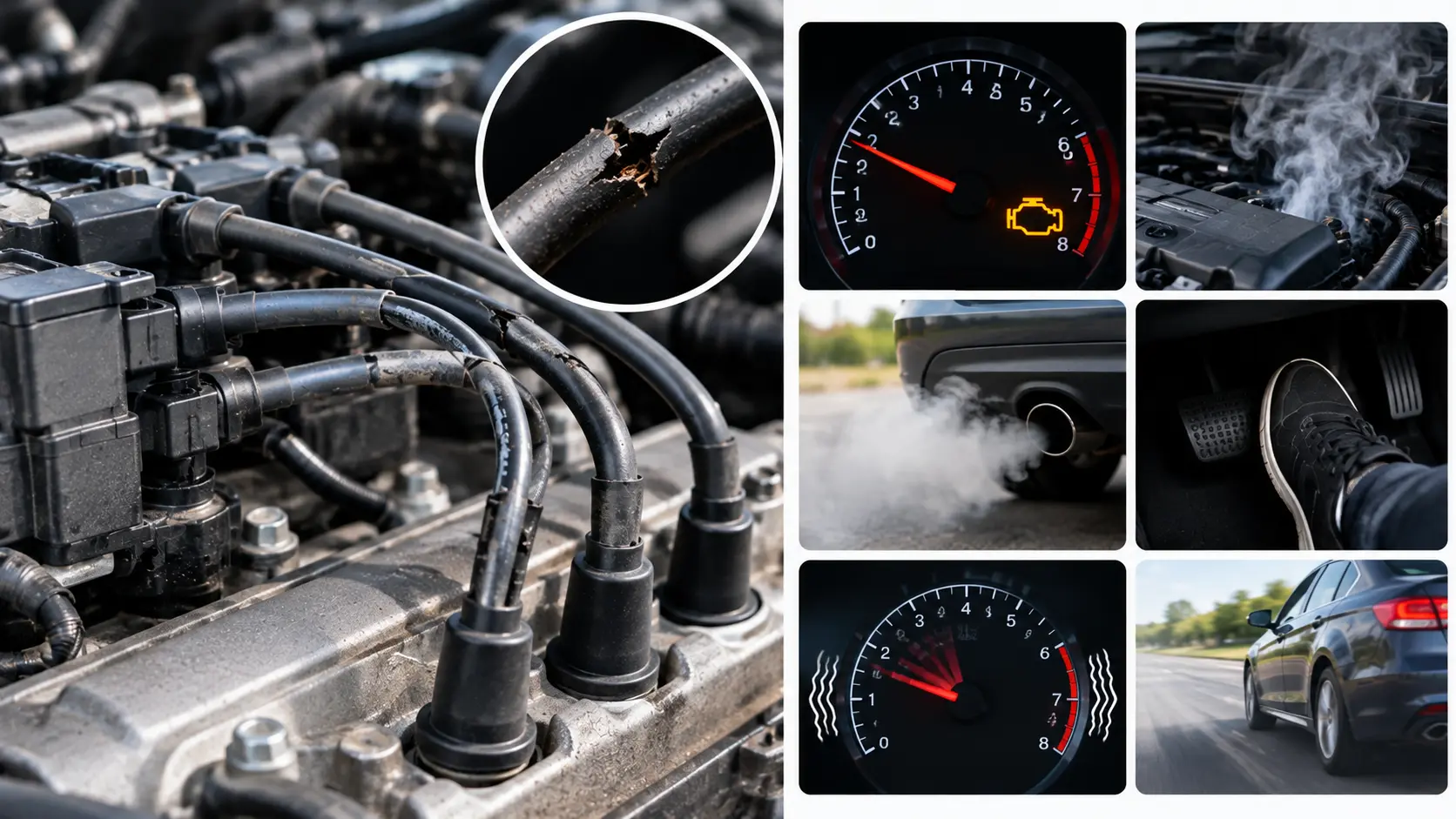
Spark plugs with worn electrodes require higher voltage to bridge the gap and produce a spark. At high engine loads, the combination of high cylinder pressure and worn electrode gap can cause intermittent misfires — incomplete combustion events that reduce power on that cylinder. All cylinders contribute to total power output — a misfiring cylinder reduces total output by its proportional share.
Failing Ignition Coils
A coil that produces insufficient spark energy — from insulation degradation or internal resistance increase — misses combustion events under high load when the cylinder pressure is highest and the spark most difficult to initiate. The power loss from a failing coil is often load-dependent — present under hard acceleration and absent at cruise — because the coil manages low-load ignition but fails under the higher voltage demand of high-load conditions.
Compression Faults — When the Engine Itself Has Worn
Compression is the foundation of power production. An engine with low compression on one or more cylinders cannot produce its rated power regardless of fuel quality, ignition timing, or boost pressure.
Worn Piston Rings
Piston rings that have worn allow combustion pressure to bypass into the crankcase rather than pushing the piston down. Power loss from ring wear is gradual and progressive — typically accompanied by increasing oil consumption as oil passes through the worn ring gaps in the opposite direction during the intake stroke.
Valve Seat Recession
Valve seats that have recessed into the cylinder head — from heat damage or from sustained operation without the lead that older engines were designed around — produce a valve that no longer seals fully. Combustion pressure escapes past the unsealed valve on every cycle, reducing compression and power.
Our car service packages include air filter inspection, plug condition check, and a power assessment road test at every major service.
Sensor and Engine Management Causes
Sensor faults produce power loss by providing incorrect data to the ECU — the engine runs less efficiently than it should based on false measurements.
MAF Sensor Contamination
A mass airflow sensor contaminated with Al Quoz industrial dust reports incorrect air mass readings to the ECU. The ECU uses this data to calculate fuel injection quantity — incorrect data produces incorrect fuelling and suboptimal combustion efficiency, reducing power output. MAF contamination typically produces a power loss that is accompanied by slightly rough running and possible fuel economy reduction.
Oxygen Sensor Degradation
An oxygen sensor past its service life provides increasingly sluggish and inaccurate exhaust gas composition feedback. The ECU’s closed-loop fuel management operates in an increasingly wide correction range as the sensor deteriorates, losing the precise fuelling control that maximises combustion efficiency and power output.
Why Dubai Creates Engine Losing Power Faster
Dubai’s environment specifically accelerates all six causes of engine losing power through dust, heat, and driving pattern.
Dust Clogs Filters and Contaminates Sensors Faster
Al Quoz industrial dust clogs air filters at a rate that residential-area dust never produces. The same fine particulate contaminates MAF sensors, affecting their calibrated output in ways that develop over thousands of kilometres. Both causes are directly amplified by Dubai’s specific air quality in the workshop and commercial driving zones where many Dubai drivers regularly travel.
Heat Degrades Turbocharger Seals and Bearings
Turbocharger components operate at extreme temperatures under any conditions — but Dubai’s ambient heat raises their baseline temperature before acceleration even begins. Turbo bearing grease degrades faster. Silicone boost hoses harden and crack faster. VGT actuator mechanisms seize from carbon faster in the high-temperature environment of Dubai’s sustained summer heat.
Oil Degradation Affects Compression, Rings, and Valve Stems
Oil that is past its effective service life contributes to ring wear, valve stem seal hardening, and carbon accumulation — all of which directly reduce compression and power. The Dubai stop-start heat that degrades oil faster than European conditions is therefore a contributor to multiple categories of power loss simultaneously.
How We Find the Actual Cause at Rapid Rev Garage
The diagnostic road test is conducted under the actual load conditions that produce the power loss — not at idle.
Road Test Under Load First
The diagnostic road test specifically replicates the conditions the driver describes — hard acceleration, highway merge, hill climb. Power loss that is only present under load is not visible on a workshop bay idle scan. The road test is conducted with a diagnostic scan running live data — MAF output, fuel trims, boost pressure, knock events, misfire counters — to capture the fault at the conditions where it appears.
Structured Component Assessment
Air filter inspection first — the 30-second check that resolves the most common cause. Fuel pressure under load. Boost pressure under load. Spark plug condition. Compression test where wear is suspected. This sequence moves from the most common and least invasive checks to the more involved assessments.
The Right Fix for Each Confirmed Cause
The repair is matched to the confirmed cause from the load-condition road test and structured assessment.
Air Filter Replacement
AED 150–400 and 15 minutes. Immediate power restoration in most cases where the filter is the confirmed cause.
Fuel Filter and Pump Service
Fuel filter replacement: 30–60 minutes. Fuel pump replacement: two to four hours depending on tank access.
Boost Leak Repair
Specific hose or pipe identified by smoke test is replaced or reseated. 30 minutes to two hours depending on the location and access complexity.
Turbocharger Service or Replacement
A turbocharger with worn seals or bearings requires professional assessment — cartridge replacement, full turbo replacement, or cleaning and seal kit depending on the specific condition confirmed.
Walnut Blasting and Carbon Cleaning
For carbon-induced power loss on direct-injection engines: three to four hours for intake valve cleaning and combustion chamber treatment. For exterior work needed alongside any engine repair, our car painting team handles colour-matched repairs at the same visit.
What Happens If Power Loss Is Left Without Repair
Most power loss causes worsen progressively — the engine loses more output with every additional kilometre driven without repair.
Progressive Deterioration in Most Cases
Most power loss causes worsen progressively rather than remaining stable. A clogging air filter gets more restricted with every drive. A failing fuel pump deteriorates under the stress of each full-demand pull. A turbocharger with worn seals accumulates damage with each use. Deferring the repair extends the fault’s deterioration timeline.
Risk of Stranding in Dubai Traffic
An engine losing power fault that progresses to the point of engine failure — a seized turbocharger, a catastrophic boost leak, a failed ignition coil — strands the vehicle. On Dubai’s highways, an unexpected loss of power is both dangerous and inconvenient.
Is It Safe to Drive With Reduced Power?
The answer depends on how severe the power loss is and whether it is accompanied by any warning lights or sudden changes.
Mild Gradual Power Loss — Driveable, Book This Week
A gradual power reduction without any warning lights or sudden change is safe for careful driving while the investigation is arranged. Avoid motorway merges and overtaking situations where full power is needed for safety.
Sudden Power Loss With Check Engine Light — Book Today
A sudden power reduction accompanied by a check engine light has a fault code stored that should be read the same day — particularly if the loss is significant enough to affect highway driving safety.
How Long the Repair Takes
Repair time depends on the confirmed cause — filter replacement is the fastest, compression repair the most involved.
Filter, Spark Plug, and Sensor Work
15 minutes to two hours depending on the confirmed component.
Fuel System and Boost System Work
Two to five hours for fuel pump or turbo hose work.
Major Engine Work
Compression-related repairs: multiple days. Turbocharger replacement: one to two days.
What the Repair Costs in Dubai
Cost depends entirely on the confirmed cause from the load-condition assessment.
Simple Causes
Air filter replacement: AED 150–400. Spark plug set replacement: AED 400–1,200. MAF sensor cleaning or replacement: AED 200–1,800 depending on vehicle. Fuel filter: AED 250–600.
Turbo and Major Repairs
Boost leak hose replacement: AED 200–800. Turbocharger cartridge or full replacement: AED 1,500–6,000+ depending on vehicle and turbo specification. Compression repair: AED 2,000–12,000 depending on extent. A written quote follows the diagnostic confirmation. Our mobile car mechanic covers Al Quoz and nearby Dubai areas for on-site air filter and initial assessment.
Preventing Power Loss in Dubai
Specific habits address the two most common causes of engine losing power in Dubai directly.
Air Filter at Dubai-Appropriate Intervals
Every 8,000–10,000 km for Al Quoz and commercial-area driving — twice as frequently as European factory schedules suggest. A clean air filter is the single most direct prevention for the most common power loss cause in Dubai.
Turbo Oil Supply Protection
Using the correct oil specification and changing it at 8,000 km intervals specifically protects the turbocharger bearing from the oil-starvation damage that produces boost loss and turbo failure. Our garage near me location in Al Quoz serves drivers from Business Bay, Jumeirah, Barsha, Satwa, Downtown, and the Sheikh Zayed Road corridor.
Why Rapid Rev Garage?
Engine losing power has causes ranging from a 15-minute air filter replacement to a multi-day turbocharger overhaul. Getting the diagnosis right before beginning any repair prevents the scenario where an air filter replacement is deferred and a fuel pump is replaced when the actual fault was a clogged filter and a MAF sensor all along. The load-condition road test with live data — not a stationary idle scan — is what reveals the faults that only appear when the engine is actually working.
FAQ — Engine Losing Power
These are the questions most frequently asked about this fault.
Why does my car lose power only on the highway and not in the city?
Highway driving demands maximum sustained power — full throttle for extended periods. Faults that only limit maximum output — a weak fuel pump, a boost leak, a worn turbocharger — are not apparent at the light throttle of city driving but become fully visible at highway demand. This load-dependent pattern immediately identifies the fault category.
Can a dirty air filter cause serious power loss?
Yes — a severely clogged air filter can reduce maximum power by 10–20%. In Dubai's dust conditions, air filter clogging to power-loss severity occurs faster than any European factory schedule accounts for.
How do I know if it's the turbo or something else causing power loss?
A boost pressure test — measuring actual boost against target boost under load — confirms turbo involvement. A boost gauge reading lower than normal under full acceleration is the simplest indicator before any professional testing.
Does power loss always trigger a check engine light?
Not always — many power loss causes develop gradually without generating fault codes, particularly air filter clogging, gradual turbo wear, and spark plug wear. A diagnostic scan may reveal stored codes; it may not. The road test with live data is necessary regardless of whether a light is present.
Is it normal for an older Dubai car to have less power than when new?
Some power reduction over high mileage is normal from natural wear. A noticeable, sudden, or rapidly progressing power reduction is not normal at any age and warrants investigation.
Conclusion
Engine losing power in Dubai traces to specific, diagnosable causes — each with a defined repair and a different cost and urgency level. Air filter, fuel system, turbocharger, ignition, compression, and sensor faults all produce power loss through different mechanisms that live-data road testing distinguishes correctly. Rapid Rev Garage in Al Quoz diagnoses every power loss complaint under load conditions — not at idle — before recommending any repair.
Rapid Rev Garage is in Al Quoz, serving drivers across nearby Dubai areas — Business Bay, Jumeirah, Downtown, Barsha, Satwa, and the Sheikh Zayed Road corridor. Book your appointment on WhatsApp or find us on Google Maps.
Rapid Rev Garage — Engine Losing Power | Al Quoz, Dubai