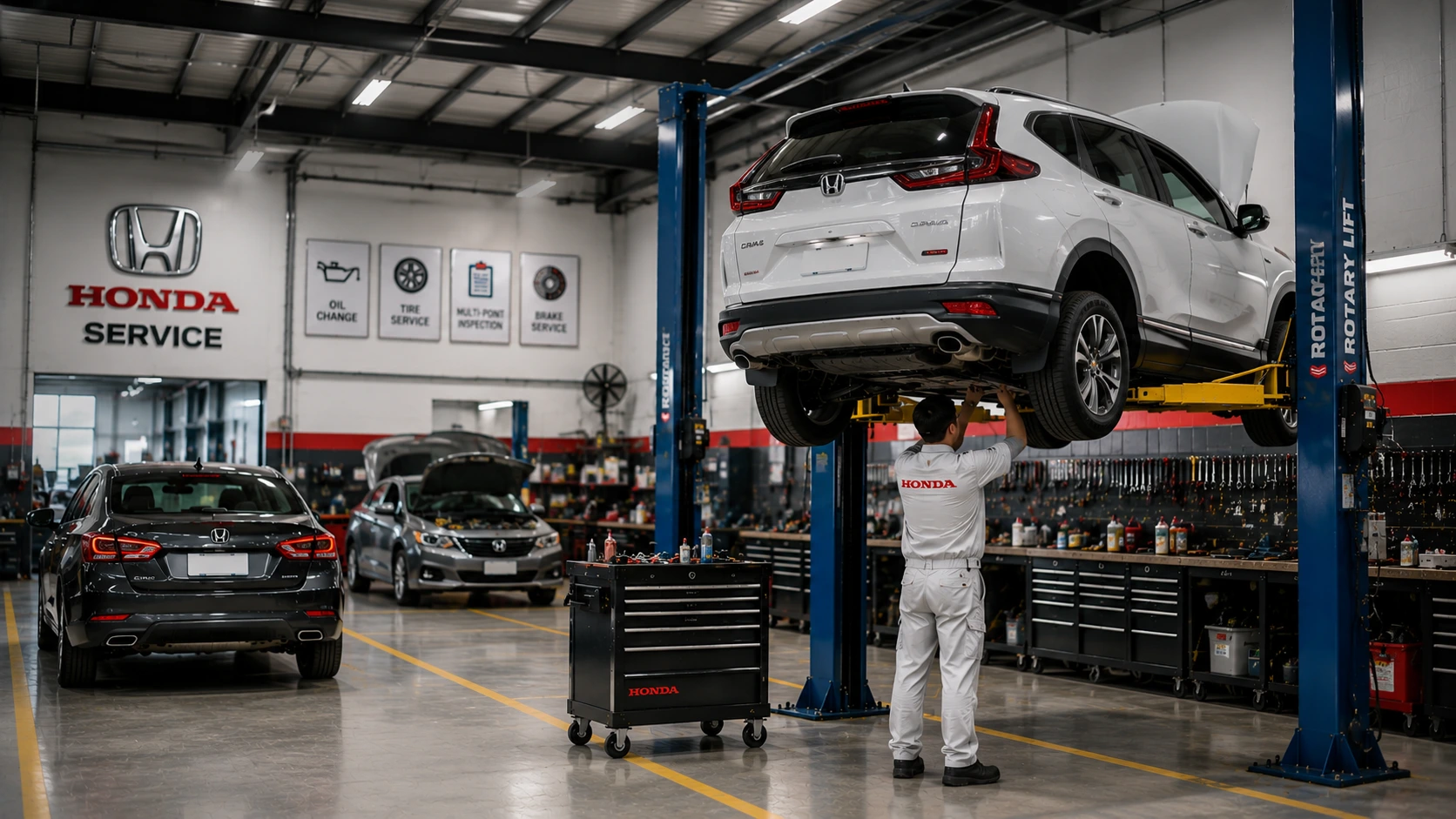
Honda has earned its reputation in Dubai’s market through reliability — the Civic, Accord, CR-V, Pilot, and HR-V are all common on UAE roads precisely because owners trust them to keep running with proper maintenance.
That reliability isn’t unconditional. It’s the product of engines, transmissions, and systems that respond well to correct maintenance and develop specific problems when the right specifications aren’t followed. Honda service in Dubai requires understanding what these vehicles need specifically — not a generic Japanese car approach applied uniformly across the range.
A proper Honda service in Al Quoz means HDS (Honda Diagnostic System) or equivalent diagnostic access, correct Honda fluid specifications, and the platform knowledge to identify the developing faults specific to each model before they become expensive repairs.
Honda Service Dubai — Why Honda-Specific Knowledge Matters
Honda vehicles use HDS (Honda Diagnostic System) as their diagnostic platform — a proprietary system communicating with every control unit across the vehicle network. Engine management, CVT transmission, ABS, airbags, body control, and Honda’s i-VTEC variable valve timing system all communicate through HDS.
A generic OBD scanner on a Honda Civic reads basic engine codes and misses faults in the CVT control module, the VTEC system’s oil pressure verification circuit, the body control module, and the SH-AWD management system on applicable models.
Proper Honda service diagnosis requires HDS or a high-grade Honda-compatible equivalent. Without it, Honda-specific fault diagnosis is incomplete — and incomplete diagnosis produces the parts-replacement cycle that costs owners money without fixing the underlying problem.
A Honda CR-V owner came to Rapid Rev Garage after a workshop had replaced the throttle position sensor chasing an erratic idle fault. The part cost AED 480 and didn’t resolve the problem. Our HDS diagnostic found a VTEC oil pressure switch fault — the system was logging insufficient oil pressure at VTEC engagement, causing the ECU to retard the engine management strategy in a way that produced the idle irregularity. Correct oil specification and switch replacement resolved it completely.
Honda Service — Model-Specific Requirements and Common Faults
Each Honda model has its own service profile and specific fault patterns that repeat in Dubai’s market. A proper Honda service workshop recognises these quickly from platform experience.
Honda Civic
The Civic is the most common Honda in Dubai and generates the highest volume of independent service visits.
1.5 VTEC Turbo Oil Dilution Concern
The 1.5-litre turbocharged VTEC engine in newer Civic variants has a known oil dilution concern in cold-weather markets. In Dubai, this specific issue is less pronounced — the climate means cold enrichment cycles are shorter and oil temperatures reach normal operating range faster.
However, Civic owners in Dubai using their cars primarily on very short trips — under 5 km — can still accumulate fuel in the oil from cold-start enrichment that doesn’t fully burn off before the engine is switched off again.
Oil service every 7,500–8,000 km maximum for the 1.5T in Dubai. Dipstick checks between services — if the oil level appears to have risen or smells strongly of fuel, the interval needs shortening further.
VTEC System Maintenance
The i-VTEC system uses oil pressure to engage the variable valve timing mechanism. Clean oil at the correct viscosity — Honda-specified 0W-20 or 5W-30 depending on variant — is critical for correct VTEC function.
A proper Honda service includes VTEC engagement verification via HDS live data — confirming the system is engaging at the correct RPM point with the correct oil pressure reading. A VTEC that’s engaging late or logging marginal oil pressure indicates either oil specification is incorrect or the oil pressure switch is developing wear.
CVT Transmission Service
Civic CVT variants use Honda’s own HFT (Human Friendly Transmission) CVT fluid specification — Honda HCF-2. This fluid is not interchangeable with other CVT fluids despite similar external appearance.
CVT fluid service interval in Dubai: every 40,000 km. Using a generic “CVT compatible” fluid in a Honda CVT causes progressive belt-pulley interface wear that develops into belt slip — a fault that feels like a transmission problem but is entirely a fluid specification issue.
Honda CR-V
The CR-V is Honda’s most popular SUV in Dubai — a family vehicle that sees high daily mileage in the city’s traffic.
1.5 VTEC Turbo in Higher Ambient Temperatures
The CR-V’s 1.5T engine faces greater thermal demand than the Civic application — the larger, heavier vehicle requires the engine to work harder in Dubai’s stop-start traffic. Oil service every 7,500 km maximum for CR-V variants in Dubai.
Coolant system inspection is particularly important on the CR-V — the 1.5T’s turbocharger generates sustained heat under the hood that accelerates coolant concentration drift. Refractometer testing at every Honda service confirms correct concentration.
Real-Time AWD System
CR-V models with Honda’s Real-Time AWD use a rear differential that has its own fluid — separate from the transmission and requiring specific Honda Dual Pump Fluid II specification. Rear differential fluid service every 40,000 km.
A proper Honda service for a CR-V AWD variant includes the rear differential as a specific line item — not as an optional extra. Workshops that service the engine and CVT without addressing the rear differential fluid are leaving 30% of the drivetrain unserviced.
Fuel System Carbon Deposits
Higher-mileage CR-V models develop fuel system carbon deposits on injector tips from Dubai’s stop-start cycle and the heat cycling that promotes deposit formation. A proper Honda service at 80,000+ km includes fuel injector condition assessment — either through HDS injector balance testing or physical inspection during a service.
Honda Accord
The Accord is Honda’s executive saloon and it’s well-suited to Dubai’s motorway network for longer daily commutes.
2.0T Engine Timing Chain
The Accord’s 2.0-litre turbocharged engine uses a timing chain rather than a belt — good news for long-term reliability in principle. However, timing chain tensioner condition should be assessed on higher-mileage examples.
A cold-start rattle clearing within 10–15 seconds on the 2.0T indicates timing chain tensioner wear. A proper Honda service assessment on a 2.0T Accord over 80,000 km includes timing chain noise assessment — catching tensioner wear before it allows chain slack.
10-Speed Automatic Transmission
The Accord’s 10-speed automatic requires Honda-specified ATF fluid — Honda ATF DW-1. Fluid service at 60,000 km in Dubai regardless of sealed-for-life guidance. Early signs of degraded fluid: slight hesitation between gears under light acceleration and occasional hunting between adjacent gears on gentle throttle.
LKAS and Honda Sensing Calibration
The Accord’s Honda Sensing suite — LKAS lane keeping, adaptive cruise control, collision mitigation braking — uses a forward-facing camera mounted near the rear-view mirror. Any windscreen replacement or work that disturbs the camera mounting requires recalibration via HDS before the Honda Sensing systems operate correctly.
A Honda service that includes windscreen work without addressing camera calibration returns a vehicle with driver assistance systems operating on incorrect reference data.
Honda Pilot
The Pilot is Honda’s three-row family SUV — practical, capable, and common among families in Dubai’s suburban areas.
V6 Engine Maintenance
The Pilot’s 3.5-litre naturally aspirated V6 is a well-proven engine with a specific maintenance consideration in Dubai. The engine uses Honda’s Variable Cylinder Management (VCM) system — similar in principle to Dodge’s MDS — which deactivates cylinders under light load.
VCM is oil-pressure dependent and oil-specification dependent. Honda 0W-20 full synthetic is the correct specification. Using 5W-30 interferes with VCM actuator hydraulics in the same way incorrect oil affects Porsche’s VarioCam Plus system — a thicker oil at the viscosity extremes doesn’t flow through the VCM actuator circuits correctly.
9-Speed Automatic Fluid
The Pilot’s 9-speed automatic uses Honda ATF DW-1. Fluid service at 60,000 km in Dubai. The 9-speed’s closely spaced gear ratios mean it’s constantly selecting between adjacent gears in stop-start traffic — the thermal load on the fluid is higher than in flowing highway use, and degradation to perceptible shift quality changes occurs faster without correct service intervals.
SH-AWD Maintenance on Higher Trims
Pilot models with Super Handling All-Wheel Drive (SH-AWD) have a specific rear differential that uses dedicated SH-AWD fluid — not standard differential oil. SH-AWD fluid service at 40,000 km in Dubai. The SH-AWD system’s torque vectoring function depends on correct fluid viscosity — degraded fluid causes reduced torque vectoring response and occasional SH-AWD warning lights.
Honda HR-V
The HR-V is the compact crossover in Honda’s Dubai range — used primarily in urban stop-start conditions.
CVT Sensitivity to Service Intervals
The HR-V’s CVT is more sensitive to service intervals than the larger Civic and CR-V units because it operates in a narrower power band — the smaller engine’s CVT works proportionally harder to manage the same stop-start load. CVT fluid service every 35,000 km for HR-V variants used primarily in city traffic.
Earth Dreams Engine Carbon Buildup
The HR-V’s 1.5-litre Earth Dreams naturally aspirated engine develops carbon deposits on intake valves over time — the direct injection variant more so than the port injection variant. A Honda service at 60,000+ km should include intake valve condition assessment for DI variants.
What a Proper Honda Service Should Cover
A complete Honda service covers every system Dubai’s conditions affect — not just the items that generate visible symptoms.
Engine Oil and Filter
Honda’s fluid specifications are specific — 0W-20 for most current VTEC and VTC engines, 5W-30 for older K-series applications. The Honda approval specification matters, not just the viscosity grade.
Oil service interval in Dubai: every 7,500–8,000 km for turbocharged models, every 8,000–10,000 km for naturally aspirated models. Honda’s Maintenance Minder system was calibrated for North American conditions — its intervals run too long for Dubai’s sustained heat.
CVT and Automatic Transmission Fluid
Honda HCF-2 for CVT-equipped models. Honda ATF DW-1 for automatic transmission models. Fluid service at 35,000–40,000 km for CVT, 60,000 km for automatic — regardless of Honda’s sealed-for-life guidance that doesn’t account for Dubai’s operating temperatures.
A proper car service for any Honda includes transmission fluid as a documented line item with the specific fluid specification recorded on the invoice.
Brake Fluid
Replacement every 18 months in Dubai — the standard two-year interval is too long given humidity cycling between air-conditioned cabins and 45°C exteriors. Honda’s brake fluid specification should be followed — not a generic DOT 3 substitute.
Air Filter
Physical inspection at every service in Dubai’s dust environment. A filter loaded by a shamal event can restrict airflow regardless of where the car sits on its service schedule.
VTEC System Verification
HDS live data confirmation of VTEC engagement at the correct RPM and oil pressure parameters. This takes minutes and catches VTEC oil circuit concerns before they develop into performance issues.
Full HDS System Scan
Complete control unit scan at every Honda service — engine, CVT or automatic, ABS, airbags, body control, Honda Sensing where equipped. Fault codes in body and comfort systems don’t always trigger dashboard warnings immediately.
Honda Service Costs at a Quality Independent in Dubai
Approximate figures for common Honda service work in Al Quoz:
- Annual major service — Civic or CR-V Quality independent: AED 350–600 | Dealer: AED 700–1,100
- CVT fluid service — Honda HCF-2 Quality independent: AED 400–650 | Dealer: AED 750–1,100
- 10-speed ATF service — Accord Quality independent: AED 500–750 | Dealer: AED 900–1,300
- Rear differential fluid — CR-V or Pilot AWD Quality independent: AED 250–400 | Dealer: AED 500–750
- Full HDS diagnostic scan Quality independent: AED 150–250 | Dealer: AED 280–450
These are approximate ranges — actual costs depend on model year, parts specification, and findings during the service visit.
Between Services — Owner Checks That Matter
Between scheduled Honda service visits, a few checks catch developing issues early.
Oil level monthly — Honda engines are generally well-sealed but the 1.5T Civic and CR-V can consume slightly on short-trip cycles in Dubai. A level that’s consistently dropping requires investigation rather than just topping up.
CVT behaviour — any change in smoothness under light acceleration, any surging at steady speed, or any hesitation on take-off is an early CVT fluid concern. Don’t wait for the scheduled service interval if these symptoms appear.
For owners needing support between services, a qualified mobile car mechanic with Honda HDS experience handles battery replacements, fault resets, and on-site diagnostics. Proper roadside assistance ensures Honda vehicles are recovered correctly when needed — particularly important for CVT-equipped models where incorrect towing technique stresses the transmission.
For paint damage from stone chips, UAE UV fading, or parking contact, professional car painting with Honda colour codes handles Lunar Silver, Sonic Grey Pearl, and Rallye Red finishes with correct preparation and clear coat chemistry.
A qualified car mechanic with genuine Honda platform knowledge handles the full scope of service and repair. For owners in Al Quoz and surrounding areas looking for a garage near me with real Honda HDS capability — the difference from a workshop applying generic Japanese car logic shows from the first diagnostic session.
FAQ
How often should I service my Honda in Dubai?
Every 7,500–8,000 km for turbocharged models, every 8,000–10,000 km for naturally aspirated — Honda's Maintenance Minder was calibrated for North American conditions and runs too long for Dubai's heat.
Does the Honda CVT need regular fluid changes in Dubai?
Yes — Honda HCF-2 fluid every 35,000–40,000 km. Generic CVT fluids cause progressive belt-pulley wear even when marketed as compatible.
What causes erratic idle on a Honda VTEC engine?
Often a VTEC oil pressure switch fault or incorrect oil specification — HDS diagnosis identifies the specific cause before any parts are ordered.
Can an independent workshop service a Honda under warranty in Dubai?
Yes — UAE consumer protection law permits servicing at any qualified workshop using correct specification parts and fluids without affecting manufacturer warranty.
What is the most common Honda fault in Dubai's market?
CVT fluid degradation from extended service intervals — causing belt-pulley wear that develops into slip and shudder symptoms that owners often attribute to mechanical transmission failure.
Conclusion
Proper Honda service in Dubai means HDS diagnostic access, correct Honda fluid specifications for every system — CVT, automatic, differential, and brake — and maintenance intervals calibrated for Dubai’s heat rather than North American conditions applied unchanged. The Hondas that stay reliable through 200,000 km in Dubai are the ones that get the right service at the right intervals.
Rapid Rev Garage in Al Quoz handles Honda service across the full model range — Civic, CR-V, Accord, Pilot, and HR-V — with HDS-compatible diagnostics and correct Honda specification fluids. Book your appointment on WhatsApp or find the workshop on Google Maps.