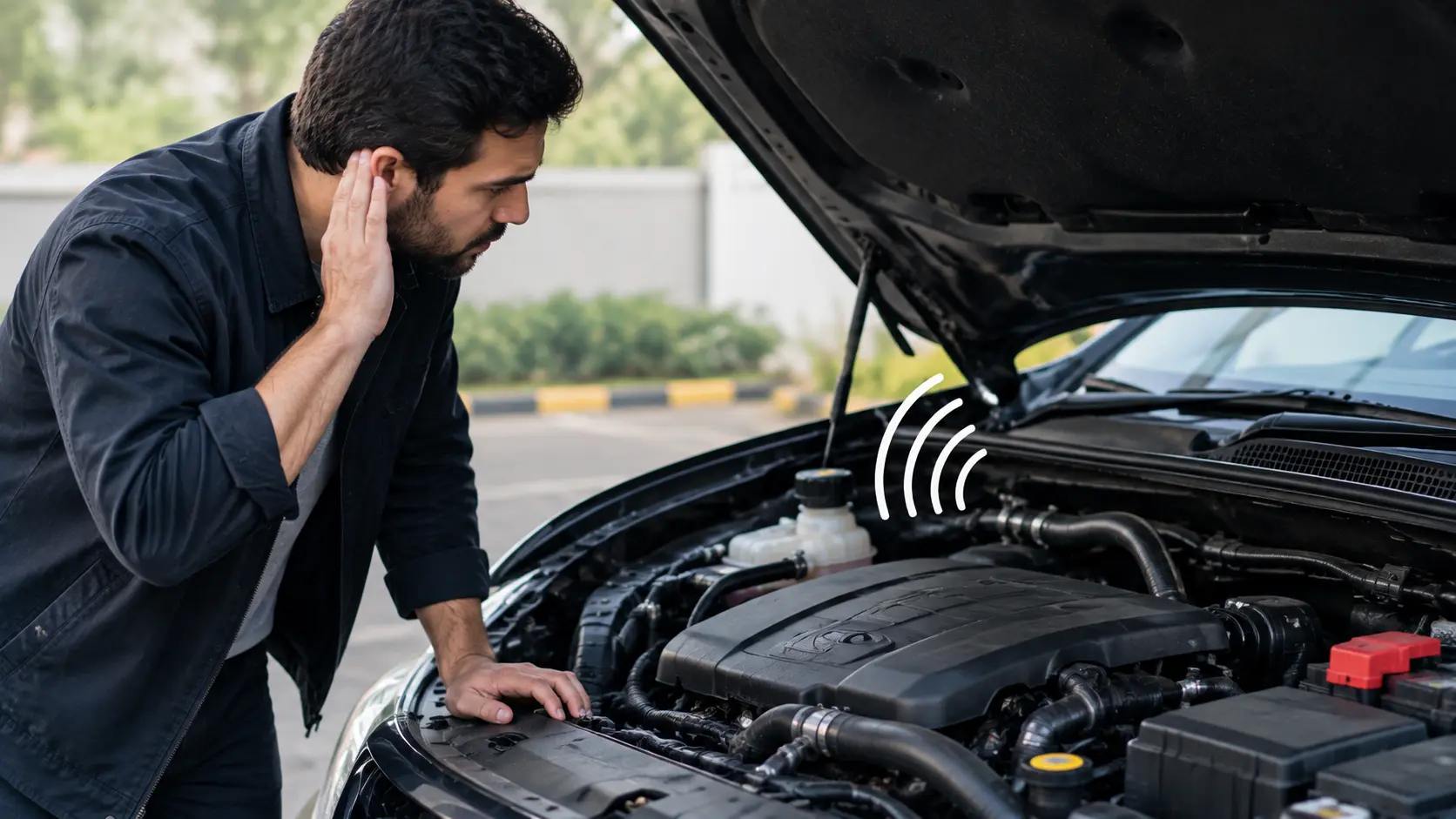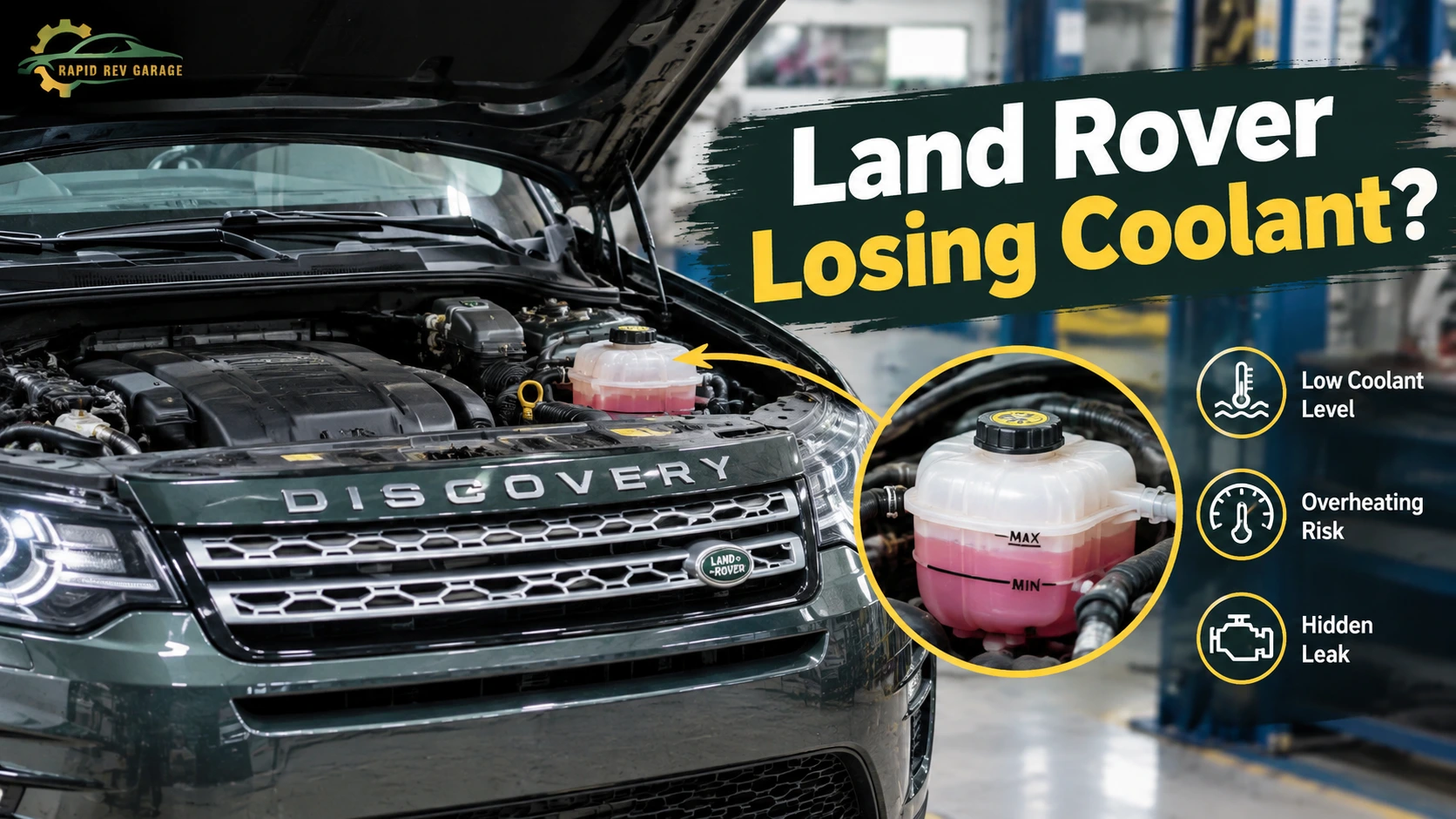
You top up the coolant. A week later, the tank is low again. There’s no puddle on the driveway and no wet patch under the car. So where is it going? This guide explains the hidden reasons, how mechanics track them down, and which repairs fix the problem for good.
Land Rover Losing Coolant With No Leak:
A Land Rover losing coolant without a visible leak usually has a hidden leak or an internal one. Hot engine parts can burn off small drips before they reach the ground. Common causes include a cracked expansion tank, a worn cap, a weeping water pump, and leaking pipes under the engine cover. Diesels often suffer from a faulty EGR cooler. A failing head gasket is another cause. Dubai’s heat puts extra stress on plastic cooling parts, so they crack sooner. A pressure test and a combustion leak test will find the cause. Fix it early, because driving on low coolant can overheat and ruin the engine.
Table of Contents
- Why Coolant Disappears With No Puddle Under Your Car
- Warning Signs Your Land Rover Coolant Level Is Dropping
- Common Causes of a Land Rover Losing Coolant Without a Puddle
- How Mechanics Find a Hidden Coolant Leak
- How a Land Rover Coolant Leak Gets Fixed
- What Happens If You Ignore Coolant Loss
- Is It Safe to Keep Driving With Low Coolant?
- How Long Coolant Leak Repairs Take
- What Affects the Cost of Coolant Leak Repair in Dubai
- How to Stop Coolant Loss Before It Starts
- How Dubai Heat Makes Coolant Loss Worse
- Why Choose Rapid Rev Garage for Coolant Leak Repair in Dubai
- Land Rover Coolant Loss FAQs
- Related Services for Your Land Rover
- Book Your Land Rover Coolant Check Today
Why Coolant Disappears With No Puddle Under Your Car
Your Land Rover cooling system is sealed. You shouldn’t need to add coolant between services. If the level keeps dropping, the liquid is escaping somewhere.
When there’s no puddle, the coolant usually goes one of two ways. It leaks onto hot engine parts and boils off. Or it leaks inside the engine and burns with the fuel.
The first is a hidden coolant leak. The second is an internal coolant leak. Both are common reasons for a Land Rover losing coolant, and both get worse with time.
Lots of owners search “land rover losing coolant” after topping up for the third time in a month. If that’s you, the good news is simple. The cause can be found. You just need the right tests.
Warning Signs Your Land Rover Coolant Level Is Dropping
Your car usually gives hints before the temperature gauge climbs. Watch for these signs:
- A “Coolant Level Low” message on the dashboard.
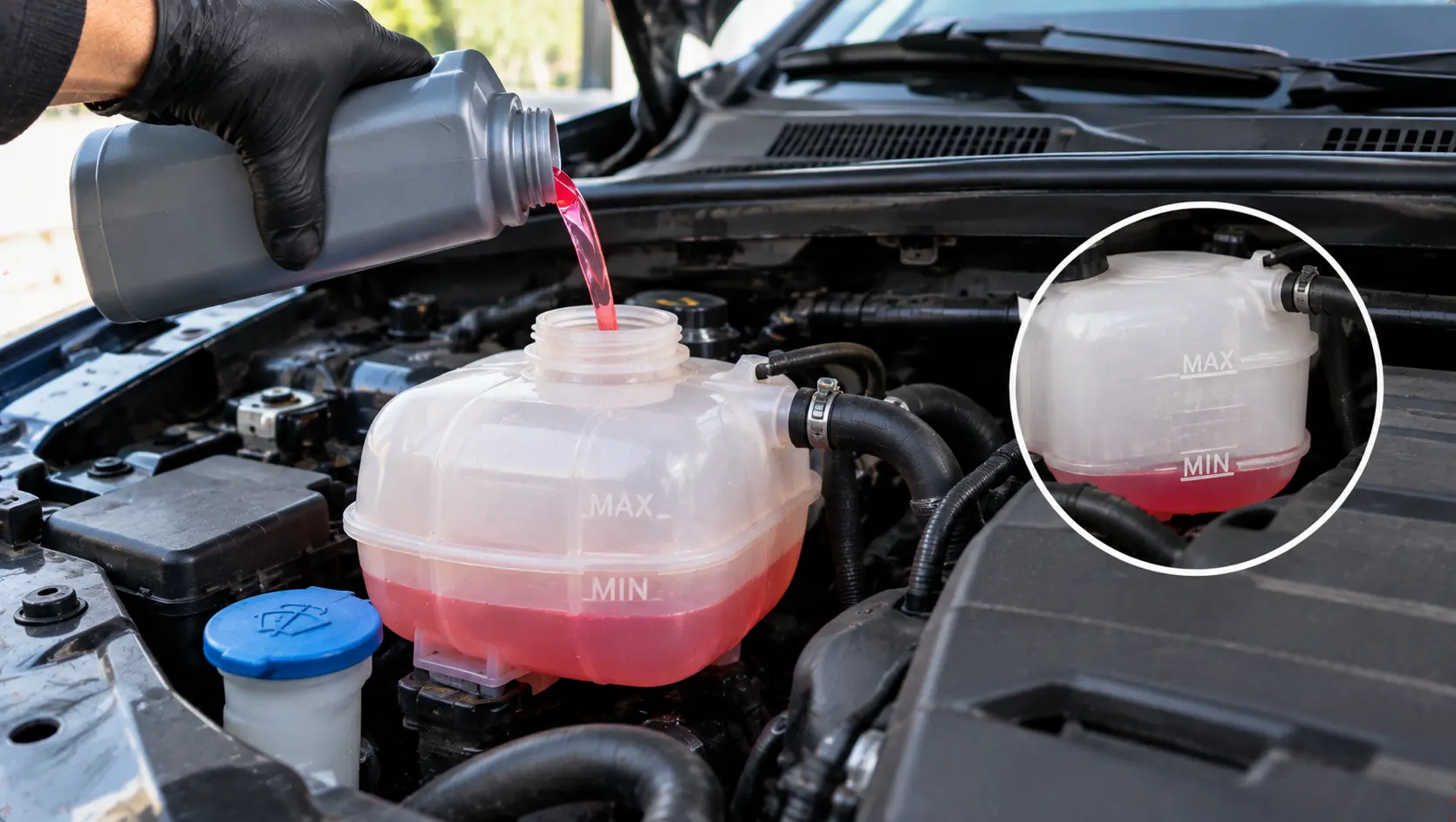
- The level in the Land Rover expansion tank sitting below MIN when the engine is cold.
- A sweet, syrupy smell after a drive, near the bonnet or inside the cabin.
- Sweet-smelling white smoke from the exhaust.
- Foggy windows or a damp front carpet.
- Dried white or pink crust around hoses, pipes or the tank.
- The temperature gauge creeping up in traffic.
Many drivers search “garage near me” at this point. Pick one with Land Rover experience. These engines hide leaks in hard-to-reach places.
Common Causes of a Land Rover Losing Coolant Without a Puddle
A small group of parts causes most cases of a Land Rover losing coolant with nothing on the floor. Here are the usual suspects.
Cracked Land Rover Expansion Tank
The expansion tank is the plastic coolant reservoir. Heat makes the plastic brittle over time. Tiny cracks form along the seams. Coolant then seeps out as vapour or dries on the hot engine. You’ll often spot a white or pink crust near the tank. This is one of the most common faults on Range Rover, Range Rover Sport and Discovery models.
Worn Expansion Tank Cap
The cap keeps the system at the right pressure. When its seal weakens, hot coolant escapes as steam. It’s a cheap part, but it’s often missed.
Leaking Coolant Pipes Under the Supercharger
On the 5.0 V8 and 3.0 V6 supercharged petrol engines, plastic coolant pipes sit under the supercharger. When they crack, coolant pools in the engine valley and evaporates. You can’t see it without removing parts.
Weeping Land Rover Water Pump
The water pump has a small drain called a weep hole. When the pump seal starts to fail, coolant seeps out slowly. On a hot engine, it dries before it can drip. Look for crusty trails below the pump.
Cracked Land Rover Thermostat Housing
Many Land Rover engines use plastic thermostat housings. They warp and crack after years of heat. The leak is usually small and hides behind other parts.
Leaking EGR Cooler on Diesel Models
Diesel engines like the TDV6 and SDV6 use an EGR cooler. It cools exhaust gas using engine coolant. If it cracks inside, coolant gets pulled into the engine and burns off. You may see white smoke but no leak at all.
Failing Land Rover Head Gasket
The head gasket seals the engine block to the cylinder head. When it fails, coolant leaks into the engine. This means coolant is entering the combustion chamber and burning with the fuel. Signs include white exhaust smoke, bubbles in the expansion tank, and overheating. Sometimes the oil turns milky.
Leaking Heater Matrix
The heater matrix is a small radiator behind the dashboard. When it leaks, coolant soaks into the carpet or turns into mist. You’ll notice foggy windows and a sweet smell in the cabin.
Air Trapped After a Coolant Service
Had your coolant changed recently? Air pockets may still be working their way out. The level drops as the air escapes. It should settle after a few drives. If it keeps dropping, there’s a real leak.
How Mechanics Find a Hidden Coolant Leak
Guessing wastes money. A proper diagnosis follows clear steps. Here’s what a good workshop checks when a Land Rover losing coolant comes in.
- Vehicle history. How fast is the level dropping? Any smoke, smell or overheating? Was the Land Rover losing coolant changed recently?
- Visual inspection. Engine covers come off. The tank, cap, hoses, Land Rover radiator, water pump, and thermostat housing are checked for crust or damp spots.
- Cooling system pressure test. A tool pumps the system to working pressure. If the pressure falls, there’s a leak. Hidden leaks often start dripping during this test.
- Cap pressure test. This checks if the cap holds pressure properly.
- UV dye test. Dye goes into the coolant. After a drive, a UV lamp shows exactly where coolant escapes, even tiny seeps.
- Combustion leak test. Also called a block test. It checks the coolant for exhaust gases. A positive result points to the head gasket, a cracked head, or the EGR cooler.
- Diagnostic scan. Software reads coolant temperature data, misfire codes, and sensor faults.
- Borescope and oil check. A small camera looks inside the cylinders for steam-cleaned pistons. The oil is checked for milky residue.
When you look for a car mechanic near me, ask if they run these tests. A quick top-up is not a diagnosis.
How a Land Rover Coolant Leak Gets Fixed
The repair depends on what the tests find. Here’s what each fix involves, plus the services that stop the problem coming back.
Expansion Tank and Cap Replacement
The system is drained and the old tank removed. A new tank and cap go in. This is a quick job on most models.
Water Pump and Thermostat Replacement
The pump is replaced with a new gasket. The thermostat is usually replaced at the same time. Both sit close together and wear out together, so this saves labour later.
Coolant Pipe Replacement on Supercharged Engines
The supercharger comes off to reach the pipes. Upgraded pipes are fitted where available. New seals and gaskets go in during reassembly.
EGR Cooler Replacement
The faulty cooler is swapped for a new unit. The intake is checked for coolant damage. Fault codes are cleared and the system is tested again.
Head Gasket Repair
The cylinder head comes off. It’s checked for warping and cracks, then machined flat if needed. A new gasket, head bolts, and seals are fitted. On some V6 diesel models, the engine has to come out first.
Heater Matrix Replacement
Part of the dashboard is removed to reach the matrix. It’s a long job, but it clears the smell and the foggy glass.
Services Every Coolant Repair Should Finish With
Every repair should end with these steps:
- A full coolant flush to remove old fluid and debris.
- A refill with Land Rover-approved long-life coolant at the right mix.
- Vacuum filling or careful bleeding to remove air pockets.
- A second pressure test to confirm the fix.
- A road test and a level check the next day.
What Happens If You Ignore Coolant Loss
Small coolant loss rarely stays small. Keep topping up without fixing it, and you risk:
- The engine overheating in traffic.
- A warped cylinder head from repeated heat spikes.
- A blown head gasket, even if the gasket was fine at first.
- Coolant mixing with oil and wearing out the bearings.
- Damage to the catalytic converter or DPF from burning coolant.
- A breakdown on the road in 45°C heat.
A Land Rover losing coolant today can need a new engine next summer. Early checks cost far less than late repairs.
Is It Safe to Keep Driving With Low Coolant?
It depends on how fast you’re losing it. If you add a little every few weeks and the gauge stays normal, short trips are usually fine while you book a check.
Stop driving right away if:
- The temperature gauge goes past the middle.
- A red coolant warning light comes on.
- You see steam or thick white smoke.
- The cabin smells sweet, and the windows fog up.
Pull over safely and switch off. Never open the expansion tank cap on a hot engine. The coolant is under pressure and can burn you badly.
If the car isn’t safe to drive, call roadside assistance instead of pushing on. For a Land Rover losing coolant slowly, book a diagnostic with Rapid Rev Garage in Al Quoz before it turns into a big repair.
How Long Coolant Leak Repairs Take
Repair time depends on where the leak is and how much needs to come apart.
| Repair | Typical Time |
| Diagnosis and pressure test | 1–2 hours |
| Expansion tank and cap | 1–2 hours |
| Water pump and thermostat | 3–6 hours |
| Coolant pipes (supercharged V8/V6) | 1–2 days |
| EGR cooler (diesel) | About 1 day |
| Heater matrix | 1–2 days |
| Head gasket | 4–7 working days |
Parts supply matters too. Common parts are usually in stock in Dubai. Some model-specific parts take a few days to arrive.
What Affects the Cost of Coolant Leak Repair in Dubai
Several things change the final bill:
- Model and engine. A V8 Range Rover costs more to work on than a smaller Evoque.
- Part location. Parts buried under the supercharger or dashboard need more labour.
- Parts choice. Genuine parts cost more than OEM-quality ones.
- Extra damage. Overheating can damage other parts along the way.
Here are rough price guides. Your quote will depend on your exact car.
| Service | Estimated Cost (AED) |
| Diagnosis and pressure test | 200–450 |
| Expansion tank and cap | 700–1,600 |
| Water pump and thermostat | 1,800–4,500 |
| Coolant pipes (supercharged) | 2,500–6,000 |
| EGR cooler | 3,000–7,500 |
| Heater matrix | 2,500–6,000 |
| Head gasket | 9,000–25,000+ |
| Coolant flush and refill | 400–900 |
How to Stop Coolant Loss Before It Starts
Most coolant problems start small. These habits catch them early:
- Check the coolant level weekly in summer, with the engine cold.
- Top up only with approved premixed coolant. Never use tap water.
- Flush the coolant every 2–3 years in Dubai.
- Replace the tank cap every time the tank is replaced.
- Ask for a pressure test before summer starts.
- Keep the radiator fins clear of dust and sand.
- Don’t ignore small crusty marks under the bonnet.
A regular car service in Dubai that includes a cooling system check catches most of these faults early.
How Dubai Heat Makes Coolant Loss Worse
Dubai is hard on any cooling system. Land Rovers feel it more because they use lots of plastic parts under the bonnet.
- Extreme heat. Summer days above 45°C push under-bonnet temperatures much higher. Plastic tanks and pipes age faster.
- Nonstop AC. The AC condenser sits in front of the radiator. It adds heat the cooling system must deal with.
- Stop-start traffic. Crawling on Sheikh Zayed Road means less air through the radiator.
- Underground parking. Moving from a cool car park into full sun makes parts expand and shrink. Over time, cracks form.
- Dust. Sand from Al Quoz and desert roads clogs radiator fins.
Check your coolant in the early morning before driving. Keep a bottle of premixed coolant in the boot. Get the system checked before long trips to Hatta or Oman.
If you notice a Land Rover losing coolant and can’t get to a workshop, a mobile car mechanic can inspect it at your home or office.
Why Choose Rapid Rev Garage for Coolant Leak Repair in Dubai
Coolant problems are common on Land Rovers in Dubai, and we know where these engines hide their leaks. Here’s what you get when you bring your car to us:
- Testing before replacing. We run pressure, UV dye, and combustion tests before changing any part.
- Clear quotes. You’ll know the cause and the cost before work starts.
- Your choice of parts. Genuine or OEM-quality, explained plainly.
- Correct coolant and filling. Approved coolant, bled properly, with no trapped air.
- Easy to reach. Our workshop is in Al Quoz, close to major Dubai roads.
If your coolant keeps vanishing, book a cooling system check with us and get a straight answer.
FAQ’s
Q1: Why is my coolant disappearing with no leak?
Hot engine parts can evaporate small leaks before they drip. Coolant can also leak inside the engine and burn off. A pressure test and a combustion test will show which one it is.
Q2: Can a head gasket leak without overheating?
Yes. A small head gasket leak can burn coolant slowly for weeks before the engine overheats. Bubbles in the tank and white exhaust smoke are early signs.
Q3: How often should Land Rover coolant be changed?
In Dubai’s heat, flush it every 2–3 years. Harsh driving conditions wear coolant out faster than the handbook interval assumes.
Q4: What coolant does a Land Rover use?
Most modern Land Rovers use a long-life OAT coolant. Check your handbook for the exact type. Mixing different coolants can cause sludge.
Q5: Can I top up coolant with water?
Only in an emergency, and use distilled water if you can. Water weakens the mix and can cause corrosion. Get the ratio corrected soon after.
Q6: Does white smoke mean head gasket failure?
Not always. Thin vapour on a cool morning is normal. Thick, sweet-smelling smoke that stays after warm-up points to coolant burning inside the engine.
Q7: Will a coolant leak damage my engine?
It will if you ignore it. Low coolant leads to overheating, which can warp the head and destroy the engine.
Related Services for Your Land Rover
Coolant problems often connect to other repairs. These services may also help:
- Engine repair in Dubai: Head gasket, EGR cooler, and internal engine repairs.
- Vehicle inspection: A full health check, useful before buying a used Land Rover.
- Car painting near me: Fix bonnet paint stained by coolant spray or faded by the sun.
Book Your Land Rover Coolant Check Today
Don’t keep topping up and hoping. A Land Rover losing coolant is telling you something is wrong. Find the cause now, while the fix is still simple.
Visit Rapid Rev Garage in Al Quoz for a full cooling system diagnosis. Message us on WhatsApp to book your slot.