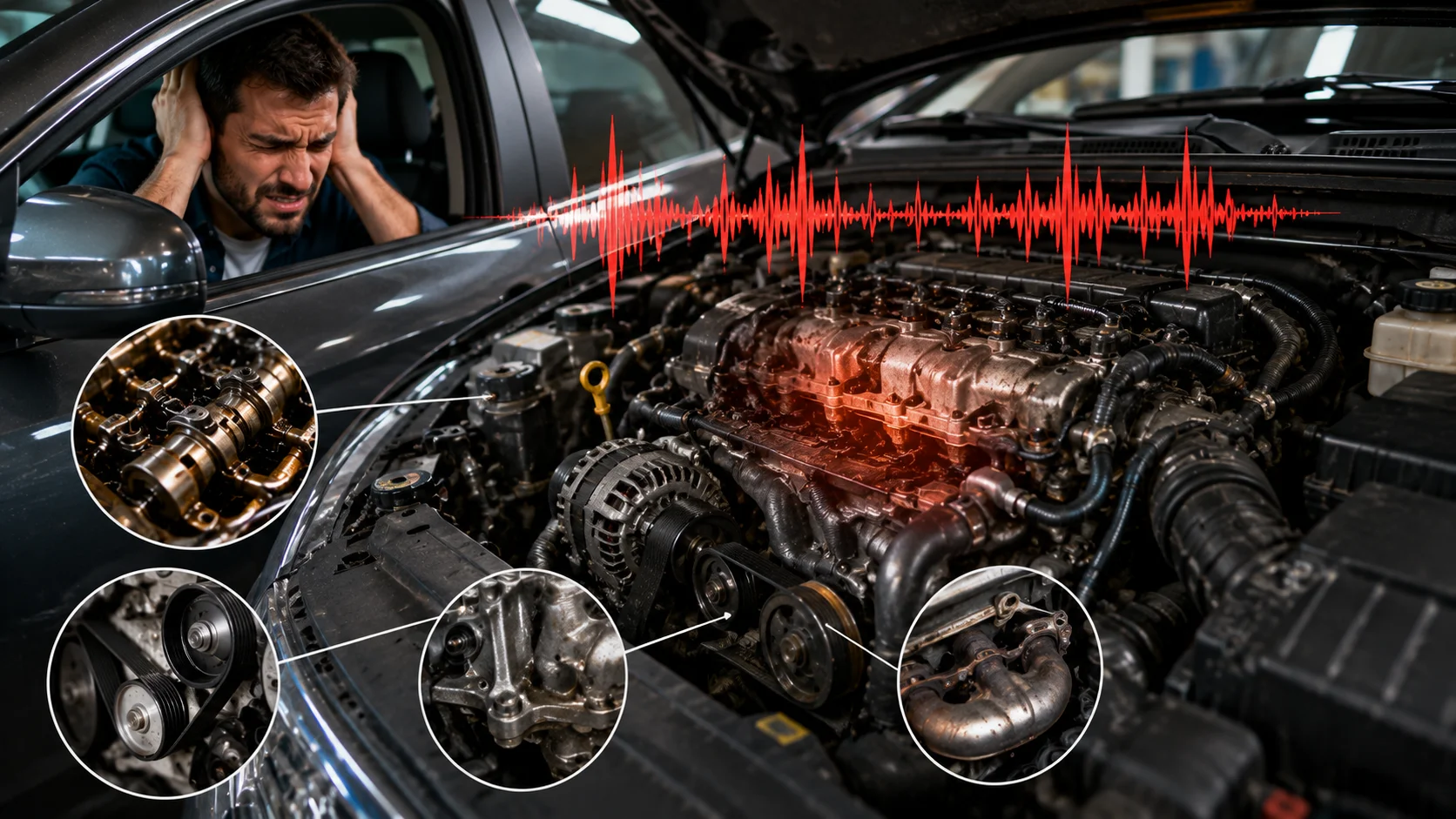
Engine noise that appears and gets ignored rarely disappears on its own. Engines don’t self-correct — a sound that’s there because something has worn, loosened, or changed mechanically will continue to be there, and will almost certainly be worse in three months than it was when first noticed. The question isn’t whether ignoring engine noise matters — it does, consistently and predictably — but how quickly the consequence arrives and how much it costs when it does.
At Rapid Rev Garage, our engine repair in Dubai team regularly diagnoses faults that began as sounds that were left too long. This is what actually happens when each of these specific noises is ignored.
Engine Noise — Quick Verdict
Ignoring engine noise always results in one of two outcomes: the fault causing the noise worsens and eventually produces a more expensive failure, or the noise was indicating an early-stage problem that was relatively cheap to fix and progresses to a problem that is not. A rod knock ignored for weeks can produce a seized engine. A timing chain rattle ignored for months can produce a jumped chain and bent valves. A valve train tick ignored for a year can produce camshaft bearing wear that requires head work. The cost comparison between acting at the noise stage versus acting after the consequence is always significant.
Engine noises occur because mechanical components are interacting in a way they weren’t designed to. A bearing that’s worn beyond its clearance produces a knock from metal-to-metal contact. A timing chain with insufficient tensioner pressure produces a rattle from slack chain slapping the timing cover. A valve stem seal that’s hardened produces a tick from the valve not fully closing. In every case, the sound is indicating a physical condition — and that physical condition doesn’t spontaneously improve.
In Dubai specifically, the rate at which these conditions worsen is accelerated by heat and driving pattern. A bearing knock that might progress slowly in a moderate climate can progress significantly faster in Dubai’s sustained heat and stop-start conditions.
What Happens When You Ignore Specific Engine Noises
This section covers the key details you need to understand the point above.
Ignoring a Rod Knock
A rod knock — deep, rhythmic, from the lower engine, worsening under load — is a connecting rod bearing that’s worn through its clearance. The metal-to-metal contact that produces the knock is also generating metal debris that enters the oil supply and contaminates it. The bearing surface continues to wear with every revolution of the crankshaft.
The Progression Without Repair
The bearing clearance increases as metal continues to wear away. The knock gets louder and more pronounced. Oil pressure drops as the worn bearing clearance allows oil to escape the circuit too quickly. Eventually, one of two outcomes occurs: the connecting rod bearing fails completely and the rod separates from the crankshaft journal, punching through the engine block — this is called “throwing a rod” and is an unrecoverable total engine failure — or the oil pressure drops enough to starve other bearings and they fail in sequence.
The Cost Comparison
A rod bearing replacement discovered at the knock stage is a significant but manageable repair. A thrown rod that has damaged the engine block requires complete engine replacement. The difference in cost is substantial.
Ignoring a Cold-Start Timing Chain Rattle
A cold-start rattle that clears within 10–15 seconds is the timing chain tensioner failing to maintain pressure overnight. As covered in the engine knocking section, this is an early-stage warning on a fault that has a specific, serious failure mode.
The Progression Without Repair
The chain stretches progressively with each cold-start cycle. The tensioner has less and less ability to take up the slack. At some point, the slack becomes sufficient for the chain to jump one or more teeth on the timing gear under the load of acceleration.
What a Jumped Timing Chain Causes
On interference engines — which include most modern turbocharged engines including the BMW N20, Audi/VW EA888, Mercedes M274, and many others common in Dubai — a jumped timing chain causes the piston to travel to top dead centre at the same moment a valve is open. The piston contacts the valve, bending it. Multiple cylinders can be affected in a single timing event. The repair involves cylinder head removal, valve replacement, and timing system replacement — a significant cost that would have been prevented by addressing the rattle months earlier.
Ignoring a Valve Train Tick
A light, rapid ticking from the upper engine — valve train tick from hydraulic lifters or VVT actuators not receiving adequate oil pressure — is less immediately dramatic than a rod knock, but its progression is still damaging.
How Valve Train Neglect Escalates
Hydraulic lifters that aren’t receiving adequate oil pressure collapse — they can no longer maintain the correct valve clearance, and the valve begins bouncing rather than seating cleanly. This affects combustion on the affected cylinder, producing a misfire alongside the tick. Over time, the camshaft lobes that contact the worn lifters develop wear, and the damage extends to a component that requires cylinder head removal to replace.
Our car mechanic team diagnoses every engine noise with sound characterisation and live data before recommending any repair, ensuring the correct component is identified.
Ignoring a Detonation Ping
A light pinging under acceleration — detonation from carbon deposits or incorrect fuel — is the least immediately dramatic noise on this list. But sustained detonation causes cumulative damage.
Piston Crown and Ring Land Damage
The pressure wave from detonation impacts the top of the piston with force that, repeated over thousands of combustion events, causes micro-fractures in the piston crown and ring lands. Piston ring land failure — where the groove that holds the compression ring fractures — allows combustion gas to bypass the ring, reducing compression and increasing oil consumption. This is an internal engine repair that the detonation ping, addressed promptly, would have prevented.
The Financial Logic of Acting on Engine Noise Early
The pattern across every category of engine noise is consistent: the repair at the noise stage costs a defined amount. The repair at the failure stage costs a multiple of that amount — and sometimes isn’t a repair at all, but an engine replacement.
Timing Chain Rattle: Early vs Late
Addressing a timing chain rattle at the tensioner stage — tensioner, guides, and chain kit — is a significant but defined cost. Addressing it after a timing jump has damaged valves requires all the timing work plus cylinder head removal, valve replacement, and head resurfacing. On some platforms in Dubai, this escalation more than triples the repair cost.
Rod Knock: Early vs Late
A rod bearing replacement is expensive but recoverable. Engine replacement after a thrown rod is several times the bearing repair cost and often approaches or exceeds the vehicle’s value.
For any breakdown caused by a noise that progressed to failure before reaching a workshop, our roadside assistance covers Al Quoz and nearby Dubai areas.
The Dubai Urgency Factor
Dubai’s heat doesn’t just make engine damage more likely — it makes the progression from early noise to serious damage faster than it would be in a moderate climate. Oil degradation from heat reduces the protective film that slows bearing wear. Heat cycling accelerates the tensioner degradation that allows chain stretch. Stop-start driving maximises the number of cold-start cycles that stress a failing tensioner.
The same rod knock that might give a driver in Germany three months to decide to book a repair may give a Dubai driver three to six weeks. This is not alarmism — it’s the predictable consequence of operating in conditions that accelerate all wear mechanisms.
Prevention — Catching Noises Before They Become Failures
The most effective way to manage engine noise is to have new noises investigated promptly rather than monitored over months. A diagnostic visit at the first appearance of a sound costs a fraction of the repair it prevents if the sound is left to develop into a failure.
Monthly Oil Level Checks
Many noises — particularly valve train ticks and early bearing noises — are exacerbated by oil that’s low or degraded. A monthly dipstick check catches oil level issues before they accelerate noise-related wear. Our car service packages include oil condition assessment and a noise check at every visit.
Dubai-Specific Advice
The urgency of acting on any engine noise in Dubai is higher than the same noise would represent in a cooler, less stop-start market. The three factors that accelerate noise progression here — heat, short-trip oil degradation, and cold-start cycling — are all consistently present in Dubai’s driving environment and all operate in the same direction: faster progression from early noise to serious damage. For any exterior work alongside engine repairs, our car painting team handles colour-matched work in the same visit.
Why Rapid Rev Garage?
We diagnose the noise before predicting the progression. A sound that can’t be characterised accurately can’t be correctly assessed for urgency, and urgency assessment determines how the owner should prioritise the repair. Diagnostic data — live oil pressure, cam timing correlation, misfire counters — alongside sound characterisation under different operating conditions gives an accurate picture of both what’s causing the noise and how quickly it needs addressing. Our mobile car mechanic covers Al Quoz and nearby Dubai areas for on-site initial assessment.
FAQ — Engine Noise
These are the questions most frequently asked when a new engine sound appears.
How long can I wait before getting an engine knock checked?
A deep knock from the lower engine should be checked within days, not weeks. The progression from early bearing knock to catastrophic failure is faster in Dubai’s conditions than in moderate climates.
Can this noise resolve on its own?
Occasionally, a valve train tick that appeared during a long period between oil changes resolves after a fresh oil change. But a noise from bearing wear, timing chain issues, or detonation has a mechanical or chemical cause that doesn’t self-correct.
Should I get a new noise checked now or wait until the next service?
Now. The question to ask is what the noise is indicating, not when the next service is due. Many engine noises represent faults that worsen faster than the next service interval.
Does this noise always mean expensive repair?
No — some noises are early-stage findings that are relatively straightforward to address. The cost is determined by the source and its stage of development, not by the presence of a noise itself. This is why early investigation is consistently the lower-cost outcome.
Does driving worsen a mechanical knock?
Yes, for mechanical noise categories — rod knock, timing chain rattle, and valve train tick all involve wear mechanisms that are accelerated by continued operation, particularly under high load.
Conclusion
Engine noise that’s ignored always progresses. The rate of progression depends on the type of noise and the conditions it’s driven through — and in Dubai’s heat and stop-start environment, that rate is faster than the same noise would develop in a moderate climate. Acting at the noise stage consistently costs less than acting at the failure stage. Rapid Rev Garage in Al Quoz diagnoses every noise complaint with the specific goal of identifying the cause accurately enough to quantify urgency, not just confirm something is wrong.
Rapid Rev Garage is in Al Quoz, serving drivers across nearby Dubai areas. Find us through a garage near me search, book your appointment on WhatsApp, or find us on Google Maps.
Rapid Rev Garage — Engine Noise | Al Quoz, Dubai