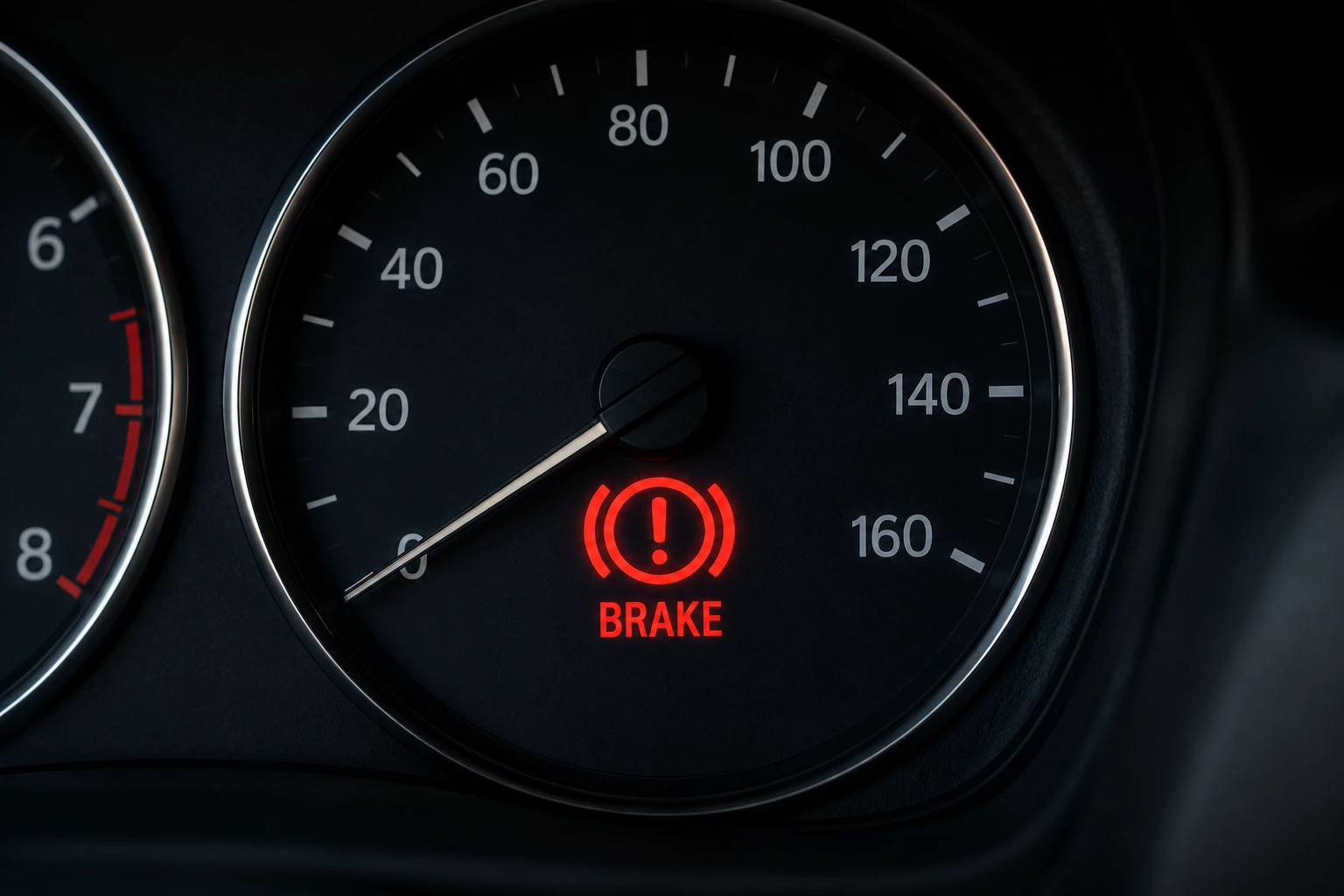
If you suddenly see a red brake symbol or the word BRAKE on your dashboard, do not ignore it. A brake warning light can mean something as simple as an engaged parking brake, but it can also point to low brake fluid, worn brake components, a hydraulic fault, or another braking-system problem.
For Dubai drivers, this deserves extra attention because frequent stop-and-go traffic, high temperatures, heavy SUV use and long highway journeys can place significant demands on the braking system.
Quick Answer
Why Is My Brake Warning Light On? The most common reasons are an engaged parking brake, low brake fluid, worn brake pads or brake linings, a brake-fluid leak, a faulty parking-brake sensor, or a problem in the hydraulic braking system. If the light stays on after releasing the handbrake, check whether the brake pedal feels soft or goes unusually low. If the ABS light and brake light are on at the same time, avoid driving until the system is inspected. A brake warning light is not something to reset blindly. A proper brake inspection can identify whether the problem is a sensor, fluid issue, pad wear, or a more serious hydraulic fault.
Table of Contents
- What Does the Brake Warning Light Mean?
- Common Symptoms to Watch For
- What Causes a Brake Warning Light?
- How a Brake Warning Light Is Diagnosed
- How the Problem Is Repaired
- What Happens If You Ignore the Brake Warning Light?
- Can You Continue Driving with the Brake Warning Light On?
- How Long Does Brake Warning Light Repair Take?
- How Much Does Brake Warning Light Repair Cost in Dubai?
- Dubai-Specific Brake Advice
- Why Choose Rapid Rev Garage for Brake Warning Light Diagnosis and Repair?
- FAQs
- Related Articles
- Book a Brake Inspection
What Does the Brake Warning Light Mean?
The brake warning light is one of the dashboard indicators you should take seriously.
In many vehicles, it appears as a red circle with an exclamation mark, while some models display BRAKE or another brake-system message. The exact symbol varies by manufacturer.
A temporary brake light during engine startup can be normal because the vehicle performs a dashboard bulb/system check. However, if the warning remains illuminated after the engine starts or appears while driving, the braking system should be checked.
The important point is that the light does not identify one specific fault. It tells you that the vehicle has detected a condition that may affect the braking system.
Brake Warning Light Checklist
If your brake warning light comes on:
- ✅ Release the parking brake completely.
- ✅ Check whether the warning light disappears.
- ✅ Notice whether the brake pedal feels normal.
- ✅ Look for fluid leaks around the wheels or under the vehicle.
- ✅ Check whether the ABS warning light is also illuminated.
- ✅ Listen for grinding, scraping, or unusual brake noises.
- ✅ If braking feels abnormal, stop driving and arrange professional assistance.
Common Symptoms to Watch For
The dashboard warning light is often accompanied by other clues. These symptoms can help a technician narrow down the problem.
| Symptom | Possible Meaning | Urgency |
|---|---|---|
| Red brake light stays on | Parking brake, low fluid, sensor or hydraulic issue | High |
| Soft brake pedal | Air, fluid problem or hydraulic fault | Very high |
| Brake pedal goes unusually low | Possible hydraulic problem | Very high |
| Grinding while braking | Severely worn pads or damaged discs | High |
| Brake fluid level keeps dropping | Possible leak or excessive pad wear | High |
| ABS and brake lights together | ABS/hydraulic system fault | Very high |
| Parking brake released but light remains | Sensor, switch or system fault | High |
| Car pulls while braking | Uneven braking or caliper issue | High |
| Longer stopping distance | Brake wear or system problem | Very high |
| Brake vibration | Disc/rotor or caliper problem | Medium–High |
Brake Pedal Goes to Floor Warning Light
A warning light combined with a brake pedal that goes close to the floor is particularly concerning. It can indicate loss of hydraulic pressure, a leak, air in the brake system, or a master-cylinder problem.
Do not treat this as a simple dashboard-light reset issue.
How Is the Brake Warning Light Problem Repaired?
The repair depends on the actual fault.
| Identified Problem | Typical Repair |
|---|---|
| Parking brake engaged | Release and verify system |
| Faulty parking brake switch | Replace switch/sensor |
| Low brake fluid | Identify cause, repair leak if needed, refill/bleed |
| Worn brake pads | Replace pads and inspect discs |
| Damaged brake disc | Resurface where appropriate or replace |
| Brake-fluid leak | Repair leaking component and bleed system |
| ABS sensor fault | Test and replace sensor if required |
| Air in brake lines | Brake bleeding |
| Master-cylinder fault | Repair/replace master cylinder |
| Wiring fault | Repair wiring/connectors |
| Brake pressure issue | Diagnose hydraulic system and repair |
What About Brake Pad Wear Indicator Light Reset?
A Brake pad wear indicator light reset should normally happen only after the underlying pad/sensor problem has been addressed.
Simply resetting the warning without replacing worn components can leave you with the same safety problem.
What Causes a Brake Warning Light?
1. Parking Brake Is Still Engaged
This is the simplest explanation.
If the handbrake or electronic parking brake has not fully released, the warning light may remain illuminated.
If the parking brake light stays on after releasing handbrake, the vehicle may have a faulty sensor or switch rather than an actual parking-brake problem.
2. Low Brake Fluid
Low brake fluid is another common reason.
Possible low brake fluid symptoms include:
- Brake warning light
- Soft or spongy pedal
- Longer pedal travel
- Reduced braking performance
- Visible fluid leakage
Low fluid should not simply be topped up without finding out why the level is low. Brake fluid can fall as brake pads wear, but a significant or sudden loss can indicate a leak.
3. Worn Brake Pads or Brake Linings
Some vehicles have electronic pad-wear sensors that trigger a warning when the friction material becomes too thin.
You may see a worn brake lining warning light or a separate brake-pad symbol depending on the vehicle.
If pads are worn, replacing them early can prevent damage to the brake discs.
4. Parking Brake Sensor or Switch Failure
A parking brake sensor switch failure can keep the dashboard light on even when the parking brake is fully released.
This is usually less dangerous than a hydraulic failure, but it should still be diagnosed because the warning light may be hiding another brake problem.
5. Brake Fluid Leak
A leaking brake hose, caliper, master cylinder, line, or connection can reduce hydraulic pressure.
Look for:
- Wetness around a brake caliper
- Fluid underneath the vehicle
- Falling brake-fluid level
- Soft brake pedal
- Brake warning light
A suspected brake-fluid leak requires immediate attention.
6. Brake Pressure Differential Valve Problem
Some hydraulic braking systems use a pressure differential valve to detect an imbalance between brake circuits.
A Brake pressure differential valve stuck in an incorrect position can trigger a warning light and may require mechanical inspection.
7. Master Cylinder or Switch Fault
The master cylinder is central to hydraulic braking. A problem with the master cylinder, its sensor, or associated switch can trigger a brake warning.
A master cylinder switch warning light should never be dismissed without diagnosis.
8. ABS System Fault
If the ABS light and brake light are on at the same time, the issue may involve the anti-lock braking system or a broader hydraulic/electronic problem.
ABS warning issues can involve wheel-speed sensors, wiring, control modules, hydraulic components, or low system voltage.
How Is a Brake Warning Light Diagnosed?
A good diagnostic process should go beyond plugging in a scanner and clearing the warning.
Step 1: Visual Inspection
The technician checks:
- Brake fluid level
- Brake hoses and lines
- Calipers
- Pads
- Discs/rotors
- Parking brake mechanism
- Visible leaks
Step 2: Brake System Assessment
The mechanic checks pedal feel, pedal travel, braking balance and other physical symptoms.
Step 3: Electronic Diagnostics
For modern vehicles, diagnostic equipment can identify stored ABS or brake-system fault codes.
Step 4: Sensor and Switch Testing
If the mechanical braking system appears healthy, technicians can inspect the parking brake switch, brake-fluid level sensor, pad-wear sensor, ABS sensors and related wiring.
Step 5: Road Test
Where safe and appropriate, the vehicle may be road-tested after inspection or repair to verify normal braking and confirm that the warning does not return.
The goal is to identify the cause, not simply turn the light off.
What Happens If You Ignore the Brake Warning Light?
Ignoring a brake warning can turn a relatively small repair into a much more expensive problem.
Potential consequences include:
- Longer stopping distances
- Brake disc damage
- Loss of braking performance
- Hydraulic brake failure
- ABS malfunction
- Increased accident risk
- More expensive repairs
For example, replacing brake pads is generally much simpler than continuing to drive until worn pads damage the discs and other components.
Can You Continue Driving with the Brake Warning Light On?
Generally, you should not continue driving until you know why the brake warning light is on.
If the light appears because the parking brake was accidentally left engaged, releasing it may solve the issue. But if the light remains on, do not assume it is harmless.
Stop driving and seek professional help immediately if:
- The brake pedal is soft.
- The pedal goes unusually close to the floor.
- The car takes longer to stop.
- Brake fluid is leaking.
- The brake warning and ABS lights appear together.
- The vehicle pulls strongly while braking.
- You hear grinding or severe scraping.
- The warning light appears suddenly while driving.
If your vehicle is unsafe to drive, roadside assistance can be safer than attempting to reach a workshop yourself.
How Long Does Brake Warning Light Repair Take?
The repair time depends on the cause.
| Repair | Approximate Time* |
|---|---|
| Parking brake/switch diagnosis | 30–60 minutes |
| Brake inspection | 30–90 minutes |
| Brake pad replacement | 1–2 hours |
| Brake fluid service | 1–2 hours |
| Brake sensor replacement | 1–2 hours |
| Brake disc replacement | 2–4 hours |
| Hydraulic leak repair | 2–5+ hours |
| Complex ABS diagnosis | 1–3+ hours |
*These are practical estimates, not guaranteed turnaround times. Vehicle model, parts availability and the severity of the fault can change the repair time.
How Much Does Brake Warning Light Repair Cost in Dubai?
There is no single price for a brake warning light because the light itself is a symptom rather than a specific repair.
Typical budgeting ranges may look like this:
| Service | Indicative Dubai Range |
|---|---|
| Basic brake inspection/diagnosis | AED 100–250+ |
| Brake fluid service | AED 150–350+ |
| Brake pad replacement | AED 250–900+ per axle |
| Brake sensor replacement | AED 150–500+ |
| Brake disc replacement | AED 500–1,500+ per axle |
| Hydraulic repair | AED 300–1,500+ |
| ABS diagnosis/repair | AED 250–2,000+ |
These are general market budgeting ranges, not fixed Rapid Rev Garage prices. Luxury vehicles, performance cars, OEM parts, electronic parking brakes and complex ABS systems can cost considerably more.
What Affects the Repair Cost?
The final price depends on:
- Vehicle make and model
- Front or rear brakes
- Brake pad material
- OEM vs aftermarket components
- Brake disc condition
- Sensor type
- Electronic parking brake design
- ABS system complexity
- Brake-fluid condition
- Whether there is a hydraulic leak
- Labour required
- Availability of replacement parts
A proper inspection is therefore more useful than guessing the price from the dashboard warning alone.
Prevention Tips for Dubai Drivers
Dubai’s driving environment can be demanding on brakes. Regular checks are especially useful if you frequently drive in traffic or use a heavy SUV.
Use This Brake Maintenance Checklist
Every few weeks:
- ✅ Pay attention to brake noise.
- ✅ Notice changes in pedal feel.
- ✅ Check for dashboard warnings.
- ✅ Watch for pulling or vibration.
During routine servicing:
- ✅ Inspect pad thickness.
- ✅ Inspect brake discs.
- ✅ Check brake-fluid level and condition.
- ✅ Inspect brake hoses and lines.
- ✅ Check ABS sensors where applicable.
Before long Dubai–Abu Dhabi or highway trips:
- ✅ Test normal braking.
- ✅ Check warning lights.
- ✅ Inspect tyres and brake condition.
- ✅ Do not start a long journey with an unexplained brake warning.
Also avoid repeatedly riding the brakes on long descents. Use appropriate engine braking where suitable and maintain a safe following distance.
Dubai-Specific Advice: Don’t Ignore a Brake Warning in Heavy Traffic
Dubai’s stop-and-go traffic can mean repeated braking, particularly around busy roads, junctions, shopping areas and peak commuting hours.
High ambient temperatures can also contribute to demanding brake operating conditions. That does not mean every brake warning is caused by heat, but it does make proper brake maintenance important.
If the warning appears while you’re driving in Dubai:
- Stay calm.
- Move to a safe location if possible.
- Avoid aggressive braking.
- Check whether the parking brake is released.
- Do not continue if braking performance feels abnormal.
- Contact a professional garage or roadside assistance provider.
If you search ‘garage near me‘, choose one that can diagnose the braking system rather than simply clear the warning.
For drivers who cannot safely reach a workshop, a mobile mechanic brake inspection in Dubai may be a practical first step when the vehicle and fault are suitable for on-site assessment.
Why Choose Rapid Rev Garage for Brake Warning Light Diagnosis and Repair?
Rapid Rev Garage provides brake repair, computerized diagnostics, general vehicle inspection, roadside assistance and mobile mechanic services in Dubai. Its workshop is in Al Quoz and its service offering includes brake repairs and diagnostics for multiple vehicle makes and models.
For a brake warning light, the important advantage is having the mechanical and electronic sides of the problem checked together.
At Rapid Rev Garage, we use computerized diagnostic equipment and provide brake-related repair services, while our mobile mechanic and roadside assistance options can help when a vehicle cannot conveniently be driven to the workshop. We provide transparent pricing and a service warranty on repairs.
FAQs
Can I drive with the brake warning light on?
It is generally not recommended. If the light remains on after releasing the parking brake, have the braking system inspected. Do not drive if the pedal is soft, braking performance is reduced, or fluid is leaking.
What would cause the brake warning light to come on?
Common causes include an engaged parking brake, low brake fluid, worn brake pads, a fluid leak, faulty parking-brake switch, hydraulic fault, master-cylinder issue, or another brake-system problem.
How do I fix my brake warning light?
First identify the cause. Check that the parking brake is released, then have the brake fluid, pads, hydraulic system, sensors and ABS system inspected. The warning should be reset only after the underlying fault is repaired.
Can I drive with the brake light on?
If you mean the red brake-system warning light on the dashboard, do not assume it is safe to drive. If the light stays on or braking feels different, arrange a professional inspection or roadside assistance.
Why is my brake light on but my brakes feel fine?
A sensor or parking-brake switch may be faulty, but low brake fluid or another developing problem is also possible. A professional inspection can distinguish between an electrical warning and a mechanical fault.
Why is my brake warning light on after releasing the handbrake?
A faulty parking-brake sensor switch, low brake fluid, wiring issue, or another brake-system fault may be responsible. If the light remains on, have it diagnosed rather than repeatedly resetting it.
Why are my ABS and brake lights on at the same time?
This combination can indicate an ABS or hydraulic braking-system fault. Because both warnings relate to braking safety, professional diagnosis is recommended before continuing to drive.
What does a soft brake pedal and warning light mean?
A soft pedal combined with a brake warning can indicate low fluid, air in the brake lines, a leak, or another hydraulic problem. This should be checked promptly.
How long can I drive with a brake warning light?
There is no safe universal distance or time. If the cause has not been identified, avoid driving unnecessarily. If braking performance is abnormal, use roadside assistance or vehicle recovery.
Does low brake fluid turn on the brake warning light?
Yes, many vehicles use the brake warning light to indicate a low brake-fluid level. However, the exact warning system varies by vehicle.
Can worn brake pads cause a brake warning light?
Yes. Vehicles equipped with brake-pad wear sensors can display a brake or pad-wear warning when the friction material reaches its service limit.
Is a brake warning light the same as an ABS warning light?
No. They can indicate different systems. However, some vehicles may illuminate both when a fault affects multiple parts of the braking system.
Where can I find the best brake diagnostic repair shop near me?
Look for a workshop that performs both physical brake inspection and electronic diagnostics. In Dubai, Rapid Rev Garage offers brake repair and diagnostic services and has a workshop in Al Quoz.
Related Articles
If you are researching brake problems, these related topics can help:
- Why Your Brakes Grab Too Aggressively and How to Fix It?
- Brake Pedal Feels Spongy in Morning
- Why Does My Car Brakes Make Noise After Rain?
- Brake Pedal Vibrates at Low Speed
- Why Do My Car Shakes When I Brake? The Most Likely Culprit
Relevant Service Page
For professional diagnosis and repair, visit Rapid Rev Garage’s Brake Repair/Service page, which includes brake replacement and broader brake diagnostic services in Dubai.
https://rapidrevgarage.com/car-brakes-repair-in-dubai/
Final Thought: Don’t Ignore the Red Brake Warning Light
A brake warning light is your car’s way of telling you that something needs attention. Sometimes the cause is simple, such as an incompletely released parking brake. Other times, it can indicate low brake fluid, worn brake components, a hydraulic problem, or an ABS-related fault.
If your brake warning light stays on, don’t guess and don’t simply reset it. Get the braking system properly diagnosed. Book your brake inspection with Rapid Rev Garage today and get the warning checked before a small brake problem becomes a serious safety issue.
You can also visit us at our Al Quoz, Dubai branch,
Rapid Rev Garage: https://maps.app.goo.gl/wjK13vovXTKx5SsH8