When fuel economy drops after an oil change, the instinct is to blame the service itself — and in many cases, that instinct is correct. An oil change that uses the wrong viscosity, overfills the sump, or disturbs a vacuum connection during the process can directly and immediately reduce the kilometres per litre the engine delivers. Understanding which change during the service caused the drop is the fastest route to resolving it.
At Rapid Rev Garage in Al Quoz, every fuel economy drops after an oil change case is diagnosed post-service fuel economy complaints with a structured assessment — checking oil specification, level, and anything that may have been disturbed during the service — before assuming an unrelated fault has developed.
Fuel Economy Drops After an Oil Change — Quick Verdict
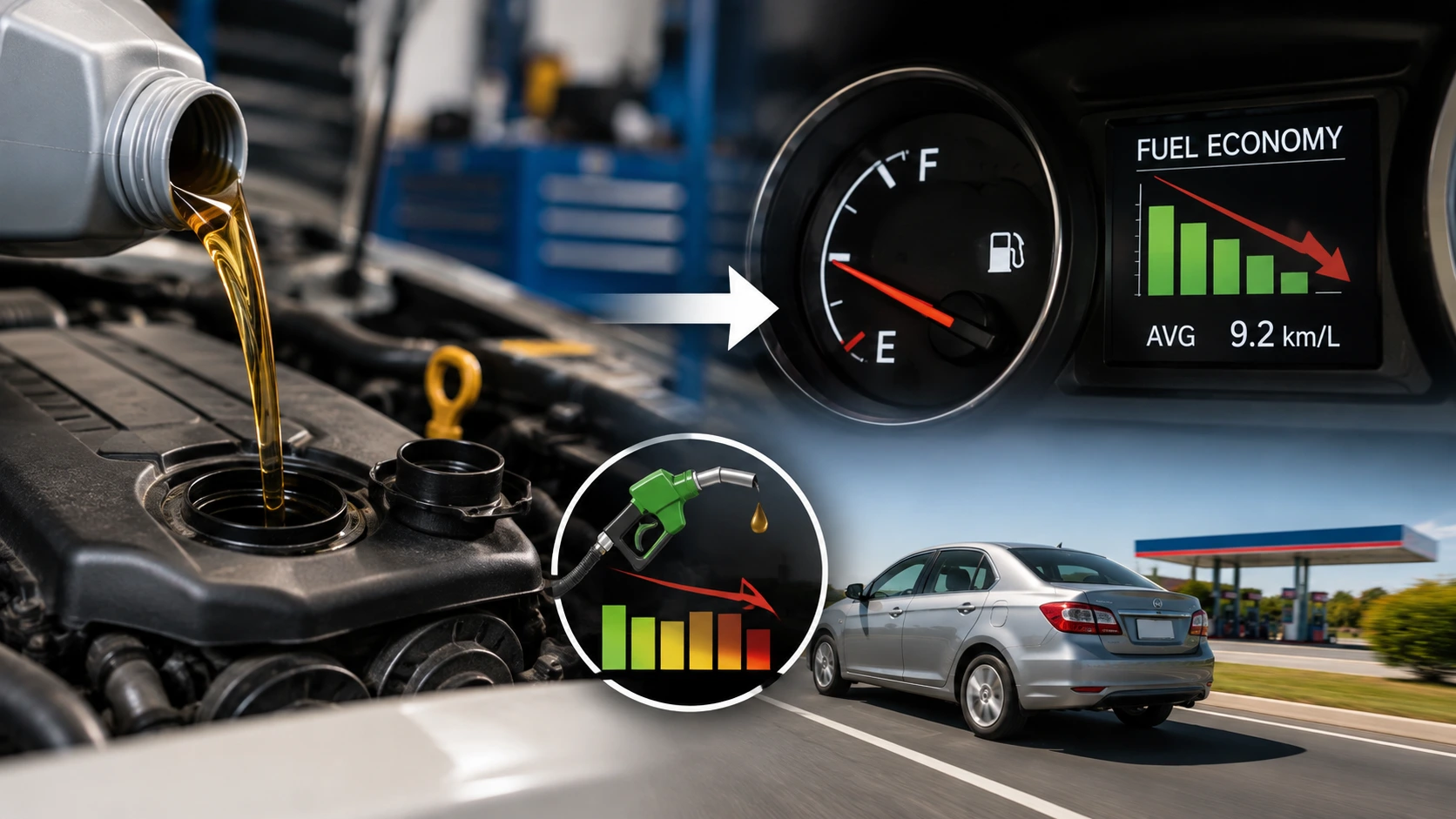
When fuel economy drops after an oil change, the most common causes are an incorrect oil viscosity that creates more internal engine friction than the specification requires, an overfill that causes the crankshaft to aerate the oil increasing resistance, a vacuum hose disturbed during the service producing a lean or rich mixture fault, or a failure to reset the oil life monitor causing the engine management system to continue running a conservative fuel strategy. Less commonly, the oil change simply coincided with an unrelated developing fault — a fuel injector, oxygen sensor, or spark plug that was already degrading and happened to become noticeable around the same time. Each cause has a different fix.
Table of Contents
- Why an Oil Change Can Directly Affect Fuel Economy
- The Specific Things That Go Wrong During a Service
- When the Oil Change Just Coincided With Another Fault
- How Dubai’s Conditions Amplify These Effects
- How We Find the Actual Cause at Rapid Rev Garage
- The Right Fix for Each Confirmed Cause
- What Happens If This Is Left Without Investigation
- Is the Drop Serious Enough to Worry About?
- How Long the Diagnosis and Fix Takes
- What It Costs to Investigate and Resolve in Dubai
- Keeping Fuel Economy Consistent After Every Service
- Why Rapid Rev Garage?
- FAQ
- Conclusion
Why an Oil Change Can Directly Affect Fuel Economy
When fuel economy drops after an oil change, the oil change has touched more of the engine’s operating environment than it appears to from the outside. Getting these right is what determines whether fuel economy drops after an oil change or not determines whether the engine runs as efficiently after the service as it did before.
Engine Oil Is a Direct Friction Variable
The engine oil specification — viscosity grade, additive package, and approval standard — is engineered to the specific internal clearances and operating temperatures of that engine. A 0W-20 engine filled with 5W-40 runs with higher internal friction at normal operating temperature because the thicker oil creates more resistance in bearings, cam followers, and VVT actuators than the engine was designed around. More friction means more fuel consumed to produce the same power output. This is not a marginal effect — filling a low-viscosity engine with high-viscosity oil can produce a measurable fuel economy reduction that persists for every kilometre driven on the incorrect oil.
The Engine Management System Responds to Oil Condition
On vehicles equipped with oil quality sensors or oil life monitoring systems, the engine management strategy adjusts based on oil condition. After a fresh oil change — particularly a change that resets the oil life monitor correctly — some vehicles briefly run a slightly richer fuel strategy as the management system re-adapts to clean oil. This is temporary and resolves within a short drive. If the monitor was not reset, the system may continue applying the conservative strategy it was using for degraded oil.
The Specific Things That Go Wrong During a Service
Each of these service-related causes produces a specific symptom pattern that helps identify it before any detailed investigation.
Incorrect Oil Viscosity or Specification
The most common direct cause. A workshop that uses whatever synthetic oil is in stock rather than the manufacturer-specified grade fills an engine designed for 0W-20 or 5W-30 with 5W-40 or 10W-40. The driver notices the fuel economy has changed within the first tank of fuel after the service.
Why This Is More Common Than It Should Be
Many independent workshops in Dubai use a small number of bulk oil grades rather than stocking the full range of manufacturer-specific fluids. An engine that requires a unique low-viscosity specification — BMW Longlife-04, VW 507.00, Mercedes-Benz 229.51 — may receive a generic synthetic of the closest available grade. For common platforms this matters significantly.
How to Confirm This Is the Cause
Checking the oil container used during the service against the specification on the engine oil cap or in the owner’s manual confirms whether the viscosity is correct. A drain and refill with the correct specification resolves the fuel economy reduction from the next drive.
Overfill Beyond the Maximum Dipstick Mark
Overfilling the sump by even a small amount — half a litre above maximum — causes the crankshaft counterweights to dip into the oil surface as the engine runs. This aeration increases oil resistance to crankshaft rotation and reduces the oil’s lubrication effectiveness from the introduced air bubbles. The engine works harder to maintain the same RPM, and fuel consumption rises.
The Simple Check
A dipstick reading with the engine off, vehicle level, and oil settled for three minutes confirms the level. A reading above the maximum mark confirms overfill. Draining the excess to the correct maximum level resolves the issue immediately.
Vacuum Hose Disturbed During Filter or Oil Cap Access
The oil filter, oil cap, and drain plug are accessed in areas of the engine bay where vacuum hoses, breather pipes, and PCV connections are nearby. A hose that is nudged loose during the service creates an unmeasured air leak that disrupts the engine management system’s air-fuel ratio calculation — producing a lean mixture fault that causes the system to compensate with additional fuelling, or a rich mixture that directly increases consumption.
What a Vacuum Leak Sounds Like
A vacuum leak often produces a faint hissing sound from the engine bay at idle. A smoke test — introducing visible smoke into the intake system — identifies the exact leak point within minutes and is the definitive confirmation tool. Our car mechanic team checks every accessible vacuum connection in the service area before completing any oil change.
Oil Life Monitor Not Reset
Many modern vehicles — particularly Honda, Toyota, and Lexus models — use an oil life monitor that adjusts fuel delivery strategy based on calculated oil condition. When this monitor is not reset after an oil change, the system continues applying the adjustments it was making for degraded oil. On some platforms this produces a measurable fuel economy reduction until the reset is performed.
When the Oil Change Just Coincided With Another Fault
Not every fuel economy drops after an oil change complaint traces to the service itself. Sometimes the timing is coincidental.
Oxygen Sensor Degradation
An oxygen sensor at the end of its service life produces increasingly inaccurate fuel mixture feedback. A sensor that was borderline before the service may cross into fault-code-triggering territory within days of it — which coincides with the service in the driver’s timeline but has no causal connection. A diagnostic scan reading oxygen sensor live data and stored fault codes distinguishes this from a service-caused fault.
Injector Wear or Carbon Fouling
A fuel injector that is beginning to deliver inconsistent fuel spray produces a gradual fuel economy reduction that may become noticeable around the time of a service — simply because the driver is paying attention to consumption after the service rather than before it. VCDS or equivalent injector balance testing identifies a contributing injector before any replacement is recommended.
Spark Plug Condition
A spark plug that has reached the end of its electrode life produces incomplete combustion on its cylinder — the unburned fuel exits without contributing to useful work. The timing of noticing this often coincides with a service because the driver is newly attentive to fuel economy after having just paid for a service.
For any breakdown caused by an engine fault discovered during this investigation, our roadside assistance covers Al Quoz and nearby Dubai areas.
How Dubai’s Conditions Amplify These Effects
Dubai’s operating environment means oil specification errors and level errors have more pronounced effects than in cooler markets.
Dubai’s environment specifically accelerates the faults that cause fuel economy drops after an oil change in this market.
Incorrect Viscosity Has Larger Effects in Heat
The viscosity difference between a correct and incorrect oil specification is largest at operating temperature — and Dubai’s stop-start traffic sustains higher operating temperatures for longer than European driving. A 5W-40 in an engine designed for 0W-20 produces more friction at 100°C coolant temperature than it would at 80°C — and Dubai vehicles spend more time at 100°C+ than European ones.
Short Trips Prevent Oil Temperature Stabilisation
Dubai’s common short-trip driving pattern means the engine oil never fully reaches its designed operating temperature on many journeys. An oil that is already slightly too thick for the specification is even thicker on these short trips — producing more friction per kilometre than the same incorrect oil would on a sustained highway run.
The Fuel Economy Baseline Is Already Stressed
A Dubai vehicle doing stop-start commuting already uses more fuel per kilometre than the same vehicle on European highways. Any additional friction or mixture disruption from a service error adds to an already higher consumption baseline — making the percentage reduction from a specification error more noticeable than it might be on a vehicle doing predominantly highway driving.
How We Find the Actual Cause at Rapid Rev Garage
A structured post-service fuel economy diagnosis takes under an hour in most cases.
Oil Specification and Level Check First
The oil container used in the service is checked against the manufacturer’s specification on the oil filler cap and in the owner’s manual. The dipstick level is confirmed against the minimum and maximum marks. These two checks take five minutes and resolve the most common causes immediately.
Vacuum System Check
A visual check of all accessible vacuum connections in the service area, followed by a smoke test if any suspected leak point is found, confirms or rules out a vacuum leak introduced during the service.
Diagnostic Scan — Codes and Live Data
A full diagnostic scan reads any fault codes that appeared after the service — vacuum leak codes, oxygen sensor faults, misfire counters, fuel trim corrections. Live fuel trim data specifically shows whether the engine management system is correcting for a lean or rich condition — which direction of correction identifies whether a vacuum leak or a rich mixture fault is present.
Oil Life Monitor Reset Confirmation
For Honda, Toyota, Lexus, and other monitor-equipped platforms, the oil life monitor status is confirmed — a monitor reading old service data is reset. Our car service packages confirm monitor reset as a standard close-out step on every eligible platform.
The Right Fix for Each Confirmed Cause
Each repair below is matched to the specific fault confirmed by the diagnostic sequence above.
Wrong Oil Specification — Drain and Correct Refill
The incorrect oil is drained and replaced with the manufacturer-specified grade. A correct-specification oil change immediately restores the fuel economy the engine was achieving before the incorrect fill. This is a straightforward correction and the most common resolution.
Overfill — Drain Excess to Correct Level
Excess oil is drained to bring the level to the maximum mark. Fuel economy recovers on the next drive once the crankshaft is no longer aerating the sump.
Vacuum Leak — Reseat or Replace the Hose
A displaced hose is reseated and secured. A hose that has cracked at the connection point is replaced. The smoke test is repeated after the fix to confirm no additional leak points remain.
Oil Monitor Reset — Procedure Specific to Platform
Honda uses a specific button sequence. Toyota and Lexus use a menu procedure in the instrument cluster. BMW, Mercedes, and Audi require scan tool access for full service interval reset. Each is completed per the manufacturer’s procedure for the specific model year.
Unrelated Fault — Addressed Specifically
An oxygen sensor, injector, or spark plug fault confirmed by the diagnostic scan is addressed separately — either at the same visit or scheduled for a follow-up service depending on urgency and parts availability. For any exterior work needed alongside engine service, our car painting team handles colour-matched repairs at the same visit.
What Happens If This Is Left Without Investigation
A fuel economy drops after an oil change complaint that is dismissed or deferred has consequences beyond the fuel bill.
Incorrect Oil Continues Damaging the Engine
An engine running on incorrect viscosity oil is not just using more fuel — it is also experiencing more internal friction than designed. Hydraulic lifters, VVT actuators, and timing chain tensioners all rely on the correct oil viscosity to function within their designed parameters. Every kilometre driven on incorrect oil accumulates wear that the correct oil would have prevented.
Vacuum Leak Produces Secondary Damage
A lean mixture from a vacuum leak that is left produces oxygen sensor damage over time as the sensor works outside its normal correction range, and catalytic converter stress from intermittent unburned oxygen. What resolves immediately as a hose reconnection today becomes a sensor and catalytic converter repair if left for months.
Is the Drop Serious Enough to Worry About?
Any fuel economy drops after an oil change that is consistent across multiple tanks of fuel — not just one fill — is worth investigating. A single tank’s variation can reflect driving conditions, AC load, or traffic pattern rather than a mechanical cause. Two consecutive tanks showing clearly lower economy than before the service, with similar driving conditions, confirms a real change that has a specific cause.
The investigation takes under an hour in most cases and resolves the most common causes the same day. The cost of the investigation is less than the additional fuel consumed over a month of degraded economy.
How Long the Diagnosis and Fix Takes
Repair time varies by confirmed cause — simpler issues resolve same-day.
Oil Specification and Level Check
Under 10 minutes including dipstick check and oil container confirmation.
Full Diagnostic Scan With Vacuum Check
30–60 minutes including road test data for fuel trim live readings.
Drain and Correct Refill
60–90 minutes including the oil change itself and post-change idle confirmation.
What It Costs to Investigate and Resolve in Dubai
Cost depends on the confirmed cause — simpler causes like an incorrect oil fill cost significantly less than sensor or injector work.
Diagnostic Assessment
AED 150–300 for a full scan and vacuum check — credited toward any repair if one is required.
Correct Oil Drain and Refill
AED 250–700 depending on the oil specification required and the vehicle’s sump capacity. Manufacturer-specific low-viscosity synthetics — BMW Longlife, VW 507.00, Toyota WS — cost more than generic synthetics.
Vacuum Hose and Sensor Work
Hose replacement: AED 150–400 depending on the hose and its routing. Oxygen sensor replacement if confirmed faulty by live data: AED 400–1,200 depending on sensor position and vehicle platform. Our mobile car mechanic covers Al Quoz and nearby Dubai areas for an on-site oil spec and level check before the vehicle is driven in.
Keeping Fuel Economy Consistent After Every Service
Specific practices at every oil change prevent post-service fuel economy changes from occurring.
Always Verify the Oil Specification Before Filling
The oil specification is on the engine oil filler cap, in the owner’s manual, and on manufacturer websites for every model year. Confirming the specification before any oil is poured — not after — prevents incorrect-viscosity fills from happening in the first place.
Confirm Level on the Dipstick Before Starting the Engine
After filling, waiting three minutes for the oil to settle and checking the dipstick before starting the engine confirms correct level without the engine running on an overfill. Our garage near me location in Al Quoz serves drivers across Business Bay, Jumeirah, Barsha, Satwa, Downtown, and the Sheikh Zayed Road corridor.
Why Rapid Rev Garage?
When fuel economy drops after an oil change, the correct investigation sequence — oil specification check, level check, vacuum inspection, diagnostic scan — identifies the cause in under an hour in most cases. We check the oil specification against the manufacturer’s requirement for every vehicle before any oil is selected — not as an afterthought. Every oil change at Rapid Rev Garage includes a post-service idle check, fault code scan, and level confirmation before the vehicle leaves the workshop.
FAQ — Fuel Economy Drops After an Oil Change
These are the questions most frequently asked about this fault.
Is it normal for fuel economy to temporarily change after an oil change?
A slight temporary variation is normal as the new oil distributes and the engine management system re-adapts — this typically resolves within a tank of fuel. A consistent reduction across two or more tanks confirms a specific cause that warrants investigation.
Can the wrong oil type really affect fuel economy noticeably?
Yes — a viscosity mismatch between specification and actual fill produces a measurable fuel economy reduction that is present on every drive. The effect is larger at operating temperature and in stop-start conditions than on cold short trips.
My garage used a branded synthetic — can it still be wrong?
Yes. A branded synthetic of the correct SAE viscosity grade may still be the wrong specification if the engine requires a specific manufacturer approval — BMW Longlife-04, Mercedes-Benz 229.51, VW 507.00. These approvals cover additive chemistry, not just viscosity.
How quickly should fuel economy return to normal after the correct oil is filled?
Within the first full tank after the correct oil is installed, assuming no other fault is present.
Should I go back to the workshop that did the service?
Yes — a reputable workshop will check the specification they used and correct any error without charging for it. If there is doubt about the oil used, bring the receipt and the vehicle's specification to the conversation.
Conclusion
Fuel economy drops after an oil change in Dubai is a specific, solvable complaint — in most cases caused by incorrect oil viscosity, an overfill, a disturbed vacuum connection, or an unreset oil monitor. Each of these has a direct fix that restores fuel economy immediately. The investigation takes under an hour. Rapid Rev Garage in Al Quoz diagnoses every post-service fuel economy complaint through a structured sequence — oil specification first, level second, vacuum and scan third — before any other fault is assumed to have developed.
Rapid Rev Garage is in Al Quoz, serving drivers across nearby Dubai areas — Business Bay, Jumeirah, Downtown, Barsha, Satwa, and the Sheikh Zayed Road corridor. Book your appointment on WhatsApp or find us on Google Maps.
Rapid Rev Garage — Fuel Economy Drops After an Oil Change | Al Quoz, Dubai