Plastic interior panels making noise — creaking, rattling, or clicking from the dashboard, door cards, centre console, or pillar trim — is one of the most common and most frustrating interior complaints in Dubai. What was a silent, premium-feeling cabin when the car was new — before plastic interior panels making noise developed — gradually develops the plastic interior panels making noise pattern that is familiar to so many Dubai owners that the driver can hear every day over road noise and music. In Dubai’s extreme heat and UV environment, this deterioration happens faster than anywhere else — the same panels that stay silent for ten years in a European climate begin making noise within three to four years of Dubai ownership.
At Rapid Rev Garage in Al Quoz, plastic interior panels making noise cases are diagnosed by isolating each source individually rather than treating the entire interior as a single problem.
Plastic Interior Panels Making Noise — Quick Verdict
Plastic interior panels making noise in Dubai are almost always caused by heat-degraded retaining clips that have lost their holding force, plastic-to-plastic or plastic-to-metal contact points between adjacent panels that were separated by foam tape or felt pads that have compressed or fallen away, dashboard components that have expanded from heat and are now touching adjacent surfaces they previously cleared, or door card mounting points that have loosened from vibration and thermal cycling. Dubai’s UV exposure hardens and embrittles the plastic itself, reducing its ability to flex without noise. The diagnosis requires isolating each rattling panel individually — pressing on each suspect area while driving to identify which one stops rattling under pressure.
Table of Contents
- Why Dubai’s Heat Makes Interior Panels Noisier Faster
- Identifying the Exact Panel Before Any Work Begins
- Dashboard and Instrument Panel Noise Sources
- Door Card Creaks and Rattles
- Centre Console and Gear Area Noise
- Pillar Trim and Headliner Sources
- How Heat and UV Destroy Panel Retention in Dubai
- How We Isolate Every Source at Rapid Rev Garage
- The Right Fix for Each Panel Type
- What Happens When Panel Noise Is Left Without Attention
- Is It Worth Fixing?
- How Long the Repair Takes
- What the Repair Costs in Dubai
- Keeping the Interior Quiet in Dubai’s Conditions
- Why Rapid Rev Garage?
- FAQ
- Conclusion
Why Dubai’s Heat Makes Interior Panels Noisier Faster
Plastic interior panels making noise in Dubai is not simply a consequence of age or poor build quality — it is a predictable consequence of the specific environmental stresses this market places on every component in the cabin.
Peak Cabin Temperature in a Dubai Summer
A vehicle parked in direct sun in Dubai’s summer reaches cabin temperatures of 70–80°C on the dashboard surface and 60–70°C at seat level. These temperatures are significantly higher than any interior component was designed to be tested against continuously. The plastic panels, foam separators, felt pads, and retaining clips all behave differently at these temperatures — expanding, compressing, and deforming in ways that change the precise contact and clearance geometries that were engineered to keep the interior silent.
UV Exposure Embrittles Interior Plastics
Ultraviolet radiation from Dubai’s intense sun degrades the polymer chains in interior plastics even through glass. A dashboard or door card plastic that has seen years of Dubai sun becomes harder, less flexible, and more prone to developing surface micro-cracks. Harder plastic transmits vibration more directly than the flexible, damped plastic it was when new — producing a crisper, more audible rattle from the same vibration source.
The Clip Degradation Cycle
Retaining clips — the plastic push-in fasteners that attach trim panels to door metal and bodywork — are designed to be inserted once and remain in place. In Dubai’s heat, these clips cycle between extreme expansion and contraction. The clip material hardens and loses its snap-in holding force. Eventually the clip is no longer holding the panel against the door metal with any meaningful force — and the panel is now held only by its own weight and any remaining contact with adjacent panels.
Identifying the Exact Panel Before Any Work Begins
Interior panel noise is only fixable when the specific panel producing the noise is correctly identified — because the same sound can appear to come from multiple locations due to resonance effects within the cabin.
The Press Test During a Drive
The most effective preliminary identification method requires a passenger. While driving over the road surface that produces the noise, the passenger presses firmly on each suspected panel in sequence. When the noise stops under hand pressure, the panel being pressed is the source — the pressure closes whatever gap or contact point is producing the noise.
Temperature-Dependent Noise
A rattle that only appears when the cabin is very hot — the first few minutes of a summer drive before the AC cools the interior — but stops once the cabin cools is temperature-driven panel expansion. The hot panel has expanded into contact with an adjacent component. This identifies the thermal nature of the cause before any disassembly.
Speed-Dependent Noise
A creak or rattle that begins at a specific speed and stops at other speeds is resonance-driven — the panel is vibrating sympathetically at the cabin’s resonant frequency at that speed. This type is harder to isolate by pressing because the driver may need to maintain a specific speed.
Dashboard and Instrument Panel Noise Sources
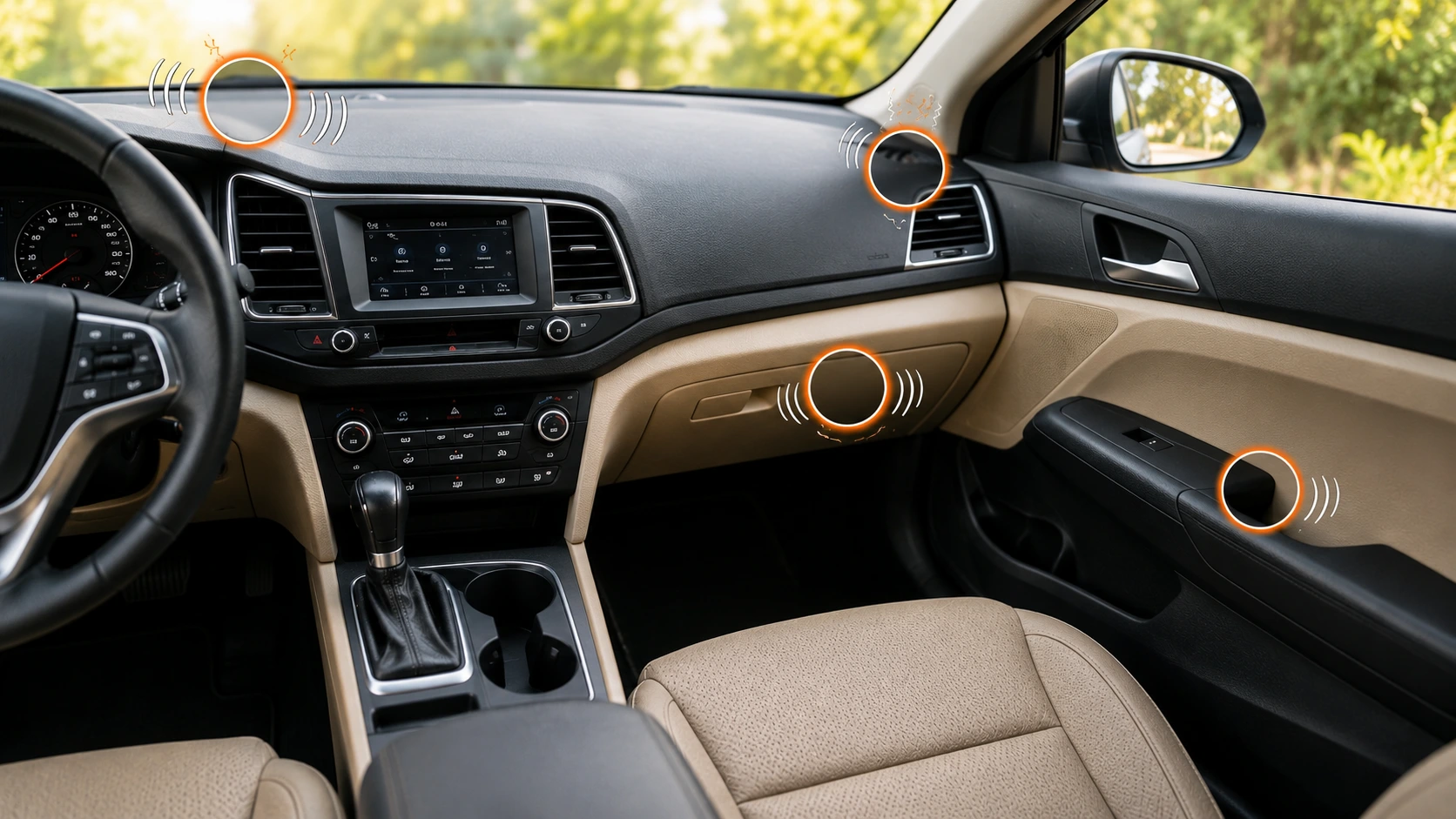
The dashboard is the most complex interior area for plastic interior panels making noise — it contains the most components — it contains the most components, the most joints between different materials, and the most attachment points that can loosen.
Dashboard-to-Windscreen Contact
The dashboard top surface runs close to the windscreen base. When the dashboard expands from heat, it can contact the windscreen or the rubber seal at the windscreen base — producing a creak specifically when the dashboard flexes over bumps or when the body twists slightly on uneven ground. This is a particularly common source in Dubai where dashboard expansion from heat is maximised.
The Foam Strip Remedy
The correct fix for dashboard-to-windscreen contact is installing adhesive foam strip between the dashboard top surface and the windscreen seal — creating a cushioned contact point rather than a hard plastic-to-rubber rattle. This is a straightforward trim repair that immediately silences this specific source.
Instrument Cluster Surround Movement
The instrument cluster surround — the panel around the speedometer and gauges — is typically retained by a combination of clips and a friction fit against the dashboard. As clips harden and lose their holding force, the surround can flex slightly on bumps, producing a creaking from the contact points between the surround and the dashboard aperture.
Glove Box Rattles
The glove box door, its damping mechanism, and any contents within can all produce rattles that appear to come from the passenger side dashboard. A glove box that no longer closes with the correct latching force — from a hinge that has loosened or a latch that has worn — rattles against the dashboard surround on every bump.
Door Card Creaks and Rattles
Door cards are large panels with many attachment points — and in Dubai’s conditions, these attachment points degrade faster than in any temperate market.
Clip Failure Along the Door Card Perimeter
The door card is attached to the door inner structure by a row of push-in plastic clips around its perimeter — typically 8–14 clips depending on the vehicle. When several of these clips have hardened and lost their retention force, the door card can flex away from the door metal over bumps, producing a creaking from the gap that opens and closes between the card and the door structure.
Why the Bottom Clips Fail First
The lower edge of the door card is closest to the road surface and is most exposed to splashed water, cleaning products, and temperature extremes from the door sill area. Bottom clips degrade faster than upper clips on most vehicles. A door card that rattles from the bottom edge but feels secure at the top has this characteristic pattern. Our car mechanic team replaces clips with the correct specification replacement — not any available clip of similar size.
Door Card to Door Seal Contact
The inner edge of the door card runs against the door rubber seal. As the door card loosens from clip failure, this edge can contact the seal and produce a creaking or rubbing noise when the door card flexes. Applying a thin bead of foam tape to the door card edge restores the separation that prevents this contact.
Window Regulator and Speaker Housing
Window regulator components and speaker housings mounted inside the door card are additional vibration sources. A speaker housing with a loose fastener rattles at specific bass frequencies. A window regulator with a loose bolt produces a clunking that sounds like a panel rattle but has a different character.
Centre Console and Gear Area Noise
The centre console — the raised structure between the front seats containing the gear lever, cupholders, and storage compartments — accumulates noise sources from multiple attachment points and the contents it holds.
Console Lid and Cupholder Rattle
The centre console lid, when its hinge or latch has loosened, produces a rattling from the lid bouncing on its closed position. Cupholders with loose insert rings produce a clicking or rattling when the vehicle moves over uneven surfaces. These are among the quickest fixes in the interior — a drop of adhesive or a foam spacer restores the correct contact and eliminates the noise.
Gear Lever Surround Movement
The surround panel around the gear lever contacts the lever assembly and the centre console. As this panel loosens from clip failure or heat-induced gap changes, it produces a rattling specifically during gear changes from the lever movement loading the panel.
Pillar Trim and Headliner Sources
The A-pillar, B-pillar, and C-pillar trims cover the body pillars and are typically retained by a small number of clips. The headliner — the fabric-covered panel that forms the roof interior — is attached to the roof structure with adhesive and retaining clips.
A-Pillar Trim Creak
The A-pillar trim between the windscreen and the front door runs close to both the windscreen seal and the door seal. As the vehicle body flexes slightly on uneven road — particularly on Dubai’s commercial road surfaces — this pillar trim can creak against the adjacent seals. Felt tape between the trim edge and the adjacent seal is the standard fix.
Headliner Separation and Rattle
A headliner that has partially separated from the roof structure — the adhesive has failed in the heat — produces a subtle movement over bumps that creates a muffled thudding or rustling sound. In Dubai, headliner adhesive failure is common on vehicles over six years old from the sustained interior temperature that exceeds the adhesive’s effective temperature rating. For any breakdown needed while interior work is being arranged, our roadside assistance covers Al Quoz and nearby Dubai areas.
How Heat and UV Destroy Panel Retention in Dubai
The combination of heat, UV, and the daily thermal cycling between underground parking cool and peak cabin temperature creates a panel retention degradation rate that is specific to Dubai.
The Clip Hardening Timeline
In a moderate European climate, interior trim clips typically maintain their retention force for the vehicle’s entire ownership period. In Dubai, clip material hardening begins to reduce retention force at three to five years on vehicles parked in direct sun. By seven to ten years, many clips have lost most of their original holding force. This is not a product quality failure — it is the material response to conditions far beyond the design environment.
Foam Tape Compression Is Permanent
The foam tape and felt pads that separate adjacent panels — preventing the plastic-to-plastic contact that produces creaking — compress permanently under sustained high temperature. Once compressed, they do not recover their original thickness. The compressed material no longer separates the panels it was installed to separate, and the panels contact each other. Replacing compressed foam tape with fresh tape restores the separation immediately. Our car service packages include interior panel clip condition assessment at every major service for vehicles over four years old.
How We Isolate Every Source at Rapid Rev Garage
Interior panel noise diagnosis requires methodical isolation rather than removing panels at random.
Road Test With Passenger for Press Testing
The diagnostic road test is conducted over the road surfaces that produce the noise, with a second technician pressing on each suspected panel in sequence. When pressing on a specific panel stops the noise, that panel is confirmed as the source.
Temperature Condition Reproduction
For heat-dependent panel noise, the vehicle is left to reach peak cabin temperature before the diagnostic drive — replicating the conditions under which the owner notices the noise rather than assessing a cool, dimensionally-changed cabin.
Panel-by-Panel Removal and Refitting
Once the source panel is confirmed, it is removed to access the attachment points — clip condition, foam tape compression, and contact surfaces are all assessed. The findings determine whether clips, foam tape, or more involved repair is required.
The Right Fix for Each Panel Type
The repair is matched to the specific cause confirmed during the press test and panel assessment.
Clip Replacement
Failed retaining clips are replaced with the correct specification replacement — not a generic clip of similar size. The correct clip has the specific retention force, head diameter, and stem length designed for that panel on that vehicle. Fitting incorrect clips produces a panel that either rattles again quickly from insufficient retention or is difficult to remove for future service.
Foam Tape and Felt Pad Replacement
Compressed foam tape is removed and replaced with fresh foam tape of the correct thickness and density for the contact point. Felt pad strips are replaced where they have compressed or adhesive has failed.
Dashboard Foam Strip Installation
Dashboard-to-windscreen contact is resolved with adhesive foam strip along the dashboard top surface edge — a straightforward trim repair that takes 20 minutes and silences this common Dubai noise source permanently. For any exterior paint repairs alongside interior work, our car painting team handles colour-matched repairs at the same visit.
Adhesive Re-bonding for Headliner
Partial headliner separation is repaired with the correct headliner adhesive — injected between the fabric and the roof panel, clamped until cured. A headliner with extensive separation requires full removal and re-bonding.
What Happens When Panel Noise Is Left Without Attention
Interior panel noise that is accepted and driven through typically gets worse rather than staying at the same level.
Secondary Panel Damage
A panel that is rattling against an adjacent panel or the door structure eventually develops wear marks and surface damage at the contact points. What is currently a noise becomes a visible cosmetic damage that requires panel replacement rather than clip replacement.
Clip Failure Spreads
One failed clip on a door card changes the load distribution on all remaining clips — the adjacent clips now carry more of the panel’s weight and suffer accelerated fatigue. A door card that has one failed clip tends to have three within six months without intervention.
Is It Worth Fixing?
Interior panel noise has no safety implication — but it does have a quality-of-life implication that many Dubai drivers underestimate.
The Attention Cost
A persistent interior rattle requires constant conscious attention to filter out — the brain notices it on every bump and cannot fully ignore it. Eliminating the source removes this distraction entirely.
Resale Value
Interior noise is one of the first things a pre-purchase inspection notes. A vehicle with a rattling dashboard or door cards is perceived as poorly maintained regardless of its mechanical condition — and negotiated accordingly. The cost of an interior noise repair is typically far less than the resale value reduction the noise produces.
How Long the Repair Takes
Repair time depends on the number of panels requiring work and the access complexity of each.
Clip Replacement on a Door Card
60–90 minutes per door including removal, clip replacement, and refitting with road test confirmation.
Dashboard Foam Strip and Windscreen Contact
30–60 minutes for foam strip installation and road test confirmation.
Full Interior Noise Audit
A full vehicle interior noise assessment and treatment — covering all four doors, dashboard, centre console, and pillars — typically takes four to six hours for a comprehensively rattling interior.
What the Repair Costs in Dubai
Cost depends on the number of panels requiring attention and the specific repair each needs.
Per-Panel Clip Replacement
Single door card clip set replacement: AED 200–600 depending on the vehicle and the number of clips. Dashboard contact foam strip: AED 150–350 including labour.
Multi-Panel Noise Treatment
Full interior noise audit and treatment: AED 800–3,000 depending on the number of panels requiring work and the complexity of access on the specific vehicle. Our mobile car mechanic covers Al Quoz and nearby Dubai areas for on-site noise assessment before bringing the vehicle in for panel work.
Keeping the Interior Quiet in Dubai’s Conditions
Specific preventive habits extend panel retention component life in Dubai’s conditions.
Window Tinting to Reduce Peak Dashboard Temperature
High-quality window tinting reduces the solar gain that drives dashboard temperatures to their peak. A cooler dashboard experiences less thermal expansion, and the clips, foam tape, and contact surfaces last longer without producing noise. This is the single most effective preventive measure for interior panel noise in Dubai.
Annual Interior Clip Inspection
Including a clip condition check at every major service — pressing on each door card and major trim panel to confirm they are still correctly retained — catches failing clips before they progress to panel movement. Replacing clips that have lost retention before they produce noise is significantly faster than finding which panel is rattling after the noise has developed.
Avoid Pressure Washing Interior Door Jambs
High-pressure water in the door jamb area drives water past door seals and behind door cards, dissolving the adhesive on foam tape and wetting the back face of clip housing plastic. This accelerates both clip failure and foam tape adhesion failure. Our garage near me location in Al Quoz serves drivers from Business Bay, Jumeirah, Barsha, Satwa, Downtown, and the Sheikh Zayed Road corridor.
Why Rapid Rev Garage?
Plastic interior panels making noise in Dubai are diagnosed by isolating the specific source before removing anything — because removing a door card to fix a rattle that is actually from the dashboard wastes time and potentially introduces new noise from incorrectly refitted clips. The press test, temperature condition reproduction, and panel-by-panel assessment together identify the source correctly before any disassembly begins.
FAQ — Plastic Interior Panels Making Noise
These are the questions most frequently asked at our Al Quoz workshop about interior panel noise.
Why did my car's interior suddenly start rattling after a summer in Dubai?
Peak summer heat in Dubai expands dashboard and trim components to the point where they contact adjacent surfaces they previously cleared — and simultaneously degrades the foam separators that were preventing that contact. The combination produces noise that was absent in cooler months.
Can I fix interior panel rattles myself?
Simple fixes — pressing foam tape between a rattling dashboard edge and the windscreen seal, tightening a loose glove box hinge — are DIY-accessible. Replacing door card clips correctly requires knowing the specific clip specification for the vehicle and ensuring the door card seats evenly without white marks from incorrect refitting.
Does interior panel noise indicate something mechanical is wrong?
In most cases, no — interior panel noise is a trim and fastener issue rather than a mechanical one. The exception is when the noise source turns out to be a window regulator, seat mechanism, or other functional component within the door or console rather than a panel attachment point.
Why does my car rattle more in summer than winter?
Thermal expansion in summer heat pushes panels and components into contact with adjacent surfaces they clear in cooler temperatures. Additionally, foam tape and felt separators that have compressed permanently in heat no longer provide the buffer they were installed to create. Both effects are temperature-driven and both are worse in Dubai's summer than its winter.
Is interior panel noise covered by car insurance or warranty?
Interior trim noise is typically classified as a wear item and not covered by standard insurance. New vehicle warranty coverage varies by manufacturer — most cover trim rattles within the warranty period if reported promptly.
Conclusion
Plastic interior panels making noise in Dubai is a predictable consequence of operating in extreme heat and UV conditions — and it is fixable by identifying the specific source and addressing the specific cause at that source. Clip replacement, foam tape renewal, and dashboard gap treatment are the most common repairs. Rapid Rev Garage in Al Quoz diagnoses every interior panel noise complaint by isolating the source first, then applying the right fix — not by removing panels at random until the noise stops.
Rapid Rev Garage is in Al Quoz, serving drivers across nearby Dubai areas — Business Bay, Jumeirah, Downtown, Barsha, Satwa, and the Sheikh Zayed Road corridor. Book your appointment on WhatsApp or find us on Google Maps.
Rapid Rev Garage — Plastic Interior Panels Making Noise | Al Quoz, Dubai