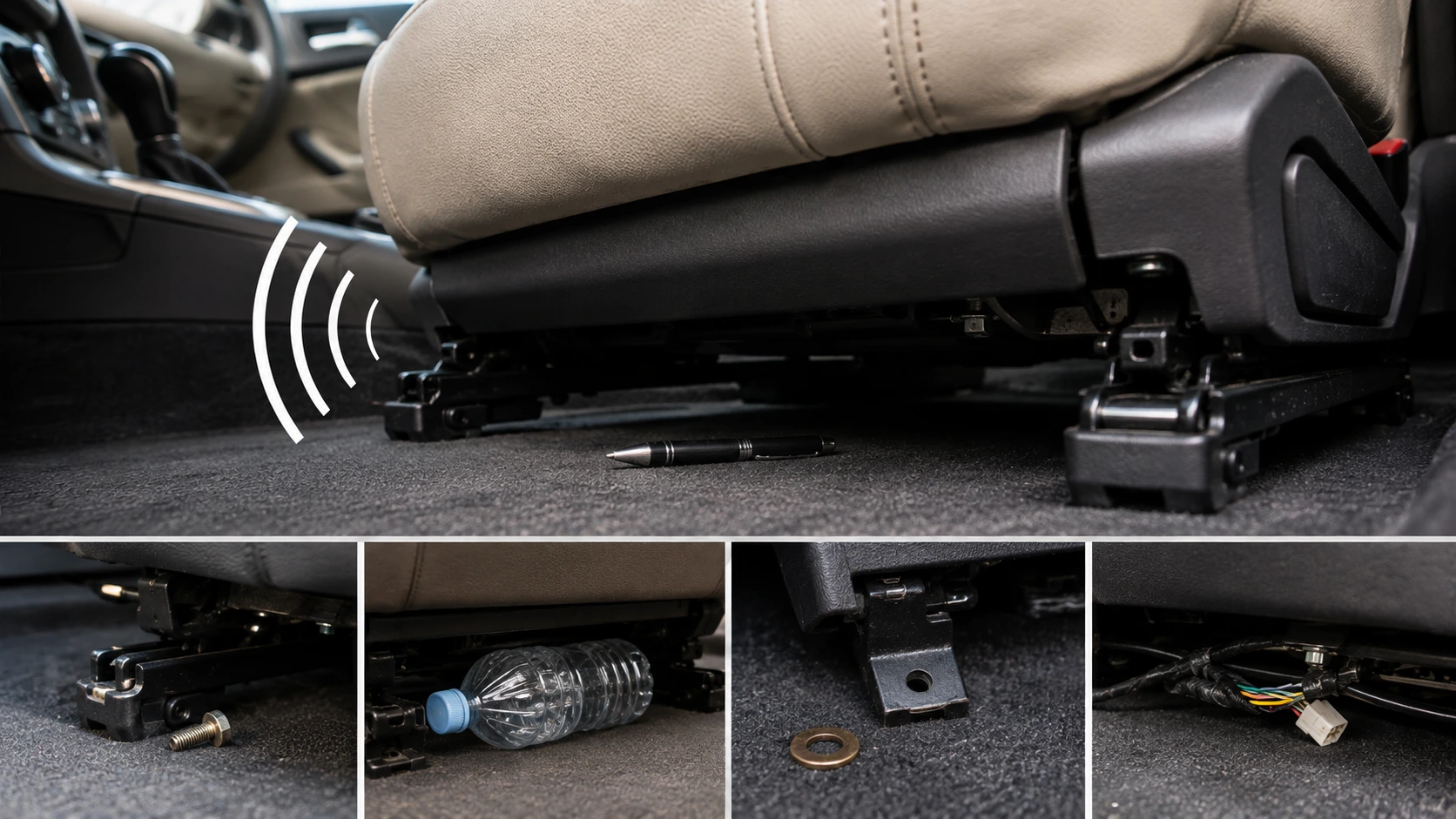
A rattling sound under the seats is one of the most difficult noises to pinpoint precisely — because the area under the seats contains a surprising number of components, the rattling sound under the seats often only appears over specific road surfaces, and the resonance from one location can make the sound appear to come from somewhere else entirely. In Dubai, this rattling sound under the seats complaint is amplified by the combination of speed bumps, rough commercial road surfaces in Al Quoz, and the thermal expansion and contraction of interior components in extreme heat.
At Rapid Rev Garage in Al Quoz, rattling sound under the seats cases are diagnosed with a structured inspection rather than random investigation — identifying the source by exclusion before anything is removed.
Rattling Sound Under the Seats — Quick Verdict
A rattling sound under the seats almost always comes from one of five sources: loose seat rail bolts or slider mechanisms that have worked free from vibration, heat shield panels on the exhaust or fuel system directly beneath the seat area that have lost their mounting integrity, unsecured wiring harnesses or electronic modules — seat heater controllers, airbag modules, seat position sensors — that vibrate against the floor or seat structure, items that have rolled under the seat and are rattling against the rails, or loose underbody components visible from underneath the vehicle. Dubai’s speed bumps, heat cycling, and rough industrial road surfaces in Al Quoz accelerate the loosening of all of these faster than smoother, cooler markets.
Table of Contents
- Why Under-Seat Rattles Are Hard to Locate Without Method
- Reading the Rattle — When It Appears and What It Sounds Like
- The Five Sources Ranked by Frequency in Dubai
- How Dubai’s Conditions Loosen Under-Seat Components
- How We Find the Exact Source at Rapid Rev Garage
- The Right Fix for Each Confirmed Source
- What Happens If This Is Left Without Attention
- Is It Safe to Drive With an Under-Seat Rattle?
- How Long the Repair Takes
- What the Repair Costs in Dubai
- Preventing Under-Seat Rattles in Dubai’s Conditions
- Why Rapid Rev Garage?
- FAQ
- Conclusion
Why Under-Seat Rattles Are Hard to Locate Without Method
The under-seat area is acoustically complex — sound bounces off the floor, door sills, centre console, and seat structure before reaching the driver’s ears. A rattle originating under the passenger seat can sound like it is coming from the driver’s side. A rattle from an underbody heat shield directly beneath the seat can appear to come from inside the cabin.
Why Road Surface Matters So Much
Most under-seat rattles only appear over specific road textures — the concrete road surface of a particular stretch, the metal expansion joint of a bridge, or the rough tarmac of an Al Quoz side street. This surface-specificity is because the rattle requires a specific vibration frequency to excite the loose component into movement. A smooth road produces no rattle from the same loose component. This is useful diagnostic information — noting exactly which road surfaces produce the rattle significantly narrows the possible sources.
Why Speed and Load Change the Rattle
Some under-seat rattles appear only when the vehicle is loaded with passengers — the extra weight on the seat structure changes which bolts and brackets are under tension and can reveal a loose point that was held by the seat’s unloaded weight. Others appear only above a specific speed, pointing toward a frequency-dependent resonance rather than a simple loose fastener.
Reading the Rattle — When It Appears and What It Sounds Like
The character of a rattling sound under the seats provides direct information about its source before any inspection begins.
A Metallic Clinking Over Bumps
A metallic clink or jingle specifically over speed bumps or expansion joints — appearing with the suspension impact and fading immediately — points toward a loose fastener, a heat shield clip, or a metal-to-metal contact point that is normally held apart by tension. This is the most common under-seat rattle character in Dubai.
A Continuous Rattle at Specific Speeds
A rattle that begins at a specific vehicle speed and stops when speed changes — rather than appearing over bumps — is a resonance-driven rattle. The component is vibrating sympathetically with the vehicle’s structure at the frequency produced by that speed. This type tends to be wiring harnesses, loose underbody panels, or heat shields.
A Rattling That Changes With Passenger Weight
A rattle that disappears when a passenger sits in the seat, or appears specifically when the seat is occupied, points directly toward the seat structure, seat rail, or seat mounting bolts — because the load change directly affects tension on those specific components.
A Scraping or Rolling Sound From Under the Seat
A scraping or rolling sound that moves position when the car corners or brakes points toward a foreign object — a bottle, a tool, a phone, a coin — that has rolled under the seat and is moving freely in the space between the rails.
The Five Sources Ranked by Frequency in Dubai
Each of the following sources has a specific symptom character that helps identify it before any component is removed.
Loose Seat Rail Bolts or Slider Mechanism
Seat rails bolt to the floor through threaded inserts in the vehicle floor. These bolts are subjected to vibration, thermal cycling, and the repeated load changes of occupants getting in and out. In Dubai’s heat, the differential thermal expansion between the steel bolt, aluminium insert, and steel floor causes the clamping force on these fasteners to cycle with temperature — gradually reducing their effective preload over years of ownership.
What a Loose Rail Bolt Feels Like Under Load
A seat rail with a loose mounting bolt produces a rattle over bumps that changes character when the occupant shifts their weight — because the rail’s position relative to the floor changes slightly when the clamping force is insufficient. This weight-dependent rattle character is the clearest indicator of a loose mounting bolt before any inspection begins.
The Slider Mechanism Itself
The seat fore-aft slider mechanism accumulates dust and debris in Dubai’s environment, which can produce a scratching or rattling when the seat is adjusted or when the slider is loaded by an occupant. A slider that has lost its lubrication produces a creaking and rattling that is position-dependent — it may rattle at one seat position but not another.
Heat Shield Panels Beneath the Seat
The exhaust system, fuel tank, and driveshaft run beneath the vehicle floor in the seat area. These components are covered by heat shields — thin metal panels attached to the vehicle floor or exhaust with clips, bolts, or spot welds. When these attachments fail — from corrosion, vibration fatigue, or the heat cycling they are specifically designed to resist — the shield vibrates against the surrounding bodywork or exhaust components.
Why This Sounds Like an Interior Rattle
A heat shield rattle from beneath the vehicle floor transmits through the floor into the cabin and appears to the driver as an interior rattle from under or behind the seat. The metallic quality of the sound is identical to an internal rattling component. The distinction is confirmed when the rattle persists even with all passengers out of the vehicle and nothing moving inside the cabin. Our car mechanic team checks both interior and underbody sources on every rattling sound under the seats complaint.
Wiring Harnesses and Electronic Modules
Modern vehicles have multiple electronic modules and wiring harnesses routed under the seats — airbag sensors, seat position sensors, seat heater controllers, and the main body wiring harness pass through this area. A wiring harness that has lost its retaining clip against the floor produces a rattle as the harness moves freely in its routing path. An electronic module bracket that has a loose fastener vibrates the module against the bracket on every bump.
Why This Is Particularly Common in Dubai’s Heat
Plastic wiring harness retaining clips harden and become brittle in Dubai’s sustained heat, eventually cracking and releasing the harness they were holding. A harness that was clipped securely when the vehicle was new may be freely rattling under the seat at 60,000 km from clip failure alone.
Foreign Objects in the Rail Area
The space under a car seat — between the rails and the floor — accumulates objects over time. In Dubai’s multi-passenger vehicle culture, where large families and shared rides are common, the variety of items that eventually end up under seats is considerable. A single small item — a pen, a coin, a small toy, a phone charging cable — can produce a continuous metallic or plastic rattle on every road irregularity.
The Fastest Check in the Diagnostic Sequence
Before any technical investigation, running a hand and a torch along the full length of the seat rails and floor beneath the seat takes 60 seconds and eliminates this cause immediately.
Loose Underbody Components
Beyond heat shields, other underbody components can produce what sounds like an under-seat rattle from inside the cabin — a loose exhaust mounting rubber that allows the exhaust to contact the floor pan, a loose underbody splash panel, or a driveshaft centre bearing bracket with a loose fastener.
How Dubai’s Conditions Loosen Under-Seat Components
Dubai’s environment specifically accelerates the loosening of under-seat components through several mechanisms.
Thermal Cycling of Fastener Preload
Every fastener holding a seat rail, heat shield, or bracket to the vehicle floor is subjected to daily thermal cycling — from cool underground parking to peak cabin temperature in summer. Steel bolts and aluminium floor inserts have different thermal expansion coefficients. Each cycle slightly reduces the clamping force the fastener generates. Over thousands of cycles in Dubai’s extreme temperature swings, bolts that were correctly torqued can work loose without any impact event.
Speed Bump Impact Frequency
As established in the suspension blog — Dubai’s speed bump density means a daily commute crosses dozens of full-compression suspension events. Each impact applies a brief but significant load to the seat rail mounting points, heat shield attachments, and underbody components directly beneath the seats. The accumulated cycle count from this impact frequency accelerates fastener loosening faster than smoother-road markets.
Dust Accumulation in Slider Mechanisms
Al Quoz industrial dust accumulates in the seat slider mechanisms faster than in clean-air residential environments. A slider packed with fine dust loses its smooth engagement and begins to produce scratching and rattling that worsens progressively as the accumulation increases. For any breakdown caused by a component failure that produces the rattle, our roadside assistance covers Al Quoz and nearby Dubai areas.
How We Find the Exact Source at Rapid Rev Garage
The diagnostic sequence moves from fastest and simplest checks first to more involved investigation if required.
Foreign Object Clearance First
The seat rail and under-seat floor area is cleared of any foreign objects before any further investigation. This takes 60 seconds and eliminates one cause completely.
Seat Rail Bolt Torque Check
All four seat mounting bolts are checked for correct torque with a torque wrench — not just by hand-feel. A bolt that feels tight by hand may be below specification, especially if the floor insert has rotated slightly. Correctly torquing all four bolts on a loose-railing seat resolves the rattle immediately if this is the cause.
Road Test After Each Intervention
A road test over the specific surface that produces the rattle confirms whether the intervention has resolved it. This step-by-step approach — fix one potential cause, road test, fix the next — prevents the scenario where multiple interventions are made and it is unclear which one resolved the rattle.
Underbody Inspection on Ramp
If the rail bolt and foreign object checks do not resolve the rattle, the vehicle is raised on the ramp and the underbody area beneath the seat is inspected for heat shield attachment integrity, exhaust mount condition, and loose underbody panels. A torch and firm hand pressure on each heat shield reveals movement that isn’t visible at rest. Our car service packages include an underbody heat shield and mounting inspection at every major service visit.
Wiring Harness Routing Check
Where underbody and rail checks have not identified the source, the wiring harnesses and module brackets under the seat are inspected for loose clips, broken retainers, and module brackets that are not fully secured. Each harness is pushed into its correct clip location and the module brackets are confirmed fastened.
The Right Fix for Each Confirmed Source
The repair is matched to the specific source confirmed by the diagnostic sequence.
Seat Rail Bolt Retorque or Thread Repair
Loose seat rail bolts are retorqued to specification using a torque wrench. Where the floor insert has been damaged and no longer holds torque correctly, a thread repair insert — or in severe cases, a floor plate repair — restores the secure fastening point.
Heat Shield Re-securing or Replacement
A loose heat shield is re-secured using the correct clip, bolt, or clamp for the specific attachment point. Where the shield itself has corroded or cracked, replacement is the correct repair. The underbody area is checked for any additional loose shields in the same inspection.
Slider Lubrication or Replacement
A dusty or dry seat slider mechanism is cleaned and lubricated with the correct lubricant for the slider type. A slider with worn engagement points is replaced with the correct unit for the vehicle.
Wiring Harness Clip Replacement
Broken wiring harness retaining clips are replaced with the correct replacement clips to resecure the harness in its routing path. Module brackets with loose fasteners are retorqued or replaced where the bracket mount has failed. For any exterior repairs needed alongside interior work, our car painting team handles colour-matched repairs at the same visit.
What Happens If This Is Left Without Attention
Most under-seat rattles are not safety-critical in their early stages — but some have consequences that are.
Loose Seat Rail Bolts Are a Safety Concern
A seat that is not securely mounted to the floor does not provide the crash protection the seat belt system is designed around. The seat belt anchor points are in the seat structure — a seat that can move during a collision because its rails are insufficiently torqued changes the geometry of the restraint system. This is the reason loose seat rail bolts are a genuine safety concern rather than just a noise inconvenience.
Heat Shield Removal Risk
A heat shield that detaches entirely — rather than just rattling — leaves the fuel lines, brake lines, and floor insulation directly above the exhaust without thermal protection. This is a fire risk that develops from what started as a simple rattle.
Is It Safe to Drive With an Under-Seat Rattle?
The safety assessment depends on the confirmed or suspected source.
Foreign Object or Slider Rattle — Driveable
A rattle confirmed to be from a foreign object or a dry slider mechanism carries no safety concern. Address within the week for comfort.
Loose Seat Rail Bolts — Address Today
A seat rail that is loose enough to produce a weight-dependent rattle should be retorqued the same day. The safety implication of a loose seat mounting is not theoretical.
Heat Shield Rattle — Address This Week
A heat shield that is rattling is one impact event away from detaching completely. Address within the week rather than indefinitely.
How Long the Repair Takes
Repair time is short for most under-seat rattle causes — the majority resolve same-day.
Foreign Object Clearance and Slider Lubrication
15–30 minutes including road test confirmation.
Seat Rail Bolt Retorque
30–45 minutes including road test after torquing all four mounting points.
Heat Shield Work
30–60 minutes for re-securing or replacing the affected shield, including underbody inspection for additional loose shields.
Wiring Harness Clip and Module Work
45–90 minutes depending on how many clips require replacement and the access required for each harness routing.
What the Repair Costs in Dubai
Cost depends on the confirmed source — simple causes like a retorque cost significantly less than heat shield replacement.
Simple Fixes
Foreign object clearance: no charge beyond inspection. Seat rail retorque: AED 100–250 including road test. Slider lubrication: AED 150–300.
Component Replacement
Heat shield replacement: AED 200–600 depending on the shield size and vehicle. Wiring harness clip replacement: AED 150–400 depending on the number and access complexity. Seat rail replacement where the mount is damaged beyond retorque: AED 500–1,500 depending on vehicle and rail specification. A written quote is provided after the diagnostic sequence confirms the specific source. Our mobile car mechanic covers Al Quoz and nearby Dubai areas for on-site initial assessment.
Preventing Under-Seat Rattles in Dubai’s Conditions
Specific habits prevent the most common under-seat rattle causes from developing.
Annual Seat Rail Torque Check
Including seat rail bolt torque in the annual service checklist catches loosening before it produces a rattle — and before the loosening reaches the level where the seat’s crash protection is compromised. This check takes three minutes with a torque wrench.
Regular Under-Seat Clearing
Making a habit of clearing the area under all seats during regular interior cleaning removes the foreign objects before they become rattle sources. In a family vehicle doing regular Dubai school runs, this habit prevents the most common and most embarrassing under-seat rattle cause.
Underbody Heat Shield Inspection at Every Service
A visual and physical check of all heat shield attachment points during every ramp inspection catches loosening shields before they detach. Our garage near me location in Al Quoz serves drivers from Business Bay, Jumeirah, Barsha, Satwa, Downtown, and the Sheikh Zayed Road corridor.
Why Rapid Rev Garage?
Every rattling sound under the seats case at Rapid Rev Garage is diagnosed with a systematic sequence rather than guesswork — because a rattling sound under the seats from a heat shield that is treated as an interior wiring issue, or a seat rail issue that is treated as an underbody panel problem, produces an intervention that doesn’t resolve the sound. Starting with the fastest checks — foreign objects, rail bolts, road test — and progressing to ramp inspection and harness assessment if the fast checks don’t resolve it means the cause is identified in the most efficient sequence possible.
FAQ — Rattling Sound Under the Seats
These are the questions most frequently asked about this fault at our Al Quoz workshop.
Why does the rattle only happen on certain roads?
The rattle requires a specific vibration frequency to excite the loose component. That frequency is produced by the resonance of a specific road surface at a specific speed. Smooth roads don't produce the triggering frequency — rough or textured roads do.
Can a loose seat cause a rattle under the seat?
Yes — and a loose seat mounting bolt is also a safety concern, not just a comfort issue. A weight-dependent rattle that changes when the occupant moves is the clearest indicator of a loose seat rail mounting point.
Why does my under-seat rattle disappear in cold weather?
Metal components contract slightly in cool conditions, which can temporarily close a gap that was rattling from thermal expansion. A rattle that disappears in winter and returns in summer is thermally-driven — confirming that a gap is opening from heat expansion and closing when cool.
Is a heat shield rattle dangerous?
A rattling heat shield is not immediately dangerous, but a detached heat shield exposes fuel lines and brake lines to exhaust heat. Addressing a rattling shield before it detaches prevents the fire risk that a detached shield creates.
How do I tell if the rattle is inside the car or from underneath?
Ask a passenger to press on the floor carpet directly under the seat while you drive over the rattle-producing surface. If the rattle stops when the carpet is pressed, the source is interior. If it continues regardless of carpet pressure, the source is likely underbody.
Conclusion
A rattling sound under the seats in Dubai has a specific source in every case — loose seat rail bolts, heat shields, wiring harnesses, foreign objects, or underbody components — and each source has a direct fix. The systematic diagnostic sequence — fastest checks first, road test after each intervention, ramp inspection if interior checks don’t resolve it — identifies the source without guesswork. Rapid Rev Garage in Al Quoz follows this sequence on every under-seat rattle complaint rather than attempting random investigation.
Rapid Rev Garage is in Al Quoz, serving drivers across nearby Dubai areas — Business Bay, Jumeirah, Downtown, Barsha, Satwa, and the Sheikh Zayed Road corridor. Book your appointment on WhatsApp or find us on Google Maps.
Rapid Rev Garage — rattling sound under the seats | Al Quoz, Dubai