Hidden car problems most drivers ignore are usually small faults that do not immediately stop a vehicle from running. Common examples include minor fluid leaks, worn suspension bushings, uneven brake-pad wear, cracked serpentine belts, early steering wear, and small coolant or heater-core leaks. The danger is that these problems can become expensive or unsafe if they are left untreated. In Dubai, extreme summer heat, traffic congestion, frequent speed bumps, and long-distance driving can make existing wear worse. If your car has an unusual smell, noise, vibration, fluid spot, loose steering feeling, or warning light, do not wait for a breakdown. A professional inspection can identify the underlying problem before it becomes a major repair.
Table of Contents
- Problem Overview
- Seven Hidden Car Problems Drivers Commonly Miss
- Symptoms to Watch For
- Common Causes
- Diagnostic Process
- Repair Process
- Risks of Ignoring These Problems
- Can You Continue Driving with Car Problems?
- Repair Time
- Cost of Repair
- Cost Factors
- Prevention Tips
- Dubai-Specific Advice
- Why Choose Rapid Rev Garage for Car Problem Diagnosis and Repair?
- FAQs
- Related Articles
- Relevant Service Page
- Final Thoughts and Call to Action
Problem Overview: Why Do Drivers Miss Early Car Problems?
A car does not always give you a dramatic warning before something fails.
Many mechanical problems begin quietly. A small transmission-fluid seep may leave only a tiny mark on the parking space. A worn suspension bushing may produce one soft clunk over a speed bump. A serpentine belt may develop cracks while the engine continues to operate normally.
This is why drivers often say, “The car was working perfectly yesterday.”
In reality, the problem may have been developing for weeks or months.
The most important lesson is simple:
If your car changes its normal sound, smell, steering feel, braking behavior, fluid level, or driving performance, investigate the change early.
For Dubai drivers, this is particularly important because high temperatures, stop-and-go traffic, long commutes and frequent road-speed bumps can place additional stress on cooling, rubber, suspension, braking and electrical components.
The 7 Hidden Car Problems Most Drivers Ignore
1. Minor Transmission Fluid Leaks
A small transmission-fluid leak can be easy to dismiss, especially when the car still changes gears normally.
One common search concern is minor transmission fluid leak cost. The actual cost depends on whether the leak comes from a pan gasket, seal, hose, cooler line or a more complicated transmission component.
What to look for
- Red, pink, brown or dark oily fluid under the vehicle
- Delayed gear engagement
- Harsh gear changes
- Transmission slipping
- Burning smell
- Low transmission-fluid level
If you notice red fluid under car after parking, do not automatically assume it is harmless. Fluid colour varies by vehicle and fluid age, so the source should be confirmed professionally.
Why it matters
Driving with low transmission fluid can increase heat and friction inside the transmission. A small leak may therefore become a much more expensive transmission repair.
2. Early Steering and Tie-Rod Wear
A steering system can gradually become loose without producing an obvious dashboard warning.
A loose steering wheel feeling may indicate worn tie-rod ends, ball joints, steering components, alignment problems or other suspension wear.
Drivers should pay attention to:
- Excessive steering play
- Vehicle wandering
- Steering vibration
- Uneven tyre wear
- Knocking when turning
- Car pulling to one side
One useful search topic is early symptoms of bad tie rod ends. These can include steering looseness, uneven tyre wear, clunking sounds and poor directional stability.
This is not an issue to ignore because steering components directly affect vehicle control.
3. Small Coolant or Heater-Core Leaks
Coolant problems do not always begin with visible steam.
Sometimes the first clue is an unusual sweet smell.
If your car smells sweet inside vents, the heating system may need inspection. One possible cause is a small heater-core leak.
Heater-core pinhole leak symptoms can include:
- Sweet coolant smell inside the cabin
- Fogging or misting of the windshield
- Damp carpet near the passenger area
- Unexplained coolant loss
- Weak cabin heating
- Low coolant warning
- Engine temperature gradually increasing
A small coolant leak can become much more serious if the cooling system loses enough coolant to cause overheating.
In Dubai’s hot climate, cooling-system health deserves particular attention.
4. Cracked or Aging Serpentine Belts
A serpentine belt drives important accessories such as the alternator, air-conditioning compressor and, depending on vehicle design, other components.
It can deteriorate before it actually breaks.
How to spot cracked serpentine belt wear
Look for:
- Visible cracks
- Frayed edges
- Missing rib material
- Glazing or shiny sections
- Squealing
- Belt flutter
- Repeated belt noise
Other hidden engine belt failure signs can include battery charging problems, overheating in certain engine designs, loss of air conditioning and sudden accessory failure.
A belt inspection is inexpensive compared with dealing with a roadside breakdown.
5. Minor Suspension Clunks
A car does not need to produce a loud banging noise to have suspension wear.
A minor clunking sound front suspension speed bumps can be an early warning of worn sway-bar links, control-arm bushings, ball joints, shock mounts or other suspension components.
Worn control arm bushing symptoms
- Clunking over bumps
- Steering instability
- Uneven tyre wear
- Vehicle pulling under braking
- Vibration through the steering wheel
- Reduced ride comfort
Dubai’s numerous speed bumps and road transitions can make suspension wear more noticeable over time.
A small suspension noise is not always an emergency, but it should not be ignored indefinitely.
6. Uneven Brake-Pad Wear
Many drivers look at the outside brake pad and assume the brakes are fine.
That can be misleading.
Inner brake pad wearing faster than outer can indicate problems such as a sticking caliper piston, restricted slide pins or other brake hardware issues.
Another overlooked problem is hidden brake rotor grooving inside face. The inner surface of the brake disc may develop wear that cannot be easily seen without proper inspection.
Warning signs include:
- Car pulling during braking
- Grinding
- Squealing
- Brake vibration
- Uneven pad thickness
- Reduced braking performance
- Brake-disc grooves
- One wheel becoming unusually hot
Brake problems should be inspected promptly because they involve a primary safety system.
7. Small Electrical and Sensor Problems
Modern cars depend heavily on electronic sensors and control modules. A sensor may become unreliable before a major dashboard warning appears.
Possible clues include:
- Intermittent warning lights
- Poor fuel economy
- Rough idle
- Difficult starting
- Unusual cooling-fan behaviour
- Random electrical glitches
- Weak battery performance
- Stop-start system problems
A diagnostic scan can identify stored or pending fault codes that may not yet have triggered a permanent warning light.
This is one reason a proper vehicle inspection is more useful than simply checking whether the dashboard currently has warning lights.
Symptoms: What Are the Signs of a Hidden Car Problem?
Watch for changes rather than waiting for complete failure.
Warnings
- ⚠️ New fluid spots under the car
- ⚠️ Unusual smell from the engine or vents
- ⚠️ New clicking, clunking or squealing
- ⚠️ Loose steering
- ⚠️ Vehicle pulling left or right
- ⚠️ Uneven tyre wear
- ⚠️ Brake vibration
- ⚠️ Reduced acceleration
- ⚠️ Gear-change hesitation
- ⚠️ Rising temperature gauge
- ⚠️ Repeated warning lights
- ⚠️ Unusual belt noise
- ⚠️ Reduced AC performance
- ⚠️ Unexpected coolant or oil loss
One symptom may have several possible causes, so avoid replacing parts based only on a guess.
Causes: Why Do These Problems Develop?
Hidden faults commonly develop because of:
- Normal component wear
- High mileage
- Extreme temperatures
- Poor-quality replacement parts
- Missed maintenance
- Fluid contamination
- Road impacts and potholes
- Repeated speed-bump impacts
- Incorrect installation
- Delayed servicing
- Previous accident damage
- Age-related rubber deterioration
Dubai’s climate is particularly demanding on rubber components, fluids, batteries, cooling systems and air-conditioning components.
Diagnostic Process: How Does a Garage Find a Hidden Problem?
A professional diagnosis should follow a process rather than rely on guesswork.
Step 1: Customer symptom review
The technician asks when the problem occurs, whether it happens when cold or hot, and whether it appears during braking, acceleration, turning or idling.
Step 2: Visual inspection
The technician checks:
- Fluid leaks
- Belts
- Hoses
- Brake components
- Suspension
- Tyres
- Battery
- Engine bay
Step 3: Computer diagnostics
An OBD or manufacturer-level scan may identify stored, pending or intermittent faults.
Current UAE market references put basic diagnostic scans around AED 50–150 and broader multi-system diagnostics around AED 200–500, although workshop pricing varies.
Step 4: Mechanical testing
Depending on the symptom, technicians may inspect steering play, suspension movement, brake thickness, fluid levels, belt condition, cooling-system pressure and other components.
Step 5: Road test
A controlled road test may help reproduce noises, vibrations, steering problems or transmission symptoms.
Repair Process: What Happens After Diagnosis?
The repair depends on the confirmed fault.
A professional repair process normally involves:
- Confirming the failed component.
- Explaining the repair options.
- Providing an estimate.
- Replacing or repairing the affected component.
- Checking related components.
- Testing the vehicle.
- Clearing relevant diagnostic faults where appropriate.
- Confirming that the original symptom has been resolved.
A good garage should explain why a component needs replacement rather than simply presenting a list of parts.
Risks of Ignoring These Problems
A small fault can become a chain reaction.
| Hidden Problem | Possible Consequence |
|---|---|
| Transmission leak | Low fluid, overheating, transmission damage |
| Tie-rod wear | Poor steering control, tyre wear |
| Coolant leak | Overheating, engine damage |
| Cracked serpentine belt | Accessory failure or roadside breakdown |
| Suspension bushing wear | Poor handling and accelerated tyre wear |
| Uneven brake wear | Reduced braking performance and rotor damage |
| Electrical/sensor fault | Poor performance or starting problems |
The biggest financial mistake is often not repairing a small problem; it is waiting until several connected components are damaged.
Can You Continue Driving with Hidden Car Problems?
Sometimes yes, but not every hidden problem is safe to drive with.
A minor suspension noise may allow you to drive carefully to a workshop. A small fluid seep may also require prompt but not necessarily emergency attention.
However, stop driving and seek professional help if you experience:
- Severe steering looseness
- Brake failure or major brake loss
- Rapid fluid leakage
- Engine overheating
- Smoke from the engine
- Major transmission slipping
- A broken belt
- Sudden loss of power
- Strong burning smell
- Dangerous vibration
If the vehicle is unsafe to drive, use roadside assistance rather than risking a breakdown or accident on a busy Dubai road.
Repair Time: How Long Do Hidden Car Repairs Take?
Repair time varies by vehicle and fault.
| Repair/Inspection | Typical Time |
| Basic diagnostic scan | 30–60 minutes |
| Multi-point inspection | 1–3 hours |
| Minor fluid leak repair | 1–4 hours |
| Serpentine belt replacement | 30–120 minutes |
| Brake pad service | 1–3 hours |
| Tie-rod replacement | 1–3 hours |
| Control-arm repair | 2–4 hours |
| Cooling-system leak repair | 1–5+ hours |
Complex European, luxury and performance vehicles can require additional diagnostic time and specialist parts.
Cost of Repair: What Should Dubai Drivers Expect?
There is no single price for hidden car problems because vehicle model, parts and labour make a major difference.
For context, current UAE repair references show suspension work ranging from several hundred dirhams for individual components to several thousand for larger suspension jobs. Inspection services commonly range from roughly AED 99 for basic checks to AED 249–499 for broader vehicle health inspections, while comprehensive inspection packages in Dubai can be around AED 299–399.
Estimated Dubai cost guide
| Service | Estimated Range |
| Basic diagnostic scan | AED 50–150+ |
| Multi-system diagnostics | AED 200–500+ |
| Basic vehicle health inspection | AED 99–249+ |
| Comprehensive inspection | AED 249–499+ |
| Tie-rod replacement | AED 200–600+ per component |
| Control-arm replacement | AED 350–2,000+ per arm |
| Suspension bushing repair | AED 200–800+ |
| Wheel alignment | AED 100–250+ |
| Brake-pad replacement | AED 200–800+ depending on vehicle |
These are market-reference ranges, not a Rapid Rev Garage quotation. Luxury and European vehicles can cost substantially more.
Cost Factors: Why Can the Same Repair Cost Differently?
The final price can depend on:
- Vehicle make and model
- Engine type
- OEM versus aftermarket parts
- Genuine versus economy components
- Labour complexity
- Accessibility of the failed component
- Number of damaged components
- Diagnostic requirements
- Wheel alignment requirements
- Programming or calibration
- Warranty requirements
For example, replacing a control-arm bushing alone may cost less than replacing the complete control arm assembly, but the correct choice depends on the vehicle and component design.
Prevention Tips: How to Catch Hidden Problems Early
Use this simple maintenance checklist:
Monthly
- ✅ Check engine oil level.
- ✅ Check coolant level when the engine is cold.
- ✅ Look for fluid spots.
- ✅ Check tyre pressure.
- ✅ Listen for new noises.
- ✅ Check warning lights.
Every service
- ✅ Inspect belts and hoses.
- ✅ Inspect brakes on both sides.
- ✅ Check suspension joints and bushings.
- ✅ Check steering components.
- ✅ Scan electronic systems when appropriate.
- ✅ Inspect battery condition.
- ✅ Check for fluid seepage.
Before a long Dubai trip
- ✅ Check tyres.
- ✅ Test the battery.
- ✅ Inspect cooling-system condition.
- ✅ Check engine oil and coolant.
- ✅ Inspect brakes.
- ✅ Test the AC.
- ✅ Look for leaks.
- ✅ Consider a complete vehicle health inspection.
Preventive inspection is usually cheaper than emergency repair.
Dubai-Specific Advice for Preventing Hidden Car Problems
Dubai drivers face conditions that can accelerate wear.
Extreme heat
High temperatures put additional stress on batteries, cooling systems, rubber components, tyres and fluids.
Heavy traffic
Long periods of idling and stop-start driving increase thermal and mechanical load.
Speed bumps
Repeated impacts can accelerate wear in shocks, control-arm bushings, sway-bar links and steering components.
Long-distance driving
Regular trips between Dubai, Abu Dhabi, Sharjah and other Emirates can turn a small fault into a roadside breakdown if the vehicle has not been inspected.
Air-conditioning demand
Dubai drivers depend heavily on AC. A small refrigerant, electrical or cooling-system issue can become more noticeable during summer.
For these reasons, a preventative vehicle inspection workshop in Dubai can be particularly useful before a long trip, before selling a vehicle or when a car develops unexplained symptoms.
Why Choose Rapid Rev Garage for Hidden Car Problem Diagnosis and Repair?
When a problem is difficult to see, accurate diagnosis matters more than simply replacing parts.
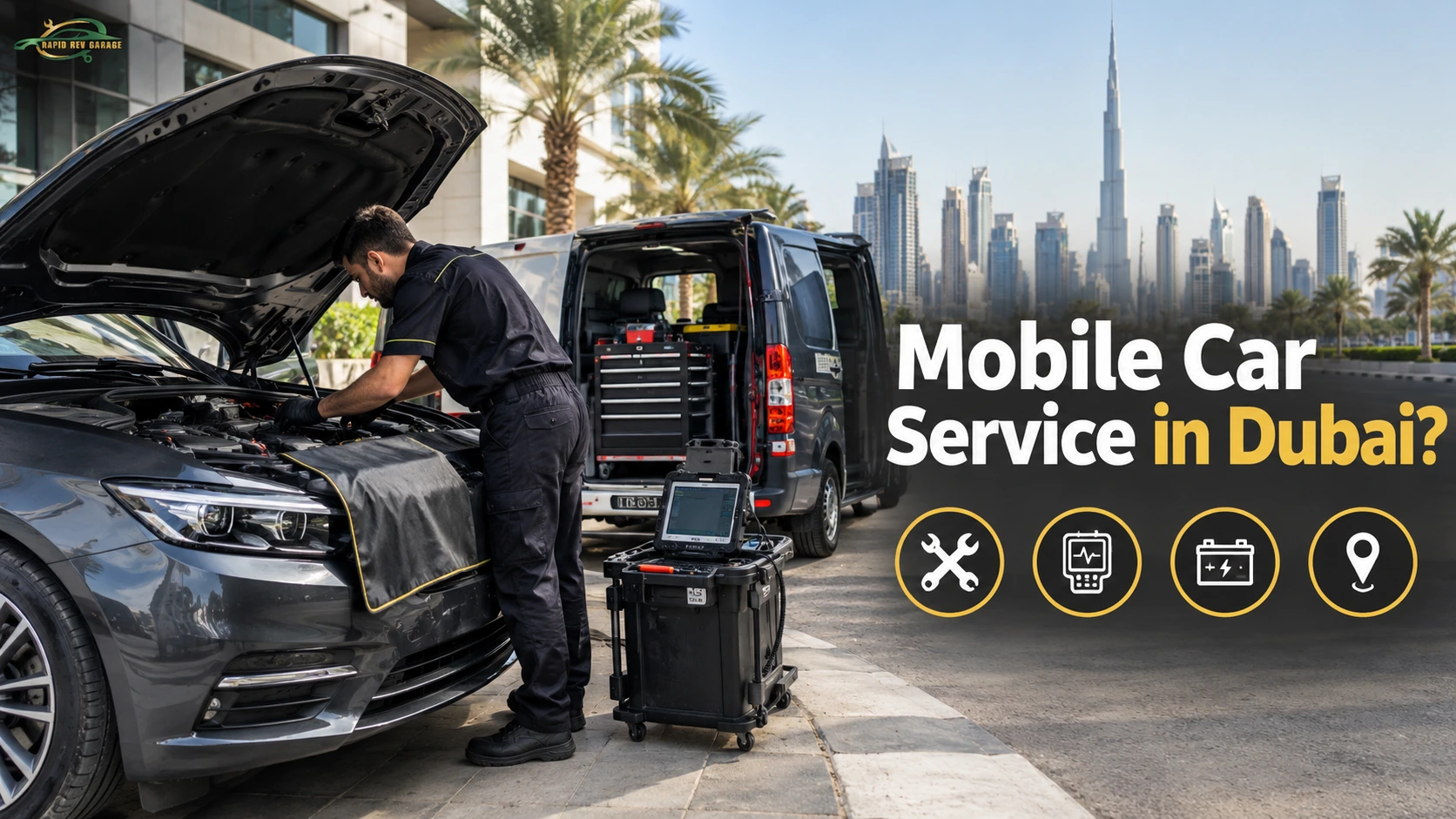
Rapid Rev Garage provides vehicle diagnostics, engine repair, suspension repair, brake repair, general maintenance, mobile mechanic services and roadside assistance in Dubai. Its workshop is based in Al Quoz, and the company also promotes mobile services for customers across Dubai.
Rapid Rev Garage states that it uses computerized diagnostic equipment and services a wide range of vehicle makes and models.
The key benefit for hidden problems is a diagnostic-first approach: identify the actual fault, explain the repair requirement, then carry out the appropriate repair rather than guessing.
FAQs
What are the most common hidden car problems?
Small fluid leaks, suspension wear, uneven brake wear, belt deterioration, steering-component wear, coolant leaks and electrical faults are among the problems drivers can overlook because the vehicle may continue operating normally.
How do I know if my car has a problem that cannot be seen?
Look for changes in noise, smell, steering, braking, vibration, fluid levels, fuel economy or driving performance. A diagnostic scan and multi-point inspection can also identify problems that are not obvious during normal driving.
What are 8 cars to avoid?
There is no universal list of eight cars that every Dubai driver should avoid. Reliability depends on model year, engine, maintenance history, accident history and regional specification. A detailed inspection is more useful than judging a vehicle only by its badge.
What is the most common problem in cars?
Wear-related problems involving brakes, tyres, batteries, fluids, suspension components and cooling systems are among the most common issues. The exact problem varies by vehicle age, mileage, climate and maintenance.
What are the top 5 most unreliable cars?
There is no scientifically valid permanent top-five list because reliability changes by model year, engine and maintenance history. Instead of relying on a generic ranking, check the specific car's service history, diagnostic faults and mechanical condition before buying.
What are the signs of a bad car?
Frequent warning lights, overheating, excessive smoke, transmission problems, steering looseness, unusual noises, repeated fluid leaks, uneven tyre wear and poor maintenance records are major warning signs.
What hidden car problems should I check before buying a used car in Dubai?
Check the engine, transmission, suspension, steering, brakes, cooling system, electrical modules, AC, tyres, underbody and accident-related repairs. A professional pre-purchase inspection can reveal issues that a short test drive may miss.
Is a small transmission leak serious?
It can be. A minor leak may initially cause little noticeable change, but continued fluid loss can contribute to transmission overheating, poor shifting and internal damage.
Why does my car make a clunking sound over speed bumps?
Possible causes include worn control-arm bushings, sway-bar links, ball joints, shock mounts or other suspension components. The exact source should be confirmed through a physical inspection.
Should I visit a mechanic if my steering feels slightly loose?
Yes. Steering looseness should not be ignored because it may involve tie rods, ball joints, steering components or alignment. A mechanic near me can inspect the steering system and determine whether the issue is minor or safety-critical.
Is a vehicle inspection worth it if there is no warning light?
Yes. Not every mechanical problem triggers a dashboard warning. Physical inspection can detect leaks, worn bushings, uneven brake wear, belt damage and other faults that electronic diagnostics alone cannot identify.
Where can I find the best full car diagnostic check near me in Dubai?
Look for a workshop that combines computerized diagnostics with a physical mechanical inspection. Rapid Rev Garage offers diagnostic and general vehicle services in Dubai, including its Al Quoz workshop and mobile assistance options.
Can Rapid Rev Garage help if my car breaks down suddenly?
Yes. Rapid Rev Garage advertises 24/7 emergency assistance, towing/recovery and mobile mechanic services in Dubai.
Related Articles
For readers researching related vehicle problems, useful topics include:
- Why Are My Car’s Plastic Interior Panels Making Noise?
- Why Is My Car Making a Rattling Sound Under the Seats?
- Why Your Car Seat Vibrates While Driving and How to Fix It?
- Can Small Dents Become Bigger Over Time? Here’s Why
- Why Does My Car Have Uneven Driving Comfort?
Relevant Service Page
For professional inspection, diagnostics and mechanical repairs, visit the Rapid Rev Garage Car Mechanic service page. The workshop provides mechanical diagnostics and repairs for major vehicle makes and models.
You can also explore Rapid Rev Garage’s Car Service Dubai page for broader maintenance and vehicle health-check services.
Conclusion
The biggest car problems are not always the loudest ones.
A tiny leak, slight steering movement, soft suspension clunk, cracked belt or uneven brake pad may seem too minor to worry about today. But these small signs are often your vehicle’s early warning system.
The smart approach is simple: notice the change, diagnose the cause and repair it before the damage spreads.
If you are searching ‘garage near me‘, choose Rapid Rev Garage for diagnostics, inspection, maintenance and repair services across Dubai.
Do not wait for a hidden car problem to become a roadside breakdown. Book a vehicle inspection with Rapid Rev Garage and find out what your car is really trying to tell you.
You can also visit us at our Al Quoz, Dubai branch,
Rapid Rev Garage: https://maps.app.goo.gl/wjK13vovXTKx5SsH8