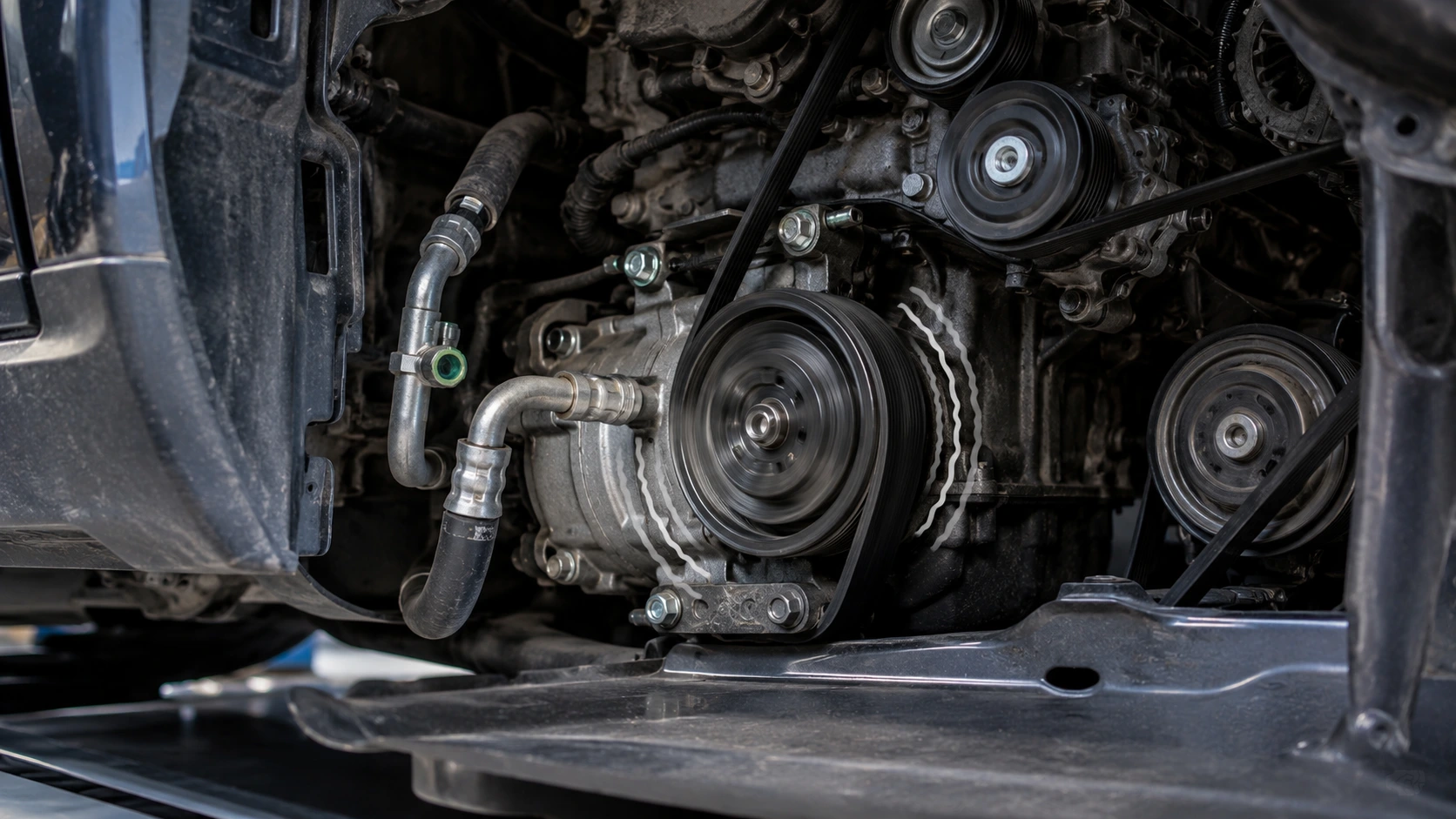
When a car AC compressor making noise situation develops — whether it is a rattling on startup, a grinding under load, a squealing when the AC is selected, or a knocking that appears and disappears — is the compressor communicating that something inside or around it has developed a fault. The compressor is the mechanical heart of the AC system, and any noise it produces under operation is a warning worth acting on before a marginal fault becomes a seized compressor that takes the entire AC system down with it.
At Rapid Rev Garage in Al Quoz, our car AC repair team diagnoses every car AC compressor making noise complaint with a pressure test, a clutch engagement assessment, and a bearing check before any repair is recommended — across all makes and models.
Car AC Compressor Making Noise — Quick Verdict
A car AC compressor making noise is most commonly caused by one of four faults: a failing compressor clutch bearing producing a grinding or squealing that appears specifically when the AC is switched on, a compressor with worn internal pistons or valves producing a knocking or rattling under load, a low refrigerant charge causing the compressor to cavitate and rattle as it circulates insufficient refrigerant, or a loose or worn AC drive belt producing squealing from belt slip at the compressor pulley. In Dubai’s sustained heat, the compressor runs near-continuously from April through October — accumulating more operating hours per year than the same compressor experiences in any European vehicle. This accelerates bearing wear, clutch wear, and internal component fatigue significantly faster than factory service intervals account for.
Table of Contents
- How to Read the Noise Before Any Inspection
- The Four Most Common Compressor Noise Causes in Dubai
- Why Dubai’s Continuous AC Use Accelerates Compressor Wear
- How We Diagnose Compressor Noise at Rapid Rev Garage
- The Right Fix for Each Confirmed Cause
- What Happens If Compressor Noise Is Ignored
- Is It Safe to Keep Using the AC?
- How Long the Repair Takes
- What the Repair Costs in Dubai
- Preventing Compressor Noise in Dubai’s Conditions
- Why Rapid Rev Garage?
- FAQ
- Conclusion
How to Read the Noise Before Any Inspection
The noise character of a car AC compressor making noise — its pitch, timing, and conditions — narrows the list of possible causes significantly before any tools are connected.
Noise Only When the AC Is Switched On
A car AC compressor making noise that appears the moment the AC is selected and disappears when it is switched off is almost certainly from the compressor clutch or compressor itself — because the clutch is the component that engages when the AC is activated. A grinding or squealing that appears with AC on and stops with AC off is the clearest diagnostic pattern for a clutch bearing or compressor fault.
Noise Present Regardless of AC Status
A noise from the compressor pulley area that is present whether the AC is on or off — and changes with engine RPM — is from the compressor’s freewheel bearing. The compressor body may be healthy, but the bearing that allows the pulley to rotate when the clutch is disengaged has worn. This bearing runs continuously whenever the engine runs, not just when the AC is selected.
Noise That Changes With Engine Load or Temperature
A knocking or rattling from the compressor area that appears under hard acceleration or that worsens as the engine warms up points toward internal compressor wear — pistons, valve plates, or connecting rods within the compressor that are producing noise under pressure.
Squealing at AC Startup That Fades
A brief squeal specifically at the moment the AC clutch engages — fading within a few seconds — is often the AC drive belt momentarily slipping as the compressor’s initial engagement load hits the belt. A belt that squeals on every AC clutch engagement has insufficient tension or is worn beyond adequate grip.
The Four Most Common Compressor Noise Causes in Dubai
Each noise source has a specific diagnosis path and a specific repair — identifying which one before starting any repair prevents replacing the compressor when the actual fault is a worn belt, or replacing the belt when the actual fault is the clutch bearing.
Compressor Clutch Bearing Failure
The AC compressor clutch consists of a pulley that rotates continuously, an electromagnetic coil, and a friction plate that engages to drive the compressor when the coil is activated. The clutch bearing sits between the rotating pulley and the compressor body — it allows the pulley to spin freely when the AC is off. When this bearing wears, it produces a grinding or squealing that changes character when the clutch engages, because the load distribution across the bearing changes.
How to Isolate This From Internal Compressor Noise
A clutch bearing fault produces its most distinctive noise when the bearing is loaded by the AC clutch engagement — the grinding typically increases when the clutch plate engages and the compressor body begins to rotate. An internal compressor fault produces noise under pressure — present throughout the AC operating cycle but often worse at idle when compressor speed is lowest relative to its pressure demand. This distinction is confirmed by observing the noise character at AC engagement versus during sustained AC operation.
Internal Compressor Wear — Pistons and Valve Plates
Modern automotive AC compressors are variable displacement piston compressors. Inside, multiple pistons compress refrigerant through valve plates that open and close on each compression stroke. When these pistons or valve plates wear — from extended operation with degraded compressor oil in the refrigerant, from a low refrigerant charge that runs the compressor dry, or from contamination — they produce a knocking or rattling under compression load.
The Contamination Risk
When a compressor produces internal noise from wear, metal particles from the worn surfaces enter the refrigerant circuit. These particles circulate through the system and contaminate the expansion valve, the evaporator, and the condenser. A compressor replacement without flushing the system of these particles produces a premature failure of the replacement compressor — because it is immediately contaminated by the debris from its predecessor. Our car mechanic team flushes the AC system as standard when replacing any compressor with confirmed internal noise.
Low Refrigerant Causing Cavitation Noise
A compressor that is circulating insufficient refrigerant — from a slow leak in the system — produces a rattling or chattering noise as it cavitates in the near-empty circuit. The compressor oil is dissolved in the refrigerant and circulates with it — a low refrigerant charge also means low oil circulation to the compressor bearings and pistons. The noise is the compressor running under-lubricated and under-loaded simultaneously.
The Refrigerant Leak Must Be Found First
Adding refrigerant to a system without finding and sealing the leak produces temporary noise resolution — and the same noise in two to four weeks when the refrigerant has escaped again. A pressure test held over time, followed by UV dye or electronic leak detection, identifies the specific leak point before any refrigerant is added.
Worn or Slipping AC Drive Belt
The AC compressor is driven by the engine’s serpentine belt on most vehicles, or a dedicated AC belt on some platforms. A belt that has glazed from heat and age, or a tensioner that has lost its spring pressure, produces squealing from belt slip at the compressor pulley. The squeal is typically most pronounced at AC clutch engagement — when the sudden addition of compressor load momentarily exceeds the belt’s grip.
Why Dubai’s Continuous AC Use Accelerates Compressor Wear
The AC compressor in a Dubai vehicle — one reason car AC compressor making noise complaints are common here — operates under conditions that accelerate every wear mechanism significantly beyond European assumptions.
Operating Hours Per Year Are Dramatically Higher
In a European climate, a car’s AC compressor runs for perhaps 3–5 months per year — the remainder of the year, the AC is off and the compressor clutch is disengaged. In Dubai, the compressor runs 8–10 months per year at full demand. The total operating hours accumulated by a Dubai compressor in three years may exceed what a European compressor accumulates in eight to ten years. Bearing wear is directly proportional to operating hours.
Peak Loads in Summer Stress Internal Components
Dubai’s summer ambient temperatures of 45°C+ mean the AC system operates against maximum head pressure — the condenser must reject heat into very hot ambient air. This raises the high-side pressure the compressor works against, increasing the load on its pistons, valve plates, and bearings for every minute of operation during summer. Our car service packages include an AC system pressure check at every major service specifically because of this sustained high-load operation.
Refrigerant Leak Risk Increases With Heat Cycling
Every AC component — hoses, O-ring seals, compressor port connections — undergoes thermal expansion and contraction with every AC cycle. In Dubai, where these cycles happen daily between underground parking cool and peak summer operation, the accumulated thermal fatigue on O-ring seals and hose ends is far greater than in stable-temperature markets. A system that was leak-free six months ago may have developed a slow leak since then — reducing refrigerant and oil circulation to the compressor.
How We Diagnose Compressor Noise at Rapid Rev Garage
Accurate diagnosis of a car AC compressor making noise requires testing under the conditions that produce the noise — not just at idle with the AC on.
Noise Characterisation at AC Engagement and Under Load
The AC is activated and the noise is assessed at the moment of clutch engagement, during sustained idle with AC on, and during revving with AC on. The noise character at each condition identifies which component is producing it — clutch bearing fault is engagement-specific, internal compressor fault is sustained under load, refrigerant cavitation is most noticeable at idle.
AC System Pressure Test
High and low side pressures are measured at idle with AC on. A system with low charge is confirmed by subnormal low-side pressure and subnormal high-side pressure. A compressor with internal valve plate wear shows low high-side pressure despite adequate refrigerant charge — the compressor cannot build pressure effectively. This pressure pattern distinguishes internal compressor wear from a refrigerant shortage.
Clutch Bearing Assessment
The AC belt is checked for tension and condition. The compressor clutch is assessed by manually checking pulley rotation with the clutch disengaged — roughness or grinding felt in the freewheel confirms the clutch bearing. The clutch engagement air gap is measured to confirm it is within specification — an incorrect gap causes the clutch plate to slip rather than engage cleanly, producing the startup squeal that resolves within seconds.
Refrigerant Leak Detection
Where low refrigerant is confirmed by pressure testing, UV dye or electronic detection identifies the leak source before any refrigerant is added. For any emergency on the road from AC system failure, our roadside assistance covers Al Quoz and nearby Dubai areas.
The Right Fix for Each Confirmed Cause
This section covers the key details for this topic.
Compressor Clutch Bearing Replacement
Where the bearing is confirmed as the noise source and the compressor body is otherwise healthy, the clutch bearing is replaced without replacing the entire compressor. The compressor body is retained and the clutch assembly — pulley, bearing, and friction plate — is replaced. Post-replacement, the clutch engagement air gap is set to specification and the AC is tested for correct cooling performance.
Compressor Replacement With System Flush
Where internal compressor wear is confirmed by the pressure test pattern and noise character, the compressor is replaced. The AC system is flushed to remove metal particles before the new compressor is installed. The receiver drier — which contains the desiccant that absorbs moisture from the refrigerant — is replaced as part of every compressor replacement, because opening the system introduces moisture that the original desiccant has already absorbed to capacity.
Refrigerant Leak Seal and Correct Recharge
The confirmed leak point is sealed — O-ring replacement, hose repair, or condenser repair depending on location. The system is then recharged to the manufacturer-specified weight in grams of the correct refrigerant specification — R-134a or R-1234yf depending on the vehicle year and platform.
Belt and Tensioner Service
A worn or glazed belt is replaced with a correctly-specified unit. The tensioner spring pressure is assessed — a tensioner that cannot maintain adequate belt tension is replaced alongside the belt. For exterior repairs needed alongside any AC work, our car painting team handles colour-matched work at the same visit.
What Happens If Compressor Noise Is Ignored
A car AC compressor making noise that is driven through rather than investigated follows a predictable and expensive progression.
Clutch Bearing Failure Seizes the Compressor Pulley
A clutch bearing that is grinding will eventually seize — the pulley locks against the compressor body rather than rotating freely. When this happens while the engine is running, the serpentine belt is immediately damaged or broken — because it cannot drive a seized pulley. A broken serpentine belt stops the alternator, water pump, and power steering simultaneously. This is a roadside emergency with significantly higher cost than the clutch bearing replacement that would have prevented it.
Internal Compressor Wear Produces Total Failure
A compressor knocking internally is distributing metal debris throughout the AC circuit with every minute of operation. When the compressor eventually seizes, it has contaminated the entire system. A total compressor failure and system contamination requires: new compressor, system flush, new receiver drier, new expansion valve, and a full refrigerant recharge. This cost is four to six times higher than a compressor replacement at the noise stage before contamination spreads.
Is It Safe to Keep Using the AC?
The answer depends on which component is making the noise.
Clutch Bearing Noise — Use Sparingly, Book This Week
If the noise is from the clutch bearing — grinding specifically when AC is on — the AC can be used carefully for a few more days. Avoid long AC-on highway runs that stress the bearing continuously. Book within the week.
Internal Compressor Noise — Switch AC Off, Book Today
A compressor producing internal knocking or grinding is spreading metal debris through the system with every AC cycle. Switch the AC off and book the same day. Continued use multiplies the total repair cost from system contamination.
Belt Squeal Only — Use Normally, Book This Week
Belt squeal from tension loss does not damage the compressor directly — but a belt that has insufficient tension can break suddenly. Book within the week.
How Long the Repair Takes
This section covers the key details for this topic.
Clutch Bearing Replacement
Two to three hours including AC performance test after replacement.
Compressor Replacement With System Flush
Four to six hours including flush, receiver drier replacement, refrigerant recharge to specification, and AC performance road test.
Belt and Tensioner Service
One to two hours including tension verification and AC performance confirmation.
What the Repair Costs in Dubai
This section covers the key details for this topic.
Clutch and Belt Work
AC compressor clutch bearing replacement: AED 400–900 depending on vehicle and clutch assembly access. AC belt and tensioner replacement: AED 300–700.
Compressor Replacement
Quality remanufactured or new compressor including system flush, receiver drier, and refrigerant recharge: AED 1,500–4,500 depending on vehicle platform and compressor specification. European and Japanese premium vehicles sit toward the higher end. A written quote is provided after the diagnostic pressure test and noise assessment confirm the specific cause. Our mobile car mechanic covers Al Quoz and nearby Dubai areas for on-site AC noise assessment.
Preventing Compressor Noise in Dubai’s Conditions
This section covers the key details for this topic.
Annual AC System Pressure Test Before Summer
A pressure test before the summer peak confirms refrigerant charge is correct — preventing the low-charge cavitation noise and compressor oil starvation that develops when refrigerant leaks slowly over winter and spring. A system confirmed at correct charge entering summer is protected against the low-refrigerant compressor damage that produces premature compressor noise.
Refrigerant and Oil Service at Correct Intervals
AC refrigerant does not need regular replacement — but if a recharge has occurred, confirming the correct quantity was added (by weight, not by gauge reading alone) ensures correct oil circulation to the compressor. A system overfilled or underfilled by more than 50 grams affects compressor lubrication meaningfully in Dubai’s high-load conditions. Our garage near me location in Al Quoz serves drivers from Business Bay, Jumeirah, Barsha, Satwa, Downtown, and the Sheikh Zayed Road corridor.
Why Rapid Rev Garage?
When a car AC compressor making noise complaint arrives at our workshop, the diagnostic sequence — noise characterisation under different AC conditions, system pressure test, clutch bearing assessment, and leak detection — identifies the specific component and its failure mode before any repair is recommended. A clutch bearing fault and an internal compressor fault produce similar-sounding noises but require completely different repairs at dramatically different costs. The pressure test is what distinguishes them definitively — and it is what we always perform before recommending compressor replacement.
FAQ — Car AC Compressor Making Noise
These are the questions most frequently asked about compressor noise at our Al Quoz workshop.
.
Why does my AC make a noise when I first turn it on but then goes quiet?
This is typically the AC clutch engagement — the brief moment of belt slip or clutch plate contact as the compressor begins rotating. If the noise fades within two to three seconds and the AC cools normally, the belt tension may be slightly low. If the noise persists or worsens over time, the clutch bearing is developing a fault.
Can I drive with a noisy AC compressor?
For belt or clutch bearing noise — yes, carefully, for a few days. For internal compressor grinding or knocking — switch the AC off and book the same day. Continued use with internal compressor noise spreads metal debris through the system.
Does adding refrigerant fix compressor noise?
If the noise is from low refrigerant cavitation — yes, once the leak is found and sealed and the correct refrigerant charge is restored. If the noise is from a worn clutch bearing or internal compressor wear, adding refrigerant has no effect.
Why did my compressor start making noise after a recharge?
A recharge that used incorrect refrigerant quantity or type, or that introduced air or moisture, can stress the compressor. A recharge that resolved an intermittent noise and now the noise has returned means the leak was not addressed before recharging — the refrigerant has escaped again.
How long does a car AC compressor last in Dubai?
In Dubai's continuous summer operation, five to eight years is a realistic lifespan for a compressor in a well-maintained system. Systems with repeated low-refrigerant operation, incorrect recharges, or extended oil change intervals on the host engine typically develop compressor noise before the five-year mark
Conclusion
A car AC compressor making noise in Dubai has specific, identifiable causes — clutch bearing wear, internal compressor wear, low refrigerant cavitation, or belt tension loss — each requiring a different repair at a different urgency level. The noise character, combined with a system pressure test, identifies the correct cause before any component is replaced. Rapid Rev Garage in Al Quoz diagnoses every compressor noise complaint through this sequence — preventing the scenario where a belt replacement is done when the actual fault is a clutch bearing, or a clutch bearing is replaced when the actual fault is internal compressor wear requiring system flush alongside the new unit.
Rapid Rev Garage is in Al Quoz, serving drivers across nearby Dubai areas — Business Bay, Jumeirah, Downtown, Barsha, Satwa, and the Sheikh Zayed Road corridor. Book your appointment on WhatsApp or find us on Google Maps.