An auto battery failure in Dubai is a different problem from one in most other markets. In Europe or North America, a battery typically gives clear warning signs over weeks before it fails completely. In Dubai’s heat, the failure is often faster, less predictable, and happens at worse moments — a covered parking garage at 2pm in August, an outdoor lot after a long airport trip, or on the way to a meeting on Sheikh Zayed Road.
Understanding the signs that an auto battery is approaching failure — and what causes batteries to degrade faster in Dubai’s specific conditions — means catching the problem before it becomes an emergency.
Auto Battery Dubai — Why Batteries Fail Faster Here
Heat is the primary enemy of battery longevity. An auto battery in Dubai experiences conditions that European and American markets don’t produce — sustained ambient temperatures above 40°C for months at a time, combined with extreme temperature cycling between hot outdoor environments and cooled underground parking.
This thermal cycling — from 45°C ambient to a 20°C air-conditioned garage and back repeatedly — stresses the battery’s internal plate structure more than consistent temperature ever would. The plates expand and contract with each cycle, the separator material between them degrades faster, and the electrolyte stratifies more aggressively than in a stable-temperature environment.
The practical result: an auto battery that lasts five to six years in Germany or the UK typically shows significant capacity degradation at three years in Dubai. Owners who expect European battery longevity end up surprised when a seemingly recent battery fails ahead of what they consider a reasonable service life.
Short-trip driving compounds the thermal damage. A car driven primarily on short runs — school drop-off, supermarket, office commutes in stop-start traffic — never gives the alternator sufficient time to restore the full charge consumed during each cold start. Over weeks and months, the battery spends increasing time in a partially discharged state, which accelerates sulphation of the lead plates and reduces capacity further.
Signs Your Auto Battery Needs Replacement
These are the indicators that an auto battery is developing or approaching failure. Some appear early — giving time for a planned replacement. Others appear suddenly and indicate the battery has already reached a critical state.
Slow Engine Cranking
The most classic indicator of a degrading auto battery is a slow, laboured engine crank at start-up — the starter motor turning the engine more slowly than usual, sometimes accompanied by a lower-pitched or straining sound.
This symptom is most pronounced in the morning after the car has been parked overnight, or after the car has been sitting in a hot outdoor environment for several hours. The battery’s internal resistance increases as it degrades, limiting the current it can deliver to the starter motor.
Why Cold Cranking Matters in Dubai
Despite Dubai’s ambient heat, engine cold-start demands are significant — the engine oil is at rest, viscosity is at its highest before warming, and the starter motor needs to overcome compression in all cylinders simultaneously. An auto battery with degraded cold cranking ampere (CCA) capacity struggles to deliver the current spike a cold start demands.
A battery that starts the car reluctantly on a cool morning in February will often fail to start it entirely after six hours in a summer parking garage.
Electrical Components Behaving Erratically
Modern vehicles have extensive electrical systems — comfort features, infotainment, lighting — that are sensitive to supply voltage. When an auto battery is degrading, its resting voltage drops and its ability to maintain stable voltage under load deteriorates.
The symptoms this produces are easy to misattribute to other faults. Dashboard lights that dim when another load is switched on. The radio that resets its settings repeatedly. The air conditioning that loses its programmed temperature preferences. Power windows that move more slowly than usual. Central locking that responds inconsistently.
These symptoms often appear at different times on different days — because the battery’s available capacity varies with its temperature and recent charge state. A Dubai Mini Cooper service and repair example that came through showed exactly this pattern — the owner had been chasing a SYNC infotainment fault for months before a conductance test revealed the battery was delivering less than 60% of its rated capacity. Replacing the battery resolved every electrical complaint immediately.
Control Unit Memory Errors
On European vehicles — BMW, Mercedes-Benz, Volkswagen Group, Audi, Land Rover — a degrading auto battery that produces voltage drops during high-current events can corrupt control unit adaptation values. The engine management system loses its learned idle adaptation. The DSG or ZF automatic transmission loses its clutch engagement learned values. The air suspension control unit loses height calibration data.
Owners experience these as the car “behaving differently” after the battery recovers — an idle that’s not quite right, gearshifts that feel less refined, or an air suspension that rides differently. The battery produced a voltage drop during a previous event, and the control units lost their stored calibration data.
Warning Lights on the Dashboard
Several dashboard warning lights are directly related to auto battery condition — though the connection isn’t always obvious.
Battery Warning Light
The battery warning light indicates the charging system isn’t maintaining voltage correctly. It can signal a failing alternator, a failed alternator belt, or a battery that’s so degraded the alternator cannot restore charge quickly enough to maintain system voltage under load.
Don’t dismiss a battery warning light that appears briefly and then disappears. Intermittent charging system warnings indicate a developing fault — the warning light appearing only under specific load conditions.
Check Engine and Other System Warnings
An auto battery producing voltage drops under load triggers fault codes across multiple systems simultaneously. A battery event that causes the voltage to dip briefly during a high-current draw creates fault codes in the engine management, the stability control system, and the body control modules — all appearing at the same time from a single root cause.
Multiple simultaneous fault codes across apparently unrelated systems is a strong indicator of a charging system or battery issue. A proper diagnostic scan with a conductance test for the battery is the correct first step before investigating each code individually.
Swollen Battery Casing
A battery with a visibly swollen casing has suffered thermal damage — typically from sustained overcharging or from excessive heat exposure. In Dubai’s summer, a battery parked in a hot outdoor location without adequate ventilation can reach temperatures that cause the electrolyte to gas and the casing to deform.
A swollen auto battery is beyond recovery — it’s a replacement item regardless of its age or how recently it was fitted. Continued use of a swollen battery carries fire risk as well as reliability risk.
Battery Age Beyond Three Years in Dubai
This isn’t a symptom — it’s a proactive maintenance guideline. An auto battery that has survived three Dubai summers should be tested with a conductance tester at every service regardless of whether any of the above symptoms are present.
A battery showing above 70% conductance health at three years can continue in service with close monitoring. A battery at 65% or below should be replaced proactively — it’s still starting the car, but its remaining capacity margin is insufficient for the demands of a Dubai summer.
How Auto Battery Testing Works — Voltage Versus Conductance
Not all battery tests produce the same information. Understanding the difference between a voltage check and a conductance test explains why voltage alone isn’t a reliable indicator of battery condition.
Resting Voltage Testing
A resting voltage check — measuring the battery’s open-circuit voltage with a basic voltmeter — tells you the battery’s surface charge. A fully charged auto battery reads approximately 12.6 volts. A partially charged battery reads lower.
What resting voltage doesn’t tell you: the battery’s actual capacity to deliver current under load. A battery can read 12.5 volts at rest — appearing fully charged — while having severely degraded plate structure that collapses under the current demand of a cold start. Voltage testing misses this completely.
Conductance Testing
A conductance tester measures the battery’s ability to deliver current through its internal plate structure — not just its surface charge. It sends a small signal through the battery and measures the response, producing a percentage reading of available capacity relative to the battery’s rated specification.
A battery showing 12.4 volts but 55% conductance on a conductance test will start the car fine on a cool morning and fail completely after six hours in a summer parking garage. The conductance test reveals this. The voltage test doesn’t.
A proper auto battery assessment at a quality workshop always uses a conductance tester. A workshop that checks the battery by measuring voltage alone is providing false reassurance.
Battery Replacement — What It Should Include
Replacing an auto battery correctly involves more than buying a new battery and fitting it in the car.
Correct Battery Specification
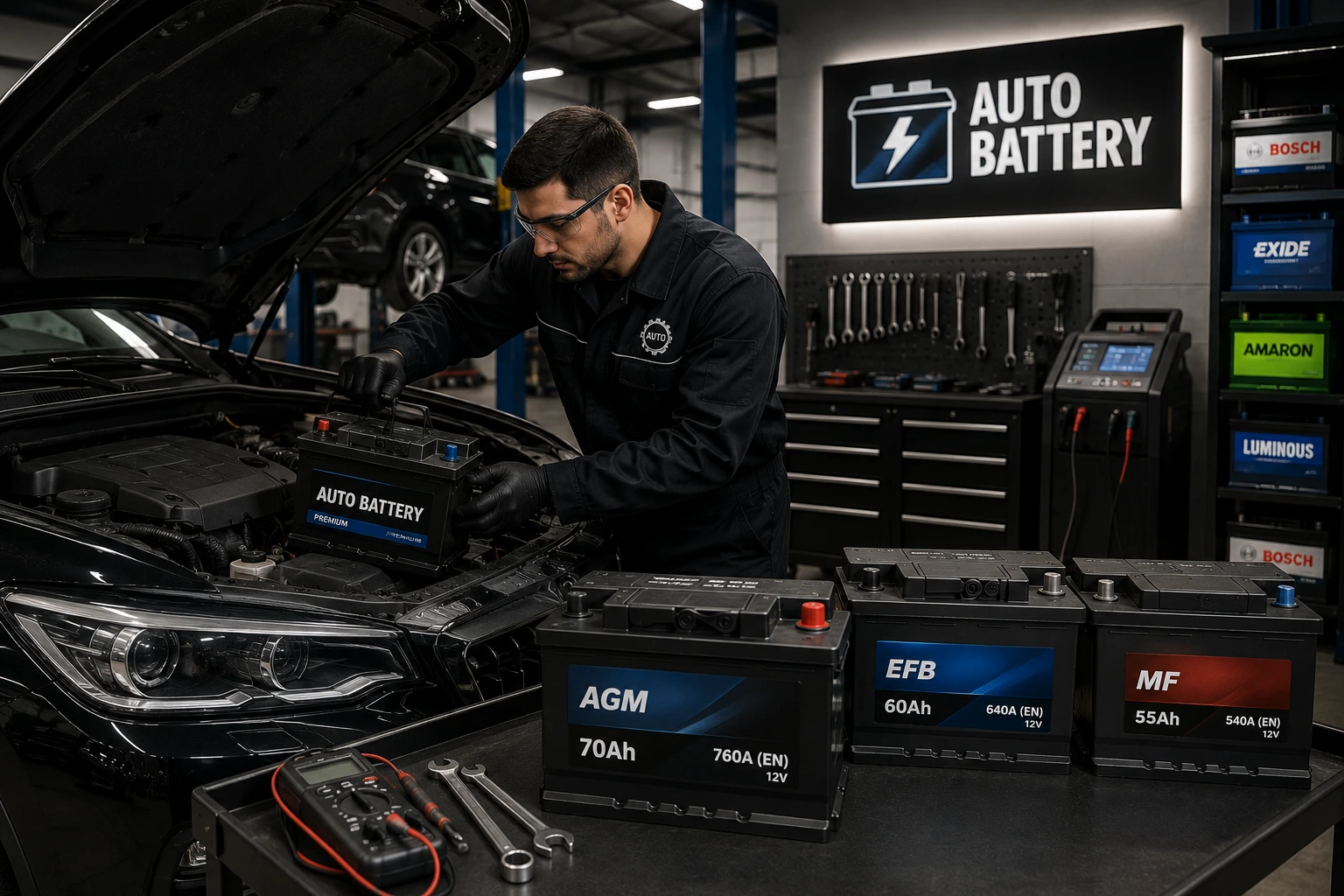
Battery specification matters — not just the physical size. The correct cold cranking ampere (CCA) rating for the vehicle and climate. The correct battery type — AGM (Absorbent Glass Mat) for vehicles with start-stop systems, EFB (Enhanced Flooded Battery) for some start-stop applications, conventional lead-acid for older vehicles without start-stop.
Fitting a conventional lead-acid battery in a vehicle designed for an AGM battery causes premature battery failure — the charging system’s charging profile for a start-stop vehicle is calibrated for AGM chemistry and will overcharge a conventional battery.
Battery Registration on European Vehicles
BMW, Mercedes-Benz, Volkswagen Group, Audi, Land Rover, Volvo, and other European vehicles require auto battery registration after replacement using the manufacturer-compatible diagnostic system. The power management system adjusts its charging strategy based on the battery’s age and capacity profile.
Without registration after fitting a new battery, the system continues charging as if the old degraded battery is still in place — the new battery is either overcharged or undercharged depending on the old battery’s stored profile. This causes premature capacity loss and potential control unit damage from incorrect charging voltage.
A proper auto battery replacement on a European vehicle includes registration as part of the service — not as an optional add-on. A qualified car mechanic with the correct diagnostic equipment performs this as a standard step in the replacement procedure.
Post-Replacement System Check
After fitting a new auto battery and completing registration where applicable, a full system scan confirms no fault codes were introduced during the replacement and that all control units have correctly recognised the new battery. Adaptation values that were lost during the battery swap — particularly in DSG transmissions and engine management systems — are confirmed reset and allowed to relearn.
When to Use a Mobile Battery Service
Not every auto battery replacement needs a workshop visit. A battery that fails in a location that’s inconvenient to leave — an office car park, a residential garage, a roadside — is a situation where a mobile service provides genuine value.
A qualified mobile car mechanic brings the correct replacement battery to the car’s location, fits it correctly, performs battery registration on applicable vehicles, and completes a basic electrical system check on-site. The car is back in service without needing recovery or a tow.
For genuine breakdown situations where the car won’t start and can’t be jump-started, proper roadside assistance gets the car moving correctly — whether through a battery jump, a battery replacement on-site, or safe recovery to a workshop where the full electrical system can be assessed.
For ongoing vehicle maintenance alongside battery replacement, a car service visit is the correct time to request a full electrical system health check — alternator output testing, ground strap condition assessment, and a complete control unit scan alongside the battery conductance test. For paint or bodywork alongside other repairs, professional car painting handles colour-matched work at the same visit.
For owners in Al Quoz and surrounding areas looking for a garage near me that handles auto battery replacement correctly — with conductance testing, correct battery specification, and proper registration on European vehicles — the difference from a workshop that just fits the nearest matching battery shows in how long the replacement lasts.
FAQ
How long does an auto battery last in Dubai?
Typically two to three years before significant capacity degradation — significantly shorter than the four to six years common in cooler markets due to Dubai's sustained heat and temperature cycling.
How do I know if my auto battery or alternator is the problem?
A conductance test identifies battery condition independently — if the battery is healthy but not holding charge, alternator output testing under load identifies whether the charging system is maintaining correct voltage.
Does auto battery replacement require coding on all cars in Dubai?
On European vehicles — BMW, Mercedes-Benz, VW Group, Audi, Land Rover, Volvo — yes. Battery registration via manufacturer-compatible diagnostic software is required after every replacement.
Can I jump-start my car and keep driving if the battery is failing?
Jump-starting provides temporary assistance but doesn't address the underlying fault. A failing battery that produces voltage drops while driving can corrupt control unit adaptation values.
What battery type does my car need in Dubai?
Start-stop vehicles require AGM specification — fitting a conventional battery in a start-stop car causes rapid battery failure from the higher charge and discharge cycling these vehicles produce.
Conclusion
An auto battery in Dubai needs proactive management rather than reactive replacement. Understanding the signs of degradation — slow cranking, electrical erratic behaviour, multiple simultaneous fault codes, and age beyond three years — and testing with a conductance tester rather than relying on voltage alone are what separate a planned replacement from an emergency.
Rapid Rev Garage in Al Quoz handles auto battery testing, replacement, and registration for all makes — with conductance testing, correct specification selection, and proper coding on European vehicles included as standard. Book your appointment on WhatsApp or find the workshop on Google Maps.