You turn the steering wheel to park in a Dubai Marina basement and a creak comes from the top of the front wheel arch, like an old door hinge. Over the speed bumps outside, a dull clunk follows. Later, the steering feels heavier than usual and does not come back to centre on its own. These are common bad strut mount symptoms, and they come from the part that holds the top of your front suspension to the car.
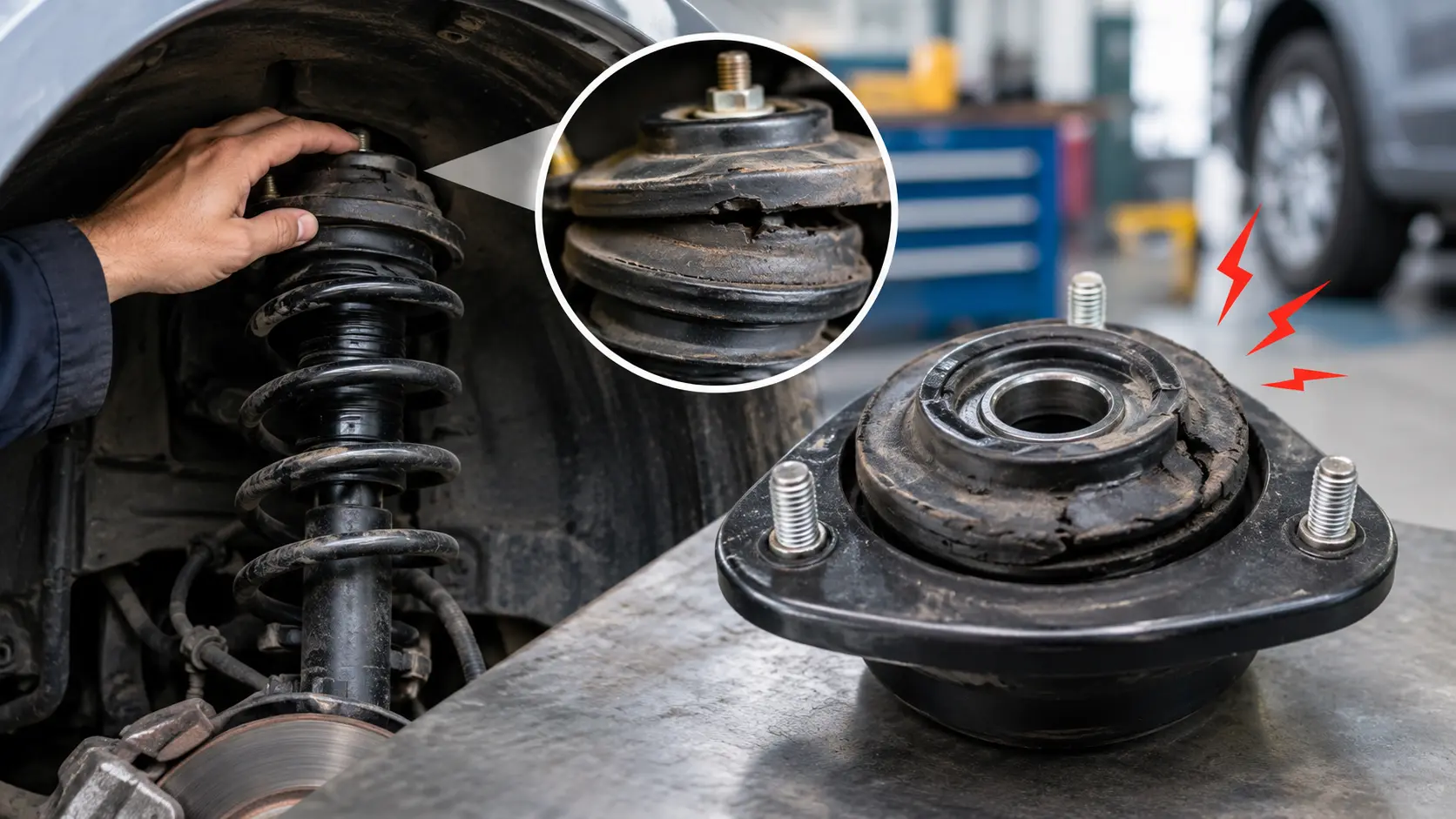
A strut mount, often called a top mount, sits at the top of each front strut where it bolts to the body under the bonnet. It has a rubber section that soaks up vibration and, on most front struts, a bearing that lets the strut and spring turn when you steer. When the rubber cracks or the bearing seizes, the suspension knocks, creaks and binds.
This guide explains what strut mounts do, the signs they are failing, why Dubai conditions wear them, how a workshop tests them and what replacement involves. It also covers the other parts that make similar noises.
Bad Strut Mount Symptoms: Quick Answer
The main bad strut mount symptoms are a creak, squeak or groan when turning the steering at low speed, a knock or clunk over speed bumps, stiff or binding steering, a steering wheel that does not return to centre, vibration through the steering at speed, poor handling and uneven wear on the inner edge of the front tyres.
YouCanic explains that cracked rubber lets metal touch metal and causes clunks, while a failed bearing stops the strut turning freely and makes steering hard. A technician listens at each mount while turning the wheel, checks the mount for cracks and play, and replaces it with a wheel alignment afterwards.
Table of Contents
- What a Strut Mount Does
- Strut Mount Rubber and the Strut Bearing
- Why Strut Mounts Wear Faster in Dubai
- Creaking or Squeaking When Turning at Low Speed
- Knocking or Clunking Over Speed Bumps
- Stiff Steering or Steering That Binds
- Steering Wheel Not Returning to Centre
- Vibration at Higher Speeds
- Uneven Wear on the Inner Edge of the Tyre
- Poor Handling and a Car That Feels Loose
- Faults That Sound Like a Bad Strut Mount
- How a Workshop Tests Strut Mounts
- What Strut Mount Replacement Involves
- Should Struts and Mounts Be Replaced Together?
- Is It Safe to Drive With a Bad Strut Mount?
- Why Does One Side Fail Before the Other?
- How Long Do Strut Mounts Last?
- Can a Bad Strut Mount Damage Other Parts?
- How to Make Strut Mounts Last Longer
- FAQ
- Conclusion
What a Strut Mount Does
Many cars sold in the UAE, such as the Toyota Corolla, Honda Civic, Nissan Altima and Kia Sportage, use MacPherson strut front suspension. The strut combines the shock absorber and the coil spring in one unit, and it also acts as the steering pivot.
The bottom of the strut bolts to the steering knuckle. The top passes through the strut mount and bolts to the body, in the strut tower under the bonnet. The mount carries the weight of that corner of the car.
The mount does two jobs. Its rubber section isolates road noise and vibration so they do not travel into the cabin. Its bearing lets the spring and strut rotate as you turn the steering wheel.
Rear struts on some cars also have top mounts, but they usually have no bearing because the rear wheels do not steer.
Strut Mount Rubber and the Strut Bearing
YouCanic explains that a strut mount has a rubber part and a bearing, and both can fail.
When the rubber cracks or breaks down, the metal parts of the mount can touch each other. That causes knocks over bumps and lets vibration into the car. The strut can also shift slightly in the tower, which changes the camber angle of the wheel.
When the bearing wears or seizes, the spring cannot rotate smoothly. The spring then winds up as you steer and releases with a creak, groan or pop. A seized bearing also makes the steering heavier and stops it returning to centre.
On some cars the bearing is a separate part that sits under the mount. On others it is built into the mount. Either way, it is usually replaced together with the mount.
Why Strut Mounts Wear Faster in Dubai
Speed bumps are a big factor. Residential areas such as Al Barsha, Mirdif, Jumeirah Village Circle and Arabian Ranches have many of them. Each one pushes the strut up hard into its mount.
Parking manoeuvres add wear to the bearing. Tight basement car parks in Dubai Marina, Downtown and Business Bay mean many full lock turns at walking pace, which is exactly when the bearing works hardest.
Heat ages rubber. The strut tower sits close to the engine. On summer afternoons when the air passes 45°C, the engine bay runs very hot, and the rubber in the mount hardens and cracks over time.
Dust and water damage the bearing. Fine sand gets past the dust seal, and car washes and pressure washers push water into the bearing. Once the grease washes out, the bearing starts to stick.
Creaking or Squeaking When Turning at Low Speed
A creak or squeak when turning the wheel is the most common sign of a worn strut bearing. YouCanic describes squeaking when turning the steering wheel, most noticeable at low speeds.
You hear it most when parking, during three point turns or when turning at junctions. The sound comes from the top of the wheel arch, near the windscreen side of the bonnet.
The noise happens because the bearing no longer turns smoothly. The coil spring twists and then slips with a creak or a pop. On hot days, when the grease is thin and the rubber is dry, the noise is often worse.
Knocking or Clunking Over Speed Bumps
YouCanic lists knocking, banging, clunking or popping over speed bumps or road irregularities as a strut mount symptom. The noise comes from cracked rubber that lets the metal parts hit each other.
The clunk is usually heard from the top of the suspension rather than from under the car. It is often loudest over slow speed bumps and when one wheel drops into a dip.
A knock over bumps is easy to confuse with a worn sway bar link or a worn shock absorber. The guide on bad sway bar link symptoms explains how to tell those apart.
Stiff Steering or Steering That Binds
YouCanic notes that a failed mount can restrict the strut’s free rotation, making the steering hard to turn. The steering may feel heavy in one direction, notchy, or as if it sticks at a certain point.
This symptom is most noticeable at low speed, when you need the most steering. Some drivers notice it first when parking and assume the power steering is failing.
If the steering is heavy only when the car is moving slowly, and you also hear creaks from the top of the wheel arch, the strut bearing is a strong suspect.
Steering Wheel Not Returning to Centre
After a turn, the steering wheel should come back to centre on its own as you drive straight. YouCanic lists a steering wheel not returning to centre as a sign of a bad mount.
A seized strut bearing holds the spring in a twisted position. That resists the natural self centring force from the steering geometry, so you have to turn the wheel back by hand.
Steering that does not return can also come from a binding ball joint, a stiff steering rack or wrong alignment angles. A technician checks each one.
Vibration at Higher Speeds
YouCanic lists excessive vibration at high speeds among the symptoms. A worn mount lets the strut move more than it should, and that movement can pass into the steering wheel and the body.
On roads such as Emirates Road or Sheikh Mohammed bin Zayed Road, you may notice a buzz or shimmy that was not there before. A worn mount can also make the car feel less settled over expansion joints and road seams.
Vibration at speed has many other causes, including wheel balance, bent rims and worn tyres. A quick balance check at a tyre service helps rule those out.
Uneven Wear on the Inner Edge of the Tyre
YouCanic explains that a worn mount can change the camber angle, usually to negative, which wears the inner edge of the tyre. When the rubber in the mount collapses, the top of the strut can shift inward, tilting the top of the wheel inwards.
Check the inner edge of your front tyres. Heavy wear there, with the rest of the tread still good, points to a camber problem. A worn mount, worn ball joints and bent parts can all cause it.
Catching it early saves the tyres. In Dubai heat, tyres already age faster, and uneven wear shortens their life further.
Poor Handling and a Car That Feels Loose
YouCanic lists poor handling among the signs. A worn mount lets the top of the strut move under load. The car may feel less precise on turn in, lean more or feel vague over uneven surfaces.
You may notice the car feels less planted on the curved ramps of interchanges or on roundabouts. The change is often slow, so many drivers only notice it once the mount is replaced and the car feels tight again.
Faults That Sound Like a Bad Strut Mount
Several parts make similar noises:
- Sway bar links. Rick’s Free Auto Repair Advice notes that worn link noise can resemble a worn strut mount.
- Worn struts or shock absorbers. These knock over bumps and let the car bounce.
- Broken coil spring. A spring that has cracked near the end clunks over bumps and turns.
- Ball joints. Worn ball joints clunk and can creak when turning.
- Control arm bushes. These creak over bumps and knock under braking.
- Power steering problems. A failing pump or rack can make steering heavy.
YouCanic also notes that worn sway bar links, bushes, damaged suspension parts and toe alignment problems can cause similar symptoms. A careful check of each part saves money on wrong repairs.
How a Workshop Tests Strut Mounts
A trained car mechanic near you starts with a road test over speed bumps and slow turns, listening for creaks and clunks and feeling for binding in the steering.
YouCanic describes a simple test. With the bonnet open and the engine running, a helper turns the steering wheel left and right while the technician listens and places a hand on each strut mount. A creak or pop that you can feel through the mount points to the bearing.
Next, the mount is checked visually. YouCanic advises looking at each top mount for cracks and checking that the strut nut is tight. A sunken or torn rubber section, or a strut rod that sits off centre in the tower, shows a worn mount.
With the wheels off the ground, the technician can grab the spring near the top and try to move the strut. YouCanic notes that movement here suggests a bad mount. The technician also checks the strut itself, the spring and the nearby links and joints.
What Strut Mount Replacement Involves
Replacing a strut mount means removing the strut from the car. The wheel comes off, the strut is unbolted from the knuckle and from the strut tower, and the whole assembly is lifted out.
The spring must then be compressed with a proper spring compressor before the top nut can be removed. This step is dangerous without the right tool, because a coil spring holds a lot of energy. It is a workshop job, not a driveway repair.
The old mount and bearing are removed, the new parts are fitted, and the spring is carefully released and seated. The strut goes back into the car, and all bolts are torqued to the maker’s figures. YouCanic gives a typical time of one to two hours per mount.
A wheel alignment is needed after the job, because removing the strut changes the camber and toe. Brand specialists such as Honda wheel alignment services set the angles to the maker’s figures for each model.
Should Struts and Mounts Be Replaced Together?
Often, yes. The labour to remove the strut is the same whether you replace the mount alone or the mount and the strut. If the strut is also worn, doing both at once saves paying the labour twice.
YouCanic suggests replacing the struts if they have not been replaced in over 50,000 miles, about 80,000 km. Many workshops also offer complete strut assemblies, which come with a new spring, mount and bearing already fitted. These are quicker to install and replace every wearing part at once.
If the struts are fairly new and still damp the car well, replacing only the mounts makes sense. A technician can bounce test the car and check the struts for leaks before deciding.
A complete suspension repair visit checks the struts, springs, mounts and links together.
Is It Safe to Drive With a Bad Strut Mount?
A creaking strut bearing is not usually an emergency. The car still steers and brakes. But a mount that has badly broken down can let the strut move enough to affect handling and alignment.
In rare cases, a mount can separate, letting the top of the strut push up into the bonnet area. This is more likely on high mileage cars with badly rusted or cracked mounts.
If the steering suddenly feels very heavy, the car handles oddly or you hear a loud bang from the suspension, stop as soon as it is safe. On a highway, turn on your hazard lights and move to the hard shoulder. Stopping in a live lane because of a breakdown brings a AED 1,000 fine and six black points under Article 98 of the UAE Federal Traffic Law. Once safe, call roadside assistance.
If you only hear a creak when parking, a mobile mechanic can do the bonnet open listening test before you book a workshop visit.
Why Does One Side Fail Before the Other?
YouCanic notes that the passenger side mount fails more often than the driver side. One reason is that roads are built with a slight slope toward the kerb for drainage, so the kerb side takes more potholes, dips and drain covers.
In the UAE, where cars drive on the right, the passenger side is the kerb side. It also takes more hits from kerbs during parking.
Even so, both mounts share the same age and heat. If one has failed, the other should be inspected at the same visit.
How Long Do Strut Mounts Last?
There is no fixed life. Many mounts last as long as the original struts, while others start creaking much sooner. Speed bumps, car park ramps, heat and water all shorten their life.
Mounts are usually inspected whenever the struts are checked. On high mileage cars, it is common to find a cracked rubber section or a rough bearing even before any noise appears.
Can a Bad Strut Mount Damage Other Parts?
Yes. A worn mount lets the strut move and shifts the wheel angles. That wears tyres unevenly and adds stress to the ball joints, tie rods and control arm bushes.
A seized bearing makes the spring wind up as you steer. Over time, that can crack the spring seat or wear the steering parts that push against the extra resistance.
Fixing a worn mount early protects these parts and the tyres.
How to Make Strut Mounts Last Longer
Slow down for speed bumps and cross them straight on. Each hard hit pushes the strut up into its mount.
Let the car roll slightly when turning the steering in car parks, rather than turning the wheel while completely stopped. That eases the load on the bearing.
Avoid pointing pressure washers into the strut towers and wheel arches. Water forced into the bearing washes out its grease.
If a kerb strike also scuffed a bumper corner or wheel arch, the bodywork can go to paint and panel repair, and the suspension should be checked at the same time.
A regular car service in Dubai should include a suspension check. If you hear creaks when turning or clunks over bumps, take the car to a car garage near you that tests each mount before replacing the struts.
FAQ
Here are the questions Dubai drivers most often ask about strut mounts.
What does a bad strut mount sound like?
It often creaks, squeaks or groans when you turn the steering at low speed, and it can knock or clunk over speed bumps. The noise comes from the top of the front wheel arch.
Can a strut mount cause heavy steering?
Yes. A seized strut bearing stops the strut turning freely, so the steering feels heavy, notchy or sticky, and the wheel may not return to centre after a turn.
How do mechanics test a strut mount?
They listen at each mount with the bonnet open while someone turns the steering, check the mount for cracks and a loose nut, and try to move the strut with the wheels off the ground.
Is driving with bad strut mounts safe?
A creaking mount is not usually an emergency, but a badly broken mount affects handling and alignment. Have it checked soon, and stop driving if the steering suddenly feels very heavy.
Does strut mount replacement need an alignment?
Yes. The strut must be removed to replace the mount, which changes the camber and toe. An alignment after the job keeps the car straight and protects the tyres.
Conclusion
A bad strut mount shows up as creaking when turning at low speed, a clunk over speed bumps, stiff or binding steering, a wheel that does not return to centre, vibration and wear on the inner edge of the front tyres. Speed bumps, tight car parks, engine bay heat and water wear mounts faster in Dubai. A listening test at each mount, a visual check and a play test confirm the fault, and an alignment follows the repair.
Rapid Rev Garage is a full workshop open 24 hours at Al Khail Gate, 12th Street, Al Quoz Industrial Area 2, serving passenger cars across Al Quoz, Business Bay, Jumeirah, Al Barsha, Satwa, Downtown and the Sheikh Zayed Road corridor. Visit https://rapidrevgarage.com, send your car model and a short video of the creak on WhatsApp, or get directions on Google Maps.
Rapid Rev Garage | Bad Strut Mount Symptoms | Al Quoz, Dubai