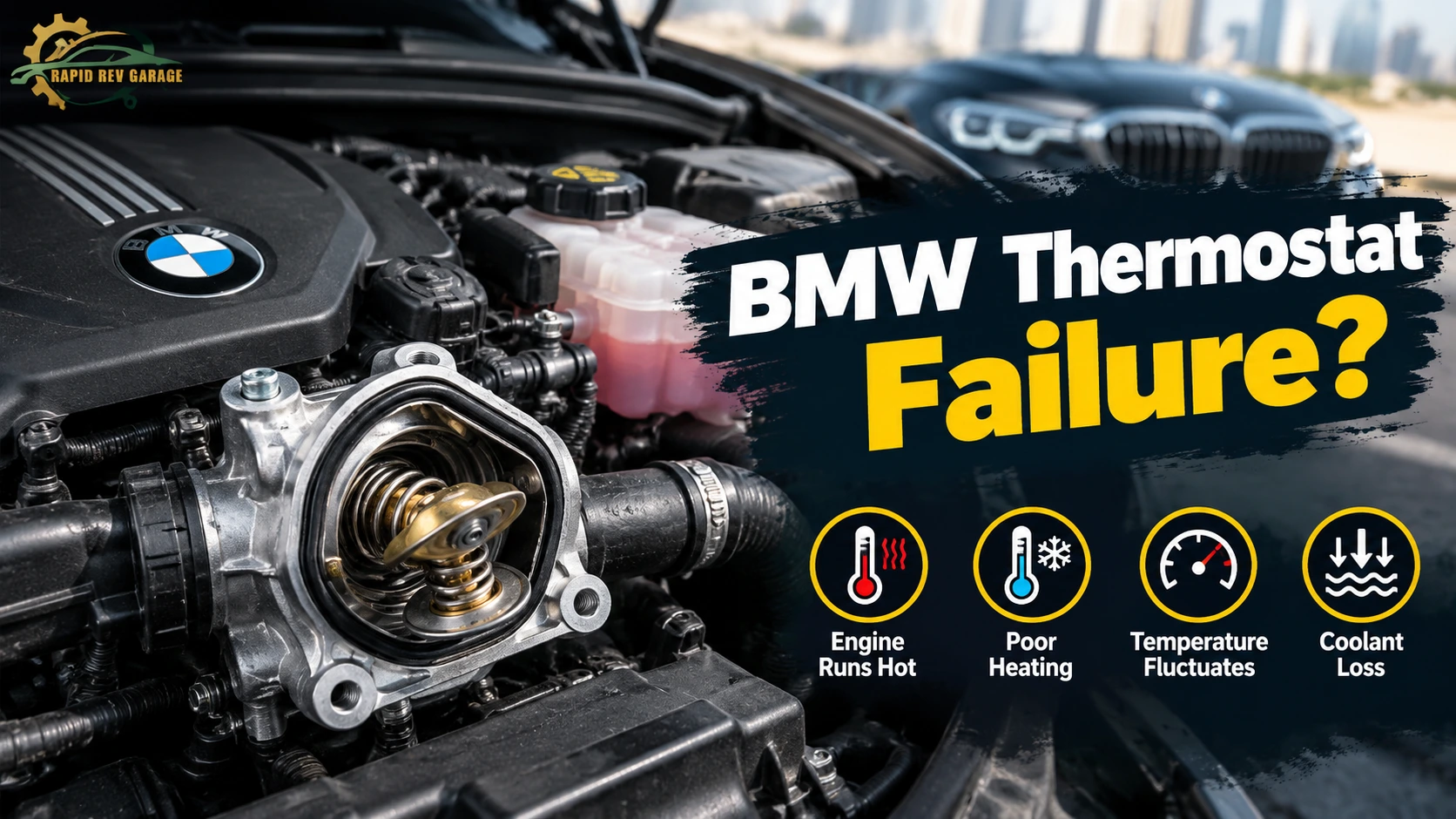
The most common signs of BMW thermostat failure are a rising temperature gauge, an engine temperature warning, poor fuel economy, and a check engine light. If the thermostat is stuck closed, coolant can’t reach the radiator, so the engine overheats. If it’s stuck open, the engine runs too cold and wastes fuel. Your BMW may also store fault codes like P0128 or 2E81. Dubai’s heat and traffic put extra strain on the cooling system so a weak thermostat can worsen quickly. Stop driving if the gauge climbs past the middle. Get a cooling system check before the problem reaches your head gasket.
What a BMW Thermostat Does and Why It Matters
Your thermostat is a small valve between the engine and the radiator. It stays closed when the engine is cold, so it warms up faster. Once the engine reaches the right heat, the valve opens. Coolant then flows to the radiator and cools down.
Most modern BMWs use an electronic thermostat. Mechanics call it a map-controlled thermostat. It has a tiny heating element inside. The engine computer uses it to open the valve early when you drive hard. When you cruise, it keeps the engine a little hotter to save fuel.
This design works well, but it has more parts that can fail. BMW thermostat failure usually means one of two things. The valve gets stuck closed or stuck open. Each one causes a different set of problems.
8 BMW Bad Thermostat Symptoms to Watch For
Some signs of BMW thermostat failure are loud and clear. Others build up slowly over weeks. Here’s what to look out for.
Temperature Gauge Climbs Toward the Red
A rising gauge is the classic sign of a BMW thermostat failure. Hot coolant stays trapped inside the engine. It can’t reach the radiator to cool off.
Keep in mind that BMW gauges are buffered. The needle stays in the middle across a wide temperature range. So when it finally moves up, the engine is already very hot.
Engine Temperature Warning Appears on the Dashboard
The BMW engine temperature warning appears as a thermometer icon. Yellow light: Drive carefully and get it checked out quickly. A red light implies you should stop and switch off the engine.
Engine Takes Too Long to Warm Up
A BMW engine running cold points to a thermostat stuck open. Coolant flows to the radiator all the time, even when the engine is cold. In Dubai’s warm weather, this is easy to miss. Watch for a needle that stays low after 15 minutes of driving.
Check Engine Light With a Thermostat Fault Code
Your BMW’s computer compares the coolant temperature to what it expects. When the numbers don’t match, it stores a code. A common BMW thermostat fault code is 2E81, which means the thermostat is stuck open. Generic codes like P0128 (engine slow to warm up) and P0597 (thermostat heater circuit) are also common.
Heater Blows Cool Air
A cold engine can’t send much heat to the cabin. You may notice this on cool winter mornings or at night in the desert. Weak heat is a quiet clue that the valve is stuck open.
Fuel Economy Drops Without a Clear Reason
A cold engine burns extra fuel to stay running smoothly. If you’re filling up more often, the thermostat could be the cause. Traffic can make this look like a fuel issue, so track your fuel use.
Coolant Leaks Near the Front of the Engine
Many BMW thermostat housings are made of plastic. Over time, they crack, or their seals shrink. Look for blue or pink crust near the housing. A sweet smell after driving is another sign.
Temperature Swings and a Loud Cooling Fan
The gauge may rise, drop, and rise again. You might also hear the electric fan running at full speed, even on short trips. This happens when the valve sticks, frees up, then sticks again.
Why BMW Thermostat Failure Happens in Dubai Heat
A thermostat doesn’t fail overnight. It wears out from heat, age, and poor coolant care. Here are the main reasons.
Plastic Housings Crack After Years of Heat Cycles
Your engine heats up and cools down every single day. Plastic parts expand and shrink each time. After enough cycles, the housing gets brittle and cracks. Dubai’s heat speeds this up.
The Electronic Heating Element Burns Out
The small heater inside a map-controlled thermostat can fail. When it does, the valve can’t open early under load. The engine computer spots this and logs a code.
Old or Wrong Coolant Builds Up Deposits
Coolant breaks down with age. Old coolant leaves scale and sludge inside the system. These deposits can jam the valve. Using tap water or the wrong coolant makes it worse.
A Weak BMW Water Pump Adds Extra Stress
Many BMWs use an electric water pump. When the pump gets weak, coolant moves slowly. The thermostat then works harder to control heat. That’s why the pump and thermostat often fail around the same time.
Low Coolant From Small Leaks
Small leaks from hoses, the radiator, or the expansion tank drop the coolant level. Air pockets form in the system. The thermostat then gets false readings and may overheat and fail.
How Mechanics Confirm a Faulty BMW Thermostat
A proper BMW thermostat diagnosis stops you from paying for parts you don’t need. A good car mechanic search should lead you to a shop that tests before replacing. At Rapid Rev Garage, our BMW repair team follows these steps:
- Scan with a BMW-level tool. We read the engine computer codes, not just the generic ones. We also watch live BMW coolant temperature data.
- Check the hoses with a heat gun. If the top radiator hose is hot and the bottom one is cold, the thermostat is likely stuck closed.
- Test the BMW coolant temperature sensor. A faulty sensor can give false readings that look like a thermostat fault. We check the sensor and its wiring first.
- Run the electric water pump test. We make sure the pump is moving enough coolant.
- Pressure-test the cooling system. This finds hidden leaks in hoses, the radiator, and the expansion tank.
- Inspect the fan and radiator. A blocked radiator or weak fan can cause the same symptoms.
This way, you only pay for the fix your car actually needs.
How BMW Thermostat Replacement Is Done Step by Step
- Once we confirm the fault, the repair is straightforward. It just needs care, because BMW cooling systems are tricky to refill.
- First, we let the engine cool fully. Then we drain the coolant into a clean container. Depending on the engine, we may remove intake pipes or the fan shroud to reach the thermostat.
- Next, we fit a new OEM-quality thermostat with fresh seals. If the water pump is weak or high-mileage, we recommend replacing it at the same time—the labor overlaps, so it saves you money later.
- We refill the system with BMW-approved coolant mixed with distilled water. Then we run the BMW bleeding routine. This uses the electric pump to push out trapped air. Skipping this step is a common reason cars overheat again after a repair.
- Finally, we clear the codes and road test the car. We check the live temperature data and look for leaks.
The full service usually includes:
- Thermostat replacement
- Coolant flush and refill
- Cooling system pressure test
- Water pump check or replacement
- Hose, radiator, and expansion tank inspection
- System bleeding and road test
What Happens If You Ignore a Bad Thermostat
Ignoring BMW thermostat failure can turn a small repair into a very large bill. A thermostat stuck closed can overheat the engine in minutes. That heat can warp the cylinder head and blow the head gasket. In severe cases, coolant can mix with oil and damage the engine.
A thermostat stuck open is slower but still harmful. The engine never reaches its proper heat. This leads to carbon build-up, oil sludge, and higher fuel costs. It can also cause problems at your vehicle inspection.
If you notice any warning signs, visit a trusted car garage early. A same-week check costs far less than an engine rebuild.
Is It Safe to Drive With a Faulty BMW Thermostat?
It depends on how the thermostat failed. If it’s stuck closed and the engine is overheating, don’t drive. Pull over safely and turn off the engine.
If it’s stuck open, you can usually drive short distances for a few days. Keep an eye on the gauge. Book a repair as soon as you can.
Never open the expansion tank cap when the engine is hot. The coolant is under pressure and can burn you. If your car overheats on the road, call for roadside assistance instead of pushing on.
How Long BMW Thermostat Replacement Takes
Most BMW thermostat replacement jobs take 1.5 to 3 hours. Four-cylinder models are usually quicker. Six-cylinder and V8 engines take longer because the part is harder to reach.
If we replace the water pump too, plan for 3 to 5 hours. In most cases, you’ll get your car back the same day.
What Affects the Cost of BMW Thermostat Repair in Dubai
The final price depends on a few key things:
- Your BMW model and engine. A 3 Series four-cylinder costs less than an X5 V8. Some V8 thermostats sit under the intake, which adds labor.
- Parts quality. Genuine BMW parts cost more than aftermarket ones. OEM-quality parts are a good middle ground.
- Water pump replacement. Doing the pump at the same time raises the bill but saves labor later.
- Coolant amount. Bigger engines need more coolant.
- Extra damage. Cracked hoses, a leaking radiator, or a damaged sensor add to the cost.
As a rough guide, a thermostat replacement in Dubai often ranges from AED 700 to AED 1,800. With an electric water pump, it can reach AED 2,200 to AED 4,500. You’ll get an exact quote after diagnosis.
Simple Habits That Prevent BMW Cooling System Problems
Most BMW cooling system problems can be delayed with basic care. Here’s what helps most:
- Check coolant monthly. Only check when the engine is cold.
- Change coolant regularly. In Dubai, every 3 years or 60,000 km is a safe interval.
- Use the right coolant. Stick to BMW-approved coolant and distilled water. Never use tap water.
- Fix small leaks early. A small drip today becomes an overheating problem tomorrow.
- Clean the radiator. Dust and sand block airflow through the fins.
- Plan at high mileage. Many owners replace the thermostat and water pump together around 100,000 to 120,000 km.
A regular car service in Dubai should include a cooling system check each time.
How Dubai Summers Push Your BMW Thermostat to Its Limit
Dubai is one of the hardest places on earth for a cooling system. Summer temperatures often pass 45°C. Your AC runs non-stop, which adds more heat to the engine bay.
Stop-start traffic on Sheik Zayed Road means less airflow through the radiator. Fine dust from areas like Al Quoz clogs the radiator fins. Parking in the sun, then in hot underground car parks, adds extra heat cycles to plastic parts.
All of this means BMW thermostat failure tends to show up earlier here than in cooler countries. Watch your gauge closely from May to September. If you can’t bring the car in, a mobile car mechanic can do a first check at your home or office.
Why Choose Rapid Rev Garage for BMW Thermostat Failure in Dubai
Our Al Quoz workshop handles BMW cooling systems every week. We know which models have weak housings and which pumps tend to fail. That experience saves you time and money.
Here’s what you get with us:
- Proper diagnosis first. We test the sensor, pump, and thermostat before replacing anything.
- BMW-level scan tools. We read the full fault history, not just basic codes.
- Quality parts. We use genuine or OEM-quality thermostats and seals.
- Correct bleeding. We run the full electric pump routine so no air stays trapped.
- Clear pricing. You get a quote before we start any work.
- Same-day service on most thermostat jobs.
If you want BMW repair done right the first time, our team is ready to help.
Frequently Asked Questions
Q1: How long does a BMW thermostat last?
Most last between 80,000 and 120,000 km. In Dubai’s heat, some fail sooner. Age and coolant condition matter as much as mileage.
Q2: Can a bad thermostat cause overheating?
Yes. A thermostat stuck closed blocks coolant from reaching the radiator. This is one of the most common causes of BMW engine overheating.
Q3: Can I drive with thermostat stuck open?
For short trips, usually yes. But fuel use goes up and engine wear increases. Get it fixed within a few days.
Q4: What does BMW code 2E81 mean?
It means the engine computer thinks the thermostat is stuck open. The engine is not reaching its target temperature.
Q5: Does the water pump need replacing too?
Not always. But if your BMW has high mileage, replacing both saves on labor. The two parts often wear out together.
Q6: Why is my BMW running cold?
A thermostat stuck open is the most likely cause. A faulty coolant temperature sensor can also give low readings.
Q7: Will a bad thermostat trigger the check engine light?
Yes, in most BMWs. The computer notices when coolant temperature doesn’t match what it expects. It then turns on the light and stores a code.
Other BMW Services That Pair Well With Thermostat Repair
A thermostat problem is often linked to other parts of the car. These services are worth thinking about at the same visit:
- Coolant flush. Clears old coolant and deposits.
- Radiator cleaning or repair. Restores airflow and stops leaks.
- Water pump replacement. Prevents a second breakdown soon after.
- Hose and expansion tank replacement. Old plastic parts crack in the heat.
- Paint care. Leaking coolant can stain paint near the bonnet. Our car painting team can restore the finish.
Book Your BMW Thermostat Check Today
Don’t wait for a red warning light. Early BMW thermostat failure is quick and affordable to fix. Late repairs can damage your engine.
Bring your BMW to Rapid Rev Garage in Al Quoz for an honest diagnosis and a same-day fix. Book your visit online, message us on WhatsApp, or find us on Google Maps.