Most Dubai drivers search for a brake mechanic near me when something has already gone wrong — a noise that’s getting worse, a pedal that doesn’t feel right, or a warning light that’s been on for a week. The search usually happens quickly, and the workshop that comes up needs to be one that actually inspects before it recommends.
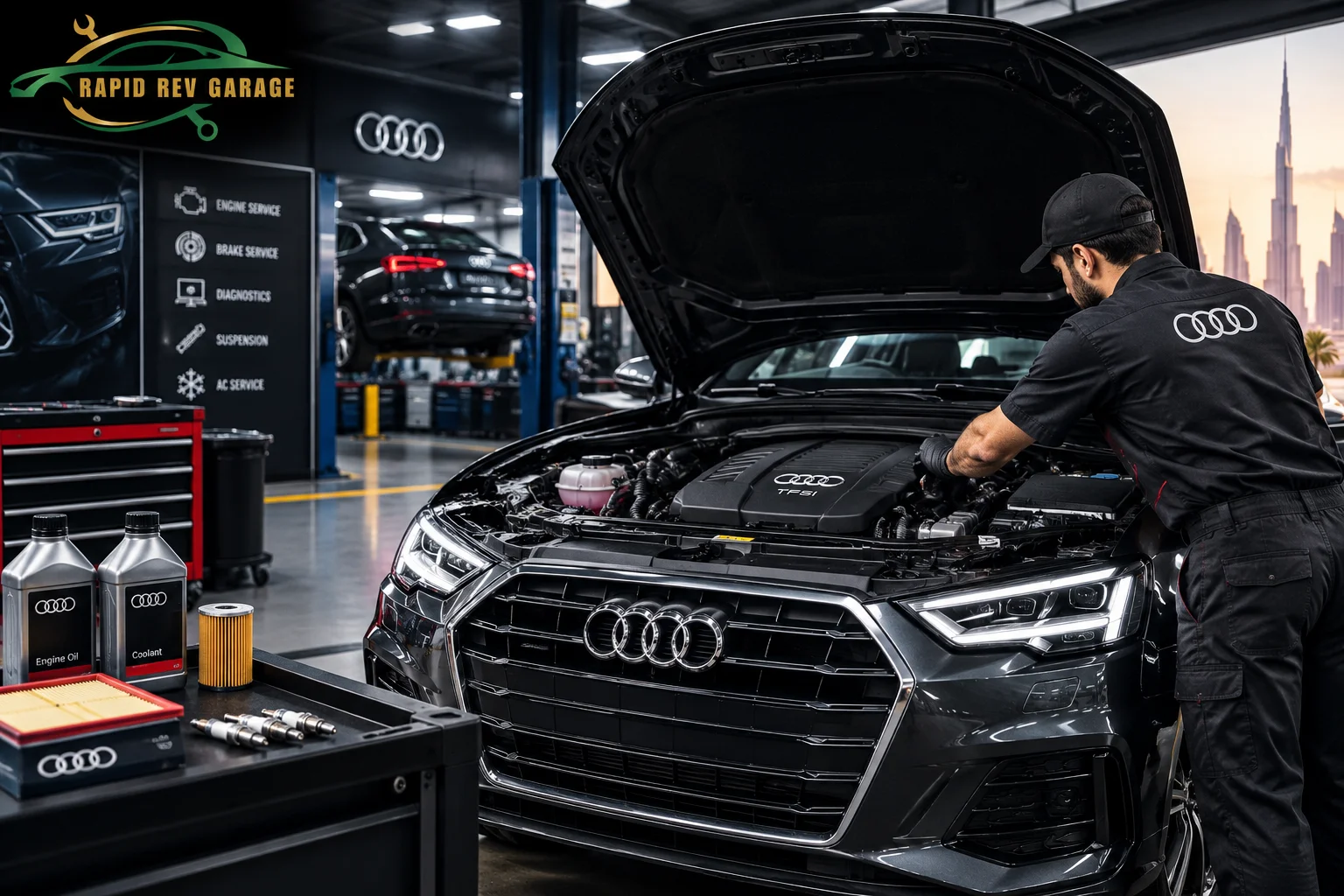
At Rapid Rev Garage in Al Quoz, that’s how every brake job works. Physical measurement first. The right diagnosis. Parts replaced only when the inspection confirms they’re due. No blanket four-corner jobs on cars where half the components still have usable life.
Brake Mechanic Near Me in Dubai — What the Job Actually Involves
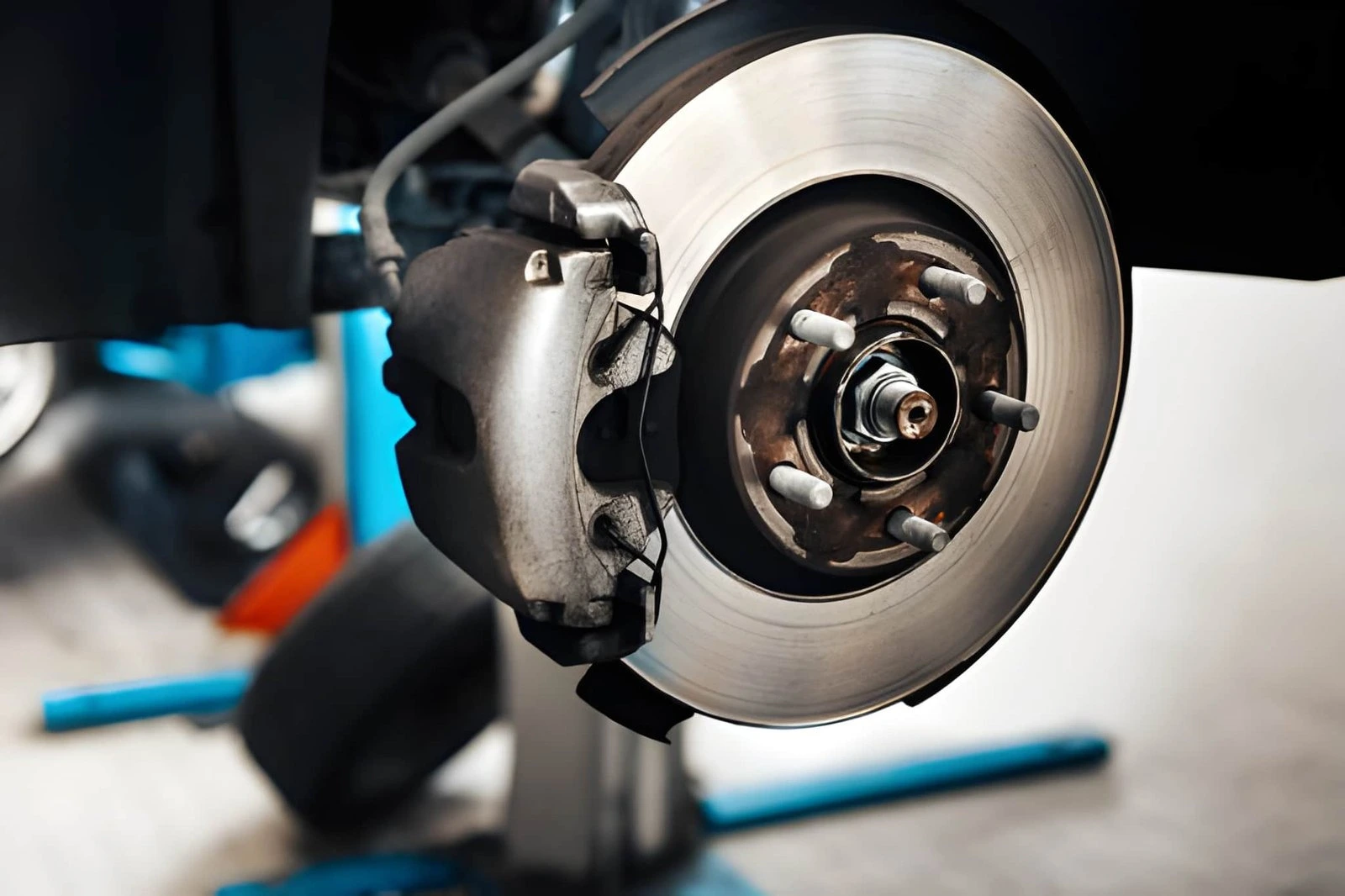
Searching brake mechanic near me in Dubai means you want someone who knows what they’re looking at under that wheel. Brake pads, discs, and calipers are the three components that make up the majority of brake work — and each one fails differently, wears at a different rate, and requires a different approach to repair or replacement.
Dubai’s conditions accelerate brake wear across all three. Stop-start Al Quoz and Business Bay traffic generates more heat per kilometre in the front brakes than highway driving does. Heavy SUVs — Patrols, Land Cruisers, Tahoes — require significantly more braking force per stop than lighter vehicles. Summer temperatures push the brake system closer to its thermal limits daily. And the humidity variation between Dubai’s dry summer and cooler, more humid winter creates corrosion conditions that affect disc surfaces faster than most owners expect.
Brake Mechanic Near Me — Brake Pad Inspection and Replacement
What wears and how to read it
Brake pad friction material starts at 10–12mm on most OEM fitments. Manufacturer minimum thickness — the point at which replacement is required — is typically 2–3mm. Most vehicles have a wear sensor embedded in the pad that triggers a dashboard warning as the material approaches this threshold. But sensors fail, rear axle sensors are missing on some vehicles entirely, and visual inspection through the wheel spoke often underestimates actual remaining thickness.
Physical measurement with a brake calliper at all four corners is the only accurate assessment. That’s what every brake mechanic near me job at Rapid Rev Garage starts with — reported in actual millimetres, not a pass/fail based on a glance through the wheel.
Glazed pads
Glazed pads are a separate issue from worn pads that not every brake mechanic catches. In Dubai’s heat, pads that have been repeatedly overheated — sustained braking on a multi-storey car park ramp, or repeated hard stops from highway speed in summer traffic — develop a hardened surface layer that reduces friction coefficient even when material thickness is still within spec. A glazed pad doesn’t always throw a warning. It just stops less effectively, quietly, every time you press the pedal.
Pad specification
Pad compound matters in Dubai conditions. Organic pads are quiet and smooth but fade under repeated heat cycles — better suited to light vehicles doing moderate city commuting. Semi-metallic pads handle heat better and are more appropriate for heavier SUVs doing daily Business Bay commutes. Ceramic pads combine good heat tolerance with low dust and are a strong choice for European performance cars. We specify compound based on what the vehicle is and how it’s being driven — not just on what fits the caliper bracket.
Our car mechanic team always fits wear sensors alongside new pads when replacing — sensors are single-use components and reusing an old sensor leaves the warning system unreliable for the next wear cycle.
Disc Inspection and Replacement — More Than Just Thickness
Rotor measurement
Brake discs don’t just wear thin — they warp, score, and develop lateral runout that affects braking quality and safety. Rotor thickness is the starting point. Every disc has a manufacturer discard specification — the minimum thickness below which the disc can’t absorb and dissipate heat safely. We measure thickness at multiple points across the swept surface, not just at one location, because uneven wear creates a thickness variation that affects brake feel even when the average reading looks acceptable.
Warping and lateral runout
Warped rotors produce the characteristic pedal pulse most drivers eventually experience — a rhythmic vibration through the brake pedal that’s most noticeable at moderate speed under light braking. This is lateral rotor runout: the disc wobbling slightly on its hub as it rotates, causing the pad to contact a high spot and then a low spot on every revolution. We check runout with a dial gauge against manufacturer tolerance — typically 0.05–0.08mm depending on the platform. Above tolerance means the rotor needs resurfacing or replacement depending on remaining thickness.
Scoring and corrosion
Deep scoring from running worn pads too long cuts grooves into the rotor face that reduce effective pad contact area. Dubai’s humidity variation — dry desert summers followed by more humid November-to-February conditions — promotes surface rust on disc faces that haven’t been used recently. Surface rust clears within the first few brake applications and is harmless. Deep corrosion on the disc hat or in the scoring grooves is a different matter and affects the structural integrity of the rotor under heavy braking.
Resurfacing vs replacement
Rotor resurfacing removes a thin layer of material to restore a flat, clean surface. It’s valid when material thickness is well above the discard specification and the warping or scoring is surface-level. It’s not valid when the rotor is at or near minimum thickness, when heat cracking is visible on the swept surface, or when corrosion has penetrated the disc body. We measure before recommending — not resurfacing as a default cheap option, and not replacing as a default upsell.
For any breakdown on the road involving brake failure or any other fault, our roadside assistance covers Al Quoz and nearby Dubai areas.
Caliper Service and Replacement — The Component Most Often Overlooked
Brake caliper pistons seize. It happens on every brand, every model, and every age of vehicle — and in Dubai’s sustained heat, it happens faster than in temperate climates. A seized caliper piston keeps the brake pad in continuous light contact with the disc even when the brake pedal isn’t being pressed. The result is drag — a wheel that generates heat during normal driving, accelerated wear on one side of the pad, uneven wear between left and right on the same axle, a slight pull to one side under braking, and eventually a disc that’s significantly more worn on one side than the other.
A proper brake mechanic near me tests caliper piston retraction manually at every brake inspection. Each piston is pushed back into the caliper bore and confirmed to move freely without sticking. Two minutes per corner. It catches seized calipers before they’ve destroyed a disc and half a pad set on one side of the axle.
Caliper rebuild vs replacement
Seized calipers can often be rebuilt — the piston and bore are cleaned, corrosion removed, new seals fitted, and the piston confirmed to move correctly. This is a legitimate repair when the caliper body itself is undamaged and the piston bore isn’t scored. When the bore is corroded beyond sealing, or the caliper bracket mounting points are damaged, replacement is the correct call.
Rear caliper handbrake mechanism
Rear calipers on vehicles with electric or cable-actuated handbrake through the caliper have an additional mechanical component — the screw mechanism inside the piston that converts cable or motor pull into piston movement. This mechanism seizes on vehicles that don’t use the handbrake regularly in Dubai (many drivers use P on automatic transmissions instead of the handbrake). A seized rear caliper mechanism is a common finding on older Audis, VWs, and BMWs — and it’s not resolved by a simple piston pushback. It requires the correct caliper wind-back tool and sometimes a rebuild or replacement.
Our car service packages include caliper piston inspection at every service visit as standard — not an add-on.
Brake Fluid — What Every Brake Mechanic Should Check
A brake mechanic near me who doesn’t test brake fluid moisture content as part of every brake job is missing a critical step. Brake fluid is hygroscopic — it absorbs moisture from the air through the brake system’s rubber components over time. Fresh DOT 4 fluid has a wet boiling point of around 155°C. Moisture-contaminated fluid can drop that boiling point below 120°C.
In Dubai, the gap between those two numbers matters. Hard braking from 120 km/h on Emirates Road in a heavy SUV generates brake temperatures that approach the lower threshold. When fluid boils under load, vapour forms in the hydraulic circuit. Vapour is compressible. Liquid isn’t. The pedal goes soft at the exact moment you need it most.
We test brake fluid moisture content with a digital tester at every brake inspection — not a colour check, an actual moisture reading. Above 3% moisture content means a full system bleed is recommended before the next hot-braking event.
ABS and Electronic Brake System Checks
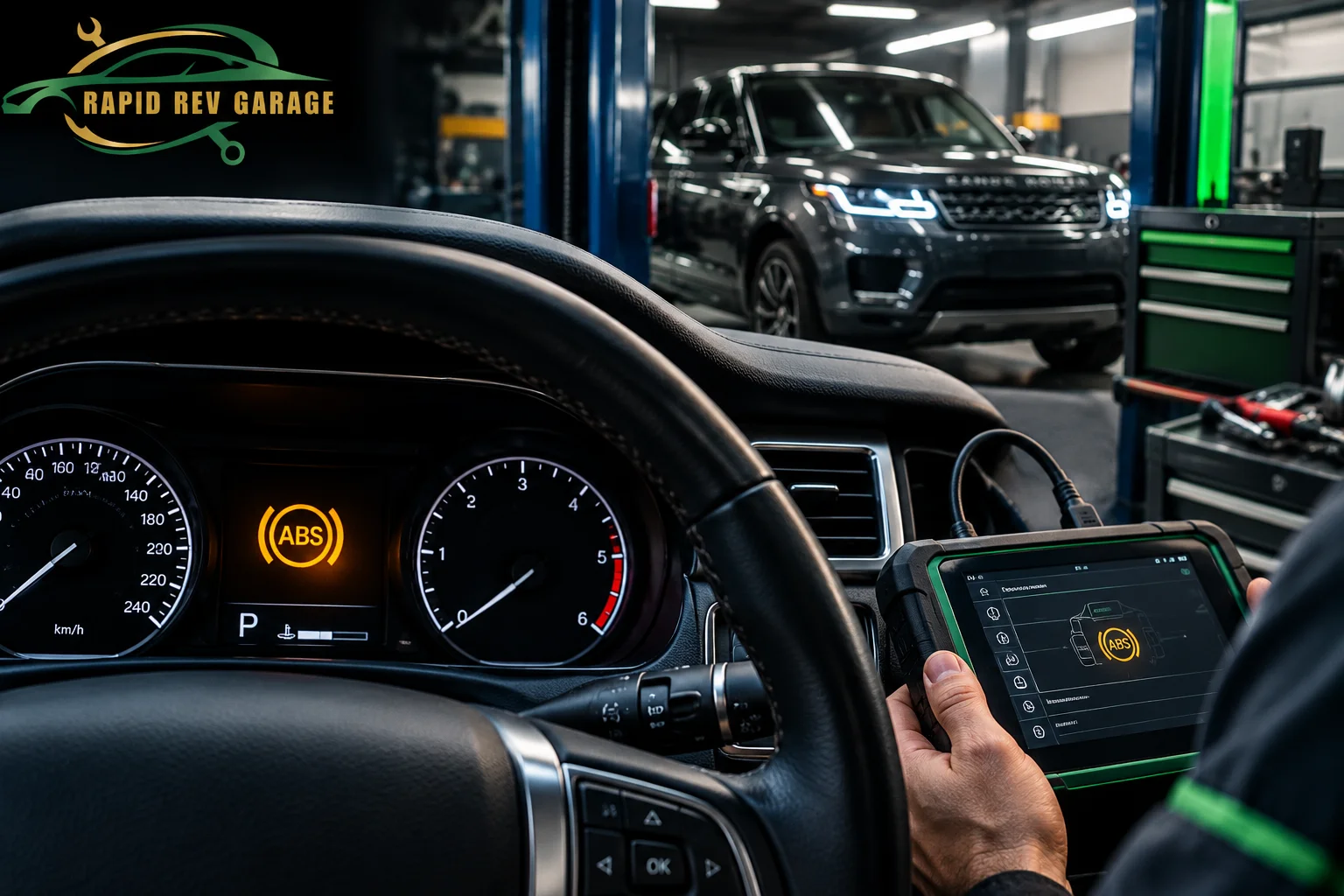
Modern brake systems are electronic as much as mechanical. ABS, EBD, ESP, and brake assist all depend on wheel speed sensors, steering angle sensors, and brake pressure sensors working accurately. A failed wheel speed sensor disables ABS entirely — the car brakes normally on dry roads but loses anti-lock function in the exact scenario where it matters: hard braking on wet winter roads or a sudden emergency stop.
We run brake system module scans using brand-compatible diagnostic equipment at Rapid Rev Garage. ABS module faults, wheel speed sensor failures, and brake pressure sensor issues are all read and reported accurately — not just cleared and monitored.
For on-site assessment before driving the car in, our mobile car mechanic comes to your location for a pad thickness check and caliper assessment without you needing to move the car.
How Long Do Pads, Discs, and Calipers Last in Dubai?
Front pads on a heavy Dubai SUV in city traffic: 25,000–40,000 km. Rear pads on the same vehicle: 40,000–60,000 km. Front pads on a lighter sedan doing highway-heavy driving: up to 55,000 km. Discs typically last two pad change cycles on most vehicles — longer on light cars, shorter on heavy SUVs or performance models doing hard driving. Calipers don’t have a fixed service life but should be inspected at every pad change and rebuilt or replaced when piston movement is impaired.
Physical measurement at every 10,000 km or 12-month service interval is the accurate way to know — mileage estimates alone don’t account for driving style, vehicle weight, or Dubai’s specific heat conditions.
Exterior Work Alongside Brake Service
If your car is already in for brake work, our car painting team handles colour-matched stone chip repairs, alloy wheel kerbing, and panel resprays alongside mechanical work in one visit.
Finding a Brake Mechanic Near Me in Al Quoz
If you’ve been searching for a garage near me in Dubai for pad, disc, and caliper work, Rapid Rev Garage is in Al Quoz — the brake mechanic near me answer for drivers across Business Bay, Jumeirah, Barsha, Satwa, Downtown, and the Sheikh Zayed Road corridor. We work on all makes and models with OEM-specification or manufacturer-approved components only.
FAQ — Brake Mechanic Near Me in Dubai
How do I know if I need a brake mechanic or just an inspection?
Any squeal, grind, vibration, soft pedal, or pulling to one side means book an inspection — measurements determine exactly what needs replacing.
Can you rebuild a seized caliper instead of replacing it?
Yes, if the piston bore is undamaged — cleaned, new seals fitted, and piston movement confirmed. Replacement is needed when the bore is corroded or the caliper body is damaged.
Should front and rear brakes be replaced at the same time?
Only if both axles are due — fronts wear 30–40% faster than rears, so replacing both when only the fronts are needed wastes money.
How long does a brake job take at Rapid Rev Garage?
Pad replacement on one axle: one to one-and-a-half hours. Full pad and disc replacement on both axles: two to three hours.
Is it safe to drive with a brake warning light on in Dubai?
A pad wear indicator means book soon — you have some distance remaining. A red brake light, grinding noise, or soft pedal means stop driving immediately.
In Conclusion
A proper brake mechanic near me in Dubai measures before recommending, uses the right compound for the vehicle, tests calipers physically, checks fluid moisture, and runs an electronic scan before closing the job. That’s what every brake visit at Rapid Rev Garage delivers.
Rapid Rev Garage is in Al Quoz, serving drivers across nearby Dubai areas — Business Bay, Jumeirah, Downtown, Barsha, Satwa, and the Sheikh Zayed Road corridor. Book your appointment on WhatsApp and find us on Google Maps.
Rapid Rev Garage — Brake Mechanic Near Me | Al Quoz, Dubai and Nearby Areas