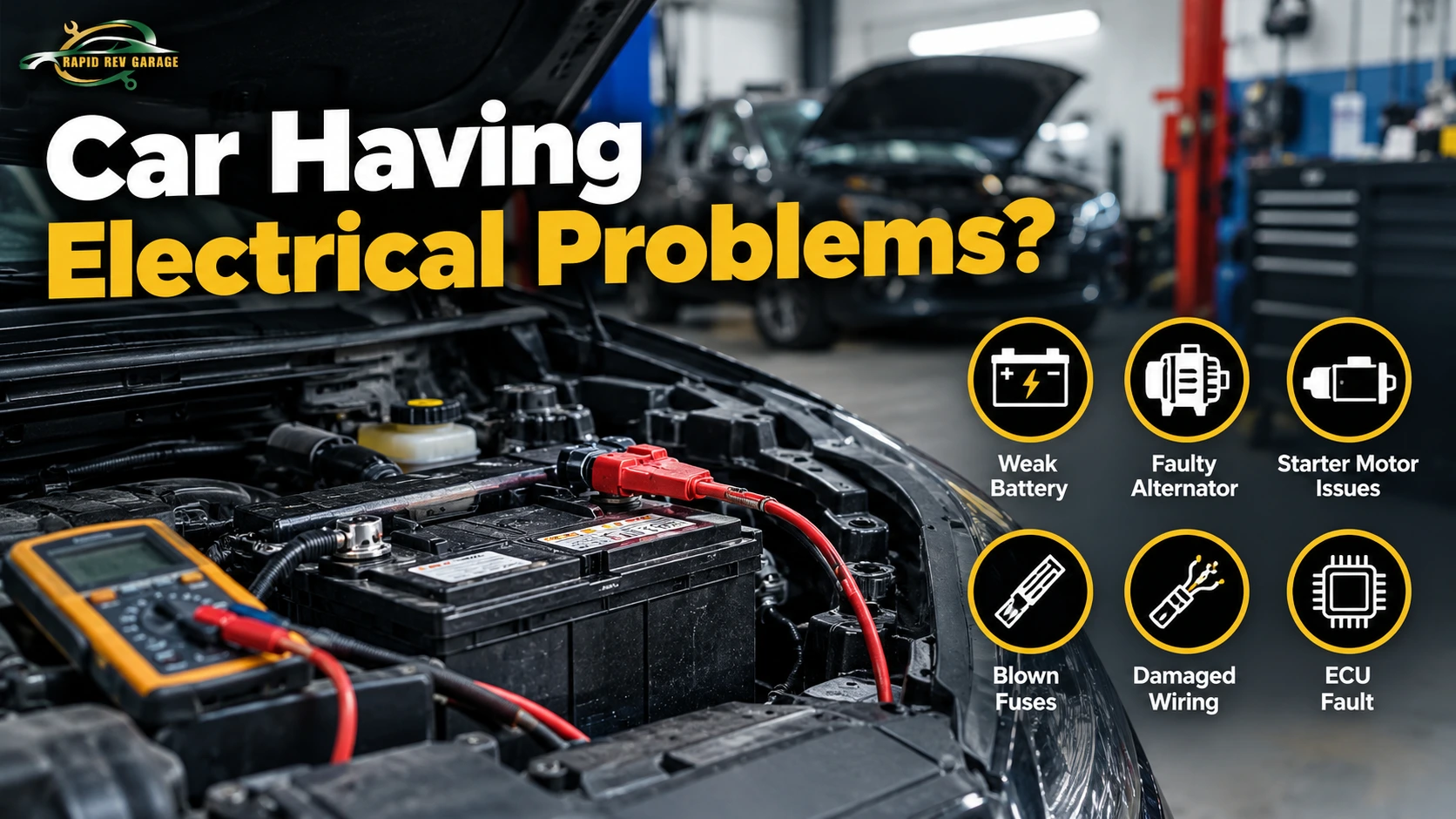
Rapid Rev Garage in Al Quoz is the car electrical shop near me Dubai drivers trust for battery diagnosis and replacement, wiring harness repair, ECU fault diagnosis and reprogramming, alternator and starter motor repair, CAN bus fault tracing, and full multi-module diagnostic scanning. Dubai’s heat and short-trip driving create electrical faults that get misdiagnosed constantly. Here’s what correct electrical diagnosis looks like — and why it matters more than the repair itself.
Car Electrical Shop near me — Why Electrical Diagnosis Is Where Most Dubai Workshops Fail
Finding a car electrical shop near me in Dubai is straightforward. Finding one that diagnoses electrical faults correctly before replacing parts is considerably harder.
Electrical faults are the most misdiagnosed category of vehicle repairs in Dubai. The reason is simple — a warning light, a dead battery, a module fault — all of these have multiple possible causes. A workshop that replaces the most likely component without verifying the actual fault gets it right sometimes. When it doesn’t, the owner pays twice: once for the wrong part, once for the correct repair. At Rapid Rev Garage in Al Quoz, every electrical fault starts with a full diagnostic scan across all vehicle modules, live data analysis, and physical circuit testing before any component is touched.
Dubai’s electrical fault patterns are specific and predictable once you’ve seen enough of them. Heat degrades wiring insulation, connector terminals, and module components faster than in any moderate climate. Short-trip driving stresses batteries through repeated partial discharge cycles. Voltage spikes from jump-start attempts damage ECU and body control modules in ways that don’t show up immediately. Knowing these patterns is what separates a car electrical shop near me that fixes the problem from one that fixes the symptom.
Battery Diagnosis — It’s Not Always the Battery
The most common call a car electrical shop near me gets in Dubai is a dead or struggling battery. The owner gets a jump start, drives to the workshop, and expects a new battery. Sometimes that’s correct. Often it isn’t — and fitting a new battery without understanding why the old one failed means the new one fails on the same timeline.
A battery that drains overnight in Dubai has one of three root causes. First, the battery itself has failed — internal cell damage, sulphation from repeated partial discharge, or heat-related degradation from prolonged summer exposure. Second, the charging system isn’t maintaining the battery — a failing alternator that isn’t producing correct output voltage, or a voltage regulator that’s supplying inconsistent charge. Third, a parasitic drain — a module or component that isn’t entering sleep mode correctly and continues drawing current after the car is switched off.
All three produce identical symptoms from the driver’s seat: dead battery in the morning. All three require different repairs. Fitting a battery for a parasitic drain problem means the new battery drains at the same rate. Fitting a battery for a charging system fault means the alternator destroys the new battery within weeks.
We test all three simultaneously. Battery state-of-health using a conductance tester — not just a voltage check, which tells you almost nothing about actual battery capacity. Charging system output voltage and current at idle and under load. Parasitic drain measurement with a clamp meter on the battery negative after all modules have entered sleep mode, typically 20–40 minutes after switching off. The result tells us exactly which of the three causes we’re dealing with — before any part is ordered.
A Toyota Land Cruiser came to our car electrical shop near me after its fourth battery replacement in eighteen months at different workshops. Each workshop fitted a battery, the car was fine for a few weeks, then drained again. We measured parasitic drain — 380 milliamps after sleep mode, well above the 50 milliamp acceptable threshold. ISTA-compatible scan showed the entertainment system amplifier module wasn’t entering sleep mode. Module software update and drain dropped to 28 milliamps. The battery it came in with — its fourth in eighteen months — was perfectly serviceable. It just needed the drain fixed, not another replacement.
Wiring Harness Repair — Dubai’s Heat Does What Cold Never Would
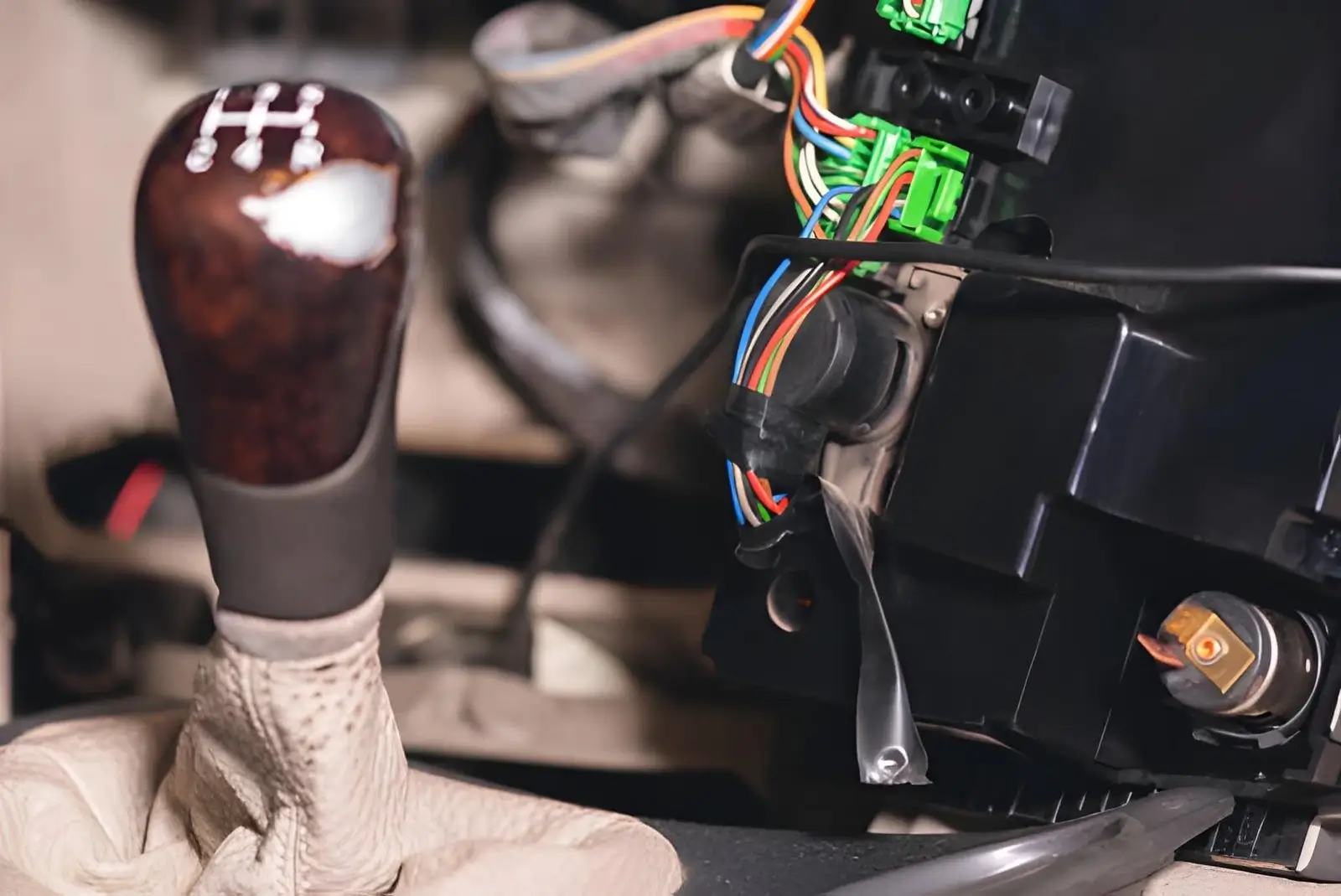
Wiring harness faults are among the most time-consuming electrical repairs a car electrical shop near me handles — and among the most frequently misdiagnosed. Dubai’s sustained heat accelerates the degradation of the PVC and crosslinked polyethylene insulation on wiring looms in ways that a temperate climate never would. Insulation that cracks, becomes brittle, or shrinks away from terminal crimps creates intermittent shorts and open circuits that appear and disappear based on engine bay temperature.
An intermittent fault is the hardest type to diagnose. The car shows a fault code when it’s warm, the code disappears when it cools down, and when the car arrives at the workshop cold it scans clean. A workshop that reads the fault history without understanding the temperature-dependent nature of the fault replaces components rather than investigating the harness.
The correct approach for intermittent wiring faults is to reproduce the condition that triggers the fault — warming the engine bay to operating temperature or using a heat gun to stress individual harness sections — while monitoring live data for the signal dropout that corresponds to the stored fault code. When the signal drops out under heat stress, the fault location is found. Then the harness is repaired at that specific point — insulation replaced, terminal cleaned and re-crimped, heat-resistant sleeving applied.
We don’t replace entire wiring harnesses unless the damage is extensive. A harness repair at the fault location, done correctly with appropriate materials, is as reliable as a new section and significantly cheaper. We’ve traced wiring faults to a single cracked insulation point on a ten-year-old Nissan Patrol whose owner had been told the entire engine harness needed replacement. The repair took two hours. The quote for a full harness replacement from another workshop had been AED 6,500.
ECU Fault Diagnosis and Reprogramming
The ECU — engine control unit — is the most important module in any vehicle. It manages fuelling, ignition timing, boost pressure on turbocharged engines, variable valve timing, emissions systems, and the torque output that every other system in the car responds to. When it develops a fault, the symptoms range from subtle — slightly higher fuel consumption, occasional rough idle — to immediately obvious: engine won’t start, severe misfire, limp mode activation.
ECU faults in Dubai fall into three categories. Software corruption — the ECU’s programming has developed errors, often from a failed over-the-air update, an interrupted reprogramming attempt at another workshop, or a voltage spike during a jump-start. Hardware fault — internal component failure, often heat-related on older modules or from water ingress through a degraded connector seal. Communication fault — the ECU is functioning but can’t communicate correctly with other modules due to a CAN bus issue, corrupted module ID, or wiring problem between modules.
Each requires a different response. Software corruption is resolved through ECU reprogramming using the manufacturer’s current calibration file — not a generic remap, but the correct factory software for that specific vehicle’s VIN. Hardware faults on certain modules can be repaired through component-level work on the circuit board — replacing failed capacitors, relay drivers, or power supply components — which costs significantly less than a new ECU. Communication faults are resolved by fixing the CAN bus issue rather than touching the ECU at all.
A Mercedes C200 came into our car electrical shop near me after a failed software update at a dealer left the ECU in a partially programmed state — the engine started but immediately entered limp mode and wouldn’t clear. We connected with Mercedes-compatible diagnostic equipment, identified the incomplete calibration file in the ECU, completed the programming sequence from the correct restore point, and cleared the fault. The owner had been quoted for an ECU replacement that wasn’t needed.
Don’t let anyone replace an ECU without first attempting reprogramming. A replacement ECU on most modern vehicles requires VIN coding, immobiliser matching, and module adaptation — all of which add cost and complexity. Reprogramming the existing module is almost always the right first step.
Alternator and Charging System Repair
The alternator is the component that keeps everything running once the engine starts. It charges the battery, powers the vehicle’s electrical load, and maintains the stable voltage that every module and sensor in the car depends on. In Dubai, alternator wear is accelerated by two specific conditions — the high electrical load of running AC at maximum in summer heat, and the battery recharge demand from repeated short-trip driving that partially discharges the battery every morning.
A failing alternator in Dubai doesn’t always die dramatically. The most common failure pattern is gradual voltage reduction — the alternator starts producing 13.8 volts instead of the 14.2–14.7 volt range a healthy charging system delivers. The battery slowly discharges over days. Lights dim slightly. The stop-start system disengages because the battery state isn’t sufficient. Eventually a battery warning light appears — by which point the battery may have been damaged by the undercharging.
We test alternator output voltage and current at multiple load points — at idle with no load, at idle with full electrical load, and at 2,000 rpm. A healthy alternator maintains voltage within a tight range across all three conditions. One that’s developing diode failure or brush wear drops voltage under load — which is the condition it’s actually operating in during Dubai driving, not the light-load bench test that makes some workshops miss the fault.
The car service packages at Rapid Rev Garage include a charging system check at every service visit. Catching an alternator at the reduced-output stage costs significantly less than catching it at the failed stage — both in parts and in battery replacement that could have been avoided.
Starter Motor Faults — Diagnosing Before Replacing
A starter motor that’s developing a fault gives warning signs before it fails completely. A slow, laboured crank that takes longer than usual to fire the engine. An occasional click with no crank that clears on the second attempt. A grinding noise on start that disappears once the engine catches. All of these are early-stage starter motor symptoms — and all of them are worth investigating before the car doesn’t start at all.
In Dubai’s heat, starter motor brushes and solenoid contacts wear faster than in moderate climates. The heat also causes the starter motor body to expand, which reduces clearance between the armature and the field windings — increasing resistance and reducing cranking torque. A starter motor that’s borderline in winter may fail completely on the first hot morning in May.
We test starter motor current draw using a clamp meter on the battery positive during cranking — a healthy starter draws within a specific current range for the engine size. High current draw indicates mechanical binding or brush wear. Low current draw with slow cranking indicates a solenoid contact fault. The test takes five minutes and tells us definitively whether the starter needs replacement or whether the fault is elsewhere — a weak battery, a poor earth connection, or a corroded starter relay.
CAN Bus Faults and Module Communication
Modern vehicles communicate through a Controller Area Network — the CAN bus. Every module on the network broadcasts and receives data continuously. When a module fails, develops a communication fault, or is fitted incorrectly after a repair, it can disrupt communication for every other module on the same bus. The result is multiple warning lights across completely unrelated systems — which is exactly what brings owners to our car electrical shop near me convinced their car has “multiple faults.”
CAN bus faults require systematic diagnosis. We identify which bus segment has the fault, which module is disrupting communication, and whether the cause is a module failure, a wiring issue on the bus, or a termination resistor fault. Without this approach, workshops replace functioning modules chasing symptoms that are caused by a single faulty node on the network.
The car mechanic team at Rapid Rev Garage handles CAN bus diagnosis across all major brands — not just European platforms. CAN bus architecture is present in every modern vehicle from entry-level Toyotas to top-specification Range Rovers.
If your car breaks down before reaching our car electrical shop near me, the roadside assistance team covers Al Quoz and nearby Dubai areas. Electrical faults that leave a vehicle stranded need careful recovery — towing incorrectly can damage modules and wiring further.
For owners needing a technician before the vehicle can move safely, the mobile car mechanic service reaches Al Quoz, Business Bay, Jumeirah, and the Sheikh Zayed Road corridor.
Need bodywork alongside electrical repairs? Our car painting team handles everything from stone chip repair to full panel work — correct OEM paint codes, proper preparation.
And for owners in Al Quoz searching for a garage near me that handles electrical work properly, Rapid Rev Garage is centrally located and accessible from every major Dubai residential area without a cross-city drive.
Frequently Asked Questions
How do I know if my car has an electrical fault?
Warning lights on the dashboard are the most obvious sign. But subtler indicators include: a battery that needs jump-starting more than once in a few weeks, lights that flicker at idle, accessories that work intermittently, a slow or laboured engine crank, modules that reset after switching off, or a burning smell from the engine bay. Any of these warrant a visit to a car electrical shop near me for a full diagnostic scan.
Why does my car battery keep dying in Dubai?
Three main causes: the battery itself has failed from heat degradation or repeated partial discharge cycles from short-trip driving; the alternator isn't charging it correctly; or a parasitic drain — a module staying active after the car is switched off — is discharging it overnight. All three need different repairs. A voltage check alone doesn't distinguish between them. Proper battery conductance testing, charging system output measurement, and parasitic drain testing together identify the exact cause.
Can an ECU be repaired instead of replaced?
Often yes. Software corruption is resolved through reprogramming — significantly cheaper than replacement. Hardware faults on certain modules are repairable through component-level circuit board work. A replacement ECU on a modern vehicle requires VIN coding and module adaptation that adds cost and complexity. Reprogramming the existing module should always be attempted first before recommending replacement.
What causes multiple warning lights to come on at the same time?
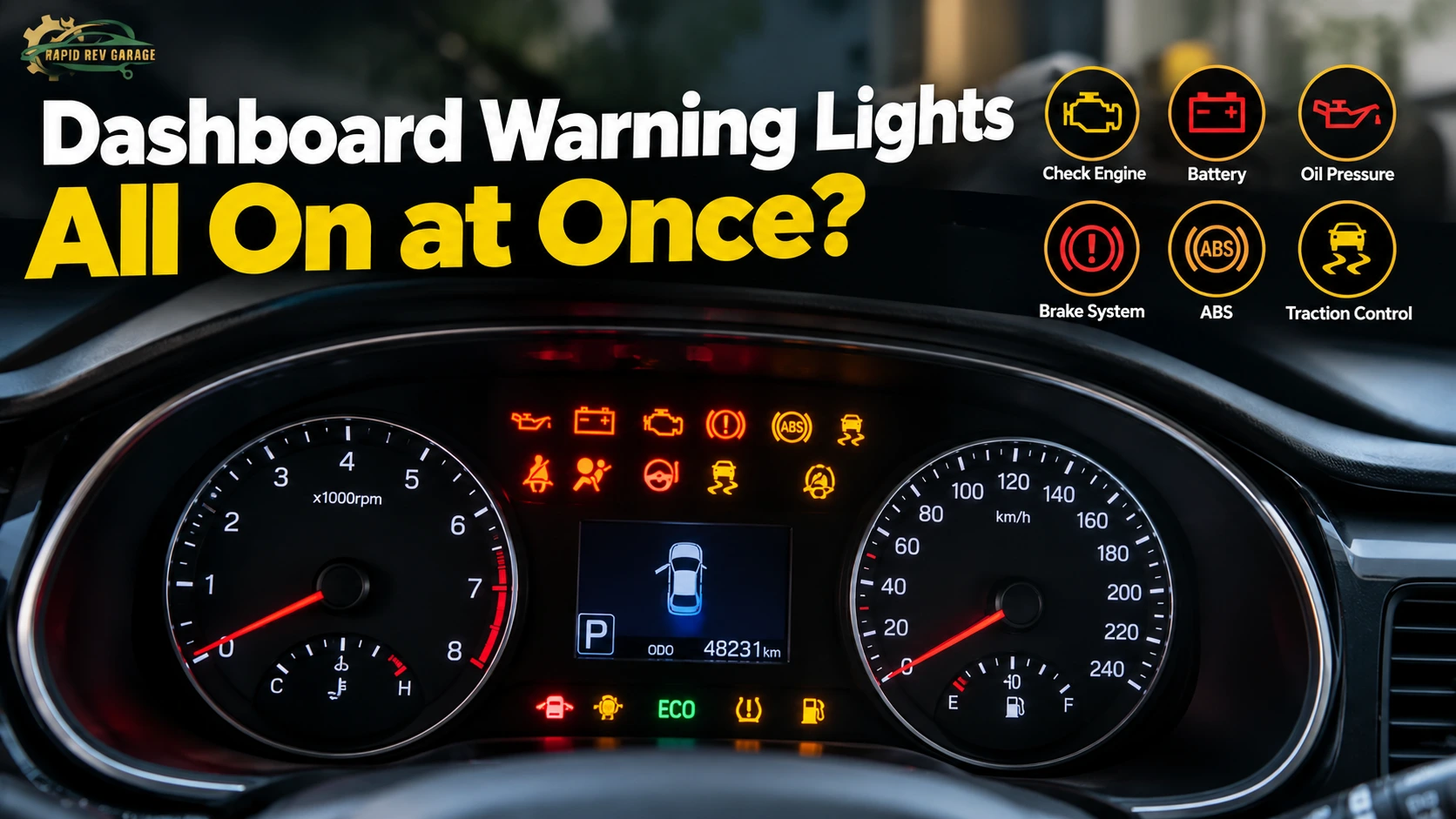
Usually a single fault that cascades across related systems through the CAN bus network. A failed wheel speed sensor triggers ABS, traction control, and stability programme warnings simultaneously. A poor battery earth connection triggers body control module communication faults that produce multiple unrelated warnings. Multiple simultaneous warning lights almost always point to one root cause — which a full multi-module scan identifies correctly.
How much does car electrical repair cost in Dubai?
Battery replacement with correct fitment runs AED 350–900 depending on battery specification. Alternator replacement is AED 800–2,500 depending on make and model. Wiring harness repair at a specific fault point runs AED 400–1,500 depending on access complexity. ECU reprogramming is AED 500–1,200. Full diagnostic scan is AED 250–450. All significantly less than main dealer rates for equivalent work.
Book at Rapid Rev Garage — Car Electrical Shop near me in Al Quoz
Rapid Rev Garage is the car electrical shop near me for Dubai owners across Al Quoz, Jumeirah, Business Bay, Downtown, Sheikh Zayed Road, Satwa, and nearby areas. Battery diagnosis, wiring fault tracing, ECU reprogramming, alternator repair, CAN bus diagnosis — all handled with proper diagnostic equipment and a clear explanation before any work starts.
Got a warning light, a dead battery that keeps coming back, or an electrical fault another workshop couldn’t resolve? Message us on WhatsApp and describe what the car is doing — we’ll advise you straight from the workshop on what needs doing and whether it’s urgent. Book your appointment and get it diagnosed correctly the first time.
📍 Find us on Google Maps — Al Quoz, Dubai.
Rapid Rev Garage — car electrical shop near me specialists in Al Quoz, Dubai.