When a car feel unstable on the highway — the vehicle wanders between lanes without deliberate steering input, requires constant small corrections to maintain a straight path, or feels nervous and unsettled at speed — the fault is in the components that determine how precisely the front wheels follow the driver’s steering input and how firmly the suspension maintains wheel geometry under load. A car feel unstable on the highway pattern is specific to speed because high-speed aerodynamic loads, suspension dynamics, and the precision demands of motorway lane-keeping expose geometry and component faults that are invisible at slow urban speeds.
At Rapid Rev Garage in Al Quoz, highway instability is diagnosed with a lane-change road test, a four-wheel alignment measurement, and a suspension component inspection — because highway instability has multiple possible causes and each requires a different repair.
Car Feel Unstable on the Highway — Quick Verdict
A car feel unstable on the highway in Dubai is most commonly caused by incorrect wheel alignment — particularly incorrect toe and caster settings that cause the vehicle to fight its straight-ahead position at speed; worn or damaged front tyres with flat spots, internal belt separation, or severe tread wear that prevent consistent road contact; worn or seized shock absorbers that cannot control wheel bounce at highway speed; loose or worn suspension components — particularly tie rod ends, ball joints, or control arm bushings — that allow wheel geometry to shift dynamically under highway load; or wheel imbalance that excites the suspension’s resonant frequency at highway speed.
In Dubai, front wheel alignment disturbance from speed bump impacts and pothole strikes is the most common cause — the vehicle that drove straight when new gradually develops highway instability from accumulated impact damage to its geometry.
Table of Contents
- Why Highway Speed Reveals What Urban Speed Conceals
- Wheel Alignment — The Primary Cause of Highway Instability
- Tyre Condition at Highway Speed
- Worn Shock Absorbers and Suspension Damping
- Loose Steering and Suspension Components
- Wheel Imbalance at Highway Resonance Speed
- How Dubai’s Roads Specifically Disturb Highway Stability
- How We Identify the Cause at Rapid Rev Garage
- The Right Fix for Each Confirmed Cause
- What Happens If Highway Instability Is Left Without Repair
- Is It Safe to Drive?
- How Long the Repair Takes
- What the Repair Costs in Dubai
- Maintaining Highway Stability in Dubai
- Why Rapid Rev Garage?
- FAQ
- Conclusion
Why Highway Speed Reveals What Urban Speed Conceals
The physics of highway driving expose alignment and suspension faults that are invisible at urban speeds — and understanding this relationship is the first step toward diagnosing a car feel unstable on the highway complaint.
The Geometry Amplification Effect
At 30 km/h in a residential street, a toe misalignment of 2mm per side produces a barely perceptible handling change. At 120 km/h on Sheikh Zayed Road, the same misalignment produces a persistent straight-line wander that requires continuous steering correction. The aerodynamic forces at highway speed amplify any geometry fault — the vehicle is sensitive to geometry at high speed in a way it simply isn’t at low speed.
Suspension Dynamics Change With Speed
At urban speed, the suspension’s damping capacity and the shock absorbers’ ability to control wheel bounce are rarely tested. At highway speed — particularly over bridge expansion joints, surface undulations, and the residual camber of Dubai’s six-lane roads — the suspension must respond to rapid load changes at high frequency. A shock absorber that provides adequate control at 60 km/h may be overwhelmed at 120 km/h — producing the floating, disconnected handling that drivers describe as car feel unstable on the highway.
Wheel Alignment — The Primary Cause of Highway Instability
Incorrect wheel alignment is the most common cause of car feel unstable on the highway in Dubai — and the most directly correctable.
Toe Misalignment and Straight-Line Wander
Toe alignment specifies the angle at which the front tyres point relative to the vehicle’s straight-ahead direction. Correct toe produces a tyre that naturally follows the straight-ahead path under load. Incorrect toe — particularly toe-out on one side — creates a tyre that pulls away from the straight-ahead path. At highway speed, the driver must apply a constant small steering input to maintain the straight-ahead course — the car feel unstable on the highway sensation of the vehicle wanting to wander without deliberate driver correction.
Caster Angle and Straight-Line Stability
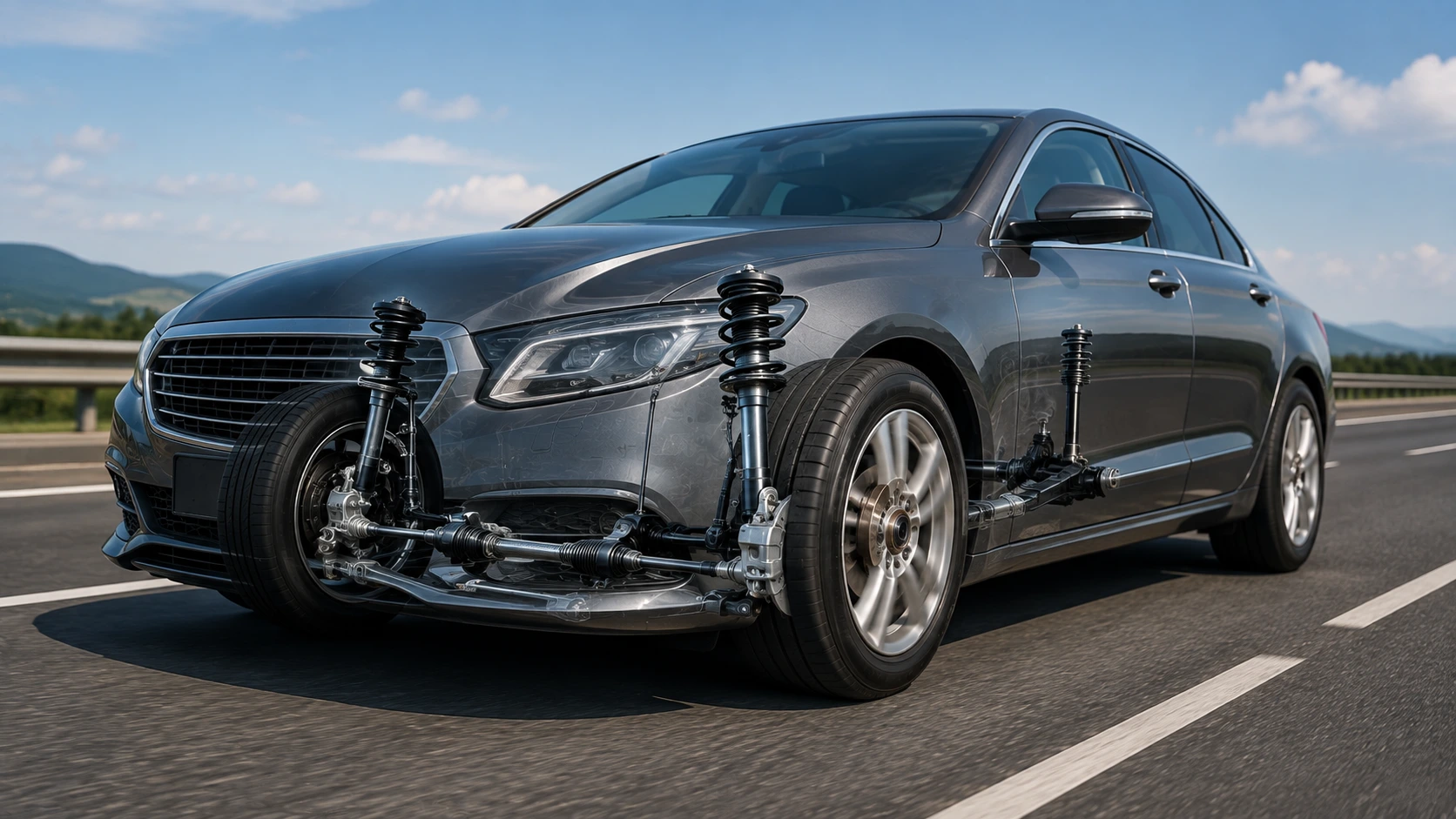
Caster angle — the forward or rearward tilt of the steering axis — provides the self-centering force that makes a car naturally return to the straight-ahead position after a lane change. Correct caster produces a vehicle that feels planted and stable on the highway. Reduced caster from a bent control arm, a shifted strut mount, or a chassis impact produces a vehicle that feels light and imprecise at the front — the classic car feel unstable on the highway description of a “floaty” front end.
Why Dubai Impacts Disturb Alignment Repeatedly
Every speed bump crossing at above-recommended speed, every pothole strike, and every kerb impact in Dubai’s residential and commercial areas applies an impact load to the wheel that changes its alignment position. The front wheels absorb the majority of these impacts — and their caster and toe angles shift progressively with each significant impact. A vehicle aligned correctly at the last service may have noticeably incorrect alignment by the next service from the accumulated impact load of Dubai’s roads. Our car mechanic team performs a four-wheel alignment measurement as the first specific test for every car feel unstable on the highway complaint.
Tyre Condition at Highway Speed
Tyres with structural damage, severe uneven wear, or age-related degradation produce highway instability directly.
Internal Belt Separation
A tyre with separated internal belts — from speed bump impact damage or age-related heat cycling — rotates with an uneven force variation that produces a rhythmic pull and instability at highway speed. this instability from a belt-separated tyre is often progressive — worsening as speed increases — and may be accompanied by a visible or palpable sidewall bulge.
Feathered Tyre Wear From Previous Misalignment
Tyres that have been running on incorrect alignment develop a feathered wear pattern on the tread blocks. A feathered tyre produces a directional force at the contact patch that makes the vehicle pull toward the side with the more advanced feathering — producing the car feel unstable on the highway sensation even after the alignment has been corrected. Correcting alignment without assessing whether the tyres are wearing in a way that continues to produce directional force leaves the highway instability partially in place.
Age-Related Tyre Hardness
Tyres more than five years old in Dubai’s UV and heat conditions harden at the compound level — the contact patch becomes less pliable and responds less consistently to road surface irregularities. The reduced road-holding consistency is felt at highway speed as a less planted, less predictable front end.
Worn Shock Absorbers and Suspension Damping
A shock absorber’s job at highway speed is to control the rate at which the wheel returns from a bump — preventing the wheel from bouncing freely after each road surface irregularity.
How Worn Shocks Produce Highway Instability
A shock absorber that has lost its damping force allows the wheel to bounce more freely after each road surface input. At highway speed, where these inputs occur rapidly, the wheel is bouncing without full damping control between each impact — the tyre contact patch is not consistently on the road. The resulting car feel unstable on the highway is described as a floating, wallowing, or bouncing sensation — different from the sharp wander of alignment fault.
The Bounce Test for Shock Assessment
Pressing firmly on each corner of the vehicle and releasing confirms shock absorber condition — a corner that bounces more than once after release has insufficient damping. At highway speed, the same insufficient damping that produces two body bounces at 5 km/h produces highway instability at 120 km/h. For any breakdown from a sudden shock absorber failure producing unsafe highway handling, our roadside assistance covers Al Quoz and nearby Dubai areas.
Loose Steering and Suspension Components
Worn tie rod ends, ball joints, and control arm bushings allow wheel geometry to shift dynamically under highway load — as described in the steering looseness and suspension clunking blogs.
Dynamic Geometry Shift at Highway Speed
At urban speed, the play in a worn tie rod end allows the tyre to move slightly before the steering input is transmitted — felt as looseness. At highway speed, the same play allows the aerodynamic side forces and road camber forces acting on the tyre to shift its angle slightly without any driver input — producing the wander and instability at highway speed. The aerodynamic loading that is absent at urban speed is what transforms a mild play fault into a significant stability fault.
Control Arm Bushing and Caster Change
A worn or collapsed rear control arm bushing can change the rear wheel’s toe angle under load — the rear axle’s compliance changes with bushing condition. A rear wheel that moves toe-out under cornering or acceleration load produces rear-end instability at highway speed — the characteristic nervous rear end that makes the vehicle feel like it is pivoting around its middle rather than tracking stably.
Wheel Imbalance at Highway Resonance Speed
Wheel imbalance produces a speed-specific vibration as described in the highway vibration blog — and this vibration, at its resonance speed range, contributes to highway instability by introducing periodic steering wheel oscillation and suspension bounce at the resonance speed.
Distinguishing Balance Vibration From Alignment Instability
Wheel imbalance produces a speed-band vibration — appearing at a specific speed range and reducing above and below it. Alignment-driven instability is consistent across a wide highway speed range rather than appearing and disappearing at specific speeds. This distinction guides the initial diagnostic direction. Our car service packages include a four-wheel alignment and balance assessment at every major service.
How Dubai’s Roads Specifically Disturb Highway Stability
Dubai’s road environment produces the alignment and suspension faults that cause car feel unstable on the highway through several specific mechanisms.
Speed Bump Impact to Caster and Toe
Every speed bump crossing at speed applies a longitudinal impact load to the front wheel — primarily in the fore-aft direction. This load moves the control arm’s pivot position, changing caster. Accumulated over hundreds of high-speed speed bump crossings per year, the caster change is measurable and produces the front-end lightness that characterises reduced caster.
Lateral Pothole and Kerb Strikes Change Toe
Lateral wheel impacts — hitting a pothole edge or a roadside kerb — apply a force that moves the wheel’s toe position. A single significant kerb strike can shift the toe on the impacted wheel enough to produce car feel unstable on the highway immediately after the impact event.
High-Speed Road Surface in UAE
UAE highway surfaces — the E11, E311, E44, and Dubai’s internal motorways — are generally smooth, which means the driver at 120–140 km/h has less road noise and surface feedback to mask handling nuances. A vehicle that feels adequately stable on the rougher surfaces of European roads may feel noticeably unstable on UAE’s smooth high-speed surfaces because the absence of road noise makes every handling sensation more perceptible.
How We Identify the Cause at Rapid Rev Garage
The diagnostic sequence starts with the highway-speed road test — confirming the instability character before any component is assessed.
Highway-Speed Road Test First
The diagnostic road test is conducted at highway speed — confirming the character of the instability before any component is assessed. Wander versus vibration versus floating sensation each points to a different component category.
Four-Wheel Alignment Measurement
A computerised four-wheel alignment measurement confirms toe, caster, and camber at all four corners against manufacturer specification. Any out-of-specification angle is identified with its deviation from specification — distinguishing a minor drift from a significant impact-induced misalignment.
Suspension Ramp Inspection Under Load
Ball joints, tie rod ends, and control arm bushings are physically assessed for play under load — the ramp inspection described in the suspension clunking blog. Any play confirmed here is a contributing factor to highway instability, not just a comfort fault.
Tyre Structural Assessment
All four tyres are assessed for belt separation, feathered wear, and sidewall bulge. A tyre with structural damage is identified for replacement before alignment — because correcting alignment on a structurally compromised tyre that is itself producing a directional force produces incomplete results.
The Right Fix for Each Confirmed Cause
Each repair is matched to the specific cause confirmed by the road test, alignment measurement, and suspension inspection.
Four-Wheel Alignment Correction
Alignment is corrected to the manufacturer’s specifications using a computerised alignment system. Where the alignment deviations are severe enough to indicate a bent component — a control arm, a strut, or a knuckle — the component is assessed before alignment is corrected into a bent system.
Tyre Replacement and Balancing
Structurally damaged tyres are replaced. Feathered tyres are replaced if the wear pattern prevents consistent directional force. All four wheels are balanced following any tyre replacement. For exterior repairs needed alongside any chassis work, our car painting team handles colour-matched work at the same visit.
Shock Absorber Replacement
Confirmed worn shocks are replaced in axle pairs — replacing only the failed corner leaves the opposite corner’s different damping rate producing handling asymmetry. Post-replacement, a road test at highway speed confirms the improvement.
Suspension Component Replacement With Alignment
Tie rod ends, ball joints, or control arm components confirmed with play are replaced and the alignment is remeasured and corrected after replacement.
What Happens If Highway Instability Is Left Without Repair
Highway instability left without repair produces specific and compounding consequences.
Progressive Tyre Wear From Alignment Fault
Incorrect alignment produces tyre wear that is continuous and progressive — a vehicle with 3mm of toe misalignment wears its tyre contact patches asymmetrically on every kilometre of driving. The highway instability that could have been resolved with a AED 200–400 alignment correction becomes an alignment correction plus tyre replacement when the tyres have been worn to the point of needing replacement from the misalignment.
Safety Risk at Highway Speeds
Confirmed loose tie rod ends or worn ball joints reduce steering response time at highway speed — the play that produces manageable wander at cruise produces significantly compromised handling in an emergency lane change at 130 km/h.
Is It Safe to Drive?
The safety assessment depends on the severity of the instability and whether any component play has been confirmed.
Minor Highway Wandering From Alignment — Drive Carefully, Book This Week
A vehicle with mild highway instability symptoms and no confirmed component play is driveable carefully at reduced highway speed. Book within the week.
Confirmed Loose Components or Tyre Damage — Book Today
Any confirmation of ball joint or tie rod play, or a visible tyre sidewall bulge: do not drive at highway speed. Book the same day. Book the same day or arrange recovery. Our mobile car mechanic covers Al Quoz and nearby Dubai areas for on-site tyre and component assessment.
How Long the Repair Takes
Repair time ranges from under 90 minutes for alignment alone to several hours for suspension component replacement with alignment.
Alignment
45–90 minutes for four-wheel alignment.
Tyre Replacement and Balancing
30–60 minutes per tyre including alignment following replacement.
Shock Absorber Replacement
Two to four hours per axle including road test confirmation.
Suspension Component With Alignment
Three to six hours depending on the component and alignment confirmation.
What the Repair Costs in Dubai
Cost depends on the confirmed cause and the components required.
Alignment and Tyre Work
Four-wheel alignment: AED 200–400. Tyre replacement: AED 250–800 per tyre. Wheel balancing: AED 150–300 for all four.
Shock and Suspension Work
Shock absorber replacement per axle: AED 800–2,500. Tie rod or ball joint with alignment: AED 800–2,500. A written quote follows the road test and alignment measurement. Our garage near me location in Al Quoz serves drivers from Business Bay, Jumeirah, Barsha, Satwa, Downtown, and the Sheikh Zayed Road corridor.
Maintaining Highway Stability in Dubai
Two specific habits maintain highway stability in Dubai’s impact-heavy road environment.
Alignment After Every Significant Impact
Any speed bump crossing at speed, pothole strike, or kerb contact significant enough to be felt in the vehicle warrants an alignment check — not waiting for the next scheduled service. The alignment cost is AED 200–400; the tyre wear and stability improvement from catching the misalignment early justifies this frequency.
Tyre Age and Pressure Checks Monthly
Monthly tyre pressure checks and annual tyre age confirmation (no tyre older than five years regardless of tread) maintain the consistent road contact that prevents tyre-related highway instability complaints from developing.
Why Rapid Rev Garage?
This complaint is diagnosed by starting with the road test at the speed that produces the instability — confirming the character of the fault before any component is assessed. Wander from alignment, floating from worn shocks, and vibration from wheel imbalance are distinguishable on the road test before the ramp inspection begins. This distinction directs the investigation correctly and prevents an alignment correction being performed on a vehicle whose actual cause is a worn shock absorber, or a wheel balancing job being done on a vehicle whose instability is from a belt-separated tyre.
FAQ — Car Feel Unstable on the Highway
These are the questions most frequently asked at our Al Quoz workshop.
Why does my car feel fine in the city but unstable at highway speed?
Alignment faults, suspension component play, and tyre issues that are minor at urban speed are amplified by highway aerodynamics and higher suspension frequencies. The instability pattern specifically at speed is the geometry and damping faults revealing themselves at the loads they are sensitive to.
Can incorrect tyre pressure cause highway instability?
Yes — underinflated front tyres produce a soft, compliant contact patch that does not maintain a consistent contact geometry under highway cornering forces. The resulting imprecision feels like a highway instability to the driver. Checking pressure before any other investigation takes two minutes.
My car pulls to one side on the highway — is that alignment?
A pull to one side at highway speed is most commonly a toe or caster asymmetry — one side's alignment setting is different from the other. It can also be from a tyre with uneven wear or a tyre with internal structural asymmetry. The alignment measurement distinguishes between these.
How often should I have a wheel alignment in Dubai?
After any significant impact, after tyre replacement, and otherwise every 15,000–20,000 km. Dubai's speed bump density and pothole exposure justify more frequent alignment checks than any smoother-road market assumes.
Can worn shock absorbers make a car feel unstable at highway speed?
Yes — worn shocks that cannot control wheel bounce at the high frequency of highway driving produce a floating, wallowing sensation that is the most common shock-related car feel unstable on the highway pattern. The bounce test at each corner confirms shock condition without a road test.
Conclusion
A car feel unstable on the highway in Dubai traces to alignment disturbance from impact-loaded roads, tyre structural faults, worn shock absorbers, loose suspension and steering components, or wheel imbalance — each identifiable by the specific character of the instability on the diagnostic road test. The alignment measurement is the first specific test for most cases. Rapid Rev Garage in Al Quoz conducts a highway-speed road test, four-wheel alignment measurement, and suspension ramp inspection before recommending any repair — ensuring the car feel unstable on the highway pattern is resolved from its actual cause rather than from the most common assumption.
Rapid Rev Garage is in Al Quoz, serving drivers across nearby Dubai areas — Business Bay, Jumeirah, Downtown, Barsha, Satwa, and the Sheikh Zayed Road corridor. Book your appointment on WhatsApp or find us on Google Maps.
Rapid Rev Garage — Car Feel Unstable on the Highway | Al Quoz, Dubai