When a car steering wheel feel loose — there is play in the steering where turning the wheel produces a delay before the car responds, or the wheel feels vague and disconnected rather than precise — the steering system has developed play somewhere between the steering column and the tyres. This condition is not just a comfort complaint — it is a direct reduction in the driver’s ability to make precise, immediate steering corrections, which affects safety during emergency manoeuvres and highway lane changes.
At Rapid Rev Garage in Al Quoz, a car steering wheel feel loose diagnosis begins with a specific steering play measurement, followed by a systematic assessment of the column, rack, tie rods, and ball joints to identify every contributing play source.
Car Steering Wheel Feel Loose — Quick Verdict
A car steering wheel feel loose in Dubai is most commonly caused by worn tie rod ends that have developed play in their ball joints, allowing the wheel to move without immediately steering the tyre; a steering rack with worn internal bearings or damaged mounting points allowing the rack to shift before transmitting the steering input; excessive play in the steering column universal joints; worn ball joints that allow the steering knuckle to move independently of the steering input; or an EPS system with torque sensor drift that produces a vague, light steering feel without actual mechanical play.
Dubai’s high-frequency low-speed steering demand from mall car parks and tight residential streets produces more total steering cycles per year than any highway-dominated market — accelerating tie rod end and rack wear faster than manufacturer service intervals anticipate.
Table of Contents
- Measuring Steering Play Before Diagnosing Components
- Tie Rod End Wear — The Most Common Loose Steering Cause
- Steering Rack Internal Wear and Mounting Faults
- Steering Column Universal Joint Play
- Ball Joint Contribution to Steering Vagueness
- EPS Torque Sensor Drift — The Electronic Loose Feeling
- How Dubai’s Steering Demands Accelerate This Fault
- How We Confirm Every Play Source at Rapid Rev Garage
- The Right Fix for Each Confirmed Cause
- What Happens If Loose Steering Is Left Without Repair
- Is It Safe to Drive?
- How Long the Repair Takes
- What the Repair Costs in Dubai
- Keeping Steering Precise in Dubai’s Conditions
- Why Rapid Rev Garage?
- FAQ
- Conclusion
Measuring Steering Play Before Diagnosing Components
The first step in diagnosing car steering wheel feel loose is quantifying the actual play in the steering — because different amounts of play point toward different component categories.
The Steering Play Test
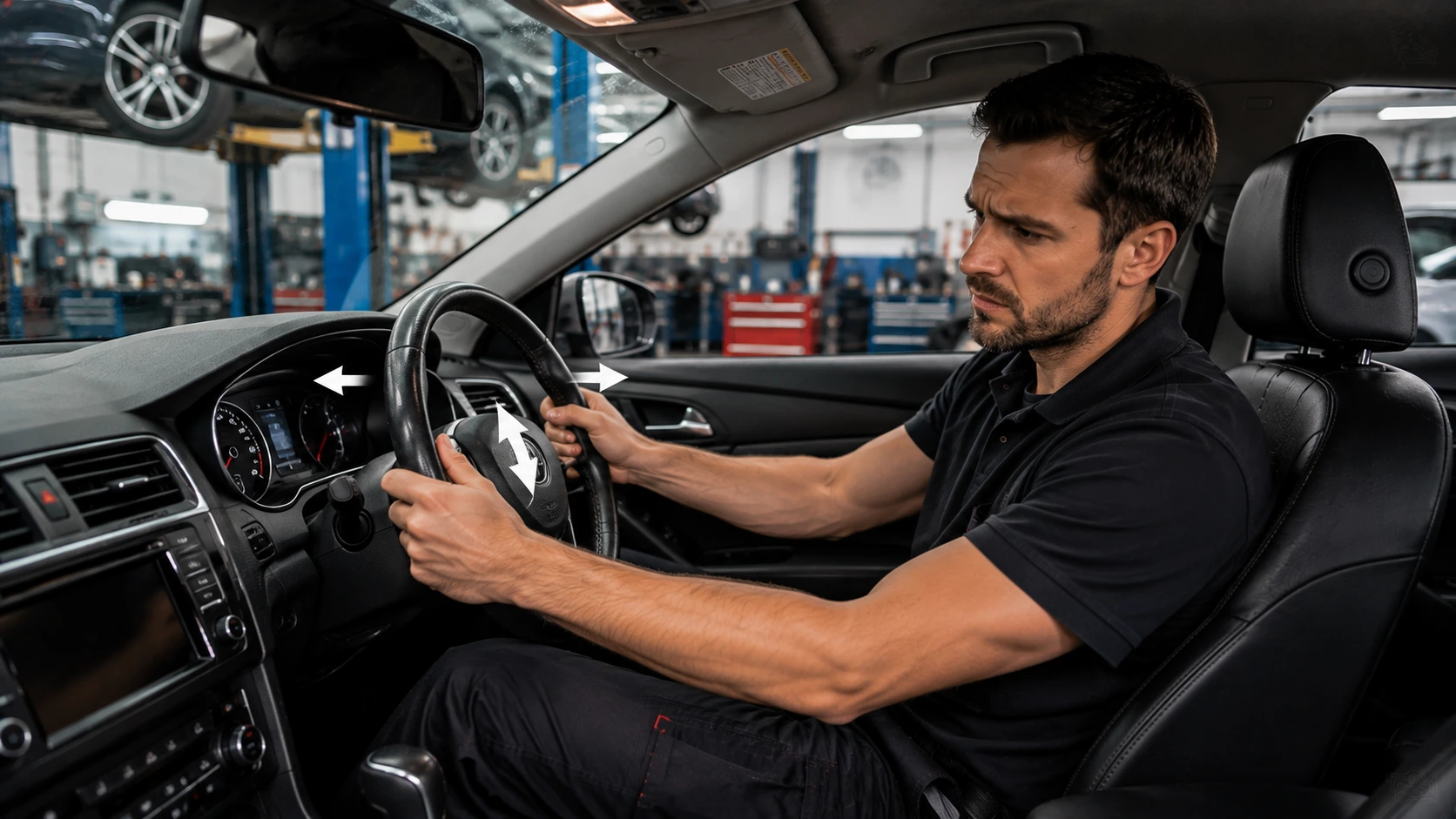
With the vehicle stationary on a level surface, the steering wheel is moved in alternating directions while observing when the front wheels begin to move. A correctly-functioning steering system produces front wheel movement with minimal steering wheel rotation — typically under 30mm of rim movement at the steering wheel for most vehicles. Play above 50–60mm at the rim indicates a fault requiring investigation.
Play vs Vagueness — An Important Distinction
Steering play — the dead zone between left and right steering input before the vehicle responds — is a mechanical fault. Steering vagueness — a disconnected, imprecise feel without a measurable dead zone — may be a mechanical fault at an early stage, or an EPS system issue. Distinguishing the two determines whether the investigation prioritises mechanical components or electronic systems. Our car mechanic team measures steering play with a steering wheel play gauge before any ramp inspection begins.
Tie Rod End Wear — The Most Common Loose Steering Cause
Tie rod ends are the ball-and-socket joints at the outer end of each tie rod that connect the steering rack output to the steering knuckle. When these joints wear, the ball develops play in its socket — the socket allows the ball to move slightly before the steering force is transmitted to the knuckle.
How Tie Rod End Play Produces Loose Steering
A tie rod end with 2mm of play allows the steering rack to move 2mm before the force is transmitted to the tyre. At the tyre contact patch — amplified by the steering geometry — this translates to the front wheel remaining stationary for a small but clearly perceptible amount of steering wheel rotation. This is the classic car steering wheel feel loose description: “I turn the wheel but nothing happens for a moment.”
The Shake Test for Tie Rod Play
Grasping the tyre at the 3 and 9 o’clock positions and pushing and pulling while the steering is locked confirms tie rod end play — the tyre rocks while the rack remains stationary. This test is performed on the ramp with the wheel off the ground. Play confirmed by this test is measured to compare against the manufacturer’s maximum allowance.
Why Dubai Accelerates Tie Rod End Wear
Dubai’s parking culture produces more full-lock tie rod end loading cycles per year than any other major driving environment. Every tight car park turn takes the tie rod end to its maximum joint angle under load — the highest-wear condition the joint experiences. Accumulated over hundreds of daily parking manoeuvres, the total joint loading far exceeds any highway-dominated market’s equivalent.
Steering Rack Internal Wear and Mounting Faults
The steering rack translates the steering wheel’s rotational input into lateral movement of the tie rods. When the rack’s internal components wear — the rack and pinion gear mesh, the rack bearings, or the rack housing seals — the steering develops play that no tie rod end replacement can correct.
Internal Gear Mesh Wear
The pinion gear at the bottom of the steering column meshes with the rack’s teeth. As these teeth wear — from the high-cycle loading of Dubai’s parking pattern — the mesh develops backlash. The driver experiences this as a dead zone in the straight-ahead position, where the steering wheel turns slightly without moving the rack in either direction. This is distinct from tie rod end play, which produces play through the entire steering arc rather than specifically near centre.
Rack Mounting Looseness
The steering rack is mounted to the subframe by bolts through rubber mounting bushings. A loose mounting bolt or collapsed mounting bushing allows the rack to shift laterally on its mounts when steering force is applied — the entire rack moves before transmitting steering input to the tie rods. This produces a heavy, imprecise feel rather than a light dead zone, and is often accompanied by a clunk when the steering is moved quickly from lock to lock. For any breakdown related to a loose steering fault, our roadside assistance covers Al Quoz and nearby Dubai areas.
Steering Column Universal Joint Play
The steering column between the steering wheel and the rack passes through one or two universal joints that allow the column to change angle as it routes from the wheel to the rack. These joints can develop play from wear or corrosion.
Column UJ Play Character
Play in a steering column universal joint produces a car steering wheel feel loose feeling that is consistent throughout the full steering arc — unlike rack wear which produces a dead zone at centre. The play is felt equally whether the wheel is near centre or at full lock. A worn UJ may also produce a clunking sound when the steering direction is reversed.
Collapsible Column Inspection
In vehicles that have been in a collision — even a minor one — the steering column’s collapsible section may have partially compressed. A partially-collapsed collapsible section changes the column’s mechanical properties and can introduce looseness or binding that was not present before the impact.
Ball Joint Contribution to Steering Vagueness
Worn front ball joints — as described in the suspension clunking blog — allow the steering knuckle to move independently of the steering input when road forces are applied. This does not produce the same dead-zone play as tie rod end wear, but it produces a steering feel that is vague and imprecise — the front wheels do not hold their commanded angle consistently under cornering load.
Distinguishing Ball Joint Vagueness From Tie Rod Play
Ball joint wear produces a car steering wheel feel loose sensation specifically during cornering — the front wheel deflects slightly from its commanded angle as road forces push against the worn joint. Tie rod end play produces a dead zone in the straight-ahead and transition phases rather than specifically during cornering. The ramp test distinguishes the two — tie rod play appears in the push-pull test at 3 and 9 o’clock; ball joint play appears in the push-pull test at 12 and 6 o’clock positions. Our car service packages include a full steering and suspension play test at every major service for vehicles over four years old.
EPS Torque Sensor Drift — The Electronic Loose Feeling
On electric power steering vehicles, a torque sensor that has drifted from its calibration produces an assist pattern that does not correctly match the driver’s input — sometimes producing more assist than needed (creating a light, vague feel) and sometimes less.
What Sensor Drift Feels Like
An EPS torque sensor fault produces a car steering wheel feel loose sensation that appears to be mechanical but has no measurable play on the physical steering play test. The wheel is mechanically connected correctly, but the assist level is inconsistent — the steering feels imprecise because the assist is not consistently calibrated to the driver’s input force.
Diagnostic Scan Confirms This Cause
A full EPS diagnostic scan reading live torque sensor output, motor current, and steering angle sensor data identifies a drifting torque sensor before any mechanical component is condemned. The scan result determines whether the fault is in the sensor, the motor, or the control module.
How Dubai’s Steering Demands Accelerate This Fault
Dubai’s driving environment subjects steering components to a level of use that exceeds any highway-dominated market.
Car Park Steering Cycle Volume
A Dubai driver visiting two malls per day, a school, and a petrol station performs dozens of full-lock or near-full-lock steering cycles per day. Each cycle loads the tie rod ends, rack, and ball joints at maximum angle. The annual cycle count for a Dubai city driver’s steering system may exceed ten years of equivalent rural or highway driving in a lower-density parking environment.
Hot Steering Fluid Degrades Rack Seals
On hydraulic power steering vehicles, the power steering fluid in Dubai’s heat operates at sustained temperatures above the range that maintains its lubricating properties for rack and pinion seals. Degraded fluid attacks the rack’s internal seals — producing fluid loss that allows air into the hydraulic circuit and accelerates internal rack wear. The resulting looseness is both a seal failure and an internal wear consequence of the degraded fluid.
How We Confirm Every Play Source at Rapid Rev Garage
The diagnostic sequence measures total play first, then traces each contributing source systematically.
Steering Play Measurement at the Rim
Play is measured at the steering wheel rim before and after each component assessment — to confirm that the identified play source accounts for the total measured play. Multiple play sources contributing to the same total are both identified and both repaired.
Ramp Push-Pull Test at All Clock Positions
The wheel is pulled and pushed at 12/6 o’clock (ball joint), 3/9 o’clock (tie rod end), and diagonally (combined) while the steering is locked. Play at each position is measured against specification.
Rack Centre Position Dead Zone Assessment
The steering is moved slowly through centre while the driver observes whether a dead zone exists around the straight-ahead position — confirming rack internal wear versus a symmetric play fault.
EPS Scan Where Applicable
On EPS vehicles, a full module scan reading torque sensor output, assist level, and fault codes distinguishes an electronic vagueness fault from a mechanical play fault.
The Right Fix for Each Confirmed Cause
Each repair is matched to the specific play source confirmed by the measurement and ramp test.
Tie Rod End Replacement With Alignment
Worn tie rod ends are replaced in pairs — the opposite side is at similar wear stage and will produce play within months of the first replacement. Post-replacement, a four-wheel alignment is performed — tie rod ends directly affect toe alignment, and replacement without alignment produces tyre wear and handling deviation. For exterior repairs needed alongside steering work, our car painting team handles colour-matched work at the same visit.
Steering Rack Replacement or Reconditioning
A rack with internal gear mesh wear is replaced with a new or quality-reconditioned unit. A rack with loose mounting is first re-torqued with fresh mounting bushings — if the play remains after this, the rack is assessed for internal damage. Post-rack replacement, four-wheel alignment is confirmed.
Column Universal Joint Replacement
A worn column UJ is replaced with the correct-specification universal joint for the column. Post-replacement, the column alignment is confirmed and the play measurement repeated.
EPS System Calibration or Component Replacement
A calibration drift is corrected through a steering angle sensor calibration procedure. A confirmed sensor or motor fault is addressed with the specific component replacement confirmed by the scan.
What Happens If Loose Steering Is Left Without Repair
Steering play that is accepted and driven through follows a direct and predictable progression.
Progressive Play Increase
The play in a worn tie rod end or rack component does not remain stable — it increases as the worn bearing surfaces continue to wear under loading. A car steering wheel feel loose symptom with 50mm of play this month has 80mm of play in three months without intervention. Progressive play increase directly degrades steering precision and ultimately safety.
Tie Rod End Separation Risk
A tie rod end with significant play is at risk of complete separation — the same failure mode as a worn ball joint. Tie rod end separation produces immediate and total loss of steering on the affected wheel. This risk increases proportionally with the degree of play. Our mobile car mechanic covers Al Quoz and nearby Dubai areas for on-site steering play assessment.
Is It Safe to Drive?
The urgency depends on the measured degree of play and whether any associated symptoms are present.
Minimal Play — Book This Week
A car steering wheel feel loose symptom with under 50mm of measurable rim play is driveable for short careful distances. Book within the week.
Significant Play — Book Today
Play above 70–80mm at the rim, or a car steering wheel feel loose symptom with any associated pulling or wandering: book the same day. Significant steering play compromises emergency manoeuvre capability at any speed.
How Long the Repair Takes
Repair time depends on the confirmed play source and whether alignment is required after component replacement.
Tie Rod End Replacement With Alignment
Two to four hours per axle including alignment.
Rack Replacement With Alignment
Four to six hours including fitting, fluid refill where applicable, and alignment.
Column UJ Replacement
Two to three hours including column reassembly and play confirmation.
EPS Calibration or Component
One to three hours depending on the specific component and calibration procedure.
What the Repair Costs in Dubai
Cost depends on the confirmed play source — tie rod end replacement costs less than rack replacement.
Tie Rod Work
Tie rod end replacement per side: AED 400–900. Full axle with alignment: AED 800–1,800.
Rack and Column Work
Steering rack replacement: AED 1,500–5,000 depending on vehicle. Column UJ replacement: AED 400–1,000. EPS sensor or motor replacement: AED 600–2,500. A written quote is provided after the steering play measurement and ramp inspection confirm the specific fault sources. Our garage near me location in Al Quoz serves drivers from Business Bay, Jumeirah, Barsha, Satwa, Downtown, and the Sheikh Zayed Road corridor.
Keeping Steering Precise in Dubai’s Conditions
Two habits prevent the most common causes of steering looseness in Dubai.
Power Steering Fluid Replacement Every Two Years
Fresh hydraulic power steering fluid maintains the rack seal integrity and lubrication quality that prevents internal wear from degraded fluid. A two-year replacement interval in Dubai’s heat maintains the fluid within its effective property range.
Annual Steering Play Measurement
An annual steering play measurement at the major service identifies developing tie rod or rack play before it reaches the threshold that affects driving precision. Catching 30mm of play before it becomes 70mm of play changes the urgency and, in some cases, the scope of the repair.
Why Rapid Rev Garage?
When a car steering wheel feel loose complaint arrives, the steering play measurement tells us immediately whether we are dealing with a mechanical play fault or an EPS vagueness fault — because only one of these produces measurable rim play on the play gauge. A measured fault is traced through the column, rack, tie rods, and ball joints systematically. An unmeasured vagueness on an EPS vehicle goes to the scan tool. This sequence prevents condemning mechanical components on a vehicle whose car steering wheel feel loose sensation is coming from a calibration drift.
FAQ — Car Steering Wheel Feel Loose
These are the questions most frequently asked about steering play at our Al Quoz workshop.
How much steering wheel play is normal?
Most manufacturers specify a maximum of 10–30mm of steering wheel rim movement before the front wheels begin to move. Above this, play is outside specification. A car steering wheel feel loose complaint with more than 50mm of play is confirmed outside any reasonable tolerance.
Can wheel alignment cause a loose steering feel?
Incorrect alignment — particularly incorrect toe — can produce a straight-line instability that feels like steering looseness. However, alignment does not produce a physical dead zone at the steering wheel. If a play measurement shows no mechanical play but the steering feels vague, alignment is checked as a contributing factor.
My steering feels loose only at highway speed — is that different?
Yes — looseness that appears specifically at highway speed is more likely a wheel balance, tyre structural, or suspension geometry issue than a tie rod or rack fault. Looseness specifically at speed warrants a road test at the speed that produces the sensation before the ramp inspection is conducted.
Should I replace both tie rod ends if only one is worn?
Yes — replacing both at the same visit is consistently recommended for the same reason both sides of brake pads are replaced simultaneously. The opposite side has accumulated similar mileage and will present the same fault within months.
Can tyre wear cause a loose steering feel?
Severely uneven tyre wear — particularly feathering from toe misalignment — produces a steering feel that the driver interprets as looseness. The tyres are pulling in slightly different directions at the contact patch. Correcting the alignment and replacing the affected tyres resolves this pattern.
Conclusion
A car steering wheel feel loose in Dubai traces to specific, measurable play sources — tie rod ends, steering rack internal wear, column universal joints, or ball joints — each confirmed by the steering play measurement and ramp push-pull tests before any component is replaced. Dubai’s high parking frequency accelerates tie rod end and rack wear faster than any highway-dominated market’s service schedule assumes.
Rapid Rev Garage in Al Quoz measures steering play, locates every contributing source, and performs post-repair alignment before returning any vehicle with a car steering wheel feel loose complaint.
Rapid Rev Garage is in Al Quoz, serving drivers across nearby Dubai areas — Business Bay, Jumeirah, Downtown, Barsha, Satwa, and the Sheikh Zayed Road corridor. Book your appointment on WhatsApp or find us on Google Maps.
Rapid Rev Garage — Car Steering Wheel Feel Loose | Al Quoz, Dubai