At a Glance
If your car hesitates before moving after you press the accelerator, it’s often a sign that something is preventing the engine or transmission from responding smoothly. Dirty fuel injectors, a failing throttle body, worn spark plugs, transmission problems, sensor faults, or restricted airflow may cause the issue. While the hesitation may seem minor at first, it can quickly develop into poor acceleration, reduced fuel economy, or even complete breakdowns if left unchecked. A professional inspection helps identify the exact cause so the correct repair can be carried out before the problem becomes more expensive.
Table of Contents
- What Does It Mean When Your Car Hesitates Before Moving?
- Common Symptoms
- Why Does a Car Hesitate Before Moving?
- How Professionals Diagnose the Problem
- Repair Process
- Can You Continue Driving?
- Risks of Ignoring the Issue
- Repair Time
- Cost Factors
- Prevention Tips
- Dubai Driving Conditions
- Why Choose Rapid Rev Garage
- Frequently Asked Questions
What Does It Mean When Your Car Hesitates Before Moving?
There’s nothing more infuriating than pressing the pedal and seeing your car hesitate before it responds. It happens when getting onto a busy road, driving away from a traffic light, or pulling out of a parking space. That split-second hesitation makes you wonder if the car is going to work or not.
This delay usually signifies that one or more of the systems that provide power to the wheels is not working efficiently. In modern cars, the engine, gearbox, fuel delivery system, ignition system, sensors, and electronic throttle all operate together in a matter of seconds. The car could stutter before speeding up if one part goes.
The problem doesn’t necessarily feel like a problem. Some drivers can feel a small delay before the car starts moving. Some drivers might feel a distinct jerk or a sluggish reaction. In more severe circumstances, the engine may rev more than typical before the car gets up to speed, or the vehicle may have trouble accelerating at all.
Because so many different systems can give identical symptoms, guessing at the source often results in unneeded repairs. Replacing spark plugs, cleaning the throttle body, or changing filters without adequate testing might not address the issue if the real problem lies elsewhere. You can replace parts, but you need a professional diagnosis to identify the root cause.
Common Symptoms
A hesitation problem rarely appears without warning. Most vehicles begin showing subtle signs before the issue becomes serious.
You may notice one or more of the following symptoms:
- A delay between pressing the accelerator and the vehicle moving.
- Slow or sluggish acceleration when pulling away from a stop.
- The engine revs increase before the vehicle gains speed.
- Jerking or shuddering during initial acceleration.
- Hesitation while entering roundabouts or merging into traffic.
- Reduced engine performance when climbing hills.
- Poor throttle response during overtaking.
- Increased fuel consumption.
- Check Engine Light appearing on the dashboard.
- Rough engine operation during low-speed driving.
In some cars, the hesitation is just when the engine is cold, while in others it develops after many minutes of driving. The driving conditions under which the hesitation occurs provide vital hints during the diagnostic process and help specialists narrow down the likely reasons.
Why Does Your Car Hesitate Before Moving?
A hesitation when pulling away from a stop isn’t a fault on its own—it’s a symptom that something in the vehicle isn’t responding as it should. Modern vehicles rely on dozens of interconnected components to deliver smooth acceleration. When one of those components starts to fail, even slightly, the result can be a noticeable delay between pressing the accelerator and the vehicle moving.
Below are the most common causes our technicians encounter during vehicle inspections.
1. Dirty or Faulty Fuel Injectors
Fuel injectors deliver a precise amount of fuel into the engine. Over time, carbon deposits and fuel contaminants can restrict the injector spray pattern, causing the engine to receive an uneven fuel supply.
Instead of producing smooth acceleration, the engine may hesitate, stumble, or feel sluggish when pulling away from a stop.
Common signs include:
- Delayed acceleration
- Rough idling
- Increased fuel consumption
- Engine hesitation under load
If left untreated, clogged injectors can place additional strain on the fuel pump and reduce overall engine efficiency.
2. Dirty Throttle Body
The throttle body controls how much air enters the engine when you press the accelerator. As dirt and carbon accumulate inside the throttle body, airflow becomes restricted, making it harder for the engine to respond immediately.
Drivers sometimes refer to this as a “lag” between when they push the pedal and when the vehicle begins to move.
Symptoms can include:
- Delayed throttle response
- Fluctuating idle speed
- Hesitation in take-off
- Engine cuts out sometimes
If the problem is caught early, routine throttle body cleaning is usually adequate to restore smooth acceleration.
3. Worn Spark Plugs or Ignition Components
Spark plugs ignite the air-fuel mixture inside the engine. As they wear out, combustion becomes inconsistent, especially during low-speed acceleration.
A weak spark can cause:
- Engine hesitation
- Misfires
- Poor fuel economy
- Reduced engine power
If ignition coils are also beginning to fail, the hesitation may become more noticeable under acceleration or while climbing hills.
4. Transmission Problems
Some of the hesitations aren’t caused by the engine. Fluid is used in automatic gearboxes, together with electronic controls and hydraulic pressure, to smoothly transmit power.
Hesitation as the vehicle begins to move can be caused by low gearbox fluid, worn clutch packs, delayed gear engagement, or valve body problems.
Drivers may notice:
- Delayed gear engagement
- Jerking during take-off
- Slow acceleration
- Gear shifting irregularities
Ignoring these symptoms can allow minor transmission issues to develop into major repairs.
5. Faulty Sensors
Modern vehicles constantly monitor engine performance using sensors that communicate with the Engine Control Unit (ECU).
If one of these sensors sends incorrect information, the ECU may calculate the wrong fuel or air mixture, resulting in delayed acceleration.
Some of the most common sensors involved include:
- Mass Air Flow (MAF) Sensor
- Throttle Position Sensor (TPS)
- Oxygen Sensors
- Crankshaft Position Sensor
- Camshaft Position Sensor
Because several sensors can produce similar symptoms, professional diagnostics are essential before replacing components.
6. Restricted Air Intake
Your engine needs a consistent supply of clean air to run right. A dirty air filter or a blockage in the intake system can impede airflow and make the engine less responsive when accelerating.
Though the problem develops slowly, many drivers finally realize:
- Sluggish acceleration
- Reduced engine performance
- Increased fuel usage
- Hesitation during take-off
Replacing a neglected air filter is a simple maintenance task that can significantly improve engine response.
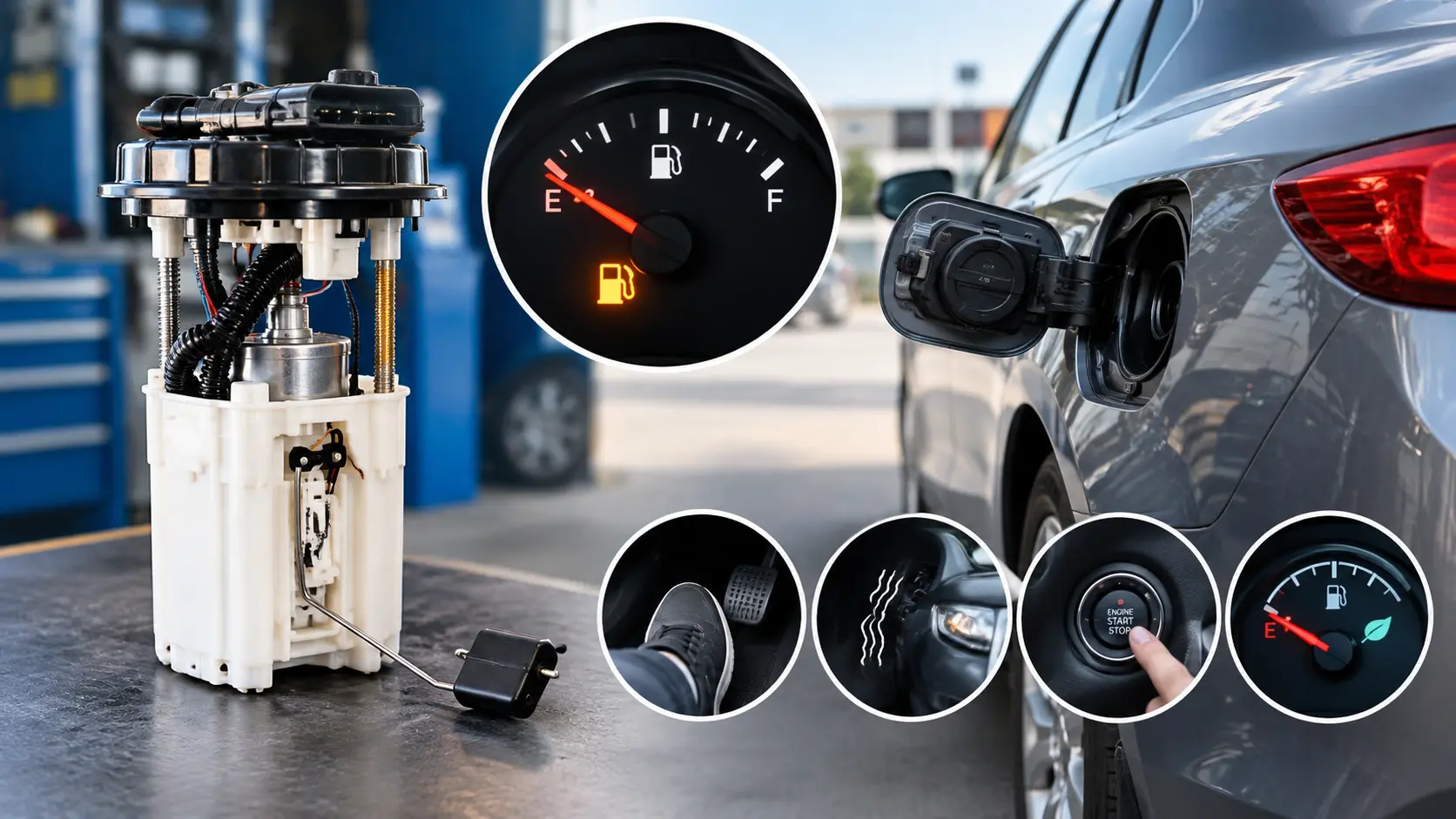
7. Fuel Pump or Fuel Filter Problems
A good fuel pump supplies fuel to the engine at the right pressure. If the fuel pressure is too low because the pump is weak or the fuel filter is blocked, the engine may start to struggle when you need more power.
Early warning indications are:
- Lag in acceleration
- Hard to start
- Loss of power when driving
- Engine stalls while under load.
Diagnosing fuel system problems early on will prevent the pump from failing.
8. Carbon Build-Up Inside the Engine
Carbon deposits naturally accumulate inside modern engines over time, particularly in direct injection engines.
These deposits can restrict airflow and interfere with combustion, leading to:
- Sluggish throttle response
- Rough idling
- Reduced fuel efficiency
- Hesitation before moving
Professional intake cleaning or decarbonization may be required to restore normal engine performance.
9. Electronic Accelerator Pedal Issues
Many modern vehicles use an electronic accelerator pedal rather than a traditional cable.
If the pedal sensor begins to fail or communication between the accelerator pedal and the ECU becomes inconsistent, the vehicle may hesitate before responding.
Drivers often report:
- Delayed throttle response
- Intermittent acceleration issues
- Dashboard warning lights
- Inconsistent vehicle performance
Electronic faults should always be diagnosed using manufacturer-approved diagnostic equipment.
10. Multiple Minor Issues Working Together
One of the biggest misconceptions is that a single failed component always causes hesitation.
In reality, many vehicles arrive at our workshop with several small issues occurring simultaneously—for example:
- Slightly dirty injectors
- A partially clogged air filter
- Worn spark plugs
- Carbon deposits in the intake system
Individually, these issues may seem insignificant, but together they can noticeably affect vehicle performance. That’s why a complete diagnostic inspection is far more effective than replacing parts based on guesswork.
How Professional Technicians Diagnose the Problem
Since several different systems can cause hesitation, accurate diagnosis is the key to a successful repair. Replacing parts without identifying the root cause often leads to unnecessary expense and recurring problems.
At Rapid Rev Garage, our technicians follow a structured diagnostic process to identify the exact source of the hesitation before recommending any repairs.
Our inspection typically includes:
Computer Diagnostics
First, we hook up high-tech diagnostic tools to the car’s built-in computer to look for fault codes, sensor readings, and real-time performance data. Often, hidden problems can be found through live diagnostics, even if no warning lights are on.
Road Test
The controlled road test lets us duplicate the reluctance under real driving conditions. This means our technicians can see if the problem happens when the car takes off, accelerates, changes gears, or when the engine is under load.
Examining the Fuel System
The pressure in the fuel delivery system, injector performance, and the condition of the fuel filter are all checked. Any blockage in the fuel flow can directly affect how fast you go.
Air Intake and Throttle Inspection
The throttle body, intake system, and air filter are inspected for carbon deposits, contamination or airflow obstructions that could cause a delay in engine response.
Ignition System Testing
Spark plugs and ignition coils are evaluated to ensure the engine is producing a strong, consistent spark during acceleration.
Transmission Evaluation
In automatic cars, the condition of the transmission fluid, gear engagement, shift quality, and electronic transmission operation are carefully evaluated to rule out hesitation caused by the gearbox.
Once all diagnostic data has been obtained, our technicians will only recommend the appropriate repair. This systematic approach avoids unnecessary parts replacements, reduces repair costs, and ensures the problem is correctly treated the first time.
Repair Process
The correct repair depends entirely on what our diagnostic inspection reveals. Since hesitation can result from several different systems, there is no one-size-fits-all solution. At Rapid Rev Garage, we repair the underlying cause rather than treating the symptoms.
Depending on the diagnosis, the repair process may include:
- Cleaning or replacing clogged fuel injectors
- Cleaning the throttle body and intake system
- Replacing worn spark plugs or faulty ignition coils
- Replacing a blocked air filter
- Repairing or replacing faulty sensors
- Servicing the fuel pump or replacing the fuel filter
- Performing a transmission service or repairing transmission-related faults
- Updating or recalibrating the engine control software where applicable
- Carrying out engine decarbonization to remove excessive carbon deposits
After the repairs are completed, our technicians perform another road test and diagnostic scan to confirm that the hesitation has been eliminated and the vehicle accelerates smoothly under different driving conditions.
Can You Continue Driving?
In some cases, a vehicle that hesitates before moving may still be drivable, but that doesn’t mean it’s safe to ignore.
A slight hesitation today can quickly develop into poor acceleration, engine stalling, or transmission failure if the underlying problem worsens.
You should avoid unnecessary driving if the hesitation is accompanied by:
- The Check Engine Light
- Engine misfires
- Loud knocking noises
- Burning smells
- Transmission slipping
- Loss of power while driving
- Excessive engine vibration
These symptoms indicate that the problem may be progressing and should be inspected as soon as possible.
Risks of Ignoring the Problem
Many drivers continue driving because the hesitation only lasts a second or two. Unfortunately, that short delay often signals a problem that becomes more expensive over time.
Ignoring the issue may lead to:
- Increased fuel consumption
- Premature wear of ignition and fuel system components
- Engine misfires
- Catalytic converter damage
- Reduced engine performance
- Transmission damage
- Unexpected breakdowns
- Higher repair costs
Addressing the issue early is almost always more cost-effective than waiting until additional components fail.
Repair Time
Repair time depends on the underlying cause and the complexity of the repair.
| Diagnostic Inspection | 30–60 minutes |
| Throttle Body Cleaning | 1–2 hours |
| Spark Plug Replacement | 1–2 hours |
| Fuel Injector Cleaning | 2–3 hours |
| Air Filter Replacement | Less than 30 minutes |
| Sensor Replacement | 1–2 hours |
| Fuel Pump Replacement | 2–4 hours |
| Transmission Diagnosis & Service | Half day to one day |
More extensive engine or transmission repairs may require additional time, but a professional diagnosis allows technicians to provide an accurate estimate before any work begins.
Cost Factors
The cost of repairing hesitation before moving varies because several different systems may be involved.
The final repair cost depends on factors such as:
- The root cause of the hesitation
- Vehicle make and model
- Engine type
- Automatic or manual transmission
- Parts requiring replacement
- Labour required
- Diagnostic complexity
Replacing a clogged air filter is naturally less expensive than repairing a failing transmission. A proper diagnosis ensures you’re only paying for the repairs your vehicle actually needs.
Prevention Tips
You can’t prevent every mechanical failure, but regular maintenance can considerably lessen the chance of reluctance on acceleration.
For smooth running of your vehicle:
- Follow the manufacturer’s recommended service schedule.
- Replace spark plugs at the recommended intervals.
- Change the engine air filter regularly.
- Use high-quality fuel whenever possible.
- Service the transmission according to manufacturer recommendations.
- Clean the body of the throttle as needed.
- Take care of the warning lights right away.
- Set up regular diagnostic checks, especially if you notice even small changes in how well it works.
Regular repair not only makes the car more reliable, but it can also make major engine and gearbox parts last longer.
Dubai Driving Conditions
Driving in Dubai places additional stress on your vehicle compared to many other regions.
High temperatures, stop-and-go traffic, long highway journeys, and dusty conditions can all contribute to hesitation-related problems.
Some of the most common Dubai-specific factors include:
- Increased carbon build-up due to heavy traffic
- Air filters clogging more quickly because of dust and sand
- Cooling system components working harder during summer
- Fuel system deposits forming over time
- Higher operating temperatures affecting sensors and electronic components
Routine servicing and timely inspections are particularly important for vehicles driven daily in Dubai’s climate.
Why Choose Rapid Rev Garage When Your Car Hesitates Before Moving?
At Rapid Rev Garage, we understand that hesitation during acceleration can have multiple causes, which is why we never rely on guesswork.
Our technicians use advanced diagnostic equipment to identify the exact fault before recommending repairs. This approach saves time, reduces unnecessary parts replacement, and helps ensure the problem is fixed the first time correctly.
When you choose Rapid Rev Garage, you benefit from:
- Experienced technicians
- Advanced vehicle diagnostics
- Transparent repair recommendations
- High-quality replacement parts
- Honest communication throughout the repair process
- Thorough quality checks before vehicle handover
Our goal is to restore smooth, reliable performance while giving you confidence every time you drive.
Frequently Asked Questions
Q1: Why does my car hesitate only when starting from a stop?
This often points to problems with the fuel system, throttle body, ignition components, or transmission. A professional inspection is the best way to identify the exact cause.
Q2: Can low transmission fluid cause hesitation?
Yes. Low or contaminated transmission fluid can delay gear engagement and cause hesitation during acceleration in automatic vehicles.
Q3: Will dirty fuel injectors cause delayed acceleration?
Yes. Dirty fuel injectors restrict fuel delivery, which can reduce engine performance and create hesitation when accelerating
Q4: Is it safe to continue driving if my car hesitates?
Occasional minor hesitation may not immediately leave you stranded, but continued driving without diagnosis can lead to more serious engine or transmission problems.
Q5: Can a dirty throttle body cause poor acceleration?
Yes. Carbon deposits build up inside the throttle body, restricting airflow into the engine and reducing throttle response. This typically results in reluctance when pulling away.
Q6: How long does it take to diagnose hesitation problems?
Most diagnostic inspections may be performed in 30 to 60 minutes, but complicated issues may require further testing.
Q7: Does hesitation always mean the transmission is failing?
No. While transmission problems are one possible cause, hesitation can also result from ignition, fuel, air intake, or electronic sensor issues.
Q8: How can I prevent hesitation problems in the future?
The simplest approach to limit the risk of hesitation is to do regular servicing, change worn parts at the right time, keep the fuel and air systems clean, and watch for warning signs early.
Related Services
- Vehicle Diagnostics
- Engine Diagnostics
- Engine Repair
- Transmission Repair
- Fuel Injector Cleaning
- Spark Plug Replacement
- Throttle Body Cleaning
- Engine Tune-Up
- Car Maintenance Service
Ready to Restore Smooth Acceleration?
If your automobile stalls before starting, don’t let a small problem turn into a big repair. A thorough check can spot the root cause early to help you prevent unnecessary breakdowns and costly repairs.
Our specialists at Rapid Rev Garage use innovative diagnostic tools to pinpoint hesitation problems and only fix what your vehicle really needs.
If your car hesitates before moving, schedule your car inspection today and let our crew restore the smooth, responsive performance you expect every time you step on the gas.