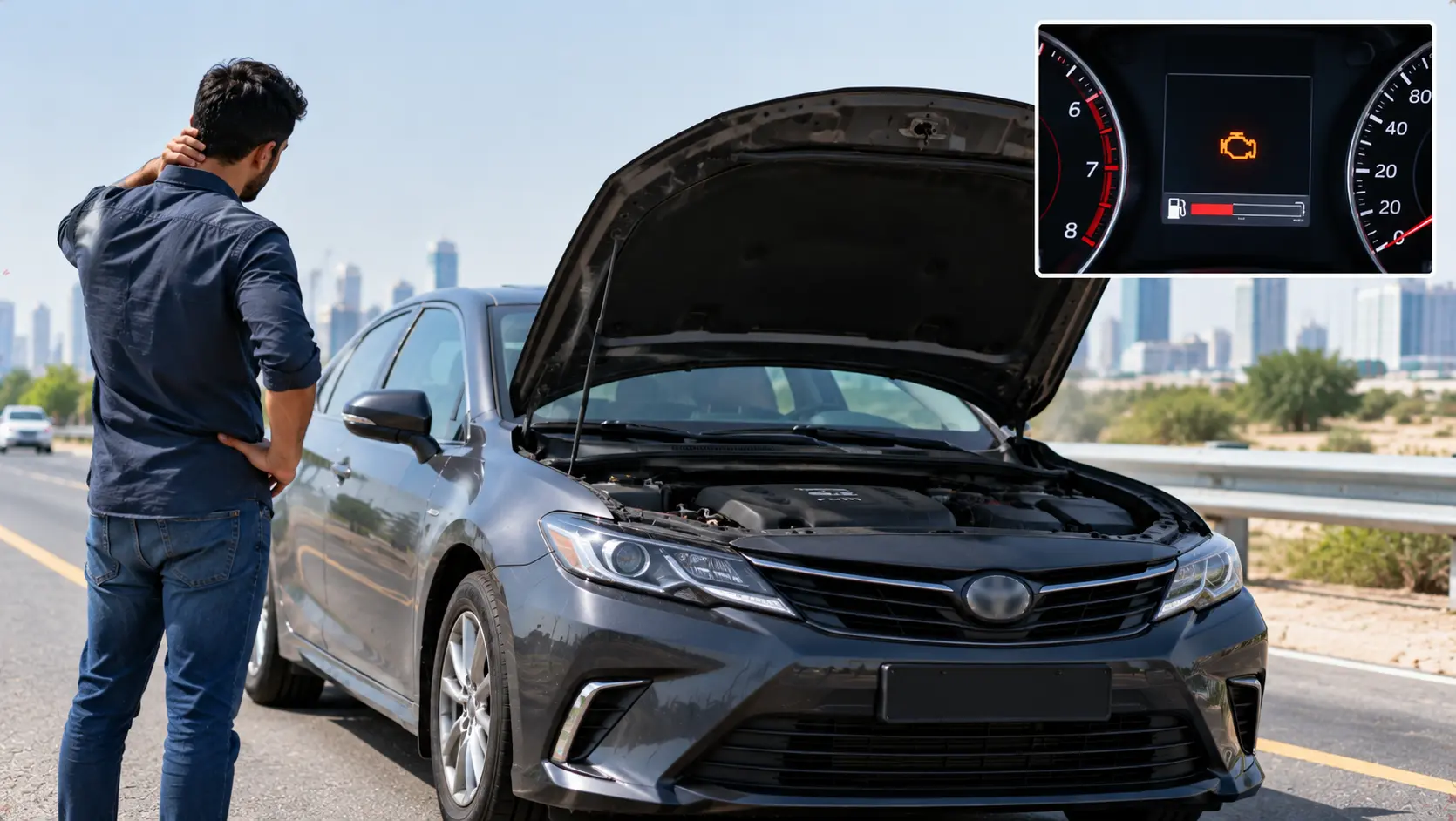
When a car loses power after 30 minutes of driving develops — strong at first of the journey, then sluggish and unresponsive as the drive continues — is a fault that is directly tied to heat. The component that is failing is not failing cold. It is failing at temperature.
In Dubai, a car loses power after 30 minutes of driving is one of the most frustrating faults to experience. The car drives well enough in short trips. It is only on longer drives — the airport run, the Abu Dhabi highway, a Friday evening trip to Hatta — that the problem appears. The driver returns from a short errand thinking the problem has resolved, only to have it return 30 minutes into the next long drive.
At Rapid Rev Garage in Al Quoz, every car loses power after 30 minutes of driving complaint is diagnosed with a hot road test — replicating the drive duration that produces the fault and reading live data at the temperature where the power loss appears.
Car Loses Power After 30 Minutes of Driving — Quick Answer
Every car loses power after 30 minutes of driving case has a fault triggered or worsened by heat. The most common causes are a catalytic converter that has partially melted internally and restricts exhaust flow once it heats and expands, a fuel vapour lock where heat causes the fuel in the supply line to partially vapourise — reducing fuel delivery, a mass airflow sensor that produces an incorrect signal at high operating temperature, a crankshaft or camshaft position sensor that develops an intermittent signal once its housing reaches a threshold temperature, a turbocharger that is heat-soaking and producing less boost as its intercooler reaches thermal saturation, an ignition coil that breaks down and produces a misfire at temperature, or an automatic transmission that is entering a protection mode from overheating. In Dubai, these are the two most common triggers for the car loses power after 30 minutes of driving pattern.
Table of Contents
- Why Thermal Faults Only Appear After Sustained Driving
- Catalytic Converter Restriction After Heat Expansion
- Fuel Vapour Lock in Dubai’s Underbonnet Heat
- MAF Sensor Fault at High Operating Temperature
- Crankshaft or Camshaft Position Sensor Thermal Failure
- Ignition Coil Breakdown at Temperature
- Turbocharger Heat Soak and Intercooler Saturation
- Transmission Overheating Protection Mode
- How Dubai’s Climate Makes Every Thermal Fault Worse
- How We Diagnose a Car That Loses Power After 30 Minutes
- The Services That Fix Each Confirmed Cause
- What Does the Repair Cost in Dubai?
- Why Rapid Rev Garage?
- FAQ
- Conclusion
Why Thermal Faults Only Appear After Sustained Driving
The root of every car loses power after 30 minutes of driving case is component behaviour at temperature. Most testing and design specifications are validated at normal operating temperature — 80–95°C coolant temperature, 60–80°C for the intake air.
In Dubai, normal operating temperature is reached within the first 5–10 minutes of driving. After 20–30 minutes of sustained driving — particularly on the highway where engine load is continuous — some components reach a secondary temperature threshold where their performance degrades. This secondary threshold is above their normal specification.
This temperature-dependence explains the car loses power after 30 minutes of driving pattern precisely. after 30 minutes of highway load. A crankshaft position sensor that produces a clean signal at 70°C develops an intermittent signal at 110°C from a hairline crack in its housing. A catalytic converter that flows freely at 400°C internally becomes restricted at 700°C when partially melted substrate blocks individual cells.
These components produce the car loses power after 30 minutes of driving pattern only at the sustained temperature Dubai reaches. The car is fine for short trips. It loses power at 30 minutes because that is when the temperature reaches the threshold. Our car mechanic team always performs the hot road test to operating temperature and records live data at the point of power loss.
Catalytic Converter Restriction After Heat Expansion
The catalytic converter contains a ceramic substrate — a honeycomb matrix with thousands of parallel channels coated with catalytic metals. Exhaust gas flows through these channels as it passes from the engine to the exhaust.
When a catalytic converter has been damaged by an overrun condition — excessive unburned fuel from a misfiring engine, from excessive oil burning, or from a failed fuel injector — the substrate partially melts. The melted ceramic closes some of the channels. The converter looks intact externally.
At cold or normal operating temperature, the remaining open channels are adequate for the exhaust flow. After 30 minutes of driving, the converter heats further — the car loses power after 30 minutes of driving symptom appears. — expanding the melted ceramic and closing additional channels. The exhaust flow restriction increases. Back pressure builds. The engine cannot expel exhaust gases efficiently and power drops.
This is confirmed by measuring exhaust back pressure upstream of the converter during the hot road test. Normal back pressure at cruise is under 0.5 bar. Elevated back pressure during the power loss confirms converter restriction. Catalytic converter replacement resolves the restriction completely. Our car service packages include an exhaust system health check at every major service for vehicles over 80,000 km.
Fuel Vapour Lock in Dubai’s Underbonnet Heat
Fuel should be in liquid form from the tank through the fuel lines to the injectors. At high underbonnet temperatures — which can reach 100°C in Dubai’s summer in confined engine bay areas — the fuel in the supply line can partially vaporise. Gas bubbles in a fuel line restrict fuel delivery — liquid fuel cannot flow past a vapour bubble as efficiently as it flows through a fully liquid line.
Vapour lock produces a specific pattern: the engine runs normally from cold, starts to stumble or lose power after sustained driving in high ambient heat, and may improve briefly if the car is stopped and cooled — when the vapour condenses back to liquid.
Modern fuel injection systems are designed with fuel return lines and high-pressure electric pumps that make vapour lock less common than in older carburettor systems — but it still occurs in poorly cooled fuel line routing, in vehicles with failing fuel system heat shielding, or in extreme underbonnet heat conditions.
MAF Sensor Fault at High Operating Temperature
The mass airflow sensor produces a voltage or frequency signal that represents the air mass entering the engine. The ECU uses this to calculate the correct fuel injection quantity.
A MAF sensor that has a degraded internal element — from contamination, from physical wear, or from heat-related component drift — may produce a correct signal at normal temperature and an incorrect signal at elevated temperature. The signal drift at temperature causes the ECU to inject an incorrect fuel quantity — too lean or too rich — producing a power loss.
This thermal MAF drift is confirmed by comparing live MAF output against the specification for the engine at various RPM during the hot road test. An output that is within range at normal temperature and drifts out of range after 30 minutes of driving identifies the temperature threshold at which the sensor fails. For any roadside emergency from a power loss on a long drive, our roadside assistance team covers Al Quoz and nearby Dubai areas.
Crankshaft or Camshaft Position Sensor Thermal Failure
The crankshaft position sensor and camshaft position sensor provide the ECU with precise timing information for fuel injection and ignition. A sensor with a hairline crack in its housing, corroded wiring, or a failing internal element may produce a clean signal when cold and an intermittent signal once the sensor housing reaches a threshold temperature.
When the CKP or CMP signal becomes intermittent at temperature, the ECU loses the timing reference for some combustion events. Injection and ignition are not fired correctly for those events. The engine misfires — producing a loss of power that worsens as the temperature rises and the sensor signal degrades further.
A CKP or CMP thermal failure is confirmed by monitoring the sensor signal during the hot road test. A signal that drops out or becomes erratic at the temperature where the power loss appears confirms the fault. The fault code may store only when the engine is hot — a cold scan of the ECU may show nothing. The scan must be performed at temperature.
Ignition Coil Breakdown at Temperature
Ignition coils — particularly coil-on-plug units that sit directly on the spark plug in the cylinder head — operate in an extremely hot environment. The coil’s internal insulation must withstand both the high voltage it generates and the high ambient temperature of the engine head.
A coil with degraded insulation manages these demands adequately when cold. At 30–40 minutes of sustained driving, the coil temperature rises to a point where the degraded insulation fails — the high-voltage pulse leaks to ground rather than firing the spark plug. The cylinder misfires.
The power loss from a coil fault at temperature is cylinder-specific — the cylinder with the failing coil misfires while the others fire correctly. The misfire produces a rough, uneven idle or a specific RPM hesitation rather than a smooth overall power reduction. A misfire code stored at a specific cylinder during the hot road test confirms the coil fault. For any paint or exterior work needed alongside mechanical repairs, our car painting team handles colour-matched repairs at the same visit.
Turbocharger Heat Soak and Intercooler Saturation
Turbocharged engines add compressed air to the cylinders — the turbocharger compresses intake air, increasing its density and the engine’s power output. The compressed air from the turbocharger is cooled by the intercooler before entering the engine — because compressed air is hot and hot air is less dense.
After 30–40 minutes of sustained highway driving, the intercooler reaches thermal saturation — it has absorbed as much heat as its airflow can remove at the current ambient temperature. The compressed air leaving the intercooler is now warmer than at the start of the drive. Warmer air is less dense — less oxygen per unit volume. The engine produces less power.
In Dubai’s summer, the ambient air entering the intercooler is already 40–45°C. The cooling margin is significantly lower than in a European market where ambient air might be 20°C. Intercooler saturation happens earlier and more completely in Dubai’s conditions — the car loses power after 30 minutes of driving pattern on turbocharged vehicles in Dubai’s summer is partly an inherent thermodynamic effect of the ambient conditions.
Where the power loss is more severe than expected, an intercooler that has reduced internal fin efficiency from contamination or a charge pipe leak that is bypassing some of the compressed air to atmosphere may be contributing.
Transmission Overheating Protection Mode
Automatic transmissions have a thermal protection function. When ATF temperature reaches a threshold — typically 130–140°C — the transmission control module enters a protection mode that reduces line pressure or limits which gears can be selected. This protects the clutch packs from overheating damage.
The driver experiences this as a sudden reduction in power and acceleration — the engine feels fine but the transmission is not transmitting full power. The protection mode produces a noticeable change in driving feel: the car that was accelerating freely at 30 minutes is now sluggish despite normal engine response.
Transmission temperature during the hot road test — read from the TCM live data — confirms whether the threshold is being reached. A transmission consistently reaching protection temperature on normal drives has either a degraded ATF that is losing thermal stability at temperature, or a failing transmission cooler that is not removing heat fast enough.
ATF replacement with correct specification fluid and transmission cooler assessment resolve this. In Dubai’s summer, ATF that has been in service for over 30,000 km may not have adequate thermal stability for sustained highway driving.
How Dubai’s Climate Makes Every Thermal Fault Worse
Every thermal fault described above is triggered at a temperature threshold. Dubai’s climate pushes every component to that threshold faster and more consistently than any European market.
A catalytic converter that reaches its restriction temperature after 60 minutes in a 20°C European climate reaches the same temperature at 30 minutes in Dubai’s 45°C summer conditions. A MAF sensor that drifts at 110°C sensor temperature reaches 110°C faster when the ambient is 45°C than when it is 20°C.
This thermal compression explains why a car loses power after 30 minutes of driving specifically in Dubai — not at 60 minutes or 90 minutes. The thermal threshold is the same. Dubai reaches it twice as fast.
How We Diagnose a Car That Loses Power After 30 Minutes
Hot road test to replicate the fault. The vehicle is driven for 30–40 minutes on a route that replicates the driving pattern where the power loss appears — highway cruise, city stop-start, or combined. Live data is monitored throughout.
Live data at the temperature of power loss. Engine RPM, MAF output, fuel trim, ignition timing, misfire count, individual cylinder contribution, transmission temperature, and turbo boost pressure are all recorded at the moment of power loss. The data narrows the cause immediately.
Fault code scan at temperature. Codes that only store when hot — CKP, CMP, coil, MAF — are read during or immediately after the hot road test, not after cooling.
Exhaust back pressure test. Measured upstream of the catalytic converter during the hot road test. Elevated back pressure at the point of power loss confirms converter restriction.
Fuel pressure test. Fuel rail pressure monitored during the hot road test. Pressure drop during the power loss confirms a fuel delivery fault — pump, filter, or vapour lock.
The Services That Fix Each Confirmed Cause
- Catalytic converter replacement. AED 800–4,000 depending on vehicle.
- Fuel system heat shielding repair or fuel line rerouting. AED 200–600.
- MAF sensor cleaning or replacement. AED 100–200 cleaning. AED 300–1,500 replacement.
- CKP or CMP sensor replacement. AED 200–800 per sensor.
- Ignition coil replacement. AED 150–500 per coil.
- ATF service. AED 500–900.
Transmission cooler cleaning or replacement. AED 400–1,200. Our mobile car mechanic covers Al Quoz and nearby Dubai areas for on-site initial assessment before the full hot road test. Our garage near me in Al Quoz serves drivers from Business Bay, Jumeirah, Barsha, Satwa, Downtown, and the Sheikh Zayed Road corridor.
What Does the Repair Cost in Dubai?
| Service | Cost Range |
| MAF sensor service | AED 100–1,500 |
| CKP or CMP sensor replacement | AED 200–800 |
| Ignition coil replacement | AED 150–500 per coil |
| ATF service | AED 500–900 |
| Transmission cooler service | AED 400–1,200 |
| Catalytic converter replacement | AED 800–4,000 |
All costs confirmed after the hot road test, live data analysis, and specific component testing at temperature.
Why Rapid Rev Garage?
Every car loses power after 30 minutes of driving diagnosis must be performed at the temperature of the fault. The fault only exists at temperature. A scan performed after the car cools shows nothing. A short test drive confirms nothing.
We drive until the car loses power after 30 minutes of driving fault appears, then read the data immediately., and scan the codes before the engine cools. The data at the temperature of failure is the only data that identifies the fault.
FAQ — Car Loses Power After 30 Minutes of Driving
Here are the questions Dubai drivers ask us most about heat-related power loss.
Why does the car drive fine for short trips?
Short trips do not reach the temperature threshold at which the fault appears. The catalytic converter, sensor, coil, or transmission that fails at temperature has not reached that temperature in a 10-minute errand. The fault is always there — the temperature to trigger it just is not reached.
Does the power come back if I stop and let the car cool?
Yes — for most thermal faults. Stopping allows the component to cool below its failure threshold. The power returns when restarted. This improvement after cooling and return of the fault after 30 minutes of re-driving is the clearest confirmation that the fault is thermal.
Can a failing fuel pump cause this?
Yes. A fuel pump motor that is failing draws higher current and heats its armature more than a healthy pump. After 30 minutes of sustained fuel delivery, the heat from the armature reduces the pump's output pressure. Fuel pressure monitoring during the hot road test confirms or rules this out.
Is a power loss after 30 minutes dangerous?
On a highway, a sudden power reduction reduces the ability to overtake safely or maintain speed in a merge situation. It is a safety concern at highway speed. Address it before the next long drive.
How do I know if it's the catalytic converter?
The clearest signs: the power loss is accompanied by a sulphur smell from the exhaust, the power loss gets worse the longer you drive, and the car improves noticeably after the engine is allowed to cool completely. An exhaust back pressure test during the hot road test confirms the restriction.
Conclusion
Every car loses power after 30 minutes of driving case crosses a specific temperature threshold — a catalytic converter restricting at high heat, a sensor failing at temperature, an ignition coil breaking down, a transmission entering protection mode, or a fuel system vapour locking. In Dubai’s climate, every one of these thresholds is reached faster and more consistently than in any cooler market.
Rapid Rev Garage in Al Quoz confirms every car loses power after 30 minutes of driving cause with a hot road test and live data at the exact temperature of the fault — confirming the specific cause before recommending any repair.
Rapid Rev Garage is in Al Quoz, serving Business Bay, Jumeirah, Downtown, Barsha, Satwa, and the Sheikh Zayed Road corridor. Book your appointment on WhatsApp or find us on Google Maps.
Rapid Rev Garage — Car Loses Power After 30 Minutes of Driving | Al Quoz, Dubai