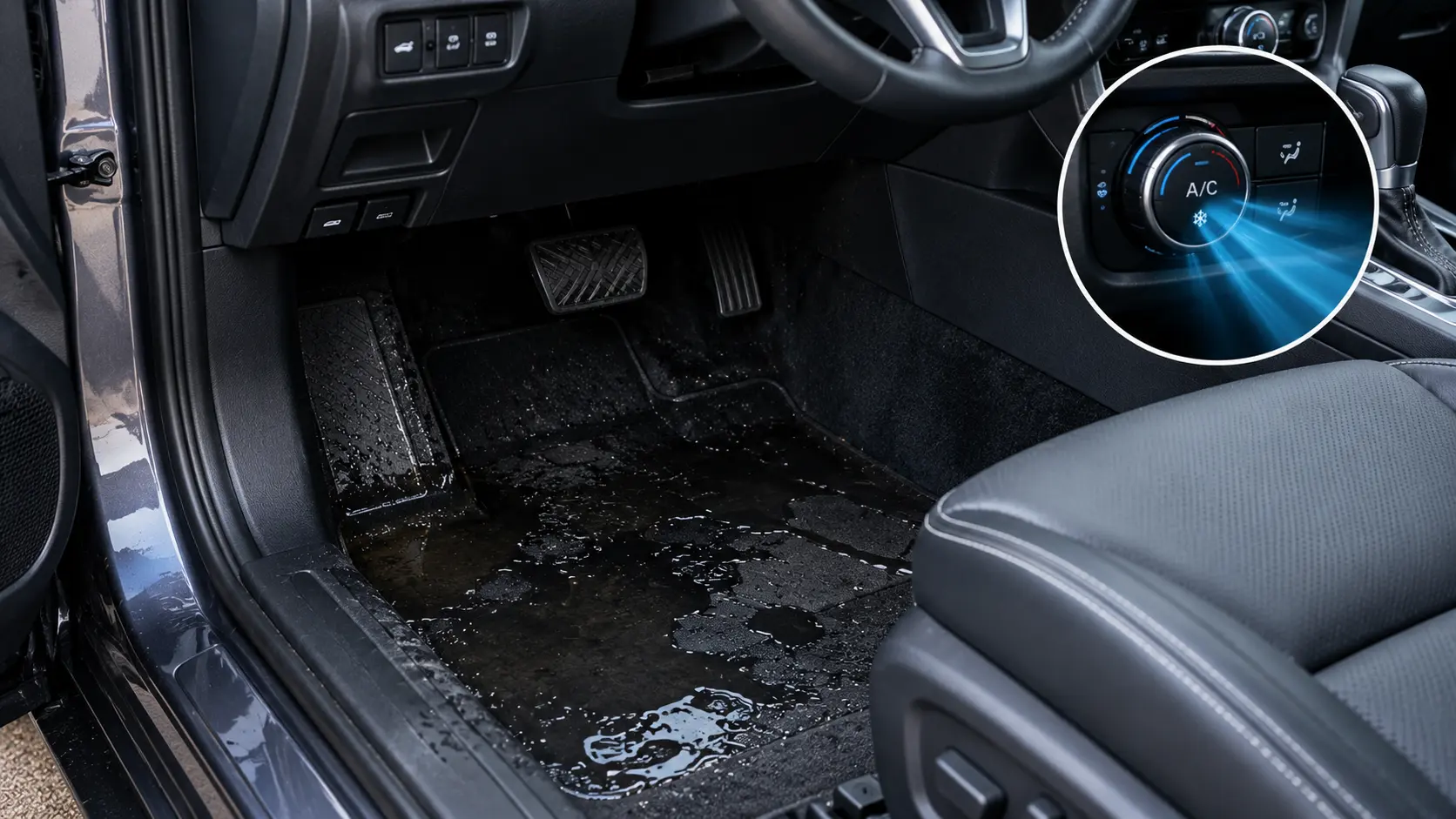
A wet driver side floor after using AC — damp carpet, a puddle under the seat, or wet shoe contact when placing the foot on the footrest — is a specific fault that connects directly to the vehicle’s air conditioning system. It is not a roof leak. It is not a window seal. It is the AC.
The wet driver side floor after using AC pattern appears in Dubai more than anywhere else because the AC runs continuously from April to September — the most intensive AC usage pattern of any market in the world. During each cooling cycle, the evaporator coil produces condensate. In a healthy system, that condensate drains away outside the car. In a faulty system, it drains into the cabin.
At Rapid Rev Garage in Al Quoz, we diagnose and fix every wet driver side floor after using AC case — clearing the drain, cleaning the damage, and confirming the system is draining correctly before returning the vehicle.
Wet Driver Side Floor After Using AC — Quick Answer
A wet driver side floor after using AC is caused by condensate from the AC evaporator coil entering the cabin instead of draining outside the vehicle. The evaporator coil sits behind the dashboard and cools the air by chilling it below its dew point — moisture in the cabin air condenses on the cold coil fins and drips into a drain pan below. From the drain pan, a drain tube routes the water outside through the firewall and drips under the car. When this drain tube blocks — from accumulated dust, debris, mould, or a kinked tube — the drain pan fills and overflows into the cabin, typically soaking the driver side or passenger side footwell carpet. In Dubai, where the AC runs year-round and the air carries dust and organic material, AC drain blockage is the most frequent cause of a wet cabin floor.
Table of Contents
- How the AC Evaporator Drain System Works
- Blocked AC Drain Tube — The Most Common Cause
- How Dubai’s Year-Round AC Use Accelerates Drain Blockage
- How to Confirm the AC Drain Is Blocked
- Secondary Cause — Leaking Heater Core on the Driver Side
- Secondary Cause — Cabin Air Intake Seal Failure
- Wet Carpet Damage and Mould Risk in Dubai’s Heat
- How We Fix a Wet Driver Side Floor After Using AC
- What Does the Repair Cost in Dubai?
- Why Rapid Rev Garage?
- FAQ
- Conclusion
How the AC Evaporator Drain System Works
The AC evaporator coil sits inside the HVAC box — a sealed housing behind the dashboard that contains both the heater core and the evaporator. Air from the cabin or from outside is drawn through the HVAC box by the blower fan.
When this air passes over the cold evaporator coil, it is chilled below its dew point. The moisture in the air condenses on the fin surfaces — exactly as condensation forms on a cold glass in a humid room. This condensate drips from the coil into a plastic drain pan at the bottom of the HVAC box.
From the drain pan, a rubber drain tube passes through the firewall — the sealed wall between the engine bay and the cabin — and exits under the vehicle. This water drips under the car during AC operation. It is the puddle of clear water that drivers notice under a parked car after an AC run — normal and expected.
When the tube is blocked, the drain pan fills. Once the pan overflows, the excess water has only one direction to go — into the cabin. On most vehicles, the HVAC box sits centrally or slightly toward the passenger side, but the overflow path typically routes water toward the driver side footwell because of floor slope. Our car mechanic team checks drain flow first on every wet cabin complaint — before any dashboard removal.
Blocked AC Drain Tube — The Most Common Cause
The drain tube from the evaporator pan passes through the firewall and exits on the underside of the vehicle. On most vehicles this tube is a rubber hose between 15–25mm in diameter.
Over time, several materials block this tube.
Dust and debris. Dubai’s air carries fine construction dust and desert particles. These enter the HVAC box through the cabin air intake and are deposited on the evaporator coil and the drain pan. Over months, this debris accumulates in the drain tube — partially or completely blocking the water flow.
Mould and biofilm. The drain pan is a warm, wet environment. Mould and bacteria form a biofilm on the drain tube walls. This biofilm thickens over time and reduces the tube’s effective diameter. At full blockage, no water exits the tube at all.
Kinking. The drain tube makes a turn through the firewall. In some vehicles and after some repair or modification work, the tube kinks at this turn — restricting or stopping flow without any biological blockage.
A blocked drain in Dubai’s climate produces wet cabin carpet faster than in any cooler market because the condensate volume is higher — the AC is working harder and producing more moisture from the humid cabin air during cooling cycles.
How Dubai’s Year-Round AC Use Accelerates Drain Blockage
In temperate climates, the AC is seasonal. The drain tube has a dry period each year — typically several months — where no water flows and where any partial biofilm dries out and reduces. The annual dry period partly self-clears the tube.
In Dubai, the AC runs twelve months a year. The drain tube carries water continuously. There is no dry period. The biofilm grows without interruption. Dust enters the HVAC box every day without respite.
A drain tube that would remain clear for four to five years in a seasonal market may block within two to three years in Dubai’s continuous use environment. A wet driver side floor after using AC that appears on a vehicle only two to three years old is not unusual — the continuous AC operation has accelerated the blockage timeline. Our car service packages include an AC drain flow confirmation at every major service for all Dubai vehicles.
How to Confirm the AC Drain Is Blocked
The simplest confirmation test: run the AC on maximum for 10–15 minutes in a hot car, then inspect underneath the vehicle. A healthy drain tube produces a steady drip of clear water from the drain exit point — typically under the front passenger area of the vehicle.
No drip at all after 15 minutes of AC operation confirms a blocked drain. The water that should have been dripping outside is accumulating in the drain pan inside the dashboard.
The passenger footwell may also be damp at this point — the drain pan has been overflowing into the cabin for some time.
On a ramp, the drain tube exit is visible and can be checked visually and physically for blockage. A thin probe inserted into the tube from outside confirms whether there is a physical blockage or a biofilm restriction. Where the blockage is soft biofilm, a careful probe clears it immediately — water exits under pressure from the accumulated pan contents.
Secondary Cause — Leaking Heater Core on the Driver Side
While a blocked drain is the most common cause of a wet driver side floor after using AC, a leaking heater core produces the same visible symptom — wet carpet — through a different mechanism.
The heater core sits inside the HVAC box alongside the evaporator. Engine coolant flows through the heater core at all times — even when the AC is running and heating is not selected. A leaking heater core drips coolant inside the HVAC box. This coolant also flows into the drain pan and exits through the drain tube in small quantities — but a significant heater core leak produces more liquid than the drain tube can pass, and the excess enters the cabin.
The distinguishing sign: a blocked drain produces clear, odourless water. A heater core leak produces liquid with a sweet glycol smell. The carpet will have a faint sweet smell if the heater core is the source. The windscreen may also show a greasy film from coolant vapour in the heater air.
A sweet-smelling wet carpet always points to the heater core rather than the drain. For any interior trim or carpet repairs from water or coolant damage, our car painting team handles interior work at the same visit.
Secondary Cause — Cabin Air Intake Seal Failure
Some vehicles draw fresh air through an external intake below the windscreen — in the scuttle area. This intake is sealed to prevent rain from entering the HVAC box directly.
Where the seal around this intake has degraded — from UV and heat damage over time — rainwater or car wash water enters the HVAC box directly and drains into the cabin. This water source is independent of AC operation — it appears after rain or after the car is washed, not specifically after AC use.
Where the wet floor appears only after rain or washing — not after AC use in dry conditions — the scuttle drain or the intake seal is the more likely cause. Clearing blocked scuttle drains and replacing the intake seal resolves this. For any roadside emergency, our roadside assistance team covers Al Quoz and nearby Dubai areas.
Wet Carpet Damage and Mould Risk in Dubai’s Heat
A wet carpet that is not dried promptly in Dubai’s conditions develops mould within 24–48 hours. The combination of warmth, moisture, and the organic material already present in the carpet fibres creates perfect mould growing conditions.
Mould under the carpet and in the foam underlay is very difficult to remove completely once established. It produces the musty smell the driver notices when the AC runs — the mould is being dried by the airflow and releasing spores into the cabin air.
Where the wet driver side floor after using AC has been present for a week or more, the carpet and underlay must be removed, dried, and treated with an antimicrobial agent — or replaced if the mould is established. Fixing the drain tube without addressing the mould leaves the mould source in the cabin.
How We Fix a Wet Driver Side Floor After Using AC
Drain tube clearance. The blocked tube is cleared with a thin probe or compressed air from the drain exit point. Where the blockage is biofilm, the tube is flushed with a cleaning solution and the flow confirmed.
Drain pan cleaning. The accumulated debris in the drain pan is cleaned through the drain tube access or through the HVAC box inspection point. Debris left in the pan reblocks the tube quickly.
Drain flow confirmation. After clearing, the AC is run for 10 minutes and the drain exit is observed. Steady drip from the correct point confirms successful clearance.
Carpet drying and assessment. The driver side carpet is pulled back and the underlay inspected for moisture and mould. Wet underlay is dried with a heat gun or fan. Mouldy material is removed and replaced.
Heater core check. Where the wet carpet has a sweet smell, the coolant level and heater core connections are checked for the secondary cause.
Our mobile car mechanic covers Al Quoz and nearby Dubai areas for on-site AC drain clearance. Our garage near me in Al Quoz serves drivers from Business Bay, Jumeirah, Barsha, Satwa, Downtown, and the Sheikh Zayed Road corridor.
What Does the Repair Cost in Dubai?
| Service | Cost Range |
| AC drain tube clearance | AED 150–350 |
| Drain pan cleaning | AED 200–400 |
| Carpet drying and antimicrobial treatment | AED 300–700 |
| Carpet and underlay replacement | AED 500–2,000 |
| Heater core replacement | AED 1,500–4,000 |
All costs confirmed after drain flow test and carpet inspection identify the extent of the damage.
Why Rapid Rev Garage?
A wet driver side floor after using AC is the drain blocked — in almost every case. The drain tube clears in 15–20 minutes and the floor stops getting wet. What takes longer is assessing whether the carpet and underlay have developed mould from the accumulated wet period.
We clear the drain, confirm the flow, inspect the carpet, and treat or replace the underlay where mould has established. The car goes back dry and clean — not just with a cleared drain and a wet carpet that will produce mould within a week.
FAQ — Wet Driver Side Floor After Using AC
Here are the questions Dubai drivers ask us most about wet cabin floors.
Is the water from the AC drain dangerous?
The condensate from a blocked AC drain is clean water — not a chemical or coolant risk. The risk is mould from wet carpet. Clear the drain promptly and dry the carpet within 24 hours to prevent mould establishing in the underlay.
How do I prevent the AC drain from blocking?
Annual AC drain clearance as a service item prevents blockage from developing to overflow level. In Dubai's year-round AC use conditions, annual clearance is more appropriate than the European standard of checking every two to three years.
Can I clear the AC drain myself?
The drain tube exit is accessible on the underside of the car without any tools — it is a short rubber hose end that can be cleared with a thin wire or straw in many cases. If the blockage is soft biofilm, clearing the exit often releases the accumulated water immediately. If the blockage is higher in the tube or in the drain pan, workshop access is needed.
Why does only the driver side get wet?
The HVAC box overflow typically channels toward the driver side because of the floor slope and the box position relative to the firewall. On some vehicles it is the passenger side. The drain pan overflow follows the lowest point of the box interior — whichever footwell is lower receives the water first.
Does a wet floor mean the AC is damaged?
No. The evaporator, compressor, and refrigerant circuit are not affected by a blocked drain. The AC continues to cool correctly — it just cannot drain the condensate outside. The only damage is from the water itself accumulating on the carpet and underlay.
Conclusion
A wet driver side floor after using AC is produced by condensate from the evaporator coil overflowing into the cabin because the drain tube is blocked. In Dubai’s year-round AC operation, this blockage develops faster than in any seasonal market — and the consequent wet carpet can develop mould within 48 hours in the heat.
Rapid Rev Garage in Al Quoz fixes every wet driver side floor after using ac case completely, and treats or replaces the underlay where damage has occurred — fixing every wet driver side floor after using AC case completely in a single visit.
Rapid Rev Garage is in Al Quoz, serving Business Bay, Jumeirah, Downtown, Barsha, Satwa, and the Sheikh Zayed Road corridor. Book your appointment on WhatsApp or find us on Google Maps.
Rapid Rev Garage — Wet Driver Side Floor After Using AC | Al Quoz, Dubai