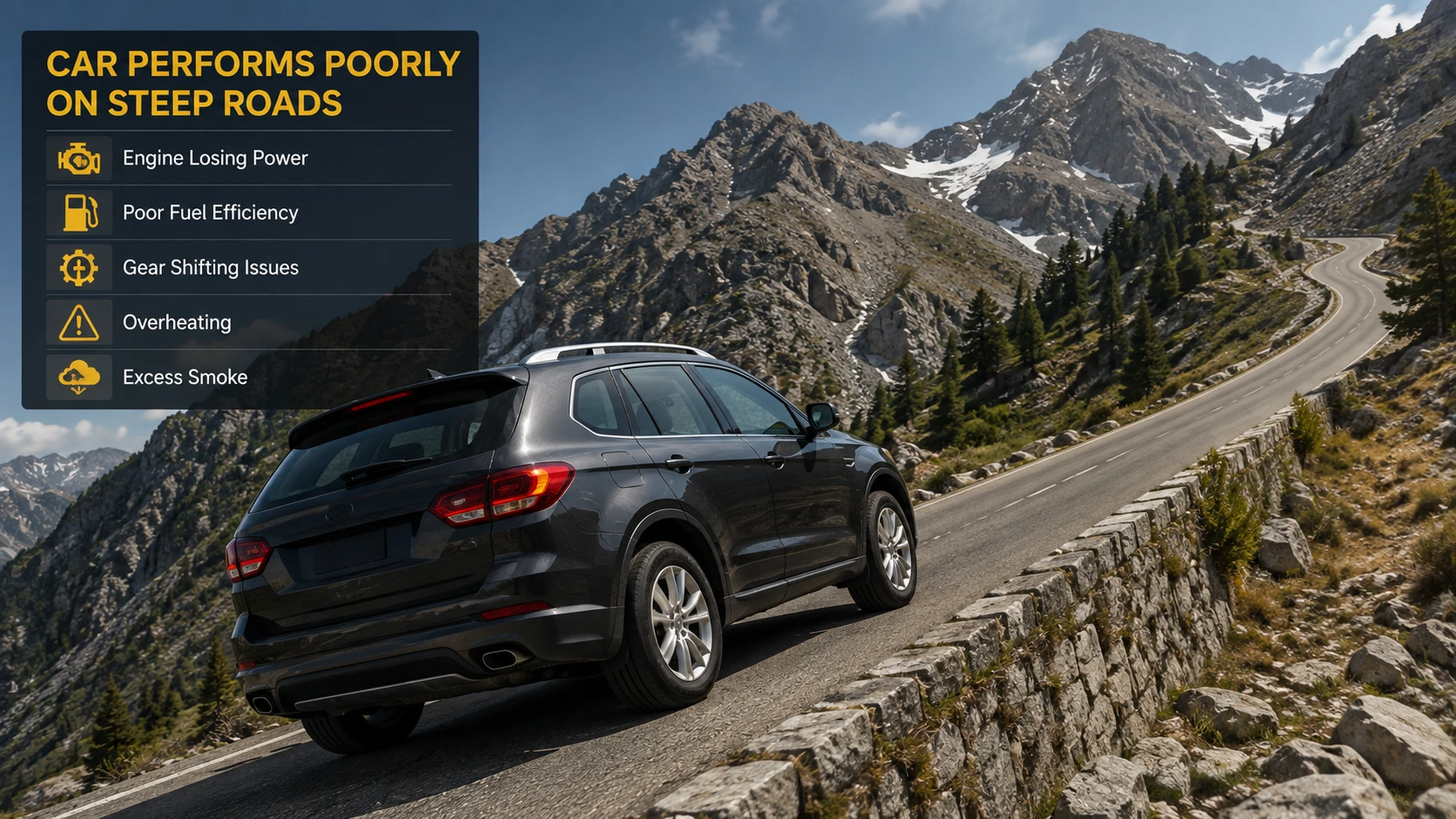
When a car performs poorly on steep roads — struggling to climb, losing speed on inclines, hesitating when asked for full power uphill — the engine and drivetrain are telling you something specific. They cannot produce the sustained power and torque the gradient demands.
Dubai isn’t a hilly city — but the roads leading to Hatta, Ras Al Khaimah mountain routes, Jebel Jais, and Jabal Hafeet expose exactly what a car’s powertrain can and cannot do under sustained load. A car that performs fine on flat Sheikh Zayed Road may struggle badly on a long gradient.
At Rapid Rev Garage in Al Quoz, car performs poorly on steep roads complaints are almost always traced to one of five specific causes — each with a clear diagnostic path and a targeted fix.
Car Performs Poorly on Steep Roads — Quick Answer
A car performs poorly on steep roads when the engine cannot produce adequate sustained power under high load conditions. The most common causes are a clogged air filter restricting airflow that the engine needs for full power, a weak fuel pump that cannot maintain rail pressure under sustained high-demand operation, a dirty or failing mass airflow sensor providing incorrect data to the ECU causing lean fuel trim at high load, a transmission that is slipping under torque load and not transferring full engine power to the wheels, or an engine with reduced compression from wear that cannot sustain peak output. In Dubai’s heat, all of these faults are amplified — the engine already works harder in 45°C ambient and has less margin to compensate for a degraded component.
Table of Contents
- Why Steep Roads Expose Faults That Flat Roads Hide
- Clogged Air Filter and the Power Loss on Climbs
- Weak Fuel Pump Under Sustained High-Load Demand
- MAF Sensor Fault and Lean Mixture at Full Throttle
- Transmission Slip Under Gradient Load
- Low Engine Compression and Reduced Climbing Power
- Turbocharger Boost Fault Under Sustained Load
- How Dubai’s Heat Makes Gradient Performance Worse
- How We Diagnose Car Performs Poorly on Steep Roads
- The Services That Fix Each Confirmed Cause
- What Does the Repair Cost in Dubai?
- Why Rapid Rev Garage?
- FAQ
- Conclusion
Why Steep Roads Expose Faults That Flat Roads Hide
On a flat road, most engines operate well below their maximum output. A car doing 100 km/h on level ground might be using 20–30% of its available power. There is a large margin between what the engine is producing and what it is capable of.
On a steep gradient, that margin disappears. The engine must produce maximum or near-maximum sustained output to maintain speed on the climb. Every fault — a restricted air intake, a weak fuel pump, a slightly misfiring cylinder — that was invisible at partial load becomes obvious at full load.
This is why a car performs poorly on steep roads complaint often surprises drivers. The car seemed fine yesterday on the highway. It is fine — at partial load. The gradient exposed what partial load was hiding. Our car mechanic team replicates high-load conditions during the diagnostic road test to confirm the fault before any work is recommended.
Clogged Air Filter and the Power Loss on Climbs
The air filter prevents dust and debris from entering the engine. In Dubai’s dusty environment — particularly near Al Quoz and construction-dense areas — the filter blocks faster than factory replacement intervals assume.
At partial throttle on flat roads, a moderately blocked filter restricts airflow slightly. The ECU compensates by adjusting fuel trim. The driver notices nothing.
At full throttle on a steep climb, the engine demands maximum airflow. A blocked filter cannot supply it. The engine is starved of the air it needs for full combustion. Power drops noticeably. The car feels sluggish and slow to respond.
A filter that should be replaced at 15,000 km in Europe needs replacement at 8,000–10,000 km in Dubai’s conditions. A filter left beyond this interval is the single cheapest cause of car performs poorly on steep roads — and the easiest fix. AED 50–200 for most filters, replaced in under 20 minutes.
Weak Fuel Pump Under Sustained High-Load Demand
At idle and light throttle, fuel demand is low. A fuel pump with 70% of its original output capacity manages this easily. At full throttle on a steep climb — maximum fuel demand sustained for several minutes — the same pump cannot keep up.
The fuel rail pressure drops. The injectors spray less fuel than the ECU commands. The mixture goes lean. The engine loses power and may misfire under load.
The driver experiences this as a car performs poorly on steep roads pattern that is progressive — the car feels normal at the start of the climb and weaker the longer the gradient continues. This progressive character under sustained load is the clearest indicator of a weak fuel pump rather than a filter or sensor fault.
A fuel pressure test measures rail pressure at idle and at simulated high load. A pump that maintains correct pressure at idle but drops under load is confirmed for replacement.
MAF Sensor Fault and Lean Mixture at Full Throttle
The mass airflow sensor tells the ECU how much air is entering the engine. The ECU uses this data to calculate injection quantity. If the MAF reports a lower air mass than is actually entering, the ECU delivers insufficient fuel — a lean mixture.
At partial load, the closed-loop oxygen sensor feedback compensates for the lean reading. At full load on a steep climb, the engine enters open-loop mode — it stops using oxygen sensor feedback and relies entirely on the MAF’s data. A contaminated MAF that was barely noticeable at partial load produces a significant lean condition at full load.
The lean mixture at full load causes the engine to lose power, hesitate, and potentially knock under the gradient demand. Live data from a diagnostic scan shows fuel trim values spiking at high load — confirming the MAF as the cause. Our car service packages include a MAF sensor inspection and live fuel trim assessment at every major service for vehicles over 60,000 km.
Transmission Slip Under Gradient Load
An automatic transmission that is slipping under torque load produces a specific car performs poorly on steep roads character. The engine revs climb as expected — but the car doesn’t accelerate proportionally. The RPM rises but the speed doesn’t follow.
This is clutch pack slip — the transmission’s internal clutch packs are not fully holding the gear under the high torque demand of a steep climb. This happens from degraded ATF that has lost its friction modifier properties, or from clutch pack wear on higher-mileage vehicles.
The gradient makes the slip obvious because the torque demand is at its highest. On flat roads, the same transmission manages because the torque load never reaches the threshold where the worn clutch pack starts to give way.
A full ATF service is the first intervention. On vehicles with significant clutch pack wear, the ATF service improves the situation but a full rebuild may be required for complete resolution. For any breakdown from a transmission fault on a mountain road, our roadside assistance team covers Al Quoz and nearby Dubai areas.
Low Engine Compression and Reduced Climbing Power
Engine compression is the measure of how well each cylinder seals during the compression stroke. Full compression produces maximum power from each combustion event. Low compression from worn piston rings, worn cylinder walls, or valve seal failure produces less power per combustion event.
On flat roads at partial load, a slightly low-compression engine produces adequate power. On a steep gradient at full load, each combustion event needs to produce maximum work. A cylinder with low compression cannot do this. The engine produces less total power than its specification — and the shortfall is most obvious under gradient demand.
A compression test across all cylinders identifies which cylinders are below specification. A leakdown test confirms whether the leakage is past the rings, past the valves, or through the head gasket. The repair path depends on the specific finding.
Turbocharger Boost Fault Under Sustained Load
On turbocharged engines — which includes most modern petrol and diesel vehicles sold in Dubai — the turbocharger provides the additional air density that enables high power output.
A turbocharger that has worn bearings, a variable vane mechanism that is sticking, or a boost hose that is leaking under pressure produces less boost pressure than specified. At light load, reduced boost is barely noticeable. Under the sustained full-throttle demand of a steep climb, the power deficit becomes significant.
The car performs poorly on steep roads pattern from a turbo fault typically appears as a power plateau — the car builds speed normally up to a certain point and then stops pulling. The boost pressure has reached the maximum the compromised turbo can produce — and it isn’t enough for the gradient.
A boost pressure test at sustained high RPM identifies the turbo fault before any disassembly is needed.
How Dubai’s Heat Makes Gradient Performance Worse
Dubai’s 45°C ambient temperature reduces engine output even before any fault is present.
Hot intake air is less dense than cool air. A naturally aspirated engine drawing 45°C air produces less power than the same engine drawing 20°C air — because the hot air contains fewer oxygen molecules per litre. The power reduction is measurable and consistent.
Turbocharged engines compensate partially through the intercooler — cooling the compressed air before it enters the engine. But a climb in peak summer heat still places the engine under more thermal stress than in any European climate.
Any existing fault — a marginal fuel pump, a slightly blocked filter, a weak compressor — produces a bigger performance deficit in 45°C heat than in 20°C. A car performs poorly on steep roads complaint that appears specifically in summer or in peak afternoon heat has a heat-amplified component to its cause.
How We Diagnose Car Performs Poorly on Steep Roads
Live data at simulated full load. We connect the diagnostic scan and watch MAF output, fuel trim corrections, throttle position, boost pressure, and injector pulse width simultaneously during a full-throttle road test. Any fault that only appears at high load is visible in this live data even on a flat road.
Fuel pressure test at idle and load. A pressure gauge measures rail pressure at idle and during a full-throttle burst. A pressure drop under load confirms a fuel pump fault.
Air filter visual inspection. The filter is removed and inspected. A filter with visible blockage is replaced before any further testing — it is the cheapest possible intervention and eliminates the simplest cause.
Compression and leakdown test. Each cylinder’s compression and leakdown percentage is measured. Results outside specification identify the cylinder and type of fault.
Boost pressure measurement. For turbocharged vehicles, boost pressure is measured at sustained high RPM and compared against specification.
The Services That Fix Each Confirmed Cause
Air filter replacement. AED 50–200. Immediate improvement in every case of filter-related power loss.
Fuel pump replacement. AED 800–2,500 depending on the vehicle platform and pump type.
MAF sensor cleaning or replacement. Cleaning: AED 100–200. Replacement: AED 300–1,500 depending on the vehicle.
ATF service for transmission slip. Full flush and refill with correct specification fluid. AED 700–1,500.
Compression and leakdown repair. Piston ring replacement, valve seal replacement, or head gasket repair depending on the confirmed fault location. AED 2,500–12,000 depending on the extent of internal engine work required.
Turbocharger service or replacement. Variable vane cleaning or wastegate actuator replacement: AED 600–1,500. Full turbocharger replacement: AED 2,000–6,000. For any paint or body repairs identified during the service visit, our car painting team handles colour-matched work at the same time.
What Does the Repair Cost in Dubai?
| Service | Cost Range |
| Air filter replacement | AED 50–200 |
| Fuel pump replacement | AED 800–2,500 |
| MAF sensor cleaning or replacement | AED 100–1,500 |
| ATF service | AED 700–1,500 |
| Engine internal repair | AED 2,500–12,000 |
| Turbocharger service or replacement | AED 600–6,000 |
All costs confirmed after the live data diagnostic and specific component testing. Our mobile car mechanic covers Al Quoz and nearby Dubai areas for on-site initial assessment. Our garage near me location in Al Quoz serves drivers from Business Bay, Jumeirah, Barsha, Satwa, Downtown, and the Sheikh Zayed Road corridor.
Why Rapid Rev Garage?
When a car performs poorly on steep roads, the fault is almost always a component that is functioning at partial capacity — adequate at low load, insufficient at the full load a gradient demands. Finding which component requires live data at high load, not a visual inspection at idle.
We read live fuel trim, boost pressure, and injector data at simulated full throttle before recommending any part. The test replicates the exact condition that produces the complaint — and identifies the specific fault that causes it.
FAQ — Car Performs Poorly on Steep Roads
Here are the questions Dubai drivers ask us most about gradient performance.
My car drives fine on flat roads — can the steep road really reveal a separate problem?
Yes. Flat road driving at partial throttle uses 20–30% of engine capability. A steep climb at full throttle uses 90–100%. Faults that are invisible at 30% load become significant at 100% load. A flat-road test cannot confirm or deny a gradient performance fault.
Does the air conditioning make gradient performance worse?
Significantly. The AC compressor adds 5–15% load to the engine depending on the vehicle. On a steep climb in Dubai summer with the AC running, this load is constant and combined with the gradient demand. A marginal engine or transmission may cope with the gradient alone but not with the gradient plus AC load simultaneously.
My automatic gearbox doesn't downshift on the climb — is that part of the problem?
A transmission that doesn't downshift into a lower gear on a gradient is failing to manage the load correctly. It should select a lower gear automatically to keep the engine in its power band. A transmission that stays in too high a gear on a climb produces exactly the same symptom as a slipping transmission — the car struggles without matching revs. Have the transmission's kick-down response and shift logic assessed.
Can a car fuel issue cause the performance loss only on climbs?
Yes — specifically a weak fuel pump, as described. The pump maintains adequate pressure at the low demand of flat driving. At the sustained high demand of a climb, pressure drops and the engine goes lean. The gradient is the trigger that makes the failing pump's limitation visible.
Is this worth fixing if I rarely drive on steep roads?
The same fault that causes poor gradient performance also causes reduced performance at full throttle on flat roads — just less noticeably. A weak fuel pump that fails on a climb is close to failing completely. A clogged filter that produces power loss on a gradient is also reducing fuel economy on every flat drive. The repair is worth doing regardless of steep road frequency.
Conclusion
A car performs poorly on steep roads because gradients demand maximum sustained output — and any component operating below specification is exposed at that load level. Clogged filters, weak fuel pumps, contaminated MAF sensors, slipping transmissions, and worn turbochargers all pass flat-road driving and fail on a climb.
Rapid Rev Garage in Al Quoz diagnoses every car performs poorly on steep roads complaint with live data at simulated full load — finding the specific fault before recommending any repair.
Rapid Rev Garage is in Al Quoz, serving Business Bay, Jumeirah, Downtown, Barsha, Satwa, and the Sheikh Zayed Road corridor. Book your appointment on WhatsApp or find us on Google Maps.
Rapid Rev Garage — Car Performs Poorly on Steep Roads | Al Quoz, Dubai