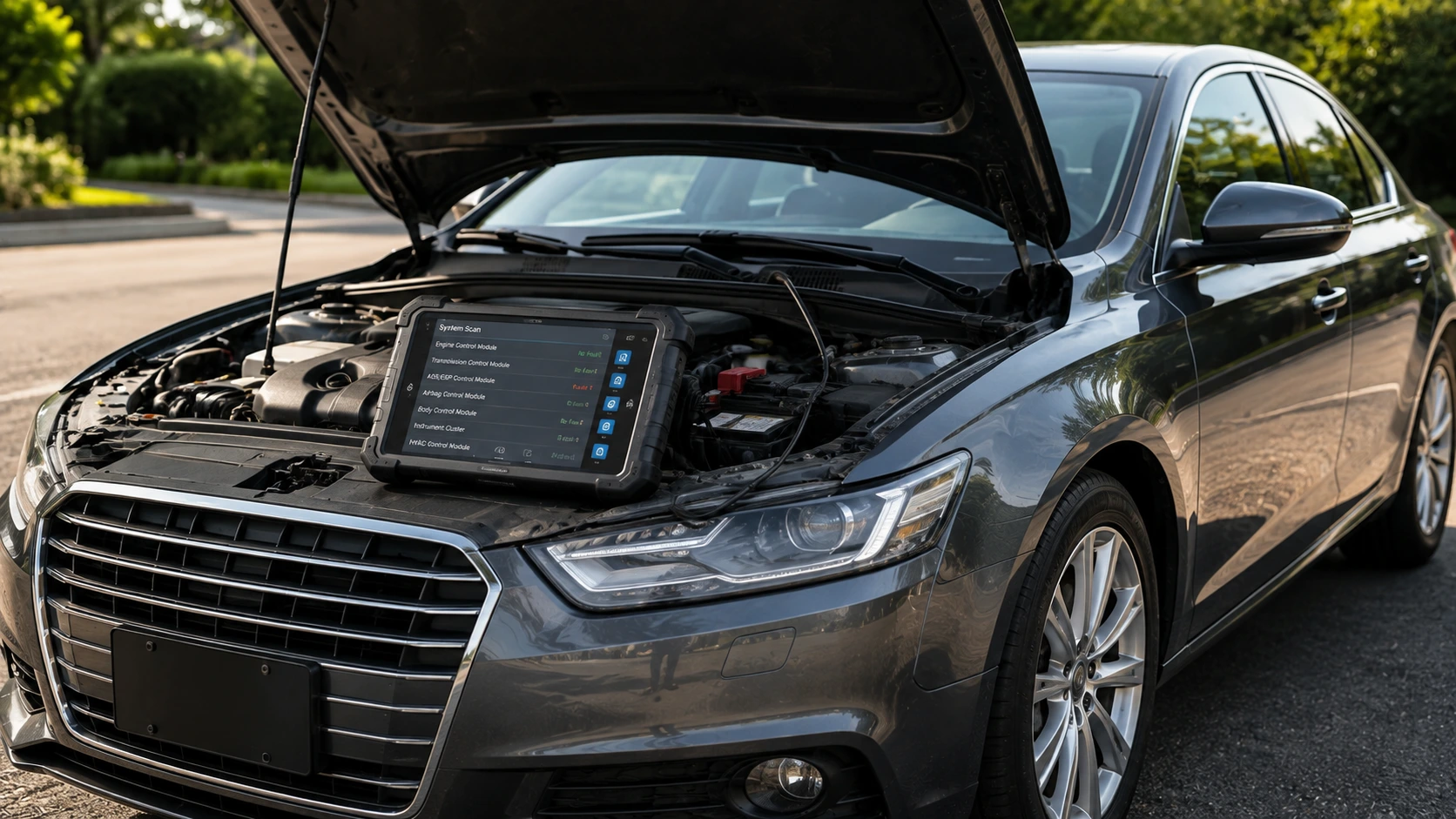
Diagnostics come before repairs for one clear reason: you can’t fix something correctly if you don’t know exactly what’s wrong.
In Dubai, many drivers skip the diagnostic step. They hear a noise, feel a vibration, or see a warning light — and they ask the workshop to just fix it. Sometimes the workshop obliges without checking. The result is parts replaced based on guesswork. And when the problem comes back, the driver pays again.
A proper diagnostic tells you the exact fault, the specific component, and the root cause. That’s why diagnostics come before repairs in every honest workshop process. It turns a guess into a confirmed repair. That’s the reason diagnostics come before repairs is not just good advice — it’s the only logical starting point.
Diagnostics Come Before Repairs — Quick Answer
Diagnostics come before repairs because modern cars have hundreds of interconnected systems. A warning light might be triggered by a sensor, a wiring fault, a mechanical issue, or a software problem — and they all look the same from the outside. Without a scan and a structured inspection, you’re replacing parts based on probability, not facts. In Dubai’s heat and stop-start conditions, faults rarely have just one cause. Diagnostics find the actual cause. Repairs then fix it once — correctly.
Table of Contents
- What Car Diagnostics Actually Involve
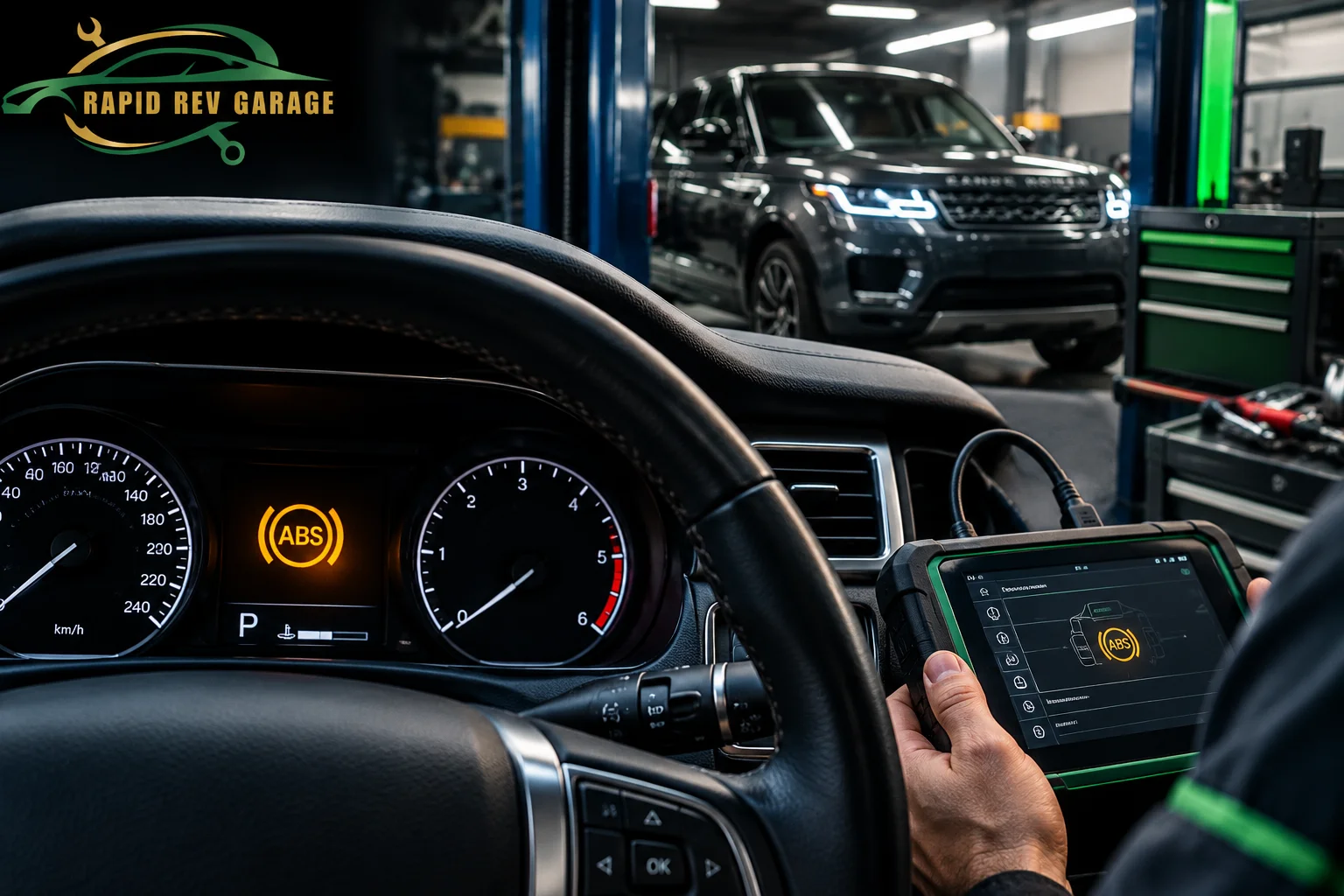
- Why a Warning Light Alone Tells You Almost Nothing
- The Real Cost of Skipping Diagnostics in Dubai
- How Modern Cars Store Fault Information You Can’t See
- Why Dubai’s Heat Creates Faults That Are Hard to Spot Without Testing
- What a Full Diagnostic Check Covers at Rapid Rev Garage
- How Diagnostics Save You Money on Parts
- When Diagnostics Are Especially Important
- What a Diagnostic Check Costs in Dubai
- Why Rapid Rev Garage?
- FAQ
- Conclusion
What Car Diagnostics Actually Involve
Most people think diagnostics means plugging in a code reader and writing down a number. That’s one small part of it.
A full diagnostic inspection covers three areas.
Electronic scanning reads every module in the car — not just the engine. Transmission, ABS, airbags, body control, HVAC, steering — each one stores data. A scan reads all of it.
Live data analysis watches how systems behave while the engine runs. A sensor that reads correctly at idle might give wrong values under load. Live data catches that.
Physical inspection checks what the scan can’t see. A cracked vacuum hose. A loose connector. A corroded terminal. These cause faults that throw codes — but the code points at a symptom, not the actual problem.
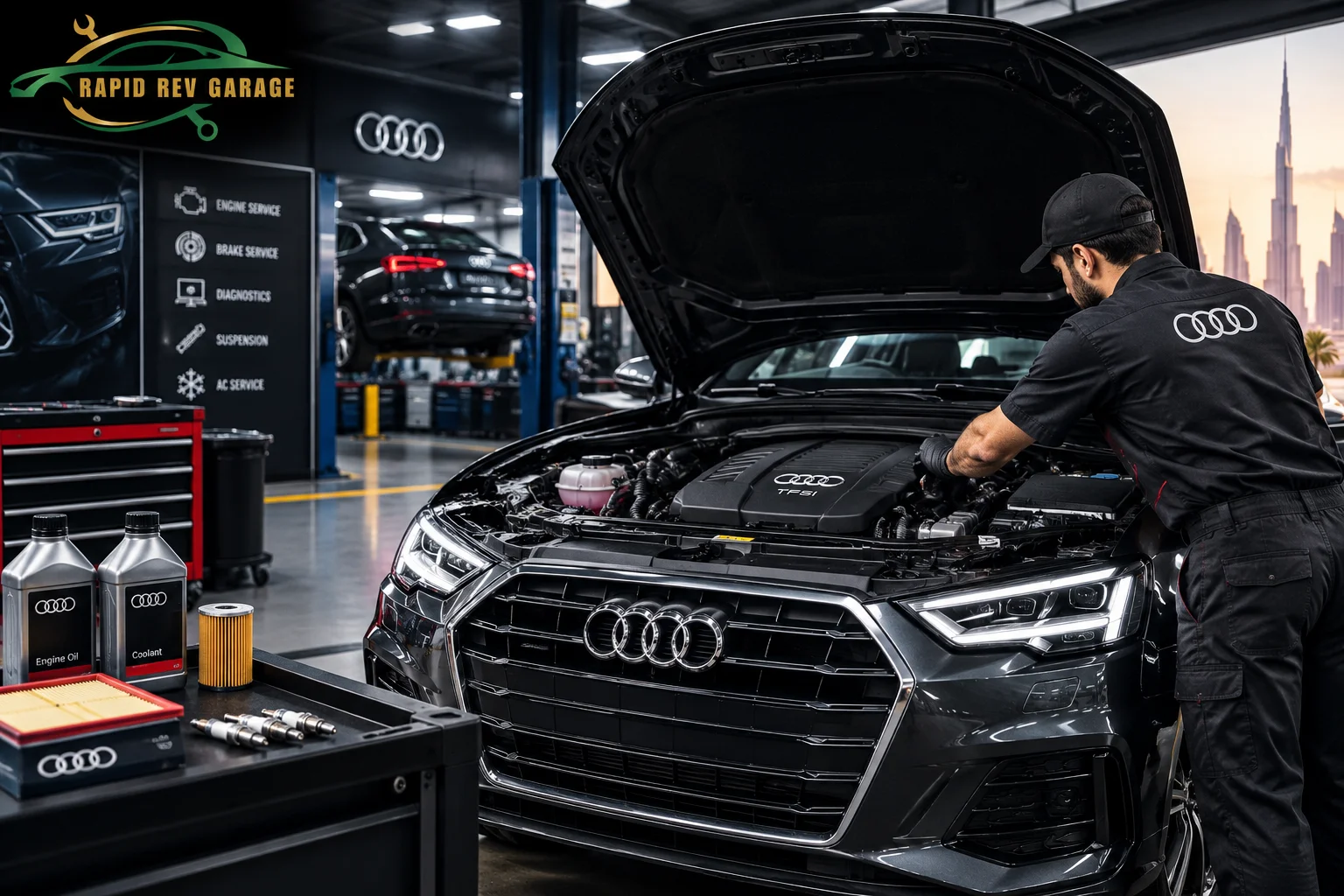
All three are needed. A code reader alone misses the physical causes. Physical inspection alone misses electronic faults. Diagnostics come before repairs because only the full picture tells you what actually needs fixing. Our car mechanic team runs all three stages on every vehicle before recommending any repair.
Why a Warning Light Alone Tells You Almost Nothing
A check engine light is one of the most misunderstood things in a car.
Drivers think it means one specific problem. It doesn’t. A check engine light can be triggered by over 1,000 different fault codes across different systems. The light is just the alert. The code tells you which system flagged a problem. But the code doesn’t tell you why.
Here’s a real example. A P0300 code means “random misfire detected.” That could be caused by worn spark plugs, a failing ignition coil, a vacuum leak, a clogged injector, low fuel pressure, or a compression fault. Six different causes. Six different repairs. Six different costs.
If a workshop replaces spark plugs based on the code alone and the actual problem is a vacuum leak — the light comes back. The plugs were wasted. The leak is still there.
This is why diagnostics come before repairs matters so much — the code is a starting point, not an answer.
The Real Cost of Skipping Diagnostics in Dubai
Skipping diagnostics feels like saving money. It usually costs more.
Here’s what typically happens. A driver notices poor performance. They ask the workshop to replace the fuel filter. The filter gets replaced — AED 300–600 spent. Performance improves slightly. A month later, the problem is back.
The actual cause was a failing fuel pump. The filter replacement masked the problem briefly. Now the pump has failed completely, costs AED 900–2,500 to replace, and the filter replacement was wasted.
A diagnostic scan before either repair would have tested fuel pressure directly. It would have confirmed the pump as the cause in 20 minutes. One repair. One cost. Done.
This pattern repeats constantly in Dubai workshops that skip the diagnostic step. Parts get replaced. Problems come back. Customers pay twice.
How Modern Cars Store Fault Information You Can’t See
Modern cars are running up to 80 electronic control units (ECUs) simultaneously. Each one monitors its system and logs faults continuously.
Some faults are active — they’re happening right now and the warning light is on. Others are pending — the system has noticed something unusual but hasn’t confirmed it yet. Others are historical — the fault happened before, possibly months ago, and the driver never knew.
All of this information is stored in the car’s memory. A diagnostic scan reads all of it. It shows the technician what’s happening now, what’s about to become a problem, and what caused an issue that has since cleared itself.
Without a scan, none of this information is accessible. The technician is working blind. For any roadside help while a fault is developing, our roadside assistance team covers Al Quoz and nearby Dubai areas.
Why Dubai’s Heat Creates Faults That Are Hard to Spot Without Testing
In Dubai, heat causes faults that behave intermittently. A component might fail when it’s hot and recover when it cools down. By the time the car reaches the workshop, the fault has disappeared.
A driver says: “The car misfires on the highway but runs fine in the workshop.” Without a diagnostic scan, the technician sees a car that runs fine. With a scan, they see historical misfire counts on specific cylinders that confirm exactly when and where the fault occurred.
Temperature sensors, pressure sensors, and oxygen sensors all drift in Dubai’s sustained heat. They give correct readings when cold and wrong readings at operating temperature. A live data scan run at operating temperature catches this. A visual inspection never would.
This is exactly why diagnostics come before repairs is more critical in Dubai than in cooler markets. Faults here are often heat-triggered and invisible at rest.
What a Full Diagnostic Check Covers at Rapid Rev Garage
Here’s what a complete diagnostic inspection includes.
Multi-module scan across all ECUs. Engine, transmission, ABS, airbags, power steering, body control, HVAC — every available module, not just the engine.
Live data road test. The car is driven under the conditions that produce the fault. Sensor outputs are watched in real time. Load-dependent faults show up here.
Fuel pressure test. Measured at idle and under load to confirm the fuel delivery is within specification.
Battery and charging system test. A load test confirms actual battery capacity. Alternator output is measured under full electrical demand.
Physical inspection of wiring, connectors, and vacuum lines. These are the causes that don’t throw codes — or throw codes that mislead the investigation.
Smoke test where applicable. A smoke machine finds vacuum and boost leaks that can’t be felt or seen any other way.
Everything found is documented before any repair is recommended. Our car service packages include a full multi-module scan at every major service — so developing faults are caught before they become breakdowns.
How Diagnostics Save You Money on Parts
Parts are expensive in Dubai. Replacing the wrong one wastes money. This is the financial argument for why diagnostics come before repairs every time.
A diagnostic check costs AED 150–400 depending on the scope. That’s a fixed cost. The repair that follows is targeted — only the confirmed faulty component is replaced.
Without diagnostics, a workshop might replace multiple parts to cover the likely causes. Each replacement is a cost. Some of those parts weren’t needed. None of it can be undone.
The diagnostic cost is always recoverable from unnecessary parts it prevents. This is why diagnostics come before repairs is not just good practice — it’s the financially sensible approach for any Dubai driver.
Consider a rough idle. Possible causes: spark plugs, ignition coil, throttle body, vacuum leak, MAF sensor, EGR valve. Replacing all of them without testing would cost AED 1,500–3,500. A diagnostic identifies which one is actually at fault. The targeted repair costs AED 300–800 in most cases.
That’s the financial case for diagnostics in numbers.
When Diagnostics Are Especially Important
Diagnostics come before repairs in every situation — but some situations make it especially critical. But there are situations where skipping them is genuinely dangerous.
After any accident. Even a minor bump can shift suspension geometry, damage sensors, or affect airbag module calibration. These faults don’t always show up immediately. A post-accident scan confirms whether any safety systems were disturbed.
When multiple warning lights appear at once. Multiple simultaneous lights are almost always caused by a single underlying fault — often a charging system problem or a CAN bus fault. Treating each light as a separate problem leads to expensive misdirected repairs.
Before buying a used car. A pre-purchase scan reads the historical fault log — including faults that were cleared before the sale. It shows whether the car has had recurring issues the seller didn’t mention.
When performance has gradually declined. Gradual faults don’t trigger warning lights until they’re advanced. A scan catches them early, when the repair is smaller and cheaper. For exterior repairs identified during a post-accident inspection, our car painting team handles colour-matched work at the same visit.
What a Diagnostic Check Costs in Dubai
A basic engine module scan at a quick-service chain: AED 0–100. This reads engine codes only.
A full multi-module scan covering all ECUs: AED 150–300 at most independent workshops.
A full diagnostic inspection including live data, physical inspection, and road test: AED 250–500 depending on vehicle complexity and the fault being investigated.
At Rapid Rev Garage, the diagnostic cost is deducted from the repair cost when the repair is carried out at our workshop. This means you get a full diagnosis at no extra cost when you proceed with the confirmed repair.
A diagnostic check should never feel like an optional extra. It’s the first step in any honest repair process. Our mobile car mechanic team covers Al Quoz and nearby Dubai areas for on-site diagnostic scans before bringing the car in for repair.
Why Rapid Rev Garage?
Diagnostics come before repairs at Rapid Rev Garage because we don’t replace parts based on guesswork. We scan every module, read live data under the conditions that produce the fault, inspect the physical system, and document every finding before recommending anything.
Every repair we recommend is backed by a confirmed fault code, a live data reading, or a physical finding — often all three.
We show you what the scan found. We explain what it means. We tell you what the repair involves and what it costs. Then you decide.
That’s what diagnostics-first actually means in practice. Our garage near me location in Al Quoz serves drivers from Business Bay, Jumeirah, Barsha, Satwa, Downtown, and the Sheikh Zayed Road corridor.
FAQ — Diagnostics Come Before Repairs
Here are the questions Dubai drivers ask us most about diagnostic checks.
My car seems fine — do I still need a diagnostic scan?
A car can have pending or historical faults stored in its ECUs without any warning light or driving symptom. An annual scan catches these before they develop into a breakdown. Many components degrade gradually and only set codes when they've already caused damage.
Can a diagnostic scan tell me everything that's wrong?
It tells you what the car's systems have detected and logged. It doesn't catch mechanical wear that hasn't yet affected sensor readings — things like a slowly-wearing brake pad or early tyre degradation. That's why the physical inspection component matters alongside the scan.
Why do some workshops offer free diagnostics?
A free scan that only reads engine codes and takes two minutes is a sales tool, not a diagnostic service. A genuine diagnostic inspection takes 30–90 minutes and covers all vehicle modules with live data assessment. These are not the same service.
My warning light came on and then went off — do I still need a scan?
Yes. An intermittent fault that clears itself still leaves a historical record in the ECU. The scan shows what triggered the light, how many times it occurred, and whether the fault is still active or pending. Ignoring a self-clearing light is how intermittent faults become confirmed breakdowns.
How long does a full diagnostic take?
A multi-module scan takes 20–30 minutes. A full inspection with live data road test takes 60–90 minutes. For complex faults with intermittent behaviour, longer testing under specific conditions may be needed.
Conclusion
Diagnostics come before repairs because replacing parts without knowing the exact cause wastes money and often doesn’t fix the problem. Modern cars store fault data across dozens of modules. Dubai’s heat creates faults that only show up under load or at temperature. A proper diagnostic reads all of it — scan, live data, physical inspection — before a single part is ordered.
Rapid Rev Garage in Al Quoz runs a full diagnostic before every repair. Not a quick code read — a complete inspection across all systems. That’s what makes the difference between a repair that fixes it once and a repair that brings the car back.
Rapid Rev Garage is in Al Quoz, serving Business Bay, Jumeirah, Downtown, Barsha, Satwa, and the Sheikh Zayed Road corridor. Book your appointment on WhatsApp or find us on Google Maps.
Rapid Rev Garage — Diagnostics Come Before Repairs | Al Quoz, Dubai