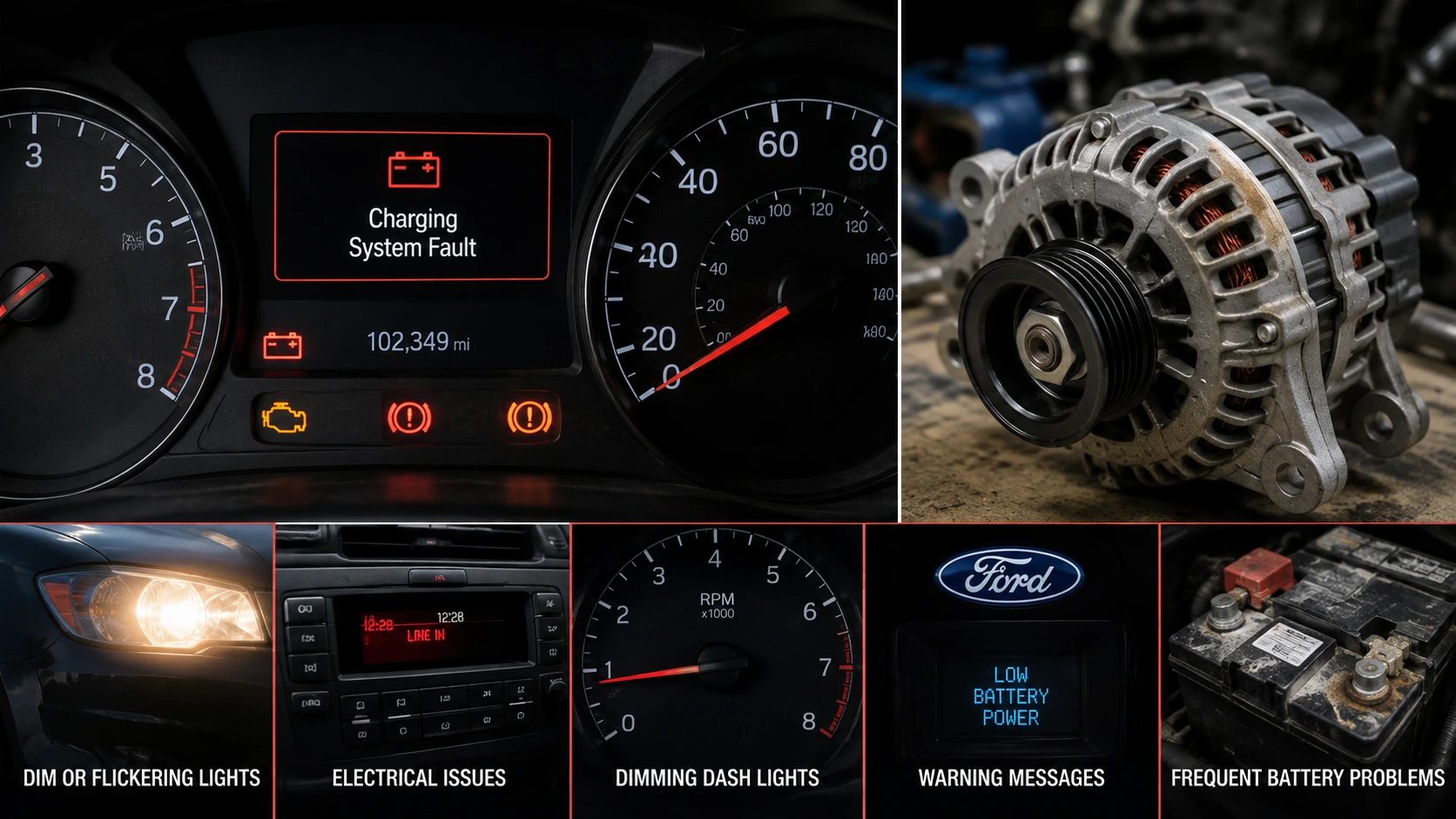
Ford alternator warning signs — Ford alternator warning signs appear across the full Ford range — from the Ranger pickups popular across Dubai’s commercial and outdoor communities to the Explorer and Edge SUVs, the Expedition, and the F-150 — and they follow predictable patterns that make them recognisable before a complete charging failure strands the vehicle. Understanding the alternator helps explain why Ford alternator warning signs follow predictable patterns that keeps the battery charged and powers every electrical system while the engine runs. When it begins to fail, it does not typically fail instantly — it communicates its decline through a specific set of warning signs that each point to a specific stage of failure.
At Rapid Rev Garage in Al Quoz, Ford charging system faults are diagnosed with load testing, voltage monitoring, and module scanning across every current Ford platform.
Ford Alternator Warning Signs — Quick Verdict
The most important Ford alternator warning signs to act on immediately are a battery warning light on the dashboard while the engine is running, dimming headlights and interior lights that are brightest at high RPM and dim at idle, accessories that slow down or underperform — slow power windows, a sluggish AC blower — a battery that repeatedly requires jump-starting despite being in good condition, an unusual whining or grinding noise from the front of the engine that changes with RPM, and a check engine light appearing alongside these electrical symptoms. Dubai’s heat accelerates alternator diode, bearing, and brush wear faster than Ford’s service intervals account for. A Ford alternator showing multiple warning signs simultaneously has very little time before complete failure.
Table of Contents
- How the Ford Alternator Works and Why It Fails
- The Warning Signs That Appear Early — Before the Battery Light
- The Battery Warning Light — What It Actually Means on a Ford
- Electrical System Symptoms That Confirm Charging Failure
- The Sounds a Failing Ford Alternator Makes
- Why Dubai’s Heat Specifically Attacks Ford Alternators
- How We Test Ford Alternator Health at Rapid Rev Garage
- Repair vs Replacement — The Right Decision for Each Ford Platform
- What Happens If Ford Alternator Warning Signs Are Ignored
- Can You Drive With a Failing Alternator?
- How Long the Repair Takes
- What the Repair Costs in Dubai
- Protecting the Ford Charging System in Dubai’s Conditions
- Why Rapid Rev Garage?
- FAQ
- Conclusion
How the Ford Alternator Works and Why It Fails
The alternator converts mechanical energy from the engine’s belt drive into electrical energy that charges the battery and powers the vehicle’s electrical systems. It does this through electromagnetic induction — a rotor spinning inside a stator winding generates alternating current, which internal diodes convert to the direct current the battery and electrical systems require.
The Components That Fail in Dubai
The alternator contains four main components that are each vulnerable to specific failure modes in Dubai’s conditions. The rotor and stator windings can develop internal shorts or open circuits from heat-induced insulation degradation. The rectifier diodes — which convert AC to DC — fail from heat and voltage spikes. The brushes and slip rings that maintain electrical contact with the rotating assembly wear from continuous use and accelerate in heat. The bearing that supports the rotor shaft develops wear from heat-degraded grease and the high-load operation of Dubai stop-start driving.
Why Ford’s Smart Charging System Changes Diagnosis
Many current Ford models — including the F-150 from 2011 onwards, the Ranger T6 and T7, and the Explorer — use a smart charging system controlled by the PCM (Powertrain Control Module) rather than a simple voltage regulator. This system varies the alternator’s output voltage based on electrical load, battery state of charge, fuel economy requirements, and driving conditions. A smart charging system can mask early alternator failure because the PCM compensates for reduced output — until the alternator can no longer produce adequate output even at maximum duty cycle.
The Warning Signs That Appear Early — Before the Battery Light
One of the most important Ford alternator warning signs is the battery warning light on the dashboard appears when the charging voltage drops significantly below the normal range. By the time the light illuminates, the alternator has already been declining for some time. These earlier signs appear before the dashboard warning.
Headlights Brightest at High RPM, Dimmer at Idle
A correctly functioning Ford alternator maintains consistent voltage across the entire RPM range — headlights and interior lights should remain equally bright whether the engine is idling or revving. When the alternator’s output is declining, its ability to maintain voltage at low RPM is the first capability to deteriorate. The result is headlights and instrument lighting that are noticeably brighter when RPM is increased and dimmer at idle — particularly noticeable in Dubai’s evening driving conditions.
Slow or Heavy Power Accessories
Power windows that operate more slowly than usual, an electric steering that feels slightly heavier than normal, or a blower motor that audibly slows when another high-load accessory is activated are all early Ford alternator warning signs. These symptoms appear because the alternator can no longer supply sufficient current for all systems simultaneously — the systems that consume the most current begin to operate below their rated performance.
Battery That Discharges Overnight Repeatedly
A healthy alternator that is failing may charge the battery adequately during driving but at a slightly lower voltage than necessary for a complete charge cycle. The battery returns from each drive with 85–90% charge rather than 100% — and over several days, this cumulative deficit produces a battery that dies overnight despite having driven the vehicle regularly.
The Battery Warning Light — What It Actually Means on a Ford
The battery warning light on a Ford — the red battery outline symbol — illuminates when the charging system voltage drops below approximately 12.5V while the engine is running. A correctly functioning alternator produces 13.5–14.5V at the battery while the engine runs.
Why the Light Can Flicker Before Staying On
On Ford’s smart charging system, the PCM modulates alternator output dynamically. A failing alternator may produce adequate voltage intermittently — causing the battery warning light to flicker or come on briefly at low RPM before switching off at higher RPM. This flickering pattern is an early Ford alternator warning sign that should not be dismissed as an electrical glitch. It confirms the alternator’s output is dropping below the threshold at low engine speeds before it has deteriorated to the point of constant undercharging.
What Happens to the PCM When Charging Voltage Drops
When charging voltage is consistently below normal on a Ford with a smart charging system, the PCM reduces electrical loads by shutting down non-essential systems — heated seats, the heated windscreen, the rear blower on dual-zone AC. These load shedding events may appear as accessories that seem to switch off by themselves. Load shedding by the PCM is a protective response to a failing alternator. Our car mechanic team reads PCM charging system data through Ford-compatible IDS or equivalent diagnostic tools before any alternator recommendation is made.
Electrical System Symptoms That Confirm Charging Failure
As alternator output continues to decline, the electrical symptoms become more pronounced and more numerous.
Multiple Warning Lights Appearing Simultaneously
When charging voltage drops below the operating minimum for the vehicle’s modules, multiple systems begin reporting faults simultaneously — ABS warning, traction control warning, electric power steering warning, and check engine light can all appear at the same time from a single charging failure event. Multiple simultaneous warning lights on a Ford are a strong indicator of a charging system failure rather than multiple independent faults.
Infotainment System Resets or Freeze
Ford’s SYNC infotainment system is sensitive to voltage variations. A failing alternator that produces voltage spikes or drops causes the SYNC system to reset, freeze, or display unusual behaviour. On the F-150 and Explorer with SYNC 3 or SYNC 4, spontaneous system resets that correlate with low RPM driving are a notable early Ford alternator warning sign.
Electric Power Steering Warning on Ford Ranger
The Ford Ranger T6 and T7’s electric power steering system requires consistent voltage to maintain its assist level. A failing alternator on the Ranger can produce a power steering warning — or noticeably heavy steering — before the battery warning light appears. For any Ford breakdown from a charging failure, our roadside assistance covers Al Quoz and nearby Dubai areas.
The Sounds a Failing Ford Alternator Makes
The alternator produces specific sounds as its internal components wear — sounds that identify which part is failing before the electrical symptoms become obvious.
Whining That Changes With RPM — Diode or Winding Fault
A whining or humming sound from the front of the engine that increases and decreases directly with engine RPM — not with belt speed or accessory load changes — indicates an alternator diode or stator winding fault. The sound is the electrical interference from a partially failed diode set passing back through the alternator’s output and causing vibration in the windings. This sound is particularly noticeable through the audio system as an interference whine that changes pitch with RPM.
Grinding or Rumbling at the Belt Area — Bearing Failure
A grinding, rumbling, or rough sound from the belt area that is consistent at a given RPM but doesn’t change with steering or AC load specifically points toward the alternator bearing. The bearing supports the rotor shaft — when its grease degrades from heat and the bearing races develop wear, the rotor begins to run eccentrically and produces the characteristic grinding.
Squealing or Chirping — Belt Tension or Pulley Fault
Squealing from the alternator belt area can indicate the belt is slipping on the alternator pulley from insufficient tension, or the alternator’s overrunning alternator pulley (OAP) — fitted to many Ford platforms to reduce NVH — has failed and is producing belt slip noise. A slipping belt reduces alternator output effectively even if the alternator itself is healthy.
Why Dubai’s Heat Specifically Attacks Ford Alternators
Dubai’s operating environment accelerates every alternator failure mechanism above what Ford’s factory service intervals account for.
Diode Failure From Heat and Voltage Spikes
Alternator rectifier diodes fail from excessive heat and voltage transients. In Dubai’s sustained underbonnet temperatures — which on a parked F-150 or Ranger in direct summer sun can exceed 80°C in the engine bay — diode junction temperatures are elevated beyond their optimal operating range during every drive. This thermal stress shortens diode life measurably below the alternator’s rated service life.
Bearing Grease Degradation in Sustained Heat
Alternator bearing grease is specified for a temperature range that Dubai’s conditions push to or beyond its upper limit during summer peak. Grease that thins and migrates from the bearing contact surfaces leaves insufficient lubrication — accelerating bearing wear on every revolution of the rotor. A bearing that would last 150,000 km in a European climate may show wear-related noise at 80,000–100,000 km of Dubai driving.
Short-Trip Stop-Start Driving Maximises Alternator Load
Dubai’s commuting pattern — multiple short trips with high electrical load from the AC running at full capacity — keeps the alternator at maximum duty cycle for the entire drive without the thermal recovery period that a long highway run provides. Alternator heat build-up per kilometre driven is higher in Dubai urban commuting than in any other driving pattern. Our car service packages include charging system voltage and load testing at every major Ford service visit.
How We Test Ford Alternator Health at Rapid Rev Garage
Ford charging system diagnosis requires Ford-compatible tools and a structured three-part test sequence.
No-Load and Full-Load Voltage Testing
The alternator output voltage is measured at the battery under no electrical load and under full electrical load — AC at maximum, headlights on, heated elements active. A correctly functioning alternator maintains 13.5–14.5V under full load. An output that drops below 13V under full load confirms insufficient alternator capacity.
Ripple Voltage Test — Diode Health
A digital multimeter on AC voltage mode at the battery terminals measures ripple voltage — the AC component that should be filtered out by the diodes. Ripple above 0.5V AC confirms diode failure — one or more diodes are no longer fully rectifying the alternator’s AC output.
Ford IDS Charging System Data
Ford-compatible diagnostic software reads the PCM’s charging system data — target voltage, actual voltage, duty cycle, and any stored charging system fault codes. This data confirms whether the smart charging system is compensating for declining alternator output and at what load condition the output is insufficient.
Belt and Pulley Visual and Tension Check
The serpentine belt condition, tension, and the alternator pulley’s rotation smoothness are assessed — confirming or ruling out belt slip and OAP failure as contributing causes before the alternator itself is condemned.
Repair vs Replacement — The Right Decision for Each Ford Platform
The repair scope depends on the test findings and the specific Ford platform — not a single default recommendation.
Remanufactured vs New Alternator
For most Ford platforms in Dubai, a quality remanufactured alternator from an established supplier is the most cost-effective correct repair — the core components are replaced or restored to specification, and the unit carries a warranty. New OEM alternators from Ford dealers are available at higher cost. Cheap unknown-brand replacements carry the risk of short service life in Dubai’s demanding conditions.
When the Belt and OAP Must Be Replaced Alongside the Alternator
Any alternator replacement should include assessment of the serpentine belt for wear, and the OAP for correct rotation — because a new alternator installed with a worn belt or a failed OAP will produce the same belt noise as before and risks premature failure of the new unit from belt slip heat.
Wiring Harness Inspection
Where an alternator has failed from a voltage spike — evidenced by diode failure — the wiring harness at the alternator output and the battery cable condition should be inspected. Burned or corroded connections at the alternator output terminal cause voltage drop that both reduces charging effectiveness and generates heat at the connection that accelerates alternator component failure. For exterior repairs needed alongside electrical work, our car painting team handles colour-matched work at the same visit.
What Happens If Ford Alternator Warning Signs Are Ignored
Acting on early warning signs prevents the stranding event that complete alternator failure produces.
Complete Charging Failure Strands the Vehicle
An alternator showing Ford alternator warning signs for weeks eventually fails completely. At that point, the battery begins discharging from the moment the engine starts — providing 20–60 minutes of driving before electrical systems begin shutting down and the engine eventually stops. On a Dubai highway or in peak-hour traffic, this is both dangerous and inconvenient.
Battery Damage From Sustained Undercharging
A battery that is never fully charged — because the alternator has been producing below-specification output for weeks — develops sulphation of its plates. Sulphated battery plates cannot accept a full charge even after the alternator is replaced. A battery that was in good condition before the alternator started failing may need replacement alongside the alternator by the time the fault is finally addressed.
Can You Drive With a Failing Alternator?
The answer depends on how far the failure has progressed.
Early Warning Signs — Drive to Workshop This Week
Dimming lights at idle, slow accessories, and a flickering battery light indicate early-stage failure. The vehicle is driveable in the short term — the battery provides backup power — but should be diagnosed within the week. Avoid leaving the vehicle parked for extended periods where the battery has no opportunity to be charged.
Battery Warning Light Permanently On — Drive to Workshop Today
A permanently illuminated battery warning light means the alternator is no longer maintaining adequate charging voltage. The battery is discharging during every drive. Drive directly to the workshop — do not use the vehicle for non-essential journeys.
Multiple Warning Lights and Electrical Failures — Recovery
If multiple warning lights have appeared and electrical systems are failing, the battery is close to discharge. Do not continue driving — arrange recovery.
How Long the Repair Takes
Repair time depends on the Ford model and whether additional components require replacement alongside the alternator.
Alternator Replacement
Two to four hours depending on the Ford model and engine variant — the F-150’s V8 and Ranger’s 2.0 EcoBoost have different alternator access paths. Includes belt inspection, output voltage confirmation after replacement, and road test.
Belt and OAP Replacement Alongside Alternator
Add 30–60 minutes for belt replacement and OAP inspection alongside the alternator replacement.
What the Repair Costs in Dubai
Cost depends on the Ford platform and whether belt, OAP, or battery work is required alongside the alternator.
Alternator Replacement
Quality remanufactured alternator including labour: AED 1,200–3,500 depending on the Ford model, engine variant, and alternator specification. The F-150 5.0 V8 alternator costs more than the Ranger 2.0 EcoBoost unit due to part cost and labour access difference.
Belt and Related Work
Serpentine belt replacement alongside alternator: AED 300–600 additional. OAP replacement: AED 200–500 additional.
Wiring and Battery Assessment
Battery load test: included as standard with every alternator replacement. Wiring harness inspection: included. Battery replacement if confirmed damaged from undercharging: AED 400–1,200 depending on battery specification. A written quote is provided after the full charging system test confirms the specific fault. Our mobile car mechanic covers Al Quoz and nearby Dubai areas for on-site charging system voltage testing.
Protecting the Ford Charging System in Dubai’s Conditions
Specific habits protect the Ford charging system from the accelerated wear Dubai’s conditions produce.
Annual Battery and Alternator Load Test
A load test at every annual service catches both a weakening alternator and a battery approaching end of life before either produces a stranding event. In Dubai’s heat, batteries and alternators both decline faster than factory replacement intervals assume — annual testing is the appropriate frequency.
Keep Electrical Loads Managed at Idle
Running the AC at maximum, rear demister, heated seats, and audio simultaneously while idling in Dubai’s stop-start traffic puts maximum load on the alternator at its lowest output speed. Where possible, reducing non-essential electrical loads during stationary idling extends alternator life. Our garage near me location in Al Quoz serves drivers from Business Bay, Jumeirah, Barsha, Satwa, Downtown, and the Sheikh Zayed Road corridor.
Why Rapid Rev Garage?
Ford alternator warning signs require Ford-compatible diagnostic tools to read PCM charging system data accurately — because a generic OBD scanner that reads only engine fault codes misses the charging system duty cycle data, target voltage, and load shedding events that distinguish early-stage alternator decline from a battery fault or a wiring issue. We use Ford IDS-compatible diagnostic platforms for every Ford charging system assessment, alongside physical ripple voltage testing and load testing, before any alternator replacement is recommended.
FAQ — Ford Alternator Warning Signs
These are the questions most frequently asked by Ford owners about charging system faults in Dubai.
How long can a Ford run after the alternator fails?
On battery power alone — typically 20–60 minutes depending on battery state of charge, electrical load, and battery age. In Dubai's heat, the AC load reduces this significantly. Do not use the vehicle for non-essential journeys after the battery warning light appears.
Can a Ford SYNC reset be caused by an alternator fault?
Yes — voltage drops from a failing alternator cause the SYNC system's processor to reset, freeze, or behave erratically. Spontaneous SYNC resets that correlate with idle operation are a genuine early Ford alternator warning sign.
Do Ford Rangers have specific alternator problems?
The Ranger T6 (2011–2022) and T7 (2022–present) with the 2.0 EcoBoost have alternators that are sensitive to the sustained high electrical load of Dubai's AC demand. The combination of maximum AC use, heated seats, and aftermarket accessories (common on working Rangers in Dubai) can push these alternators to their output limits.
My Ford battery keeps dying but tests fine — could it be the alternator?
Yes — a battery that tests at adequate capacity but repeatedly discharges is being undercharged by the alternator rather than having a capacity fault itself. A charging system voltage test at idle and under load identifies whether the alternator is maintaining adequate voltage.
Is it worth repairing a Ford alternator rather than replacing it?
On most Ford platforms, individual component repair (replacing brushes, diodes, or bearings) is available but rarely cost-effective compared to a quality remanufactured unit that has been restored comprehensively. Individual component repair is appropriate for specialist alternators where full replacements are unavailable.
Conclusion
Ford alternator warning signs — dimming lights, slow accessories, a flickering or permanent battery warning light, SYNC resets, RPM-dependent whining, and multiple simultaneous dashboard warnings — follow a predictable progression from early decline to complete failure. Acting on the early signs prevents the stranding event that complete alternator failure produces.
In Dubai’s heat, the decline from first sign to complete failure happens faster than in any cooler market. Rapid Rev Garage in Al Quoz diagnoses every Ford charging system fault with Ford-compatible tools, a ripple voltage test, and a load test before any alternator replacement is recommended.
Rapid Rev Garage is in Al Quoz, serving Ford owners across nearby Dubai areas — Business Bay, Jumeirah, Downtown, Barsha, Satwa, and the Sheikh Zayed Road corridor. Book your appointment on WhatsApp or find us on Google Maps.
Rapid Rev Garage — Ford Alternator Warning Signs | Al Quoz, Dubai