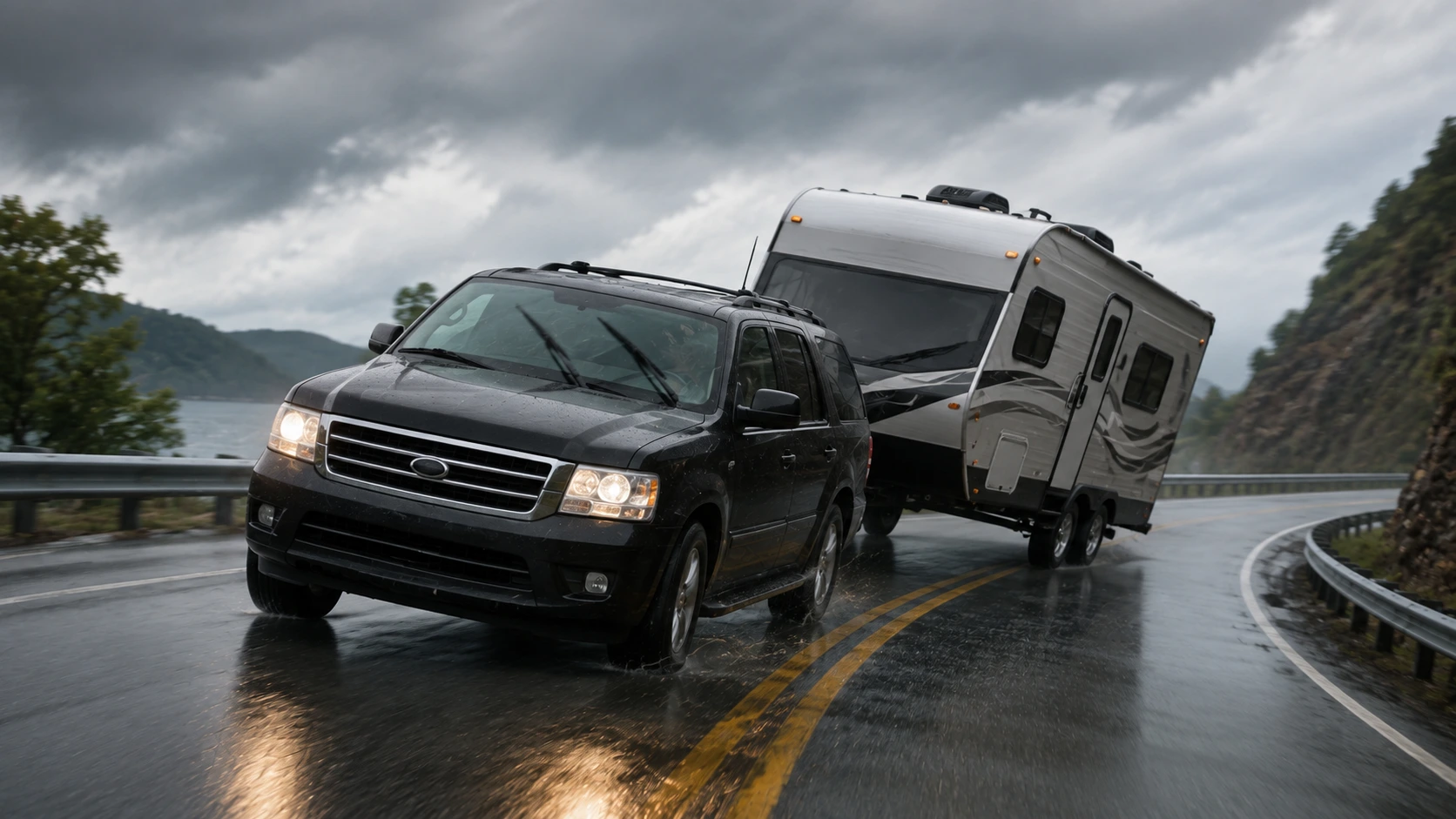
When a vehicle loses stability while towing — swaying, fishtailing, or being pushed around by the trailer — is one of the most dangerous driving situations on Dubai’s roads. At 100 km/h on the E611 or Emirates Road, a trailer that starts swaying can take the tow vehicle with it.
Understanding why a vehicle loses stability while towing is not just useful — it is safety-critical for anyone towing a boat, a caravan, a horse trailer, or a car hauler in the UAE.
At Rapid Rev Garage in Al Quoz, we prepare tow vehicles for safe operation and diagnose stability faults on vehicles that have experienced a towing incident. Every vehicle loses stability while towing cause has a specific fix — and most are preventable with the right preparation.
Vehicle Loses Stability While Towing — Quick Answer
A vehicle loses stability while towing when the trailer’s forces overcome the tow vehicle’s ability to maintain directional control. The most common causes are an overloaded or incorrectly loaded trailer with too much tongue weight at the rear, a trailer that is too heavy relative to the vehicle’s rated towing capacity, incorrect tow ball height producing an unlevel trailer, worn rear shock absorbers that cannot control the additional weight on the rear axle, insufficient tyre pressure for a loaded tow vehicle, or a speed that exceeds what the trailer and tow vehicle combination can safely manage. In Dubai, the long straight highways encourage higher towing speeds than are safe — and the consequences of instability at 110 km/h are severe.
Table of Contents
- What Actually Causes Trailer Sway and Instability
- Overloaded Trailer and Exceeding Tow Capacity
- Incorrect Tongue Weight Distribution
- Wrong Tow Ball Height and Unlevel Trailer
- Worn Rear Shock Absorbers Under Tow Load
- Tyre Pressure and Tyre Condition When Towing
- Speed as a Direct Cause of Towing Instability
- Trailer Brake Faults and Their Effect on Stability
- How to Recover From Trailer Sway While Driving
- How We Prepare a Vehicle for Safe Towing
- What Does Tow Vehicle Preparation Cost in Dubai?
- Why Rapid Rev Garage?
- FAQ
- Conclusion
What Actually Causes Trailer Sway and Instability
Trailer sway starts as a small oscillation — the trailer moves slightly left or right. If the cause is not addressed, the oscillation grows with each cycle — each sway causes a correction that produces a counter-sway. Without intervention, the amplitude increases until the combination is out of control.
The physics behind sway is straightforward. Understanding the pivot point is key to understanding why a vehicle loses stability while towing. The trailer’s weight behind this pivot acts like a pendulum — any lateral force that sets it moving tends to continue and amplify unless damping forces are sufficient to absorb it.
The damping forces are the tow vehicle’s suspension, tyres, and brakes. When these are inadequate — from worn shocks, incorrect tyre pressure, or brakes that cannot respond fast enough — the oscillation grows rather than damps out.
Understanding this mechanism explains why a vehicle loses stability while towing from multiple different root causes. Any factor that reduces the damping forces or increases the lateral forces acting on the trailer makes sway more likely and harder to control. Our car mechanic team assesses tow vehicle suspension, tyres, and braking before any towing preparation is signed off.
Overloaded Trailer and Exceeding Tow Capacity
Every vehicle has a maximum rated tow capacity — the maximum weight of trailer it can safely tow. This rating is based on the vehicle’s engine power, transmission cooling capacity, braking ability, and suspension load rating.
Towing a trailer heavier than this rating produces instability because the trailer’s momentum at speed significantly exceeds what the tow vehicle’s brakes can manage in an emergency stop — and its suspension cannot control the oscillation forces from a trailer that heavy.
In Dubai, boat towing is extremely common — and boat-related vehicle loses stability while towing incidents are among the most frequent we see — and larger boats can weigh significantly more than many SUV owners realise. A 6-metre boat with engine, trailer, and gear can weigh 2,500–3,500 kg. A vehicle rated to tow 2,000 kg is being asked to tow 150–175% of its capacity. The consequences become apparent on the first highway drive.
Check the vehicle’s towing capacity — found in the owner’s manual or the door jamb sticker — before hitching any trailer. This is the single most fundamental check in preventing vehicle loses stability while towing on UAE highways.
Incorrect Tongue Weight Distribution
Tongue weight is the downward force the trailer exerts on the tow ball. Correct tongue weight should be 10–15% of the total trailer weight for stable towing.
Too little tongue weight — less than 10% — means the trailer’s weight is concentrated toward its rear. This rear-heavy distribution makes the trailer pivot around the tow ball easily. Small lateral forces start the sway process and the rear-heavy trailer amplifies it.
Too much tongue weight — more than 15% — transfers excessive load onto the rear axle of the tow vehicle. This overloads the rear tyres and shocks, lightens the front axle, and reduces front wheel steering control and braking.
The correct tongue weight is achieved by correct loading of the trailer — heavier items loaded forward of the axle, lighter items behind. A tongue weight scale — available from towing equipment suppliers — confirms the tongue weight before any highway drive.
Wrong Tow Ball Height and Unlevel Trailer
The tow ball height should be set so the trailer travels level when hitched — the trailer floor is horizontal, not angled up or down.
This wrong height is a direct cause of vehicle loses stability while towing — a trailer angled nose-up from a low tow ball — transfers more tongue weight to the tow vehicle’s rear than the same trailer level. The trailer’s rear rides high, reducing tyre grip at the trailer’s rear axle. Both factors increase sway tendency.
A trailer angled nose-down — tow ball too high — transfers less tongue weight to the tow vehicle and more to the trailer’s rear axle. This produces the rear-heavy distribution that creates sway.
The tow ball height is adjusted by the receiver hitch insert. A drop or rise hitch insert brings the ball to the correct height for the specific trailer and vehicle combination. This is a one-time setup step that is frequently skipped — and frequently responsible for a vehicle loses stability while towing on the first trip. For any bodywork or paint repairs on a vehicle that has been in a towing incident, our car painting team handles colour-matched repairs at the same visit.
Worn Rear Shock Absorbers Under Tow Load
The rear shock absorbers control how quickly the rear of the vehicle moves up and down in response to road forces. When towing, the tongue weight adds a constant downward force on the rear axle. The shocks are now working under increased static load while also managing the dynamic forces from road surface and trailer oscillation.
Worn rear shocks that are marginally adequate for normal driving are insufficient for towing. Under normal driving, their reduced damping allows the rear to bounce more than it should — but this is rarely critical. Under towing load, the same reduced damping allows trailer sway forces to build rather than damping them out.
The bounce test — pressing firmly on each rear corner and counting how many times the corner bounces after release — is a quick indicator. A corner that bounces more than once has insufficient damping. Under towing load, this becomes a stability issue.
Replacing rear shock absorbers before any significant towing operation is a standard preparation step. For longer towing distances — UAE to Oman via Hatta, or any route involving mountain roads — this is essential rather than optional. For any breakdown from a suspension fault while towing, our roadside assistance team covers Al Quoz and nearby Dubai areas.
Tyre Pressure and Tyre Condition When Towing
Towing increases the load on every tyre. The rear tyres carry the tongue weight added to the normal rear axle load. The front tyres carry the normal front axle load minus the reduced weight from tongue weight transfer.
Correct tyre pressure for towing is typically higher than normal driving pressure — the vehicle’s owner manual specifies the recommended pressure for maximum load conditions. Running at normal driving pressure while towing at maximum load underinflates the tyres relative to the load they are carrying. This increases tyre flex, generates heat, and reduces the tyre’s load-carrying stability margin.
Tyre condition matters equally. A tyre with shallow tread has less lateral grip — less resistance to the lateral forces that initiate sway. A tyre with a bulge or sidewall damage under towing load is at serious risk of failure. Check tyre pressure against the maximum load specification and inspect tyre condition at all four corners before any tow journey. Our car service packages include a load-capacity tyre pressure check as part of every towing preparation service.
Speed as a Direct Cause of Towing Instability
Every trailer-vehicle combination has a maximum safe towing speed — the speed above which sway forces exceed the system’s ability to self-correct.
Dubai’s highways — E611, E311, E44 — have high posted speed limits and are smooth enough that 120 km/h feels natural. For a towing combination, this speed is frequently above the safe operating range — particularly for lighter vehicles towing heavier trailers.
As speed increases, the kinetic energy of the trailer increases with the square of the speed. A sway that is manageable at 80 km/h may be uncontrollable at 110 km/h. The forces acting on the tow vehicle from a swaying trailer at 110 km/h can exceed what the steering and braking can counteract.
A general rule: tow at no more than 90% of the maximum posted speed limit. On UAE highways with 120 km/h limits, keep towing speed at 100 km/h or below. For a trailer combination that has any history of instability, reduce to 90 km/h until the cause is identified and corrected.
Trailer Brake Faults and Their Effect on Stability
Trailers above a certain weight — typically 750 kg in most jurisdictions — require their own braking system. The trailer brakes activate when the tow vehicle brakes, preventing the trailer from overrunning the vehicle under heavy braking.
A trailer brake system that is not functioning — failed electric actuator, broken cable, corroded connections — means the trailer has no braking capacity. Under emergency braking on the highway, the trailer continues forward at full speed while the tow vehicle is decelerating. The trailer pushes the tow vehicle’s rear, causing jackknifing — the most extreme form of towing instability.
Confirm trailer brake function before every tow journey. Apply the brakes gently at low speed and feel for the trailer’s braking contribution. Any uncertainty warrants inspection before a highway drive.
How to Recover From Trailer Sway While Driving
If sway begins on the highway, the correct response is counterintuitive. Most drivers instinctively steer to try to correct the sway. This amplifies it.
Do not steer to correct sway. Hold the steering wheel firmly and straight. Steering inputs add lateral forces to a system that is already oscillating — they make it worse.
Do not accelerate. Higher speed makes sway worse by increasing the kinetic energy of the oscillating trailer.
Apply gentle, steady braking. The trailer brakes — if equipped — should activate and slow the trailer’s oscillation. On a vehicle with a trailer brake controller, a manual brake application helps.
Allow speed to reduce progressively. As speed drops below the sway’s resonant range, the oscillation will self-dampen. Keep the wheel straight and allow the speed to drop until stability returns.
Pull over safely when stable. Stop, inspect the trailer load and hitch, and identify what changed before the sway began. Our mobile car mechanic covers Al Quoz and nearby Dubai areas for on-site assessment if the vehicle or trailer needs inspection after a sway incident.
How We Prepare a Vehicle for Safe Towing
Rear suspension assessment. Rear shock absorbers bounce-tested and measured for damping force. Any shocks below specification recommended for replacement before towing.
Tow ball and hitch inspection. Tow ball torque verified. Receiver hitch security confirmed. Ball height measured against the trailer’s specified coupling height.
Tyre pressure set to tow specification. All four tyres inflated to the manufacturer’s maximum load pressure from the door jamb sticker.
Brake system check. Rear brake pad thickness and disc condition confirmed. Brake fluid condition tested for moisture content.
Trailer brake connection verified. Where a trailer brake controller is fitted, activation and response is tested before departure.
Weight rating confirmation. Actual trailer weight compared against the vehicle’s maximum rated tow capacity. Any combination above 90% of rated capacity is flagged with a clear recommendation.
What Does Tow Vehicle Preparation Cost in Dubai?
| Service | Cost Range |
| Rear shock absorber replacement | AED 800–2,500 per axle |
| Tow ball replacement or torque check | AED 100–400 |
| Drop/rise hitch insert | AED 200–600 |
| Brake fluid flush | AED 200–400 |
| Brake pad and disc inspection | AED 150–400 |
| Full towing preparation service | AED 500–800 plus any parts required |
A written report of all findings is provided. Our garage near me in Al Quoz serves drivers from Business Bay, Jumeirah, Barsha, Satwa, Downtown, and the Sheikh Zayed Road corridor.
Why Rapid Rev Garage?
When vehicle loses stability while towing occurs, the cause is almost always in the preparation — or the absence of it. Incorrect tongue weight, worn shocks, wrong ball height, overloaded trailer — these are all findable and fixable before the first trip.
We assess every component of the towing system before sign-off — suspension damping, tyre pressure at tow specification, hitch integrity, brake condition, and trailer weight against capacity. Every finding is documented and explained before any tow journey begins.
FAQ — Vehicle Loses Stability While Towing
Here are the questions Dubai drivers ask us most about towing stability.
My SUV is rated to tow 3,500 kg — does that mean any trailer up to that weight is safe?
The rating defines the maximum but not the ideal. Towing at the maximum rated capacity puts every system at its design limit. For comfortable, stable towing, aim for 70–80% of the rated capacity for most combinations. At 90–100% of rated capacity, ensure all preparation steps are completed — shocks, tyres, tow ball height — without exception.
Is trailer sway always the driver's fault?
Not always. A trailer with an incorrectly loaded centre of gravity — even when the tongue weight is correct — can sway at speeds that would otherwise be stable. A trailer tyre blowout can initiate sway independently of the tow vehicle's condition. But the most common causes of a vehicle loses stability while towing — overloading, worn shocks, incorrect height, wrong pressure — are all preventable preparation failures.
Does towing in Dubai's heat affect stability?
Heat affects tyre pressure — as temperature rises, tyre pressure increases. A tyre inflated to the correct cold pressure can become overinflated in Dubai's midday heat. This changes the tyre's contact patch and can reduce stability. Check pressure in the cool of the morning, set to specification, and be aware that pressures will rise during the drive.
How do I know if my vehicle's tow rating covers the UAE roads?
UAE road conditions — smooth surfaces, long straights, high speed limits — are relatively benign for towing. The tow rating is the relevant reference regardless of which roads are used. The speed limitation is the most important UAE-specific consideration — high posted limits encourage speeds that exceed safe towing ranges for many combinations.
Should I fit a sway control device to my trailer?
A weight distribution hitch with integrated sway control is one of the most effective hardware interventions for trailer sway. It redistributes tongue weight more evenly across all four tyres and adds friction damping to the hitch point — reducing sway amplitude directly. On a combination that is near its rated capacity or has a history of sway, this is a worthwhile investment.
Conclusion
Every vehicle loses stability while towing situation we see traces to preparation failures — overloaded trailer, incorrect tongue weight, wrong tow ball height, worn shocks, or wrong tyre pressure. Dubai’s high highway speeds make the consequences of these failures more severe than on lower-speed roads anywhere else.
Rapid Rev Garage in Al Quoz prepares every tow vehicle with a complete stability assessment — suspension damping, hitch integrity, tyre pressure, brake condition, and weight rating comparison — before any tow journey begins.
Rapid Rev Garage is in Al Quoz, serving Business Bay, Jumeirah, Downtown, Barsha, Satwa, and the Sheikh Zayed Road corridor. Book your appointment on WhatsApp or find us on Google Maps.
Rapid Rev Garage — Vehicle Loses Stability While Towing | Al Quoz, Dubai