When AC stops cooling while idling but performs fine at speed, the system is telling you something specific — and it is not just that the AC is “getting old.” The reason this pattern happens at idle and not on the move is rooted in exactly how the AC circuit rejects heat, and which components carry that burden when the car is stationary. In Dubai’s summer, this fault moves from uncomfortable to genuinely unsafe cabin temperatures within minutes of stopping.
At Rapid Rev Garage in Al Quoz, we diagnose this specific pattern daily — it is one of the most common AC complaints from April through October.
AC Stops Cooling While Idling — Quick Verdict
When AC stops cooling while idling in Dubai, the cause is almost always one of four things: the condenser cooling fan is weak or failed, the refrigerant charge is low from a slow leak, the compressor is worn and can’t maintain adequate pressure at low RPM, or the condenser fins are blocked with Al Quoz dust reducing heat rejection. At speed, natural airflow through the front grille compensates for all of these — which is why the fault only appears at idle. A pressure test, cooling fan output check, and condenser inspection identify which of the four is responsible.
Table of Contents
Here is everything covered in this guide.
- Why This Only Happens at Idle — The Core Explanation
- What You Notice in the Car — Recognising This Fault
- The Four Causes — What Each One Means
- How We Find the Actual Fault
- The Correct Fix for Each Cause
- What Happens If This Gets Ignored
- Is It Safe to Keep Using the Car?
- How Long the Repair Takes
- What the Repair Costs in Dubai
- How to Prevent This From Happening Next Summer
- The Dubai Factor — Why This Is More Common Here Than Anywhere
- Why Rapid Rev Garage?
- FAQ — AC Stops Cooling While Idling
- Conclusion
- Related Articles
Why This Only Happens at Idle — The Core Explanation
Understanding why this fault pattern is idle-specific is the key to diagnosing it correctly — and it starts with how the condenser works.
What the Condenser Needs to Reject Heat
The AC condenser sits at the front of the vehicle behind the grille and works exactly like a radiator — it absorbs heat from the refrigerant and releases it to the outside air. To do that effectively, it needs a continuous flow of air across its fins. The faster that airflow, the more heat it removes per second.
What Changes When the Car Stops
When the car is moving — even at 30 km/h — forward motion pushes air through the front grille and across the condenser continuously. The system has plenty of airflow to reject heat, even if other components are slightly compromised. When the car stops in traffic, that natural airflow disappears entirely. The system now depends entirely on the electric cooling fan to pull air across the condenser. Any weakness in the fan, the refrigerant charge, or the condenser’s ability to transfer heat becomes immediately obvious — because the natural airflow buffer that masked it at speed is gone.
Why Dubai Makes This Pattern Appear Faster
In a moderate climate, a slightly weak cooling fan or marginally low refrigerant might never produce a noticeable idle cooling drop — the ambient air temperature is low enough that the system manages even under reduced airflow. In Dubai’s 45°C+ summer air, there is no margin. A cooling fan running at 80% output that cools adequately in Germany fails visibly in a Business Bay traffic jam.
What You Notice in the Car — Recognising This Fault
The symptom pattern for this fault is specific enough that most drivers can identify it before visiting a workshop.
Cold Air Moving, Warm Air Stopped
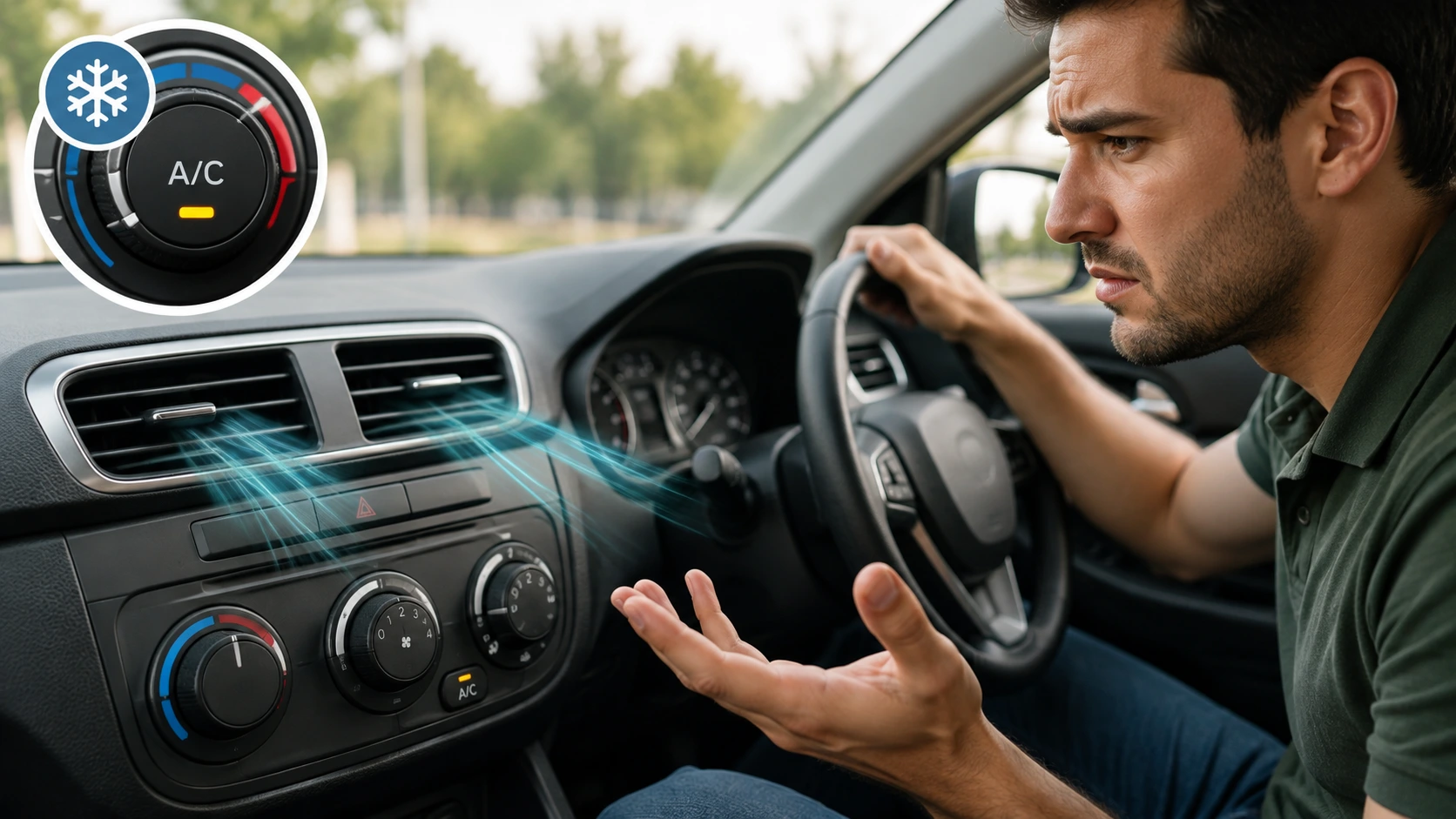
The classic pattern — AC blows noticeably cold air at motorway speed or when driving, then progressively warms as the car slows for traffic. Once stationary, the vents blow warm or mildly cool air rather than cold. When the car moves again and speed builds, cooling returns. This exact pattern — cooling quality directly correlated with vehicle speed — points almost exclusively to a condenser airflow issue.
Cooling Weaker on Hot Days Than Cool Days
A system with borderline refrigerant or a partially restricted condenser may cool adequately on cooler winter days but fail noticeably on hot summer days. The Dubai winter-summer difference in ambient temperature is large enough that a system that “seemed fine in December” can produce very poor idle cooling in July without any new fault developing — the ambient temperature change simply exposed a marginal system.
Compressor Clutch Cycling Rapidly
A compressor clutch that engages and disengages repeatedly — audible as a rapid clicking from the engine bay — indicates the refrigerant pressure is dropping below the system’s minimum threshold. The clutch cuts out to protect the compressor, the pressure recovers, and it cuts back in. This rapid cycling is usually more noticeable at idle because the compressor runs at lower RPM and produces less pressure than at highway speed.
The Four Causes — What Each One Means
Several components can produce the idle-specific cooling failure, and identifying the correct one before ordering any parts is what prevents paying for a repair that doesn’t fix the problem.
Cooling Fan Not Performing at Full Output
The electric cooling fan — or fan pack, on vehicles with separate radiator and condenser fans — is the component that replaces the natural airflow the moving car provides. A fan running at reduced speed because of a worn motor, a failed relay, a damaged blade, or a thermal switch not activating correctly is the most common single cause of idle-specific AC failure in Dubai.
How Fan Failure Produces Exactly This Symptom
A failed cooling fan has no effect at speed because natural airflow does its job instead. The moment the car stops, the failed fan cannot compensate, condenser heat rejection drops, system pressure rises, and the AC either struggles or cuts out entirely. Drive away, natural airflow returns, cooling resumes. The symptom is entirely explained by the fan’s inability to substitute for natural airflow at idle.
How Al Quoz Dust Accelerates Fan Motor Failure
Fine industrial dust from Al Quoz accumulates in fan motor bearings and blade assemblies. Motor bearings running with dust contamination wear faster than clean bearings — producing a fan that turns but at reduced speed and airflow, rather than a fan that stops entirely. This partial failure is harder to notice than a completely failed fan, but produces the same idle cooling deterioration.
Low Refrigerant From a Slow Leak
When refrigerant level is below specification, system pressure at idle — where the compressor runs at its lowest output — drops below the threshold needed for effective cooling. At speed, higher compressor RPM partially compensates. At idle, the low charge is fully exposed.
Why Recharging Without Finding the Leak Fails
This is the single most common mistake in AC repair across Dubai workshops. The system is recharged, cools well for two to four weeks, then the same idle cooling failure returns as the gas escapes through the same unsealed leak point. A pressure test that holds the system under pressure for a timed interval, followed by UV dye leak detection or electronic refrigerant sniffing, finds exactly where the gas is escaping — allowing a seal repair before any refrigerant is added.
Common Leak Locations in Dubai’s Heat
O-ring seals at the compressor ports and condenser connections are the most frequent leak points — heat cycling between underground parking cool and peak underbonnet temperatures hardens these rubber seals faster than in any temperate market. Condenser joint leaks from stone chip damage are the second most frequent. Evaporator leaks are less common but produce a refrigerant smell inside the cabin alongside the cooling loss.
Worn or Weak Compressor
The compressor is driven by the engine — at idle, engine speed is at its minimum and the compressor turns at its slowest. A compressor whose internal efficiency has dropped from wear can maintain adequate refrigerant flow at high RPM but falls short at idle RPM. The result is the same idle-specific cooling failure, but from a different cause entirely from a fan fault.
How to Distinguish Compressor Weakness From Fan Failure
A pressure gauge test during idle and during acceleration reveals the difference — a fan fault produces normal high and low side pressures but the cabin temperature rises from inadequate condenser heat rejection. A weak compressor produces low high-side pressure that is further reduced at idle RPM. These two patterns are distinguishable on gauges, which is why a gauge test is part of every AC diagnosis before any part is replaced.
Our car mechanic team runs pressure readings alongside a live fan output test on every AC stops cooling while idling complaint.
Blocked Condenser Fins — The Invisible Restriction
The condenser fins accumulate dust and debris on their front face over time. In Al Quoz’s industrial environment, this accumulation happens faster than in residential areas. A condenser that is 30–40% blocked by compacted dust cannot transfer heat effectively — the fan moves air, but the air cannot pass through the blocked fins efficiently.
Why Condenser Blockage Is Often Missed
A blocked condenser looks fine from casual visual inspection because the dust packs into the fin gaps rather than sitting on the surface visibly. The fins themselves appear present and undamaged. Only a close inspection with a torch, or a before-and-after pressure comparison after cleaning, reveals the restriction. Condenser cleaning as part of every AC service — not just when a fault appears — prevents this accumulation from reaching the performance-affecting threshold.
How We Find the Actual Fault
Every AC stops cooling while idling complaint at Rapid Rev Garage follows a diagnostic sequence that confirms the cause before any part is recommended.
Road Test to Confirm the Pattern
The car is driven first to confirm the idle-specific symptom — cooling quality assessed at speed, then at idle, with vent temperature measured in both conditions. This confirms the fault is genuinely idle-specific rather than a general cooling failure, and establishes the baseline for post-repair comparison.
Cooling Fan Output Test
Fan speed and amperage draw are tested at the fan itself — confirming actual output against specification rather than simply confirming the fan turns. A fan running at 60% of rated speed passes a visual test and fails a performance test.
AC System Pressure Test
High and low side pressures are measured at idle and at 2,000 RPM. The comparison between idle and rev pressures identifies whether the compressor output is adequate or whether low charge is exposed specifically at idle. A system with adequate charge and a weak compressor shows different pressure characteristics from a system with a weak charge and a healthy compressor.
Refrigerant Leak Detection
Where charge is confirmed low, UV dye or electronic detection identifies the specific leak point before any refrigerant is added. This step is what prevents the repeat-recharge cycle.
Condenser Inspection
Physical inspection of condenser fin blockage with a torch, and where relevant, a pressure drop test across the condenser to confirm airflow restriction.
The Correct Fix for Each Cause
The repair is matched to the confirmed diagnosis — not the most common cause, and not the cheapest repair first.
Cooling Fan Replacement or Repair
A failed or weak cooling fan motor is replaced. On vehicles with a fan relay fault rather than a motor fault, relay replacement resolves the fan failure at lower cost. The specific failure mode is confirmed before parts are ordered.
Leak Repair and Correct Recharge
The confirmed leak point is sealed — O-ring replacement, condenser joint repair, or evaporator work depending on location. The system is then recharged to the manufacturer-specified weight in grams, not estimated by gauge reading. Our car service packages include a leak check and condenser inspection at every AC service visit specifically because of how common this fault pattern is in Dubai.
Compressor Replacement
Where compressor internal efficiency loss is confirmed by pressure testing, replacement with a correctly-specified unit for the vehicle. Post-installation, the system is evacuated, recharged to specification, and road-tested to confirm cooling at idle.
Condenser Cleaning or Replacement
A partially blocked condenser is cleaned with appropriate pressure washing from the rear face — pushing accumulated debris forward and out rather than deeper into the fins. A condenser that has physical damage from stone chips alongside blockage may require replacement.
What Happens If This Gets Ignored
An AC stops cooling while idling fault that is left unaddressed in Dubai’s heat typically progresses in two directions.
Compressor Damage From Refrigerant Loss
A system with low refrigerant circulates insufficient refrigerant oil to the compressor bearings alongside the refrigerant. Running a compressor on low refrigerant — even if the compressor itself is healthy — progressively damages the compressor bearings and seals. What would have been a seal repair and recharge becomes a compressor replacement.
Complete System Failure in Peak Summer
A marginally performing system at the start of summer often fails completely by August when ambient temperatures peak. A cooling fan running at 70% output that produces uncomfortable but bearable idle cooling in May produces no usable cooling at all in August at 48°C ambient. The fault that was uncomfortable in spring becomes unacceptable in summer — and the repair is the same either way.
For any situation where the AC failure makes the vehicle unsafe to use in summer heat, our roadside assistance covers Al Quoz and nearby Dubai areas.
Is It Safe to Keep Using the Car?
A car with AC stops cooling while idling is mechanically safe to drive — it is not a mechanical safety fault in the sense of brakes or steering.
The Comfort and Health Consideration
In Dubai’s summer heat, a car that stops cooling at idle produces cabin temperatures that are genuinely hazardous to occupants during extended stops. A car stuck in traffic on Sheikh Zayed Road with a failed idle AC system can reach interior temperatures that are a real health concern within 10–15 minutes — particularly for children or elderly passengers.
Book Within the Week
This is not an emergency stop-and-recover situation in most cases — but it should be diagnosed and repaired within a week rather than monitored through summer. Every week of delayed repair in peak summer increases both the discomfort risk and the likelihood of secondary compressor damage from low refrigerant operation.
How Long the Repair Takes
Repair time depends entirely on the confirmed cause.
Fan Replacement
Cooling fan replacement: typically two to three hours depending on the vehicle and fan assembly configuration.
Leak Repair and Recharge
Leak detection, seal repair, and correct recharge: two to four hours depending on where the leak is located. An evaporator leak requiring dashboard disassembly takes longer.
Compressor Replacement
Compressor replacement, system evacuation and recharge: typically four to six hours, sometimes requiring the vehicle overnight if specific compressor parts are on order.
What the Repair Costs in Dubai
Cost is determined by the confirmed fault — a fan relay replacement costs very differently from a compressor replacement.
Cooling Fan Work
Fan relay replacement: AED 150–350. Fan motor or assembly replacement: AED 400–900 depending on vehicle. Performance test included before and after.
Refrigerant Leak and Recharge
Leak detection and single O-ring seal: AED 300–600. Condenser replacement for leak: AED 700–1,800 depending on vehicle. Evaporator replacement: AED 1,200–3,500 depending on dashboard access complexity. Refrigerant recharge (R-134a or R-1234yf as applicable): AED 200–500.
Compressor Replacement
AED 1,500–5,000 depending on compressor specification and vehicle make. A full written quote is provided after diagnosis and before any work begins. Our car painting team can handle any exterior work needed alongside AC repairs at the same visit.
How to Prevent This From Happening Next Summer
Most cases of AC stops cooling while idling in Dubai are preventable with specific maintenance habits adjusted for local conditions.
Annual Pre-Summer AC Service
Before April — before peak heat — a full AC pressure test, condenser cleaning, fan output check, and cabin filter replacement identifies every marginal component before it fails in peak summer conditions. Addressing a borderline fan at AED 400 in March costs less than replacing it as an emergency in August at peak workshop demand.
Correct Refrigerant Leak Response
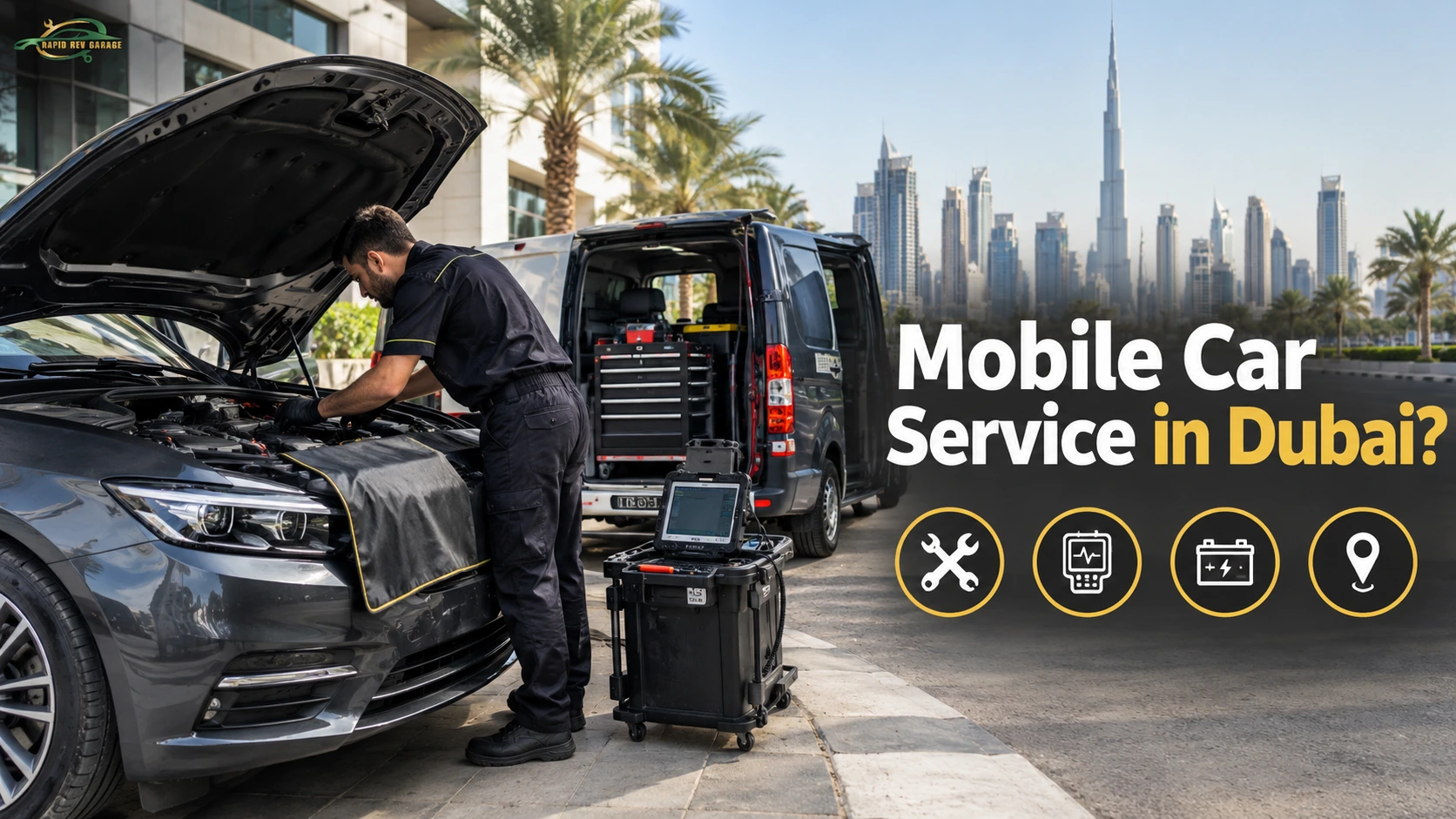
Never accept a recharge without a leak check. If the system was recharged at any point and cooling has declined again, a leak is present and must be found and sealed before the next recharge. Repeated recharging without leak repair progressively starves the compressor of refrigerant oil. Our mobile car mechanic covers Al Quoz and nearby Dubai areas for an on-site pressure check before deciding whether to drive the vehicle in.
The Dubai Factor — Why This Is More Common Here Than Anywhere
Dubai’s operating environment makes idle-specific AC failure significantly more common than in any moderate market.
Ambient Temperature Leaves No Margin
At 45°C+ ambient, the condenser must reject an enormous amount of heat per second to maintain cabin cooling. Any reduction in condenser efficiency — from dust blockage, reduced fan speed, or low refrigerant — that would be manageable in a 25°C ambient becomes a total cooling failure at 45°C. The Dubai summer simply removes all the buffer that masks marginal systems elsewhere.
Dust Accumulation Rate Is Higher in Al Quoz
Fine industrial dust accumulates on condenser fins at a rate that residential-area drivers never experience. A vehicle parked near Al Quoz’s industrial streets for six months accumulates condenser blockage that would take years to develop in a clean-air environment.
AC Runs Year-Round at Maximum Load
Dubai vehicles run AC at maximum or near-maximum for eight to ten months of the year. Compressor seal wear, fan motor bearing wear, and O-ring degradation that would develop over eight to ten years of seasonal European AC use happens in three to four years of year-round Dubai use. Maintenance intervals that account for this usage pattern are shorter than any factory schedule assumes. Our garage near me location in Al Quoz is accessible from Business Bay, Jumeirah, Barsha, Downtown, Satwa, and the Sheikh Zayed Road corridor.
Why Rapid Rev Garage?
We don’t recharge first and diagnose later. Every AC stops cooling while idling case at Rapid Rev Garage starts with pressure testing, fan output measurement, and condenser inspection — because adding refrigerant to a system with a weak fan fixes nothing, and replacing a compressor on a system whose only problem was low refrigerant from a leaking O-ring is a significant unnecessary cost.
The pressure test and fan test together take less time than a recharge — and they produce an accurate diagnosis rather than a temporary improvement that the underlying fault reverses within weeks.
FAQ — AC Stops Cooling While Idling
These are the questions Dubai drivers most often ask about this specific fault.
Why does my car AC work fine on the motorway but blow warm air in traffic?
At speed, air rushing through the front grille cools the condenser regardless of the fan's condition. At idle, only the electric fan cools the condenser — and any weakness in the fan, refrigerant charge, or condenser becomes immediately apparent without the natural airflow buffer.
My AC was just recharged but it's warm at idle again — why?
The refrigerant escaped through the same leak that was never found before the recharge. A pressure test and leak detection before recharging is what prevents this from repeating.
Can a clogged cabin filter cause AC to fail at idle specifically?
A heavily clogged cabin filter reduces airflow into the cabin, making the AC feel weaker — but it doesn't produce the specific idle-only pattern. The idle-specific pattern is condenser-side, not cabin-side.
Is it safe to drive in Dubai summer with AC that fails at idle?
The car is mechanically safe, but cabin temperatures during traffic stops in peak summer heat are a genuine health risk. Repair within the week rather than driving through summer with this fault.
How often should the condenser be cleaned in Dubai?
Annually at minimum — and more frequently for vehicles parked or driven regularly near Al Quoz's industrial area, where dust accumulation on condenser fins is significantly faster than in residential areas.
Conclusion
AC stops cooling while idling in Dubai is a specific, predictable fault with a limited number of causes — all of them identifiable by a proper pressure test, fan output check, and condenser inspection before any part is replaced. Cooling fan output, refrigerant charge, compressor condition, and condenser cleanliness are the four components that determine idle cooling performance. Rapid Rev Garage in Al Quoz diagnoses each one correctly before recommending any repair.
Rapid Rev Garage is in Al Quoz, serving drivers across nearby Dubai areas — Business Bay, Jumeirah, Downtown, Barsha, Satwa, and the Sheikh Zayed Road corridor. Book your appointment on WhatsApp or find us on Google Maps.
Rapid Rev Garage — AC Stops Cooling While Idling | Al Quoz, Dubai