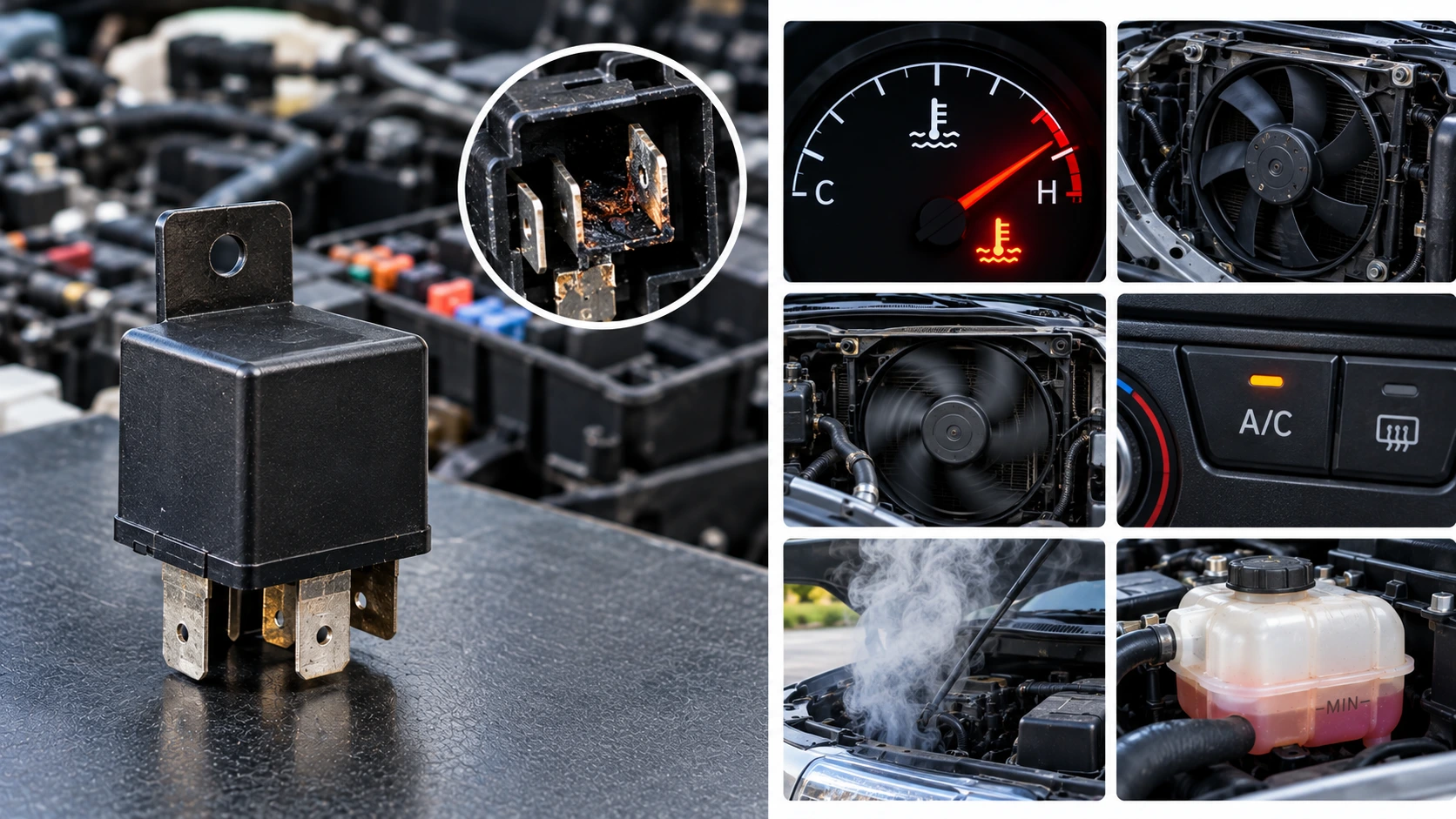
The temperature needle creeps up while you wait at a red light on Al Khail Road, then drops back once traffic moves. The AC blows warmer air whenever the car is stopped. Or the opposite happens: the radiator fan keeps roaring long after you switch off in your building car park. These are common bad cooling fan relay symptoms, and the relay is often one of the cheapest parts to fix in the whole cooling system.
The cooling fan relay is an electrical switch that lets the engine computer turn the radiator fan on and off. When it fails, the fan either does not run when it should or will not stop. In Dubai, where the fan does most of the cooling work in slow traffic, a dead relay can push an engine into overheating quickly.
This guide explains what the relay does, the signs it is failing, why UAE conditions wear relays out, how a workshop tests the relay and fan circuit and what the repair involves.
Bad Cooling Fan Relay Symptoms: Quick Answer
The main bad cooling fan relay symptoms are overheating in slow traffic or at idle, a radiator fan that does not run when the engine is hot, a fan that runs all the time or after the engine is off, a flat battery from the fan running, weaker AC cooling when stopped, a clicking or buzzing relay and a check engine light with code P0480 or P0481.
Carista notes that P0480 flags a fault in the primary cooling fan control circuit, and lists a relay stuck open or closed, or with burnt contacts, as a common cause. A mechanic commands the fan on, swaps in a good relay and checks power at the fan.
Table of Contents
- What the Cooling Fan Relay Does
- Why Fan Relays Fail Faster in Dubai
- Overheating in Slow Traffic or at Idle
- Radiator Fan Not Running When Hot
- Fan Running All the Time or After Switch Off
- Flat Battery From a Fan That Will Not Stop
- Weaker AC When the Car Is Stopped
- Clicking, Buzzing or a Hot Relay
- Check Engine Light With Codes P0480 or P0481
- Fan Working at One Speed Only
- Faults That Look Like a Bad Fan Relay
- How a Workshop Tests a Cooling Fan Relay
- What the Repair Involves
- Can You Swap the Fan Relay Yourself?
- Is It Safe to Drive With a Bad Fan Relay?
- How to Protect the Cooling Fan System
- FAQ
- Conclusion
What the Cooling Fan Relay Does
Most modern cars use an electric fan behind the radiator instead of a belt driven fan. The fan motor draws a large current, far more than the engine computer can switch directly. The relay solves this.
The engine computer sends a small signal to the relay’s coil. That signal closes heavy contacts inside the relay, which send full battery power to the fan motor. When the computer removes the signal, the contacts open and the fan stops.
The computer switches the fan on when the coolant temperature reaches a set point, and also whenever the AC is running, because the AC condenser needs airflow. Many cars use two fans or two speeds, with separate relays for each. Some newer cars use a fan control module instead of simple relays.
Why Fan Relays Fail Faster in Dubai
In Dubai, the cooling fan works far more than in cooler places. The AC runs almost all year, and the fan runs whenever the AC is on. Long idling in stop and start traffic on Sheikh Zayed Road means the fan does most of the cooling with no help from road speed.
Each time the relay switches, a small spark forms across its contacts. Over thousands of cycles, the contacts burn and pit. Carista lists burnt contacts among the common relay faults. More fan use means more switching and faster wear.
Heat adds to it. The relay box often sits in the engine bay, where temperatures climb well above the outside air. On a summer afternoon when the air passes 45°C, the relay and its connector bake, and plastic housings and solder joints can crack.
Overheating in Slow Traffic or at Idle
Overheating that only happens when the car is stopped or moving slowly is the classic sign of a fan problem. Carista notes that a P0480 fault can let the engine overheat in slow traffic or during heavy AC use.
At highway speed, air rushes through the radiator and the fan is not needed much. In traffic, at the lights or in a queue at a car park exit, the fan provides almost all the airflow. If the relay fails, the fan stays off and the temperature climbs.
The gauge often drops again once you start moving. That pattern points strongly to the fan system rather than the water pump or thermostat. The guide on bad car thermostat symptoms explains how to tell them apart.
Radiator Fan Not Running When Hot
The most direct sign is a fan that does not spin when it should. Carista lists a fan that does not engage when it should among the symptoms of P0480.
A simple check is to switch on the AC with the engine running. On most cars, the fan should start within a few seconds. You can also let the engine idle until it is fully warm and watch whether the fan comes on as the temperature gauge reaches its normal position.
Listen as well as look. On many cars, you can hear the fan start with a whoosh from the front of the car. If you never hear it in summer traffic with the AC on, the fan system is worth checking.
Keep your hands, hair and clothing well away from the fan. It can start without warning, even with the engine off on some cars.
Fan Running All the Time or After Switch Off
A relay can also fail in the opposite way. Carista notes that the relay may be stuck closed, and lists a fan that runs constantly with the ignition on as a symptom.
When the contacts weld together, the fan gets power all the time. It may run as soon as you switch on the ignition, even with a cold engine, and keep running after you switch off and lock the car.
Many cars run the fan for a few minutes after switch off to cool a hot engine. That is normal. A fan that keeps running for a long time, or runs on a cold engine, is not.
Flat Battery From a Fan That Will Not Stop
A fan stuck on drains the battery quickly, because the fan motor draws a large current. A car left overnight in a building car park in Business Bay with the fan running can have a flat battery by morning.
If your battery keeps going flat and you have noticed the fan running after you park, the relay is a likely cause. Replacing the battery without fixing the relay means the new battery will go flat too.
A mechanic can measure the current draw with the car locked. A battery and charging test at the same time shows whether the battery has been damaged by repeated deep discharge.
Weaker AC When the Car Is Stopped
The AC condenser sits in front of the radiator and needs the fan to shed heat when the car is not moving. Carista notes that AC cooling weakens when the fan fails, because the condenser depends on it.
The AC may blow cold on the highway and warm at the lights or in a drive through queue. Some cars also switch off the AC compressor when pressure gets too high, which makes the cabin warm up quickly.
Before paying for AC gas or a compressor, check whether the fan runs with the AC on. An AC system check should always include a fan test.
Clicking, Buzzing or a Hot Relay
A relay that clicks rapidly, buzzes or feels very hot can be failing. Rapid clicking often means the coil is getting a weak or interrupted signal, or the relay is chattering because its contacts are worn.
A relay with burnt contacts may click as normal but not pass enough current to run the fan. The relay may look fine from the outside while the contacts inside are pitted.
Melted plastic or brown marks on the relay or its socket point to overheating from a poor connection. The socket may need repair as well as the relay.
Check Engine Light With Codes P0480 or P0481
Carista explains that P0480 flags a fault in the primary cooling fan control circuit, meaning the engine computer cannot reliably turn the fan on or off when it should. P0481 covers the second fan or second speed circuit on many cars.
These codes do not always mean the relay has failed. Carista lists the relay, the fan motor or its wiring and, less often, the engine computer’s fan driver as possible causes.
A scan tool reads the code and can often command the fan on, which is the first test a mechanic uses to narrow the cause down.
Fan Working at One Speed Only
Many cars run the fan at low speed for gentle cooling and high speed when the engine is hot or the AC pressure is high. Separate relays or a resistor control the two speeds.
If one relay fails, the fan may work only at low speed or only at high speed. A fan that only runs on low may not cool enough in summer traffic. A fan stuck on high is loud and drains more power.
Carista notes that P0481 often relates to the second fan or speed circuit. Testing both speeds with a scan tool shows which relay has failed.
Faults That Look Like a Bad Fan Relay
Several other faults cause the same symptoms. Carista lists a fan motor that is shorted or open, and broken wiring between the relay and the motor, among the causes of P0480. A blown fuse in the fan circuit also stops the fan.
A faulty coolant temperature sensor can stop the computer switching the fan on, because it never sees the engine as hot. A thermostat stuck closed or a failing water pump causes overheating even with a working fan.
The guides on bad car thermostat symptoms and failing water pump symptoms explain those faults. Testing the fan circuit first is quick and rules the cheapest parts in or out.
How a Workshop Tests a Cooling Fan Relay
Carista describes a clear process. The mechanic uses a scan tool to command the fan on at idle and checks whether it runs. If it does not, the fan relay is swapped first, because it is the cheapest fix.
Many cars use identical relays for other circuits, such as the horn. Swapping in a known good relay of the same type is a quick test. If the fan then works, the old relay has failed.
If a new relay does not fix it, Carista advises measuring the fan motor’s resistance and confirming that 12 volts reach the motor when the fan is commanded on. The fuse, the relay socket and the wiring are checked too. Book this test with an experienced car mechanic near you so the right part is replaced.
What the Repair Involves
If the relay has failed, it is unplugged and a new one of the same type is fitted. On most cars, it sits in the fuse and relay box in the engine bay. The job is quick once the fault is confirmed.
If the socket is burnt or corroded, it is repaired or replaced, because a bad socket will damage a new relay. If the fan motor has failed, the fan assembly is replaced. Broken wiring is repaired through an auto electrical repair.
After the repair, the mechanic commands the fan on and off with the scan tool, checks both speeds, runs the engine up to temperature to confirm the fan switches on by itself and clears any codes.
Can You Swap the Fan Relay Yourself?
On many cars, yes. The relay box lid usually has a diagram showing which relay controls the fan. With the engine off, pull the fan relay and swap in an identical relay from a less important circuit, then test the fan.
Only swap relays with exactly the same part number and pin layout. Fitting the wrong relay can damage the circuit. Do not push a relay in by force, and never bridge the relay socket with a wire.
Keep hands away from the fan, which can start suddenly. If the fan still does not work, the fault is elsewhere in the circuit, and a mechanic should trace it.
Is It Safe to Drive With a Bad Fan Relay?
A fan relay stuck on is a nuisance and drains the battery, but the engine will not overheat. A relay stuck off is more serious, because the engine can overheat in slow traffic within minutes in UAE heat.
If the gauge climbs in traffic, switch off the AC to reduce engine load, and if it keeps rising, pull over and switch off. Driving an overheated engine can warp the cylinder head, which an engine repair specialist would then need to fix.
If the engine overheats on a highway, reach the hard shoulder rather than stopping in a live lane, which brings a AED 1,000 fine and six black points under Article 98 of the UAE Federal Traffic Law. Then call roadside assistance. Coolant boiling out of the overflow tank can splash onto the bodywork, and stains left in the sun may need paint and panel repair.
How Long Do Cooling Fan Relays Last?
There is no fixed life for a relay. Many last for years, while others fail early from heat, heavy use or a poor socket connection.
In Dubai, the fan runs whenever the AC is on, so the relay switches far more often than in cooler climates. A car that spends a lot of time in slow traffic wears its fan relay sooner.
Some owners keep a spare relay of the right type in the glovebox, because it is small and easy to swap. If the fan stops working, a swap at the roadside can get you to a workshop without overheating.
Can a Bad Fan Relay Damage the Engine?
The relay itself does not damage the engine, but the overheating it allows can. If the fan does not run in traffic, the coolant temperature rises until the engine overheats. That can warp the cylinder head, blow the head gasket and damage the engine.
A relay stuck on causes different damage. It drains the battery, and repeated deep discharges shorten battery life. It also wears the fan motor faster, because the motor runs far more than it should.
Fixing a failing relay early costs very little compared with the damage either fault can lead to.
How to Protect the Cooling Fan System
Keep the radiator and AC condenser clean, so the fan does not have to work as hard. Dust and insects block the fins, especially after dust storms. Have the fan tested at every service, both with the AC on and with the engine hot.
Avoid pressure washing the engine bay, because water forced into the relay box causes corrosion. If you see melted plastic or burnt marks on the fuse box, have it checked straight away.
A regular car service in Dubai includes a cooling fan check. If the car is at home with an overheating problem, a mobile mechanic can test the relay and fan in your parking space. Before each summer, choose a car garage near you that tests the fan at both speeds.
FAQ
Here are the questions Dubai drivers most often ask about cooling fan relays.
What happens when a fan relay fails?
If it sticks open, the radiator fan does not run, so the engine can overheat in traffic and the AC cools less when stopped. If it sticks closed, the fan runs all the time and can drain the battery.
Can a bad fan relay cause overheating?
Yes. If the relay fails open, the fan stays off. At highway speed, road airflow cools the engine, but in slow traffic or at idle, the temperature climbs quickly without the fan.
Why does my radiator fan keep running?
A relay with welded contacts can keep the fan running even after you switch off. Some cars run the fan for a few minutes after switch off by design, but a fan that runs for a long time or on a cold engine points to a fault.
How do you test a fan relay?
Command the fan on with a scan tool, or switch on the AC and watch the fan. Swap in an identical relay from another circuit. If the fan then works, the old relay has failed.
What does code P0480 mean?
P0480 means the engine computer has detected a fault in the primary cooling fan control circuit. The cause may be the relay, the fan motor, the wiring or, less often, the computer's fan driver.
Conclusion
A bad cooling fan relay shows up as overheating in slow traffic, a fan that does not run or will not stop, a flat battery, weaker AC when stopped, a clicking or hot relay, one speed only and codes P0480 or P0481. Heavy AC use and engine bay heat wear relays faster in Dubai. Commanding the fan on, swapping in a good relay and checking power at the fan motor confirms the fault quickly.
Rapid Rev Garage is a full workshop open 24 hours at Al Khail Gate, 12th Street, Al Quoz Industrial Area 2, serving passenger cars across Al Quoz, Business Bay, Jumeirah, Al Barsha, Satwa, Downtown and the Sheikh Zayed Road corridor. Visit https://rapidrevgarage.com, send your car model and symptoms on WhatsApp, or get directions on Google Maps.
Rapid Rev Garage | Bad Cooling Fan Relay Symptoms | Al Quoz, Dubai