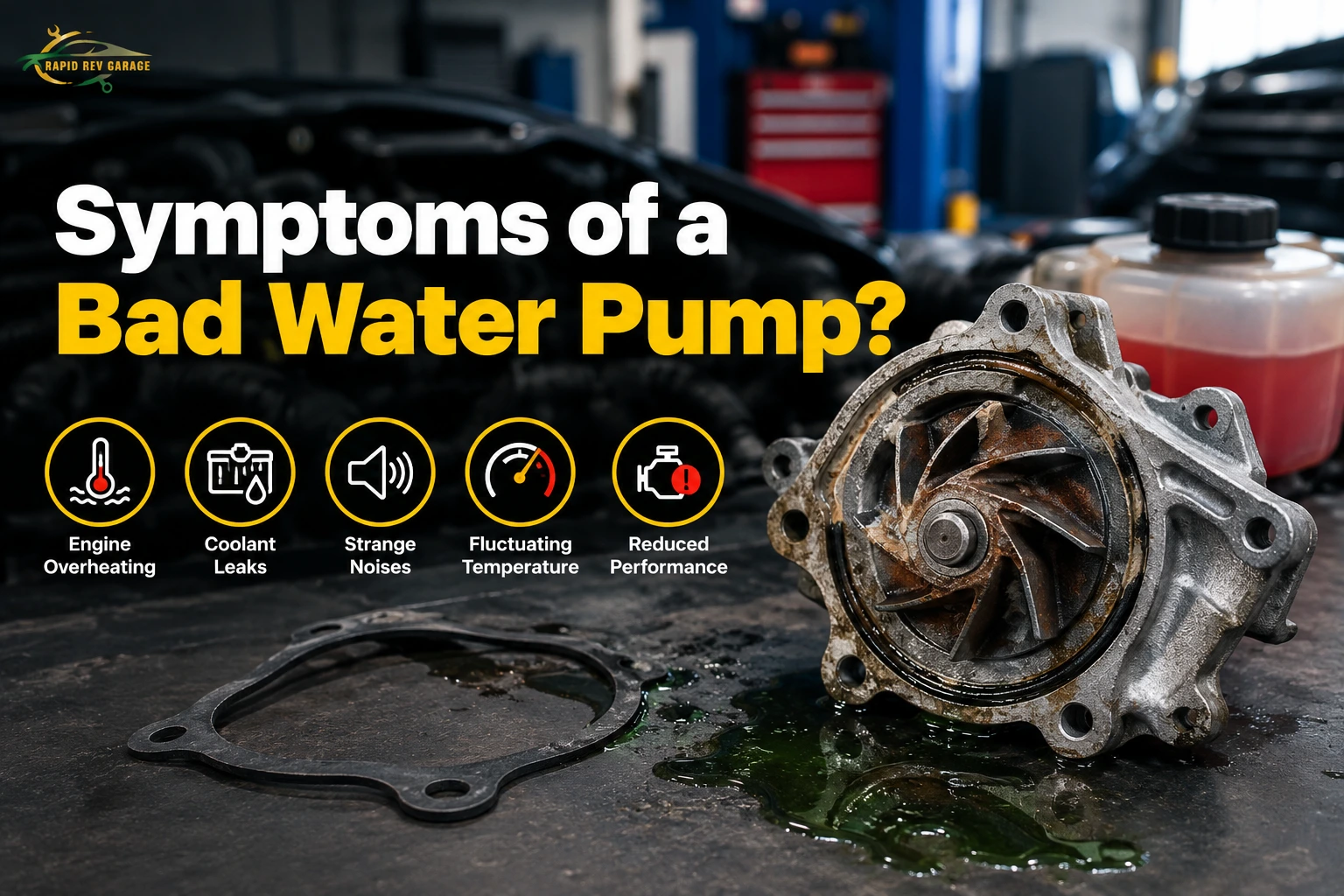
The most common signs of a bad water pump are engine overheating and coolant leaking from the front of the engine. A whining or grinding noise that rises with engine speed is another clue. You may also see the coolant level drop repeatedly, steam from under the bonnet, or a temperature gauge that jumps up and down—each points to a pump that can no longer move coolant through the car’s cooling system. Still, a stuck thermostat, a clogged radiator, a split hose or a failed fan can cause the same problems. A pressure test and a close look at the pump confirm the fault before you replace any parts.
What Does a Car Water Pump Do?
The water pump keeps coolant moving between the engine and the radiator. Without that flow, engine heat has nowhere to go. When a bad water pump slows the flow, the engine can start running hot within minutes.
How the Water Pump Circulates Engine Coolant
Most pumps are at the front of the engine. A belt drives a pulley on the pump. This drives an internal shaft, where a small bladed wheel (an impeller) forces coolant through the engine block and cylinder head.
The heated coolant is carried to the radiator. Air flowing through the radiator fins cools it, and the pump returns it to the engine. The loop runs all the time the engine is running.
Most modern cars, including many hybrids and most BMW models, have an electric water pump. It has its own motor. The engine computer controls it . An electric pump failure usually triggers a warning message on the dash, rather than a leak or noise.
Why the Water Pump Is Important for Engine Cooling
An engine generates a lot more heat than it can dissipate on its own. The coolant carries the heat away, but only as long as it moves. A healthy pump keeps the engine running in its usual temperature range of roughly 90 to 105°C in most cars.
If flow slows, hot spots form around the cylinders. First to go is the head gasket and cylinder head. This is how a simple pump problem can become a big engine repair expenditure.
What Are the Common Symptoms of a Bad Water Pump?
Water pump trouble usually starts small. A drip, a faint whine, or a gauge that sits slightly higher than normal are early clues. Each sign below comes with what it usually means.
Engine Overheating While Driving
The worst thing is if the temperature gauge goes past the middle. It often happens first in slow traffic because less air is moving through the radiator. The gauge can dip back on the highway, which can make you assume the problem is gone.
The engine temperature warning light tells you that your engine is already overheating. Pull over and turn it off safely.
Coolant Leaking Near the Water Pump
Check the ground under the front of the car after it has been parked. Coolant dripping underneath the car leaves a sweet-smelling puddle that is green, pink, orange, or blue.
Most pumps have a small weep hole below the shaft. It lets coolant escape when the inner seal starts to fail, so the coolant does not reach the bearing. A water pump weep hole leak often leaves dried crust or a stain trail below the pump before you ever see a puddle. Check for a coolant leak near the water pump even if the engine isn’t overheating yet.
Whining, Grinding, or Squealing Noise
A whine that rises and falls with engine speed often points to a worn pump bearing. A grinding sound means the bearing is close to failing. A squeal at start-up is more often the drive belt slipping on the pump pulley or another pulley.
Noise alone does not prove the pump is at fault. The alternator, idler pulleys, and belt tensioner can make similar sounds, so a mechanic checks each one.
Coolant Level Dropping Repeatedly
If you top up the coolant reservoir every week or two, the coolant is going somewhere. A low engine coolant level with no puddle can mean a slow leak that dries on the hot engine before it reaches the ground.
Low coolant can also cause overheating. The pump can only move the coolant that is there.
Steam Coming From the Engine Bay
Steam coming from the engine bay means coolant is boiling or spraying onto hot parts. It may come from a failed pump seal, a split hose, or a radiator cap that no longer holds pressure.
Never open the radiator cap on a hot engine. The coolant is under pressure and can cause serious burns. Wait at least 30 minutes for it to cool.
Water Pump Pulley or Bearing Problems
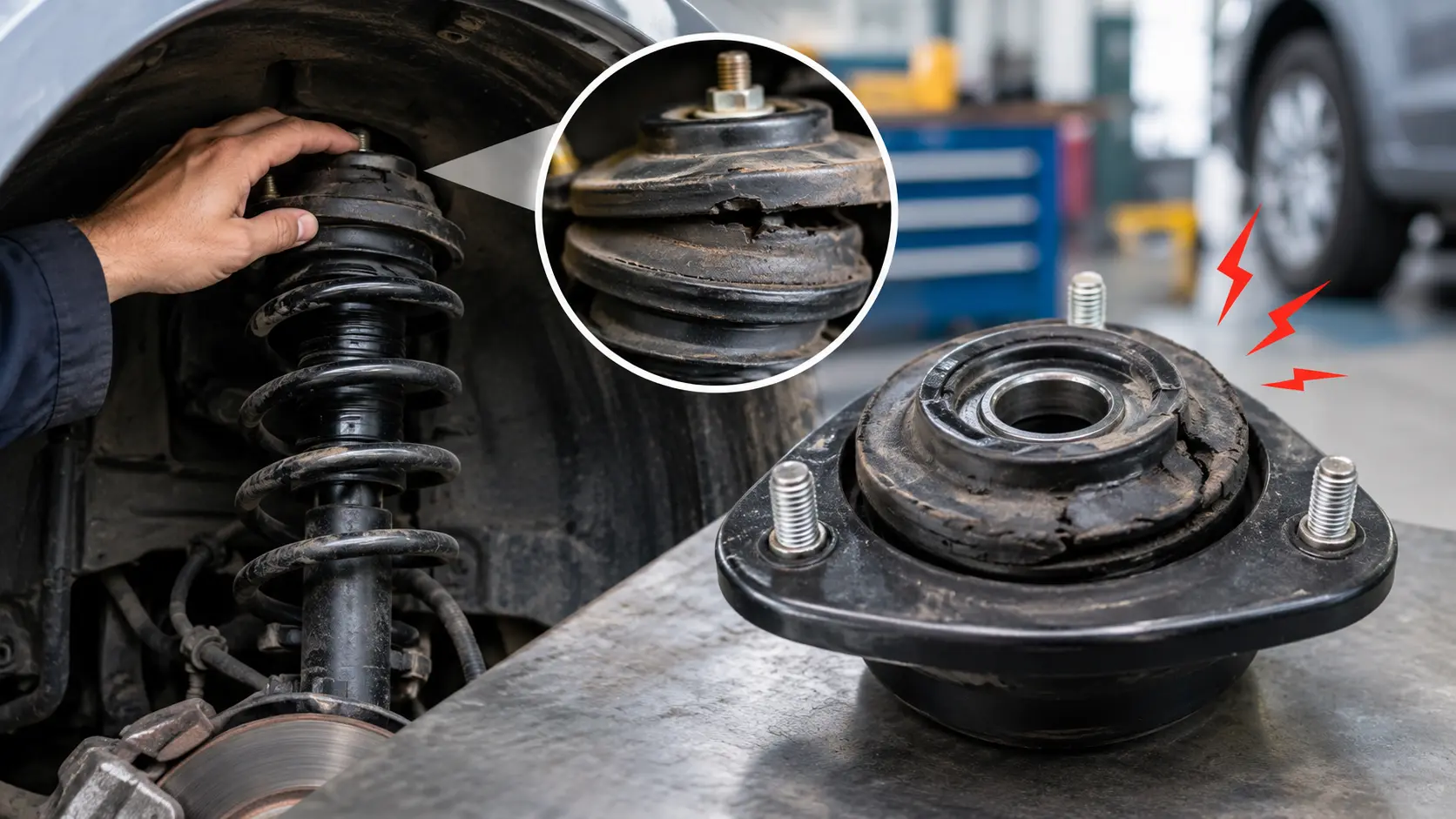
Water pump bearing failure lets the shaft move in ways it should not. You may see the pulley wobble while the engine runs, or the belt may run off-line and wear on one edge. With the engine off and cool, a mechanic can rock the pulley by hand. Any play or rough feel means the bearing is worn.
Water pump pulley problems can also throw the belt. On many cars, the same belt drives the alternator and power steering, so a battery light or heavy steering may follow.
Poor Coolant Circulation or Temperature Fluctuations
A damaged impeller will keep spinning, but it won’t move much coolant. The gauge may fluctuate, the heater may blow cool air when the engine is idling, and the top radiator hose may be cooler than it should be. These coolant circulation issues can happen even without a leak or noise.
The table below links each sign to its most likely reason and the check that confirms it.
| What You Notice | Most Likely Reason | What the Mechanic Checks |
| Temperature gauge climbs in traffic | Weak flow from a worn impeller, or low coolant | Coolant level, flow at the radiator, fan operation |
| Puddle or crust under the front of the engine | Pump seal leaking through the weep hole | Weep hole, pump gasket, nearby hoses |
| Whine or grinding that rises with revs | Worn pump bearing | Pulley play by hand, stethoscope on the pump |
| Coolant needs topping up often | Slow leak at the pump or another part | Pressure test of the full cooling system |
| Steam from under the bonnet | Coolant boiling or spraying from a seal | Pressure test, radiator cap test |
| Pulley wobble or belt worn on one edge | Bearing play or a bent pulley | Belt alignment, pulley run-out |
| Gauge swings, heater cold at idle | Damaged impeller or air in the system | Hose temperatures, coolant bleed, flow check |
What Causes a Car Water Pump to Fail?
Water pumps wear out with age and mileage, but poor care speeds up the process. Most failures trace back to one of the causes below.
Worn Water Pump Bearings or Seals
The pump shaft spins thousands of times a minute whenever the engine runs. Over the years, the bearing wears, and the seal around the shaft dries out. Once the seal leaks, coolant can reach the bearing and wash out its grease, which speeds up the wear.
Corrosion and Contaminated Coolant
Coolant contains additives that protect metal parts from rust. Those additives wear out over time. Old coolant turns acidic, eats into the impeller and pump housing, and leaves scale inside the system. Rust and scale then grind against the pump seal like fine sand.
Damaged Impeller or Pulley
Some pump blades are made of plastic. If you heat and cool the machine repeatedly, the blades could break or the impeller could loosen on its shaft, causing it to slip. Metal impellers can rust if the blades are very thin. A belt that is too tight puts side load on the pulley, which wears it out quickly.
Worn or Loose Water Pump Drive Belt
A belt that is too loose slips, so the pump spins slower than it should. A belt that is too tight pulls hard on the pump shaft and wears the bearing. A worn tensioner can cause either problem. On timing-belt engines, a failed pump bearing can also damage the timing belt.
Incorrect Coolant or Poor Cooling System Maintenance
Mixing different types of coolant can create gel or sludge that clogs small passages. Adding more tap water weakens the protection and adds minerals that leave behind scale. If you don’t change the radiator, the pump will keep running on old fluid for years.
Can a Bad Water Pump Cause Engine Overheating?
Yes. Overheating is the most common result of a failing pump. It happens either through a leak that drains the coolant or through a worn impeller that stops moving coolant well.
How Reduced Coolant Circulation Affects Engine Temperature
Coolant has to leave the engine, go to the radiator to lose heat, and then return. When the pump doesn’t move as much water, it stays in the engine longer and heats up. Only what hits the radiator can cool it.
The AC makes things harder in Dubai. Since the AC condenser sits in front of the radiator, the air that reaches it is already warm. In the summer, when it’s 45°C and traffic is slow, a weak pump is often first seen.
What Can Happen if You Ignore an Overheating Engine
Engine parts expand as they heat up. Past a certain point, the aluminum cylinder head can warp, and the head gasket can fail. You may then see white exhaust smoke, milky oil, or coolant loss with no outside leak.
In the worst cases, pistons can seize in the cylinders. A water pump job can turn into a head gasket repair or even an engine replacement.
How Can You Tell if the Water Pump Is Bad or the Thermostat Has Failed?
Both faults cause overheating, so drivers often confuse them. The thermostat is a valve that opens to let coolant reach the radiator once the engine warms up. If it sticks shut, coolant stops flowing to the radiator even with a healthy pump. Leaks and noise point to the pump, while a fast rise in temperature with no leak points more to the thermostat.
|
Sign |
Points to the Water Pump |
Points to the Thermostat |
| Coolant leak at the front of the engine | Yes, often from the weep hole | Rarely, only at the thermostat housing |
| Whining or grinding noise | Yes, from a worn bearing | No, a thermostat makes no noise |
| Overheats within 10 to 15 minutes of starting | Possible | Common when stuck closed |
| Slow to warm up, heater lukewarm on the road | Unlikely | Common when stuck open |
| Upper radiator hose stays cool while the engine is hot | Possible with a failed impeller | Common when stuck closed |
| Pulley wobble or belt wear | Yes | No |
A mechanic confirms the failed part by checking hose temperatures with an infrared thermometer and watching coolant flow once the engine warms up. On many cars, it makes sense to fit a new thermostat with the pump, because the coolant is already drained.
How Do Mechanics Diagnose a Failing Car Water Pump?
A proper water pump inspection rules out other parts first. Replacing a bad water pump that wasn’t faulty wastes money and leaves the real problem in place. A good car mechanic works through the checks below.
Inspecting for Coolant Leaks
The mechanic inspects the weep hole, pump gasket, and surrounding hoses with a torch and mirror. Dried coolant crust shows where a leak has been. For slow leaks, the mechanic adds UV dye to the coolant. The dye glows under a UV lamp and shows the exact leak point.
Checking Water Pump Bearings and Pulley
With the engine off and the belt removed, the mechanic rocks the pulley by hand to feel for play. Spinning it shows any roughness in the bearing. With the engine running, a mechanic’s stethoscope on the pump body picks up bearing noise. The belt and tensioner are checked at the same time.
Testing Cooling System Pressure and Coolant Circulation
Attach a pressure gauge to the heater or the tank. Once the system reaches about 1 bar (15 psi), the gauge shows whether the pressure drops. If the pressure drops but there is no outside leak, the head seal may be broken. There is a separate pressure test for the radiator cap.
The repair checks flow by watching the coolant move and comparing hose temperatures after the thermostat opens. A scan tool can read problem codes and turn on the pump to test cars with an electric pump.
How Mechanics Replace a Leaking or Noisy Water Pump
A failed or bad water pump is replaced, not repaired. Rebuilding the bearing and seal costs more in labor than a new pump. A full job should follow these steps.
- Drain the coolant into a container for safe disposal.
- Remove the drive belt and, on some engines, the timing cover and timing belt.
- Unbolt the old pump and clean the engine surface where it sits.
- Fit the new pump with a new gasket or O-ring, tightened to the maker’s torque figure.
- Refit the belt and set its tension, or line up the timing marks on timing-belt engines.
- Refill with the coolant type the manufacturer lists, then bleed out trapped air.
- Run the engine to full temperature, check for leaks, and road test the car.
Parts Often Replaced at the Same Time
Some pieces are good to change with the pump out. The thermostat is cheap and close by on many engines. With timing belt engines, you normally change the belt, tensioner, and idler pulleys at the same time because the work overlaps. If your coolant hoses and radiator cap are cracked or swollen, it’s best to replace them.
Why Bleeding Air From the Cooling System Matters
Air can get trapped around the thermostat or cylinder head after a refill. The engine could then get too hot, even if the pump is brand new. Many cars have bleed screws, and some need a vacuum fill tool to remove the air. A missed bleed is a common reason a car overheats again soon after you change the pump.
Can You Drive With a Bad Water Pump?
You can drive a short distance with a small, slow leak if the temperature gauge stays normal and the coolant is topped up. Don’t drive if the gauge climbs past the middle, the warning light comes on, you see steam, or the pump grinds loudly.
Every minute an engine overheats adds to the damage. If the gauge heads toward red, switch off the AC and turn the heater to full hot while you find a safe place to stop. The heater pulls some heat away from the engine. Then pull over and turn off the engine.
If the car keeps overheating, call roadside assistance instead of driving on. A recovery truck costs far less than a new engine. A grinding pump is risky too, because a seized bearing can throw the belt. On timing-belt engines, a pump failure can break the belt and let the valves hit the pistons.
For a small leak with a normal gauge, a mobile car mechanic can check the pump and coolant level where the car is parked.
How Long Does Water Pump Replacement Take?
Most pumps driven by the outside accessory belt take about 1.5 to 3 hours to replace. Pumps driven by the timing belt often take 3 to 5 hours or more, because the front of the engine has to come apart. Some V6 and V8 engines need a full working day.
Draining, bleeding, and a test drive add more time. Part supply matters as well. Pumps for common models are easier to find than parts for rare or older European cars, which may need to be ordered.
How Much Does Water Pump Replacement Cost in Dubai?
The final price depends on the car and how deep the pump sits in the engine, so a fair quote comes after an inspection. Labor is a large part of the bill. Pitstop Arabia reports that independent garages in Dubai charge about AED 100 to 200 per hour, while dealers charge about AED 200 to 400 per hour.
These are the main cost factors:
- Vehicle make and model. European and luxury cars usually have pricier parts.
- Part type. OEM pumps cost more than aftermarket ones, and remanufactured pumps are cheaper but vary in quality.
- How the pump is driven. An accessory-belt pump is the quickest job, a timing-belt or timing-chain pump means more labor, and an electric pump is a costlier part.
- Related parts. Coolant, a gasket, a thermostat, a belt, and a tensioner add to the total.
- Extra damage. Overheating that has warped the head or blown the gasket raises the cost significantly.
Ask for a written quote that lists parts and labor separately before any work starts.
When Should You Replace a Car Water Pump?
Replace the pump once you confirm a fault. That means a leak from the weep hole or gasket, play or noise in the bearing, a damaged impeller, or a failed electric pump. A leaking pump will not seal itself, and “stop leak” additives only delay the job.
If you take good care of your coolant and engine, many water pumps will last between 100,000 and 160,000 km. When the timing belt drives the pump, most manufacturers recommend replacing the pump with the belt at the intervals listed in the owner’s manual. Paying the same person to do both jobs at once saves money.
Not sure which design your car has? A search for a garage near me will bring up local workshops that can check the service book and engine layout for you.
How to Make a New Water Pump Last Longer
A new pump lasts longest in a clean, well-kept cooling system. These habits help:
- Change the coolant at the interval your manufacturer lists. Many long-life coolants need changing every 2 to 5 years.
- Use the exact coolant type for your car, and don’t mix colors or brands.
- Top up with pre-mixed coolant or distilled water, never tap water.
- Check the coolant level once a month with the engine cold.
- Have the drive belt and tensioner checked at each service.
- Fix small leaks early, before low coolant leads to overheating.
A regular car service in Dubai that includes a cooling system check will catch most of these issues before they leave you stranded.
Water Pump Advice for Dubai Drivers
Dubai’s climate is hard on cooling parts. Most engine cooling system problems here show up in summer, when air temperatures above 45°C leave the radiator less cool air to work with. Long idle times on Sheik Zayed Road and in school-run traffic raise engine heat while the car barely moves.
The radiator and condenser fins get dirty from places like Al Quoz, which stops air from moving through them. Ask your mechanic to clean them gently while the car is in the shop. Cars parked outside can go from warm at night to very hot in the afternoon, which stresses the seals and hoses.
Plan to have your cooling system checked out before summer starts, around April. It’s too late to get your car fixed if it overheats at night because many shops are closed. The full-service Rapid Rev Garage in Al Quoz Industrial Area 2 is open 24 hours a day. You can bring your car in outside normal business hours for a water pump check.
Why Choose Rapid Rev Garage for Water Pump Repair in Dubai
For Dubai drivers dealing with a leaking, noisy, or overheating water pump, Rapid Rev Garage is a strong choice. The reasons below relate directly to this kind of repair.
Open 24 Hours as a Full Workshop
Water pumps do not fail on a schedule. The garage runs around the clock as a full workshop, not only as a roadside service. Diagnosis and repairs can start as soon as the car arrives. Many other workshops in the area close in the evening.
Passenger Cars Only
The workshop works only on passenger cars. Sedans, SUVs, and family cars make up all its work, including belt-driven, timing-belt, and electric pump designs.
Easy to Reach in Al Quoz
The garage is at Al Khail Gate, 12th Street, Al Quoz Industrial Area 2, near Al Khail Road. The location suits drivers bringing a car in carefully or arriving by recovery truck.
Frequently Asked Questions
Q1: What is the first sign of a bad water pump?
A small coolant leak or a crusty stain below the pump is often the first sign. A faint whine from the front of the engine can also show up early, before any overheating.
Q2: Can a bad water pump leak coolant without overheating?
Yes. A slow leak from the weep hole can go on for weeks with a normal gauge, as long as you keep topping up. The leak will grow, so you still need to replace the pump.
Q3: Will a bad water pump make a grinding noise?
It can. Grinding usually means the bearing is badly worn and close to seizing. Stop driving and get the car checked, since a seized pump can throw the belt.
Q4: Can a bad water pump cause coolant loss?
Yes. A failing seal or gasket lets coolant escape, and some leaks dry on the hot engine without leaving a puddle. A pressure test shows where the coolant is going.
Q5: How long can you drive with a failing water pump?
There is no safe number of days. With a small leak and a normal gauge, a short trip to the workshop is usually fine. Once the engine overheats, stop straight away.
Q6: Does a new water pump need a new timing belt?
Only if the timing belt drives the pump. On those engines, the belt has to come off anyway, so most mechanics replace both at the same time. Pumps driven by the outside accessory belt do not need a new timing belt.
Related Services That Often Go With Water Pump Repair
A water pump job can also lead to other work.
- Engine repair, when overheating has damaged the head gasket or cylinder head.
- Car AC repair, since AC load and cooling problems often show up together.
- Battery and alternator checks, when a failed pump pulley has thrown the belt.
- Car painting for bodywork and paint repairs while the car is in.
Book a Water Pump Inspection in Al Quoz
If your temperature gauge is climbing, coolant keeps disappearing, or the engine whines at idle, get the pump checked before it fails. Rapid Rev Garage is open 24 hours at Al Khail Gate, Al Quoz Industrial Area 2. Send a message on WhatsApp, or find the workshop on Google Maps.