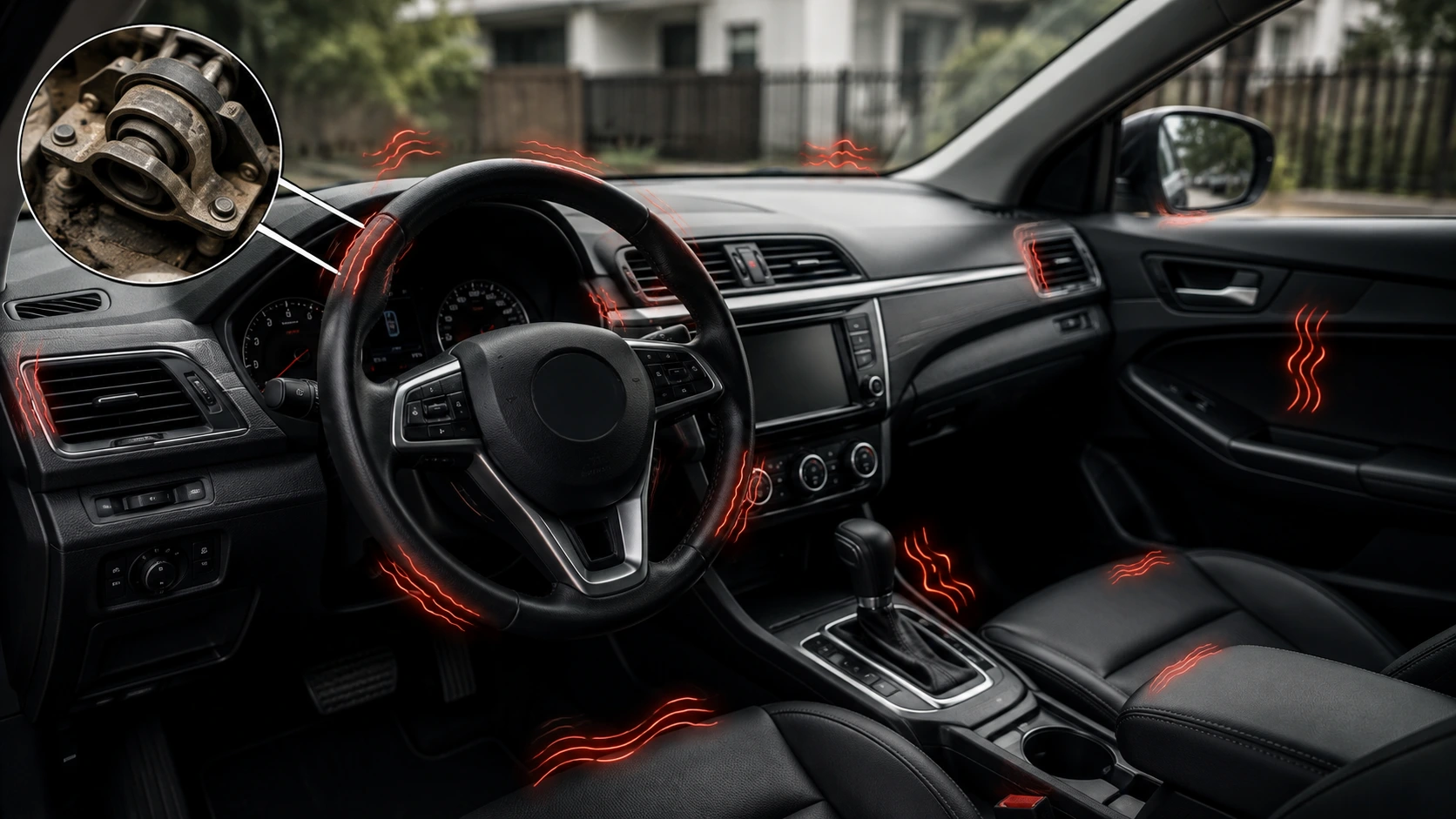
A car cabin vibrate while stationary — a shake or tremor that runs through the seats, steering wheel, and dashboard when the car is sitting still with the engine running — is a fault that is both uncomfortable and diagnostic. It is the engine communicating that something in its idle balance is wrong.
In Dubai, this complaint is most common in stop-start traffic and at long traffic light stops — conditions that expose faults that highway driving masks — because at speed, road noise and tyre noise cover a significant amount of engine and drivetrain vibration.
At Rapid Rev Garage in Al Quoz, cabin vibration at standstill is diagnosed with live engine data, a misfire scan, and a mount deflection test — before any component is touched.
Car Cabin Vibrate While Stationary — Quick Answer
A car cabin vibrates while stationary because the engine or drivetrain is not running in balanced equilibrium at idle. The most common causes are a misfiring cylinder from a worn spark plug or failing ignition coil that disrupts the engine’s firing sequence; a failed engine mount that no longer isolates the engine’s rotation from the body; a carbon-fouled throttle body producing an unstable idle RPM; a vacuum leak allowing unmetered air into the intake and creating a lean stumble; or an AC compressor that is adding an unbalanced load to the engine at idle. In Dubai, all five causes develop faster than European service intervals assume — heat cycling degrades mounts, carbon accumulates on throttle bodies faster from short trips, and ignition components wear sooner from high cold-start frequency.
Table of Contents
- Why Stationary Conditions Reveal Vibration That Driving Hides
- Engine Misfire at Idle — The Most Direct Cause
- Failed Engine Mount — Vibration That’s Always There
- Throttle Body Carbon and Hunting Idle
- Vacuum Leak Causing a Lean Stumble at Idle
- AC Compressor Load Adding Vibration at Standstill
- Fuel Injector Issues at Low Idle Demand
- How Dubai’s Conditions Create Cabin Vibration Earlier
- How We Diagnose Car Cabin Vibrate While Stationary
- The Services That Fix Each Confirmed Cause
- What Does the Repair Cost in Dubai?
- Is It Safe to Keep Driving?
- Why Rapid Rev Garage?
- FAQ
- Conclusion
Why Stationary Conditions Reveal Vibration That Driving Hides
When the car is moving, road noise, wind noise, and tyre noise produce a constant background that masks a significant amount of engine and drivetrain vibration. The driver doesn’t notice the engine’s imbalance because other sounds and vibrations are louder.
When the car stops — at a traffic light, in a queue, in a car park — that background disappears. The engine’s vibration is now the dominant sensation. A misfire that was invisible at 80 km/h is obvious when the car is stationary in silence.
This is why car cabin vibrate while stationary complaints often appear suddenly. The fault may have been developing for weeks — it just wasn’t noticeable until the driver had a long traffic light stop that removed the masking noise.
The stationary condition is also more demanding for the idle system. At speed, the engine is under load — fuel and air are being consumed at a rate that keeps the combustion sequence stable. At idle with no load, the fuel injection quantity is at its minimum and the firing balance of each cylinder matters more. A cylinder that was misfiring occasionally under load is misfiring consistently at idle. Our car mechanic team runs a live misfire count at idle before any other test — per-cylinder data identifies the specific fault in minutes.
Engine Misfire at Idle — The Most Direct Cause
The engine fires each cylinder in a precise sequence. On a 4-cylinder engine, each cylinder fires once every two revolutions. On a 6-cylinder, the firing events are more frequent and the balance is smoother. When one cylinder misfires — fails to produce its combustion event — the power sequence has a gap. That gap creates an imbalance that the driver feels as a rhythmic shake.
Worn Spark Plugs
A spark plug with worn electrodes requires higher voltage to fire and produces a weaker, less consistent spark. At idle — where cylinder pressure is lower than at load — a worn plug fires inconsistently. The misfire on that cylinder produces the rhythmic stumble that makes the car cabin vibrate while stationary.
In Dubai, spark plugs wear faster than European service intervals assume. Multiple daily cold starts, high ambient heat, and frequent short trips that never allow the combustion chamber to self-clean all accelerate electrode erosion. A plug specified for 60,000 km replacement may be producing cabin vibration at 40,000 km in Dubai’s driving pattern.
Failing Ignition Coils
An ignition coil with degraded insulation or a cracked housing misfires under heat stress. In Dubai’s underbonnet temperatures — which regularly exceed 80°C — coil insulation breakdown is significantly faster than in any European climate. A coil that is failing produces misfires at idle that disappear once the engine warms slightly and the coil’s thermal expansion seals the crack temporarily — only to return at the next cold start.
Failed Engine Mount — Vibration That’s Always There
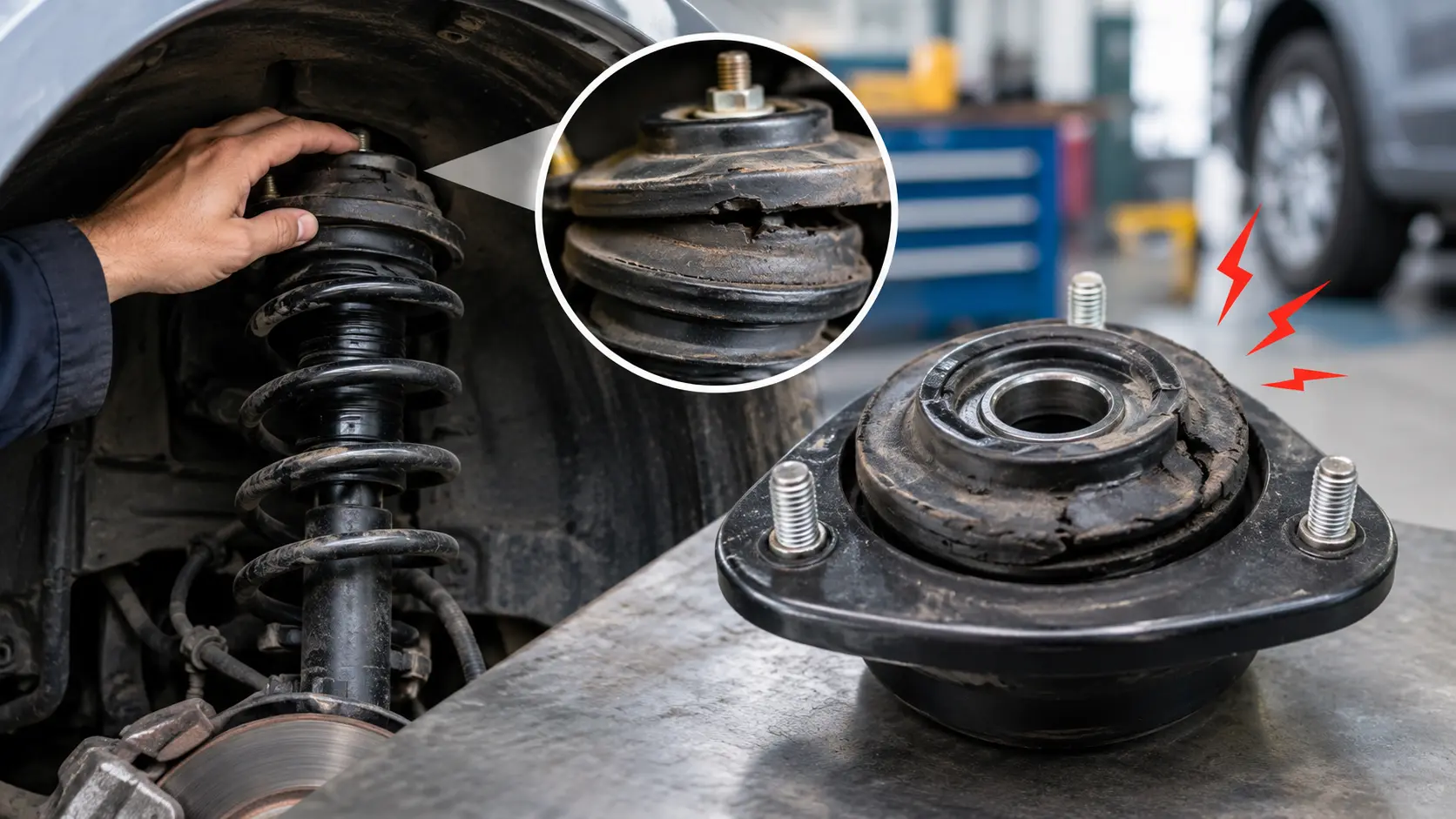
Engine mounts connect the engine to the body and absorb the engine’s rotational vibration. A healthy mount is a sandwich of rubber between two metal plates — the rubber isolates the engine’s vibration from the body.
A failed mount — collapsed rubber, cracked hydraulic chamber, or dried-out rubber — transmits the engine’s natural vibration directly to the body. The result is a car cabin vibrate while stationary that is constant rather than rhythmic — a buzz or tremor that is present at all times when the engine is running, not just at specific RPM.
The key diagnostic test: shift from Drive to Neutral in an automatic transmission. The load on the engine and mounts changes. If the car cabin vibrate while stationary improves significantly in Neutral compared to Drive, the mount is the primary cause — the torque load that changes between Drive and Neutral is what the failed mount cannot isolate.
Hydraulic mounts — used on most modern vehicles — fail by losing their hydraulic fluid through a cracked diaphragm. Once the fluid is gone, the mount has no damping. It looks intact from outside. The fluid loss is only confirmed by inspection of the mount’s condition on the ramp. Our car service packages include an engine mount deflection test at every major service for vehicles over 60,000 km.
Throttle Body Carbon and Hunting Idle
A throttle body with carbon deposits on the bore edges and plate produces an unstable idle. The idle air control system — whether a motorised throttle plate or a separate idle air control valve — cannot find a stable operating position against the irregular carbon deposits.
The result is a hunting idle: the engine RPM rises and falls around the target idle speed. The cabin feels this as a cyclical car cabin vibrate while stationary — the vibration changes character as the RPM rises and falls rather than having a fixed frequency.
In Dubai, throttle body carbon accumulates faster than in highway-dominated markets. Every short trip that never reaches sustained high-combustion-temperature operation deposits carbon on the throttle bore. A Dubai vehicle doing four or five short city trips per day accumulates throttle carbon at a rate that sustained highway driving never produces.
A throttle body cleaning removes the deposits. Post-cleaning, a throttle body adaptation reset through the scan tool teaches the ECU the clean bore dimensions — preventing the ECU from applying its carbon-compensating corrections to the freshly-cleaned bore.
Vacuum Leak Causing a Lean Stumble at Idle
Every intake system component downstream of the mass airflow sensor must be sealed. Any crack, split hose, or failed gasket allows unmetered air into the intake — air the ECU doesn’t know about.
At idle, the fuel injection quantity is at its minimum. An unmetered air leak shifts the air-fuel mixture lean. The ECU compensates by increasing injection quantity — but if the leak is significant or intermittent, the compensation is imperfect. The mixture oscillates between lean and correct, producing a stumble at idle that is felt as car cabin vibrate while stationary.
In Dubai, rubber vacuum hoses harden and crack from UV and heat exposure faster than in any temperate climate. A hose that was flexible and sealed at three years becomes brittle at five years in Dubai’s outdoor conditions. The crack appears first at the connection points where the hose is under the most stress — at the hose end clamps. For any roadside help from a fault that developed into a breakdown, our roadside assistance team covers Al Quoz and nearby Dubai areas at any time.
AC Compressor Load Adding Vibration at Standstill
When the AC compressor engages, it adds a sudden mechanical load to the engine via the belt drive. The ECU compensates by increasing idle RPM slightly to maintain stable running.
On a healthy engine with healthy mounts, this compensation is smooth and invisible. On an engine with a marginal idle — from throttle body carbon or a slightly misfiring cylinder — the compressor load addition pushes the idle below stable and a vibration appears specifically when the AC is running.
The diagnostic indicator: the car cabin vibrate while stationary is present only when the AC is switched on and disappears when the AC is switched off. This pattern confirms that the engine’s idle quality is marginal and the AC compressor load is the tipping point — not the primary cause.
Addressing the underlying idle quality fault — throttle body cleaning, plug replacement — resolves the vibration. Switching the AC off is not the fix; it is confirming where the fault threshold is.
Fuel Injector Issues at Low Idle Demand
A partially blocked fuel injector delivers less fuel than commanded. At high-load driving, the ECU compensates effectively. At idle — where the commanded quantity is already at minimum — a blocked injector cannot deliver even that minimum consistently.
The result is a cylinder running lean at idle, misfiring intermittently, and contributing to the car cabin vibrate while stationary pattern. Unlike a spark plug misfire, an injector fault produces misfires specifically at very low RPM and may clear at higher RPM when the injector’s restriction is less significant relative to the total fuel flow.
A live data scan watching per-injector fuel trim and the misfire count per cylinder at idle identifies the blocked injector before any disassembly. An ultrasonic injector cleaning restores full flow in most cases — full injector replacement is required only where the injector tip is physically damaged.
How Dubai’s Conditions Create Cabin Vibration Earlier
Dubai’s specific driving pattern maximises every mechanism that causes car cabin vibrate while stationary.
Cold starts per year. A Dubai driver doing four or five daily trips completes significantly more cold starts per year than a European driver. Each cold start is a thermal cycle for spark plugs, ignition coils, and engine mounts. More thermal cycles per year means faster degradation of all three.
Short trips and carbon accumulation. Every trip that ends before the engine reaches full operating temperature deposits more carbon on the throttle body and in the combustion chamber. A sustained highway temperature phase cleans combustion deposits. A Dubai vehicle doing only short city trips never reaches this cleaning temperature.
Heat degrading mount rubber. Dubai’s sustained underbonnet temperatures keep engine mount rubber at elevated temperature for more hours per year than any European climate. The rubber degrades from heat independently of mileage — a four-year-old Dubai vehicle may have mount rubber at the end of its service life.
How We Diagnose Car Cabin Vibrate While Stationary
Live misfire scan at idle. The diagnostic scan runs at idle with per-cylinder misfire counts displayed. A cylinder accumulating misfires above the others identifies the specific plug or coil at fault in minutes.
Drive to Neutral comparison. Shifting from Drive to Neutral at idle changes the mount loading. A significant vibration improvement in Neutral confirms mount involvement before any ramp inspection.
Throttle body idle stability observation. Live RPM data is observed at idle for hunting — the RPM rising and falling around target. A stable RPM with rough vibration confirms misfire or mount. A fluctuating RPM confirms throttle body or vacuum fault.
Smoke test for vacuum leaks. A smoke machine pressurises the intake and smoke escapes from any leak point. The exact leak location is confirmed before any hose is replaced.
Mount deflection test. With the vehicle in Drive and brakes applied, gentle throttle is applied while a technician watches powertrain movement. Engine movement beyond the minimal deflection of healthy mounts confirms the failed mount position.
The Services That Fix Each Confirmed Cause
Spark plug replacement. Full set replaced with correct specification. Misfire counters confirmed at zero during post-repair idle observation. AED 400–1,200 depending on engine type.
Ignition coil replacement. Faulty coil identified by cylinder-specific misfire data and confirmed by coil swap test. AED 400–1,200 per coil.
Engine mount replacement. Failed mounts replaced with correct-specification units. AED 500–1,500 per mount. On vehicles with multiple failed mounts, all failed units replaced at the same visit to prevent immediate return for the adjacent mount.
Throttle body cleaning. Professional cleaning with adaptation reset. AED 350–700. For any exterior repairs needed alongside engine work, our car painting team handles colour-matched bodywork at the same visit.
Vacuum hose replacement. Cracked or split hoses replaced. Post-repair smoke test confirms the intake is fully sealed. AED 200–600 depending on the number and location of affected hoses.
Fuel injector cleaning or replacement. Ultrasonic cleaning for confirmed partial blockage. Full replacement where physical damage is confirmed. AED 200–600 for cleaning. AED 400–1,500 per injector for replacement.
What Does the Repair Cost in Dubai?
| Service | Cost Range |
| Spark plug replacement | AED 400–1,200 |
| Ignition coil replacement | AED 400–1,200 per coil |
| Engine mount replacement | AED 500–1,500 per mount |
| Throttle body cleaning | AED 350–700 |
| Vacuum hose replacement | AED 200–600 |
| Fuel injector cleaning | AED 200–600 |
All costs confirmed after the misfire scan and mount deflection test. Written quote before any work begins. Our mobile car mechanic covers Al Quoz and nearby Dubai areas for on-site idle vibration assessment. Our garage near me in Al Quoz serves drivers from Business Bay, Jumeirah, Barsha, Satwa, Downtown, and the Sheikh Zayed Road corridor.
Is It Safe to Keep Driving?
A car cabin vibrate while stationary that is caused by a misfire is driveable carefully for a few days. Avoid sustained hard acceleration — a misfiring cylinder sends unburned fuel to the catalytic converter, which can permanently damage it under sustained misfire.
A mount fault producing severe vibration with visible engine movement: book the same day. Excessive engine movement from failed mounts produces contact with surrounding components — exhaust pipes, brake lines — that creates secondary damage.
A vacuum leak or throttle body fault producing a hunting idle: book within the week. The lean condition it creates can cause additional damage to the oxygen sensors and catalytic converter over time.
Why Rapid Rev Garage?
Car cabin vibrate while stationary has a specific cause in every case — misfire, mount, throttle body, vacuum, or AC load. The misfire scan identifies the cylinder. The Drive-to-Neutral comparison isolates mount involvement. The idle RPM stability confirms the throttle body or vacuum. These three tests take under 30 minutes and identify the cause before any component is opened.
We don’t replace spark plugs based on mileage alone when a misfire fault is present — we confirm which cylinder is misfiring and which specific component is causing it. The repair matches the confirmed fault.
FAQ — Car Cabin Vibrate While Stationary
Here are the questions Dubai drivers ask us most about stationary cabin vibration.
My car vibrates at idle only when the AC is on — should I just turn the AC off?
No. The AC engagement is revealing a marginal idle quality fault — not causing one. The underlying cause is usually throttle body carbon or a misfiring cylinder that is just below the symptom threshold without the AC load. Switching the AC off masks the symptom. The underlying fault continues to develop.
The vibration is worse when the engine is cold — what does that mean?
A cold engine idles at higher RPM initially, then drops to normal idle as it warms. If the vibration is worst during this warm-up phase, the cause is likely cold-sensitive — an ignition coil that cracks under cold thermal stress, or a throttle body carbon pattern that causes stumbling at the transitional RPM during warm-up.
Can a dirty fuel filter cause cabin vibration at idle?
A partially blocked fuel filter reduces the fuel supply under high demand. At idle, fuel demand is at its minimum and a moderately blocked filter rarely causes idle vibration. However, a severely blocked filter reduces rail pressure enough to cause idle stumble on some engines. Fuel pressure testing at idle confirms or eliminates this cause.
My car vibrates in Drive but not in Reverse — is that a mount?
Drive and Reverse produce different torque directions through the drivetrain. If the vibration is direction-specific — present in Drive but not Reverse or vice versa — a failed transmission mount or a specific-direction drivetrain fault is likely. The Drive-to-Neutral comparison is the first test — if Neutral is better than both Drive and Reverse, the mount is confirmed.
How long can I drive on a misfiring cylinder before it damages the catalytic converter?
At idle, the risk is lower because the exhaust flow is slow. Under acceleration with a misfire, unburned fuel reaches the catalytic converter at a higher rate and temperature — damaging the substrate faster. Limit driving to gentle, low-RPM use if a misfire is confirmed. A misfire that has been present for more than two weeks of normal driving may already have partially damaged the converter — a post-repair converter assessment is recommended.
Conclusion
A car cabin vibrate while stationary comes from one of five causes — misfire from worn ignition components, a failed engine mount, throttle body carbon producing a hunting idle, a vacuum leak causing lean stumble, or AC compressor load exposing a marginal idle. In Dubai, all five develop faster than in cooler markets — heat, short trips, and high cold-start frequency accelerate every mechanism.
Rapid Rev Garage in Al Quoz diagnoses every car cabin vibrate while stationary complaint with a live misfire scan, Drive-to-Neutral comparison, and idle RPM stability observation before any repair is recommended.
Rapid Rev Garage is in Al Quoz, serving Business Bay, Jumeirah, Downtown, Barsha, Satwa, and the Sheikh Zayed Road corridor. Book your appointment on WhatsApp or find us on Google Maps.
Rapid Rev Garage — Car Cabin Vibrate While Stationary | Al Quoz, Dubai