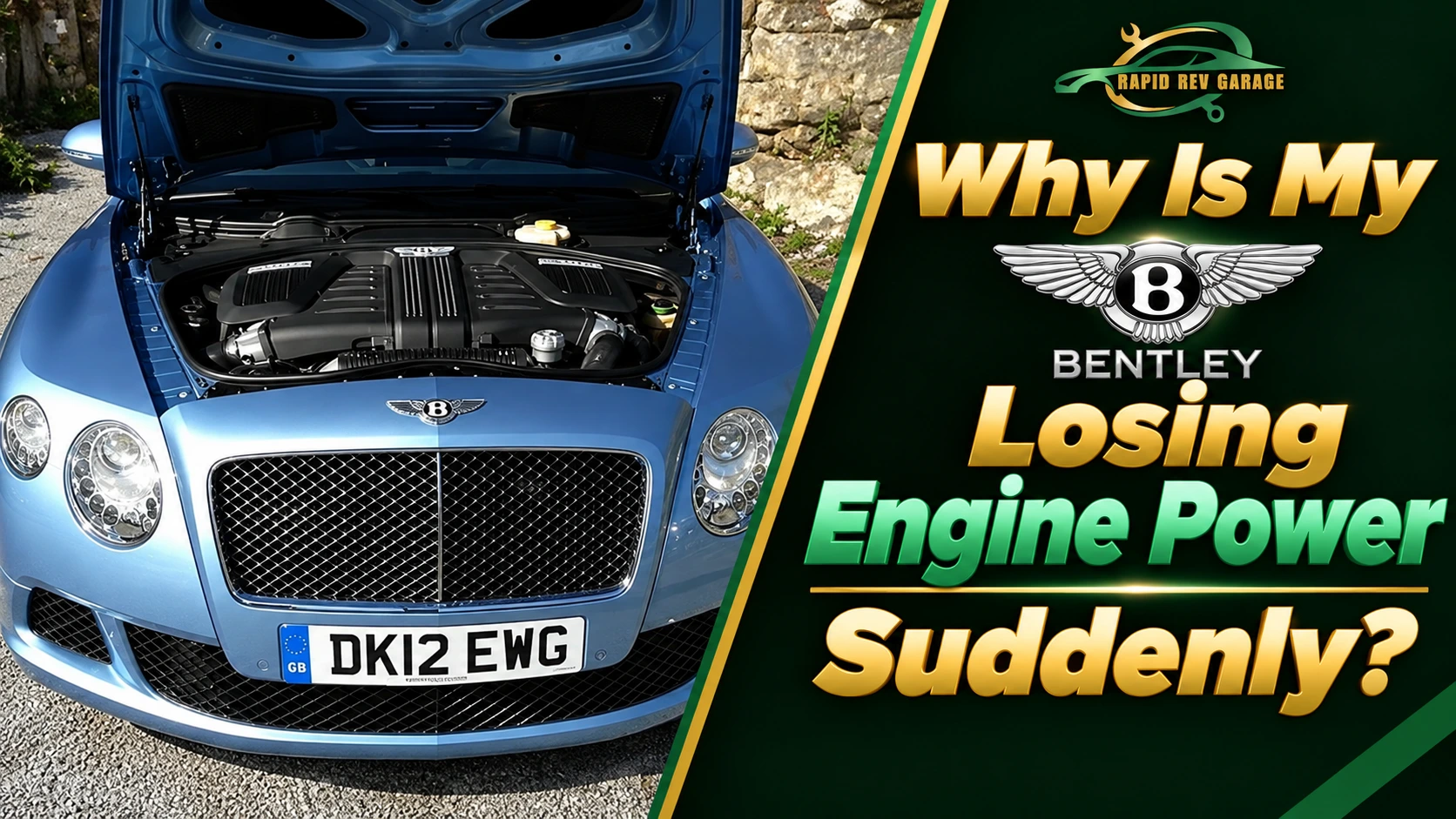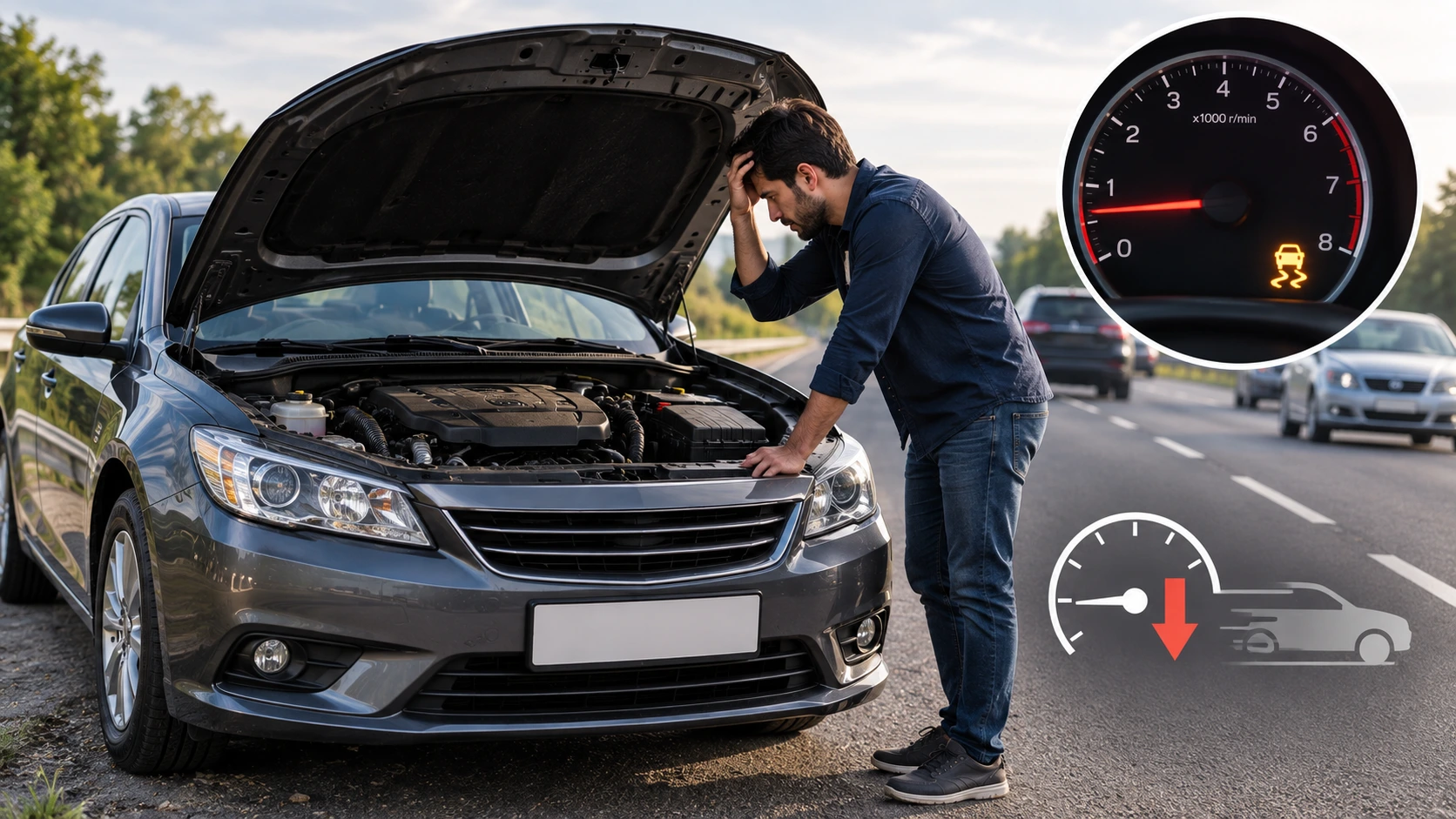
When a car suddenly lose performance, the acceleration that was responsive yesterday feels sluggish today, the car that merged confidently onto Sheikh Zayed Road now struggles to reach speed, or a turbo vehicle that was pulling strongly has lost its push under load — the fault has appeared acutely rather than developing gradually. This sudden onset is diagnostically useful: a sudden performance drop points toward a specific fault that has crossed a threshold or failed outright, rather than the gradual wear that produces progressive power loss.
At Rapid Rev Garage in Al Quoz, when a car suddenly lose performance, the diagnosis identifies what changed — what component reached its failure threshold, what sensor crossed its fault boundary, or what system collapsed — to produce an immediate, noticeable change rather than a gradual deterioration.
Car Suddenly Lose Performance — Quick Verdict
A car suddenly lose performance situation in Dubai is most commonly caused by one of seven faults: a turbocharger boost fault from a split boost pipe or failed actuator — the most immediately dramatic performance loss on turbocharged vehicles; an ignition coil failure that removes one cylinder from contributing to power output; a mass airflow sensor that has suddenly failed rather than progressively degraded; a sudden clog of the fuel filter reaching a complete restriction threshold; a timing chain jump on higher-mileage engines that suddenly retards timing significantly; a throttle body that has accumulated carbon to the point of sudden throttle plate sticking; or the engine management system entering limp mode from a sensor fault that commands maximum fuel safety restriction. Each cause produces a specific pattern in the data that a diagnostic scan and targeted road test identifies before any component is replaced.
Table of Contents
- Why Sudden Performance Loss Is Different From Gradual Power Loss
- Reading the Sudden Drop — When and How It Appeared
- Turbocharger Boost Failure — The Most Dramatic Sudden Loss
- Single Cylinder Loss From Ignition Coil Failure
- MAF Sensor Sudden Failure
- Fuel Filter Complete Restriction
- Timing Chain Jump or Cam Timing Fault
- Engine Management Limp Mode — The Safety Restriction
- Throttle Body Sticking or Carbon Lock
- How Dubai’s Conditions Produce Sudden Performance Failure
- How We Find the Exact Cause at Rapid Rev Garage
- The Right Fix for Each Confirmed Cause
- What Happens If Sudden Performance Loss Is Driven Through
- Is It Safe to Keep Driving?
- How Long the Repair Takes
- What the Repair Costs in Dubai
- Why Rapid Rev Garage?
- FAQ
- Conclusion
Why Sudden Performance Loss Is Different From Gradual Power Loss
The onset pattern is the most important diagnostic information when a car suddenly lose performance.
What Sudden Means in Diagnostic Terms
When a car suddenly lose performance within a specific drive — or even at a specific moment during a drive — rather than developing over weeks or months. The driver can often identify approximately when it happened: “it happened when I accelerated onto the highway,” “it started after I stopped at the traffic light,” “it happened during the school run this morning.” This specificity is valuable — it identifies the operating condition that triggered the fault.
Why Sudden Loss Points Toward a Different Component Category
Gradual performance loss points toward progressive wear — piston rings, turbocharger seals, spark plug electrode wear. Sudden performance loss points toward threshold failures — a component that was borderline and has now crossed its failure point, or a component that has failed outright. The diagnostic approach is therefore different: rather than compression testing and turbocharger seal assessment, sudden loss diagnosis prioritises the systems that can fail acutely — ignition coils, boost pipes, MAF sensors, limp mode triggers.
The Warning Light as a Timing Marker
A car suddenly lose performance fault that coincided with a check engine light appearing has a fault code stored at the moment of the performance change. That code is the most direct diagnostic information available — it identifies the system the management system recognised as faulting at the moment the performance changed. Reading it is the first physical diagnostic action.
Reading the Sudden Drop — When and How It Appeared
The specific conditions under which the performance dropped identify the fault category before any scan tool is connected.
Sudden Loss Under Hard Acceleration
Performance that is fine at light throttle but suddenly dropped under full acceleration — specifically at the moment of hard throttle application — points toward a boost system fault. A boost pipe that splits under full boost pressure, or a boost solenoid that fails under the duty cycle of full load, produces exactly this pattern: normal at part throttle, sudden loss the moment full throttle is applied.
Sudden Loss at Idle, Affecting All Driving Conditions
A performance drop that happened while the car was idling at a traffic light — and now affects all driving — points toward an ignition coil, a sensor failure, or a limp mode trigger. The engine is now running on a compromised base condition that affects all driving rather than a load-specific failure.
Performance Drop That Appeared After a Restart
A car that was running normally, was switched off, and then started again performing poorly has developed a fault that persists through a key cycle rather than resolving with restarting. This rules out a momentary sensor glitch and confirms a fault that needs investigation.
Performance Drop Specific to One RPM Band
A performance drop that is only present in a specific RPM range — the engine pulls normally below 3,000 RPM and loses power above it, or feels normal above 2,000 RPM and hesitates below it — points toward a turbocharger threshold fault, a variable valve timing fault, or a specific fuel delivery issue at those operating conditions.
Turbocharger Boost Failure — The Most Dramatic Sudden Loss
A turbocharged engine that has suddenly lost its boost pressure experiences the most dramatic performance drop of any fault on this list — because the turbocharger can contribute 30–50% of the engine’s peak power output, and losing it suddenly is immediately and unmistakably noticeable.
Split or Disconnected Boost Pipe
The most common cause of sudden boost loss in Dubai is a split or disconnected intercooler pipe or boost hose. These silicone or rubber pipes carry pressurised air between the turbocharger compressor and the engine — and a pipe that has been partially cracked from heat cycling can split completely under the first full boost event of a drive. The performance drop is immediate and dramatic — the engine suddenly feels like it has lost 40% of its power, which it effectively has.
The Hissing Sound as a Diagnostic Clue
A split boost pipe often produces an audible hiss under acceleration — the pressurised air escaping through the split. A driver who notices both a hissing sound and a sudden performance drop has confirmed the boost pipe as the cause before any workshop visit. A smoke or pressurisation test of the intake system pinpoints the exact split location.
VGT Actuator Sudden Failure
Variable geometry turbocharger actuators that have been accumulating carbon deposits can suddenly seize — producing a turbocharger that is locked at a fixed blade position rather than adjusting for optimal boost across the RPM range. The performance drop is most pronounced at the RPM range that requires blade angle adjustment — typically below 2,500 RPM where VGT contributes most to low-end torque on diesel engines. Our car mechanic team reads VGT actuator position and target discrepancy data as the first turbocharged-engine check when sudden boost loss is the complaint.
Single Cylinder Loss From Ignition Coil Failure
An ignition coil that fails completely — rather than the gradual decline that produces a load-dependent misfire — removes its cylinder from contributing to power output entirely. On a four-cylinder engine, this is a 25% power reduction. On a six-cylinder, 17%. Either is immediately noticeable as a sudden performance loss.
How Complete Coil Failure Feels Different From Progressive Coil Decline
A coil that is declining produces misfires under specific high-load conditions. A coil that has failed completely produces a consistent misfire on its cylinder at all RPM and load conditions — the engine runs on three or five cylinders regardless of throttle input. The performance loss is constant rather than load-dependent, and the engine often produces a consistent rough idle alongside the power loss.
The Check Engine Light Pattern
A failed ignition coil almost always triggers a check engine light immediately — the misfire counter for the affected cylinder reaches the fault threshold quickly when the cylinder is consistently misfiring. The fault code identifies the specific cylinder — P0301 through P0306 for cylinders one through six — immediately directing the diagnosis to the coil and spark plug on that cylinder.
MAF Sensor Sudden Failure
A mass airflow sensor can fail suddenly rather than degrading gradually. A MAF sensor that fails completely produces a specific engine management response — the ECU switches to a default fuelling map based on throttle position and RPM rather than actual air mass data.
What the Default Fuelling Map Feels Like
The default fuelling map is conservative and imprecise compared to normal closed-loop operation. The engine may run noticeably richer or leaner than optimal, producing either a slightly flat, sluggish throttle response with black exhaust smoke, or a lean stumble under acceleration. The performance loss is real but typically moderate — not as dramatic as a boost failure — and is often accompanied by a check engine light.
Why Complete MAF Failure Differs From Contamination
A contaminated MAF sensor produces gradual performance deterioration as the contamination builds up on the sensing element. A failed MAF sensor produces a sudden switch to the default fuelling map — a step change rather than a gradual decline. The diagnostic distinction is confirmed by comparing MAF output during the road test: a contaminated sensor produces readings that are present but inaccurate; a failed sensor produces no signal or a static default value.
Fuel Filter Complete Restriction
A fuel filter that has been accumulating restriction over thousands of kilometres can reach the point of complete restriction suddenly — the last few percent of blockage produces a disproportionately large drop in fuel flow. A driver whose vehicle has been subtly losing fuel delivery capacity may notice the final complete restriction as a sudden dramatic power loss.
The High-Load Trigger Pattern
Fuel filter complete restriction typically presents most dramatically under full load — the engine manages light-throttle driving on what fuel gets through the near-total restriction, but under full throttle where fuel demand is maximum, the filter cannot supply enough and the engine stumbles severely. For any breakdown from a sudden performance failure, our roadside assistance covers Al Quoz and nearby Dubai areas.
Engine Management Limp Mode — The Safety Restriction
Limp mode — also called fail-safe mode or reduced performance mode — is the engine management system’s protective response to a sensor or actuator fault that it cannot safely resolve during normal operation. The system dramatically reduces fuel delivery, ignition advance, and in turbocharged vehicles, boost pressure — to a level where the engine can continue operating without risk of damage from the faulting component.
What Limp Mode Feels Like
A car suddenly lose performance from limp mode feels dramatically restricted — as if the accelerator is physically limited to 30–40% of its normal travel. The engine will not accelerate beyond a specific RPM or speed regardless of throttle input. The check engine light is almost always illuminated. The vehicle typically drives but without any meaningful performance.
What Triggers Limp Mode
Common limp mode triggers include throttle position sensor fault, turbocharger boost pressure outside acceptable limits, transmission overtemperature, oil pressure warning, and multiple simultaneous sensor faults. A diagnostic scan reads the specific fault code that triggered limp mode — resolving the trigger releases the restriction.
Clearing Limp Mode
Some limp mode events are self-clearing after a key cycle — the fault resolves, the engine management resets, and the performance returns. A limp mode that is self-clearing is still a fault that produced a fault code and should be diagnosed — a fault that triggers limp mode intermittently will trigger it more frequently as the underlying cause develops. Our car service packages include a multi-module diagnostic scan as part of every service — catching stored limp mode events from previous drives that the driver may not have connected to a service need.
Throttle Body Sticking or Carbon Lock
A throttle body that has accumulated carbon deposits can develop sudden sticking — the throttle plate that was opening correctly yesterday has accumulated enough carbon on its bore edge to prevent full-range movement today. The symptom is typically a throttle that feels restricted at a specific position — full acceleration produces a fraction of the expected response because the plate cannot reach its fully-open position.
How Dubai’s Conditions Produce Sudden Performance Failure
Dubai’s heat, dust, and driving patterns all contribute to the component conditions that produce sudden performance loss.
Heat Cycling Cracks Boost Pipes
Silicone and rubber boost pipes cycle between the cool of underground parking and the sustained heat of a highway run. The pressure and temperature differential that this cycling produces fatigue the pipe material at stress points — bends, clamp locations, and connector lips. A pipe that has been fatiguing through cycles can split suddenly on the first full-boost event of a drive that takes the pipe beyond its fatigue tolerance.
Carbon Accumulation Reaches Critical Thresholds
Carbon builds up gradually but its effect on performance is not linear — a throttle body with 80% of its bore clear operates almost normally, but the same body at 50% clear produces an immediate, noticeable restriction. The jump from marginal to problematic can happen within a single oil change interval in Dubai’s stop-start driving pattern.
Dust-Contaminated MAF Sensors Fail Suddenly
A MAF sensor contaminated by Al Quoz industrial dust can operate in a degraded but functioning state for thousands of kilometres and then fail suddenly when a dust particle finally bridges a critical gap in the sensing element. The gradual contamination that preceded the failure produced subtle performance degradation; the final failure produces the sudden drop.
How We Find the Exact Cause at Rapid Rev Garage
The diagnostic sequence starts with the fault code stored at the moment of the performance drop — the most direct evidence.
Diagnostic Scan — Fault Codes and Live Data First
Every sudden performance loss diagnosis starts with a full multi-module scan. The fault code stored at the moment of the performance change is the most direct evidence of the cause. Where no code is present, live data during a road test that replicates the sudden loss condition captures the specific parameter that fails under those conditions.
Road Test Under the Fault Conditions
The road test specifically replicates the conditions under which the performance dropped — full throttle acceleration, specific RPM ranges, or the starting conditions. Live data streaming during the test captures boost pressure, MAF output, throttle position, fuel trim, and misfire counters at the moment the performance drops.
Targeted Component Testing
Based on the fault code and live data findings, targeted testing confirms the specific component — boost pipe smoke test, coil swap test, MAF output voltage assessment, fuel pressure under full load.
The Right Fix for Each Confirmed Cause
Each repair is matched to the specific cause confirmed by the code reading and road test data.
Boost Pipe Replacement
A split boost pipe is identified by the smoke test and replaced with the correct pipe for the specific turbocharger outlet and intercooler inlet. All adjacent hose clamps are inspected and retorqued at the same time.
Ignition Coil Replacement
The failed coil is confirmed by the cylinder-specific fault code and coil swap test, then replaced with a correct-specification unit. The spark plug on the same cylinder is replaced at the same time.
MAF Sensor Cleaning or Replacement
MAF cleaning if contamination is the cause, replacement with a correct-specification sensor if the sensor has failed outright. Post-replacement fuel trim adaptation is monitored during a road test.
Fuel Filter Replacement
The fuel filter is replaced and fuel pressure under load is confirmed to have returned to specification after replacement.
Limp Mode Fault Resolution
The specific fault code that triggered limp mode is addressed — sensor replacement, actuator repair, or software update depending on the specific trigger identified.
Throttle Body Cleaning
Carbon deposits are removed using professional throttle body cleaning procedure, followed by a throttle adaptation reset through the scan tool. For exterior work needed alongside any engine repair, our car painting team handles colour-matched repairs at the same visit.
What Happens If Sudden Performance Loss Is Driven Through
Driving through a sudden performance loss without investigation has different consequences depending on the cause.
Boost Pipe Loss — Turbocharger Oil Starvation Risk
A turbocharged engine running without boost because of a split pipe is also potentially running at higher-than-normal exhaust temperatures as the engine works harder to produce the same output. Extended driving in this condition stresses the turbocharger beyond its normal thermal load.
Limp Mode — Continued Restriction Won’t Self-Correct
A car in limp mode that continues to be driven is operating on a safety restriction. The underlying fault that triggered limp mode continues to develop — and the protective restriction may deepen rather than release over time, producing a vehicle that eventually cannot be driven usefully at all.
Is It Safe to Keep Driving?
The urgency depends on the severity of the performance drop and whether any unusual sounds or warning lights accompany it.
Moderate Sudden Performance Drop — Drive Carefully to Workshop
A performance drop of 20–30% with the engine running smoothly otherwise, no unusual sounds, and a steady (not flashing) check engine light: drive carefully to the workshop within the next day or two.
Severe Sudden Performance Drop or Unusual Sounds — Workshop Today
A performance drop of more than 30%, any unusual engine sounds alongside the loss, or a flashing check engine light: drive to the workshop directly or arrange recovery. Do not use the vehicle for non-essential driving.
How Long the Repair Takes
Repair time depends on the confirmed cause — some resolve same-day, others require parts and more time.
Quick Repairs
Boost pipe replacement: one to two hours. Ignition coil replacement: one to two hours. MAF sensor work: one to two hours.
Moderate Repairs
Fuel filter replacement: one to two hours. Throttle body cleaning and adaptation: two to three hours.
More Involved Repairs
Timing chain and VGT actuator work: four to eight hours depending on the engine. A written estimate is provided after the diagnostic confirms the specific cause. Our mobile car mechanic covers Al Quoz and nearby Dubai areas for on-site initial scan and boost pressure assessment.
What the Repair Costs in Dubai
Cost depends on the confirmed cause from the diagnostic sequence.
Boost Pipe and Coil Work
Boost pipe replacement: AED 300–800 depending on the pipe and access complexity. Ignition coil replacement: AED 400–1,200 depending on vehicle and coil specification.
Sensor and Filter Work
MAF sensor: AED 200–1,800 depending on vehicle. Fuel filter: AED 250–600. Throttle body cleaning: AED 350–700.
Turbocharger and Timing Work
VGT actuator cleaning or replacement: AED 800–2,500. Timing chain kit: AED 1,500–4,500. A written quote follows the diagnostic confirmation. Our garage near me location in Al Quoz serves drivers from Business Bay, Jumeirah, Barsha, Satwa, Downtown, and the Sheikh Zayed Road corridor.
Why Rapid Rev Garage?
When a car suddenly lose performance, the diagnostic priority is identifying what changed — not what is most likely to be wrong in general. A boost pipe fault, an ignition coil failure, a limp mode trigger, and a MAF sensor failure all produce sudden performance drops with different root causes and different urgency levels. The fault code stored at the moment of the performance change, combined with a road test that replicates the fault conditions, produces an accurate diagnosis rather than a parts-swapping exercise.
FAQ — Car Suddenly Lose Performance
These are the questions most frequently asked when sudden performance loss appears.
Why did my car lose power suddenly and then recover?
A fault that triggers and then resolves — limp mode that cleared on restart, an intermittent boost solenoid, or a MAF sensor that briefly lost signal — produces this pattern. The fault code from the event is stored even after performance returns. Read it before the next occurrence.
Can bad fuel cause a sudden performance drop?
Contaminated fuel — from a station with a fuel quality issue or from accidental incorrect fuel type — can produce sudden performance loss when the affected fuel reaches the injectors. If the timing correlates with a specific fuel fill, drain and refill with correct specification fuel as the first step.
Why does my turbocharged car feel like a naturally aspirated engine?
A turbocharged engine that has suddenly lost all boost pressure from a failed or split pipe produces this exact description — the engine makes only its naturally aspirated power output. This is almost always a boost pipe or boost solenoid fault rather than turbocharger internal failure.
Is limp mode dangerous to drive in?
Limp mode is designed to allow the vehicle to reach safety or a workshop — not to be driven in indefinitely. The underlying fault that triggered it continues to develop. Investigate and resolve the trigger promptly.
Should I drive to a workshop or get the car recovered?
If the performance drop is severe enough that the vehicle cannot safely merge onto a highway or maintain traffic speed, recovery is safer than driving. If the vehicle can still drive safely at reduced performance, drive directly to the workshop.
Conclusion
A car suddenly lose performance is a specific diagnostic event — a fault that crossed a threshold or failed outright, producing an immediate and noticeable change. The sudden onset is the most useful diagnostic clue: it points toward ignition coil failure, boost pipe splits, MAF sensor failure, limp mode triggers, and fuel filter restriction — the components that fail acutely rather than wear gradually. Rapid Rev Garage in Al Quoz diagnoses every sudden performance loss with a fault code reading and a load-condition road test before any component is recommended for replacement.
Rapid Rev Garage is in Al Quoz, serving drivers across nearby Dubai areas — Business Bay, Jumeirah, Downtown, Barsha, Satwa, and the Sheikh Zayed Road corridor. Book your appointment on WhatsApp or find us on Google Maps.
Rapid Rev Garage — Car Suddenly Lose Performance | Al Quoz, Dubai