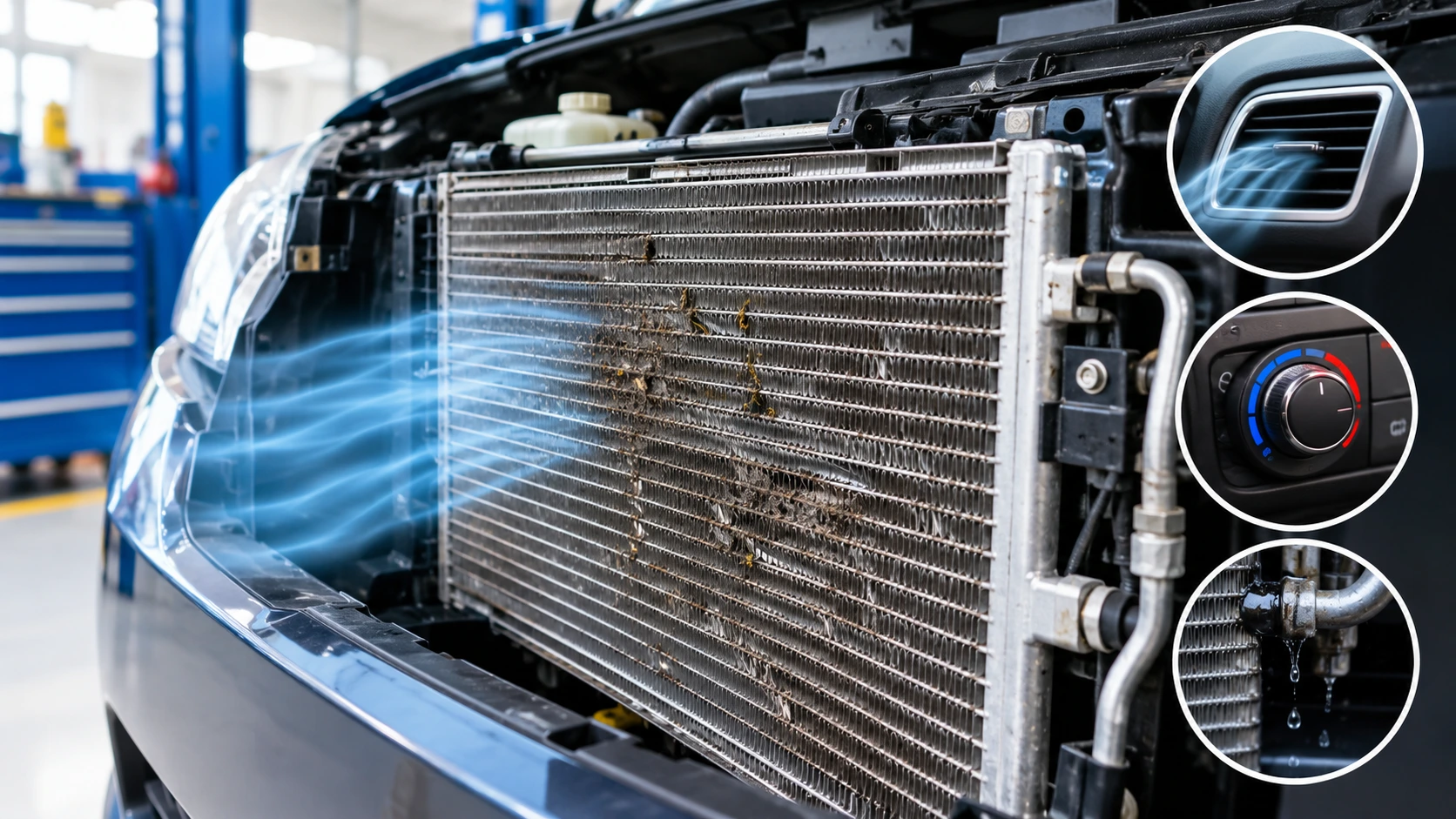
The AC blows nicely cold while you cruise along Emirates Road. As soon as you stop at the lights or crawl through the Dubai Mall car park, the air turns lukewarm. Then it cools again once traffic moves. This pattern is one of the most common bad AC condenser symptoms, and it usually means the condenser at the front of the car cannot get rid of heat when there is no road speed to help it.
The condenser sits in front of the radiator, behind the grille and bumper. It is the first thing stones, sand and insects hit, and it takes the full force of Dubai’s summer heat. When it is blocked, bent or leaking, the whole AC system struggles.
Before anyone adds gas, an AC repair specialist will normally check the system pressures and look at the condenser fins and fans. This guide explains what the condenser does, the signs it is failing, why it fails in Dubai, how it is tested and what replacement involves.
Bad AC Condenser Symptoms: Quick Answer
The main bad AC condenser symptoms are AC that cools on the highway but turns warm at idle, weak cooling overall, AC gas that keeps running low, oily patches or dye on the condenser, bent or packed fins behind the grille, very high pressure on the high side, a compressor that keeps cutting out and an engine that runs hot in traffic.
SlashGear notes that a condenser blocked by debris, damaged or short of airflow cannot release heat, so the air will not be cool. A mechanic checks pressures with gauges, inspects the fins and fans, and uses dye or a detector to find leaks before replacing the condenser.
Table of Contents
- What the AC Condenser Does
- Why Condensers Fail Faster in Dubai
- AC Cold While Driving but Warm at Idle
- Weak Cooling on Hot Afternoons
- AC Gas That Keeps Running Low
- Oily Patches or Dye on the Condenser
- Bent, Blocked or Packed Fins
- Very High Pressure and a Compressor That Cuts Out
- Engine Running Hot in Traffic
- Damage After a Front End Knock
- Faults That Look Like a Bad Condenser
- How a Workshop Tests an AC Condenser
- Cleaning or Replacing the Condenser
- What Condenser Replacement Involves
- Can a Small Condenser Leak Be Repaired?
- How to Protect the Condenser
- What Is the Receiver Drier Built Into Many Condensers?
- Is Condenser Damage Covered by Insurance?
- FAQ
- Conclusion
What the AC Condenser Does
The condenser is a thin radiator for the AC system. The compressor squeezes the refrigerant into a hot, high pressure gas and sends it to the condenser. Air flowing through the condenser fins cools the gas until it turns into a liquid.
That liquid then travels to the expansion valve and the evaporator behind the dashboard, where it absorbs heat from the cabin air. Without a working condenser, the refrigerant stays hot, the pressure climbs and the cooling drops.
The condenser relies on airflow. At speed, road air does most of the work. At idle, the electric cooling fans pull air through it. Anything that blocks the fins or stops the fans hurts cooling, most of all when the car is stopped.
Why Condensers Fail Faster in Dubai
Position is the main reason. The condenser sits right behind the grille, so it takes stones from the road, sand from desert winds and insects on highway drives. Fins get bent, packed and corroded, and stone strikes can puncture the thin tubes.
Heat is the second. On a summer afternoon when the air passes 45°C, the condenser has to cool refrigerant using air that is already very hot. The smaller the temperature difference, the harder it works and the higher the pressures run.
Dust adds the third. Dust storms and construction dust pack the fins, especially on cars parked outside or driven daily through industrial areas such as Al Quoz. A layer of dust can cut airflow sharply even when the fins look fine from a distance.
AC Cold While Driving but Warm at Idle
This is the classic condenser pattern. At highway speed, a strong flow of air passes through the condenser, enough to cool the refrigerant even if the fins are partly blocked. At idle, the fans alone cannot push enough air through blocked fins.
As the refrigerant stays hot, high side pressure rises. The system may shut the compressor off to protect itself, and the vents blow warm air until the car moves again.
The same pattern comes from a failed cooling fan or fan relay. A mechanic checks that the fans run at full speed with the AC on before blaming the condenser. The guide on bad cooling fan relay symptoms explains that fault.
Weak Cooling on Hot Afternoons
A partly blocked or damaged condenser may cope in the cooler months, then struggle when temperatures peak. Drivers often notice the AC is fine in the morning but weak on the drive home in the afternoon.
The difference is how much heat the condenser can shed. On a mild day, a partly blocked condenser has enough margin. On a very hot day, it does not, and cooling drops.
Weak cooling can also come from low gas, a failing compressor or a faulty expansion valve. The guide on bad AC expansion valve symptoms explains how gauge readings separate those faults.
AC Gas That Keeps Running Low
Condensers are one of the most common leak points in a car AC. Their thin tubes sit at the front, exposed to stones, corrosion and vibration. A small pinhole lets refrigerant escape slowly, and the cooling fades over weeks.
If the AC needs a top up every few months, the gas is leaking somewhere. SlashGear notes that simply adding more refrigerant will not fix the underlying problem. Each top up also lets moisture into the system.
A leak test before any recharge saves money. Finding and fixing the leak once is cheaper than paying for repeated top ups that never last.
Oily Patches or Dye on the Condenser
AC refrigerant carries a small amount of oil to lubricate the compressor. When refrigerant leaks, it leaves an oily residue at the leak point. On the condenser, this shows as a dark, oily patch that collects dust.
Many workshops add UV dye to the system during a recharge. If the condenser leaks, the dye glows yellow or green under a UV lamp at the leak point.
Look through the grille with a torch for wet or dusty patches on the condenser. Oily areas near the edges, the pipe connections or the lower corners are common leak points. A leak at a pipe connection is often a worn O ring rather than a failed condenser, which is a much cheaper fix.
Bent, Blocked or Packed Fins
Bent or flattened fins block airflow just like dirt does. Stones, pressure washers and minor knocks flatten fins over time. A condenser with large flattened areas cools far less than one with straight fins.
Packed fins are just as common. Dust, sand, insects, leaves and plastic bags can cover large parts of the condenser surface. Mechanical Malarkey describes a case where the radiator behind a clean looking condenser was caked with dirt, which pushed AC pressures up.
A few bent fins do little harm. Large blocked areas need cleaning or, if the fins are badly damaged, a new condenser.
Very High Pressure and a Compressor That Cuts Out
A condenser that cannot cool the refrigerant causes very high pressure on the high side. Mechanical Malarkey describes high side pressure reaching about 500 psi at 3,000 rpm before the pressure switch shut off the compressor, caused by dirt blocking airflow through the radiator and condenser.
When the pressure switch trips, the compressor stops and the vents blow warm air. Once the pressure drops, the compressor restarts. This on and off cycling wears the compressor clutch.
Very high pressure also puts strain on hoses, seals and the compressor itself. Fixing the airflow problem protects the rest of the system.
Engine Running Hot in Traffic
The condenser sits in front of the radiator, so a blocked condenser also blocks airflow to the radiator. The engine may run hotter in traffic, and the temperature gauge may climb on summer afternoons.
At the same time, the heat from a hot condenser warms the air reaching the radiator. Both systems suffer together.
If your engine runs hot and the AC is weak at the same time, a blocked condenser or radiator is a likely cause. The guide on clogged radiator symptoms explains how to tell where the blockage is.
Damage After a Front End Knock
Even a light front end bump can damage the condenser. Car park knocks, kerbs and minor collisions push the bumper back into the condenser, bending fins or cracking tubes and fittings.
The AC may work at first, then lose gas over days or weeks through a crack. Drivers often do not link the AC problem to the knock.
If the front bumper has been damaged, have the condenser checked during the bumper repair. Stone chips and scrapes on the bumper itself may also need paint and panel repair. For accident damage, the police report rules apply, and the condenser can usually be included in the insurance claim.
Faults That Look Like a Bad Condenser
Several faults cause the same symptoms. A failed cooling fan or fan relay stops airflow at idle. A blocked radiator behind the condenser cuts airflow to both. Low gas from a leak elsewhere causes weak cooling.
An overcharged system runs high pressure without any condenser fault. A failing compressor cannot build enough pressure. A blocked expansion valve or receiver drier restricts flow.
Testing the fans, checking the radiator and reading pressures with gauges separates these faults before a new condenser is fitted.
How a Workshop Tests an AC Condenser
A proper test starts with a visual check through the grille and, if needed, with the bumper or grille removed. The mechanic looks for bent fins, packed dirt, oily patches and stone damage.
Next, gauges are connected to the high and low service ports. With the AC on full and the engine at idle, then at a higher speed, the mechanic compares the pressures with the manufacturer’s chart. High side pressure that climbs at idle and drops at speed points to an airflow problem.
The mechanic checks that the cooling fans run at full speed with the AC on, measures the temperature across the condenser and uses UV dye or an electronic detector to find leaks. Book these tests with an experienced car mechanic near you before paying for a new condenser.
Cleaning or Replacing the Condenser
If the condenser is dirty but not leaking, cleaning often restores cooling. Fins are cleaned with low pressure water or air, blowing from the engine side outward. Mechanical Malarkey describes removing the condenser and fans and spraying water through to restore normal pressures.
If the condenser is leaking, badly bent or corroded, it needs replacing. Many modern condensers have the receiver drier built in, so the drier is replaced with it.
Never use a high pressure washer close to the fins. It flattens them and reduces airflow further.
After cleaning, the mechanic rechecks the pressures at idle with the AC on full. If the high side pressure is back within the normal range for the outside temperature, the condenser can stay. If it is still high, the condenser or the fans need further work.
What Condenser Replacement Involves
The refrigerant is first recovered with a recovery machine. On many cars, the front bumper and sometimes the headlights come off to reach the condenser. The AC lines are disconnected and the condenser is removed.
A new condenser is fitted with new O rings, lubricated with the correct AC oil. The receiver drier or desiccant is replaced if it is separate. The correct amount of compressor oil is added to replace what was in the old condenser.
The system is vacuumed to remove moisture and air, checked for leaks and recharged with the exact amount and type of refrigerant. The mechanic then checks pressures and vent temperature at idle and at speed.
Can a Small Condenser Leak Be Repaired?
Usually not. Condenser tubes are thin aluminium, and repairs to pinholes rarely last under the high pressure the system runs at. Welding or epoxy repairs often fail again within weeks.
Leak sealers added to the refrigerant may slow a tiny leak but can clog the expansion valve and contaminate workshop equipment. Many workshops will not work on systems that contain sealer.
In most cases, replacing the condenser is the reliable fix. A fitting or O ring leak at the pipe connections, though, can often be fixed by replacing the seal alone.
Does a Bad Condenser Affect Fuel Use?
Yes, slightly. A blocked or failing condenser makes the compressor run harder and for longer, because the system pressure is higher. The compressor takes its power from the engine, so the engine uses more fuel.
The cooling fans also run more, which draws more power from the alternator. On a car that sits in Dubai traffic with the AC on for long periods, the extra load adds up.
Cleaning a dirty condenser often makes the AC colder and quieter, and can reduce the load on the engine.
How to Protect the Condenser
Have the condenser fins checked and cleaned at services, especially after dust storms and long highway drives. Keep the grille clear of leaves and plastic bags. Use a grille mesh if your car is often driven on gravel roads.
Fix leaks properly rather than topping up again and again. Make sure any recharge includes a vacuum to remove moisture. Have the cooling fans tested before summer.
A regular car service in Dubai includes an AC performance check. If the AC is weak at home, a mobile mechanic can check the fans and look at the condenser fins. If the compressor seizes or the belt breaks on a highway, reach the hard shoulder rather than stopping in a live lane, which brings a AED 1,000 fine and six black points under Article 98 of the UAE Federal Traffic Law, then call roadside assistance. For a full test with gauges, choose a car garage near you.
What Is the Receiver Drier Built Into Many Condensers?
Many modern condensers have the receiver drier built into one side. The drier holds a material that absorbs moisture and traps debris in the refrigerant, protecting the expansion valve and compressor.
When the condenser is replaced, the built in drier comes with it. On cars with a separate drier, it is usually replaced at the same time, because opening the system lets moisture in and an old drier may already be saturated.
A saturated drier lets moisture travel through the system, where it can freeze at the expansion valve or form acid with the oil. Replacing it is a small cost that protects the rest of the AC.
Is Condenser Damage Covered by Insurance?
If the condenser was damaged in an accident, such as a front end collision or a car park knock, it is usually covered by a full cover insurance claim along with the bumper and other parts. Gulf News reports that under UAE law, garages cannot repair accident damage without approval from the licensing authorities, which means a police report is needed first.
Condenser failure from age, corrosion or stone chips over time is usually treated as wear and tear, so it is not covered. A stone strike that causes a sudden leak can be harder to classify, so check your policy.
For accident damage, an accident repair workshop can include the condenser, radiator and AC recharge in the same job.
FAQ
Here are the questions Dubai drivers most often ask about AC condensers.
Why is my AC warm at idle?
The most common causes are a blocked or damaged condenser, a failed cooling fan or a fan relay fault. At idle, the fans alone must push air through the condenser. If airflow is poor, pressure rises and cooling drops.
Can a dirty condenser stop AC cooling?
Yes. Dust, sand and insects packed in the fins block airflow, so the refrigerant cannot cool. Pressure rises, and the compressor may cut out. Cleaning the fins often restores cooling if the condenser is not leaking.
How do I know my condenser leaks?
Look for oily, dusty patches on the condenser through the grille. Workshops use UV dye, which glows at the leak point under a UV lamp, or an electronic detector. AC gas that keeps running low is a strong sign.
Can a condenser leak be repaired?
Usually not reliably. The thin aluminium tubes rarely hold a repair under high pressure. Replacing the condenser is the normal fix. Leaks at a pipe fitting can often be fixed by replacing the O ring.
Does a front bumper knock damage the condenser?
It can. Even a light knock can push the bumper into the condenser, bending fins or cracking tubes. The AC may lose gas slowly afterwards. Have the condenser checked whenever the front bumper is repaired.
Conclusion
A bad AC condenser shows up as AC that cools on the highway but turns warm at idle, weak cooling on hot afternoons, gas that keeps running low, oily patches, bent or packed fins, very high pressure, a compressor that cuts out and an engine that runs hot in traffic. Its position at the front and Dubai’s heat and dust make it a common failure point. Gauges, fan checks and leak detection confirm the fault before replacement.
Rapid Rev Garage is a full workshop open 24 hours at Al Khail Gate, 12th Street, Al Quoz Industrial Area 2, serving passenger cars across Al Quoz, Business Bay, Jumeirah, Al Barsha, Satwa, Downtown and the Sheikh Zayed Road corridor. Visit https://rapidrevgarage.com, send your car model and AC symptoms on WhatsApp, or get directions on Google Maps.
Rapid Rev Garage | Bad AC Condenser Symptoms | Al Quoz, Dubai