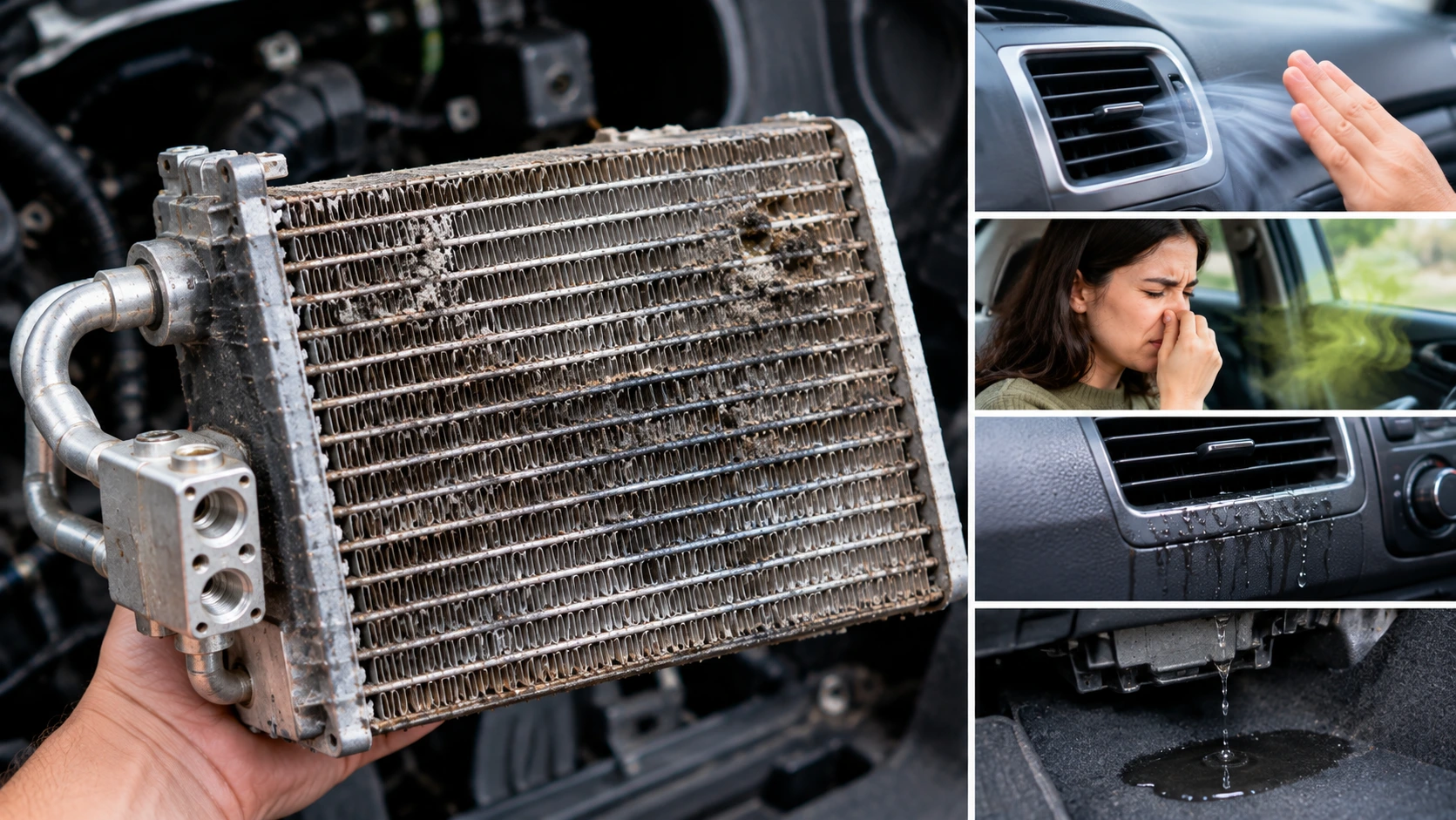
Every time you switch on the AC in the morning, a damp, musty smell comes through the vents. The cooling is a little weaker each week, the passenger footwell carpet feels damp, and the AC gas was topped up only a few months ago. These are classic bad AC evaporator symptoms, and they point to a part hidden deep behind the dashboard.
The evaporator is the small radiator inside the dashboard that actually cools the air. Refrigerant flows through it, the blower pushes cabin air across its fins, and the air comes out of the vents cold. When the evaporator leaks, clogs with dirt or grows mould, the cooling drops and the smell gets worse.
Because it sits behind the dashboard, an evaporator repair is a bigger job than most AC work. An AC repair specialist will normally test for leaks and check the drain and cabin filter before deciding the evaporator itself has failed. This guide explains how the evaporator works, the signs of failure, why it fails in Dubai, how it is tested and what replacement involves.
Bad AC Evaporator Symptoms: Quick Answer
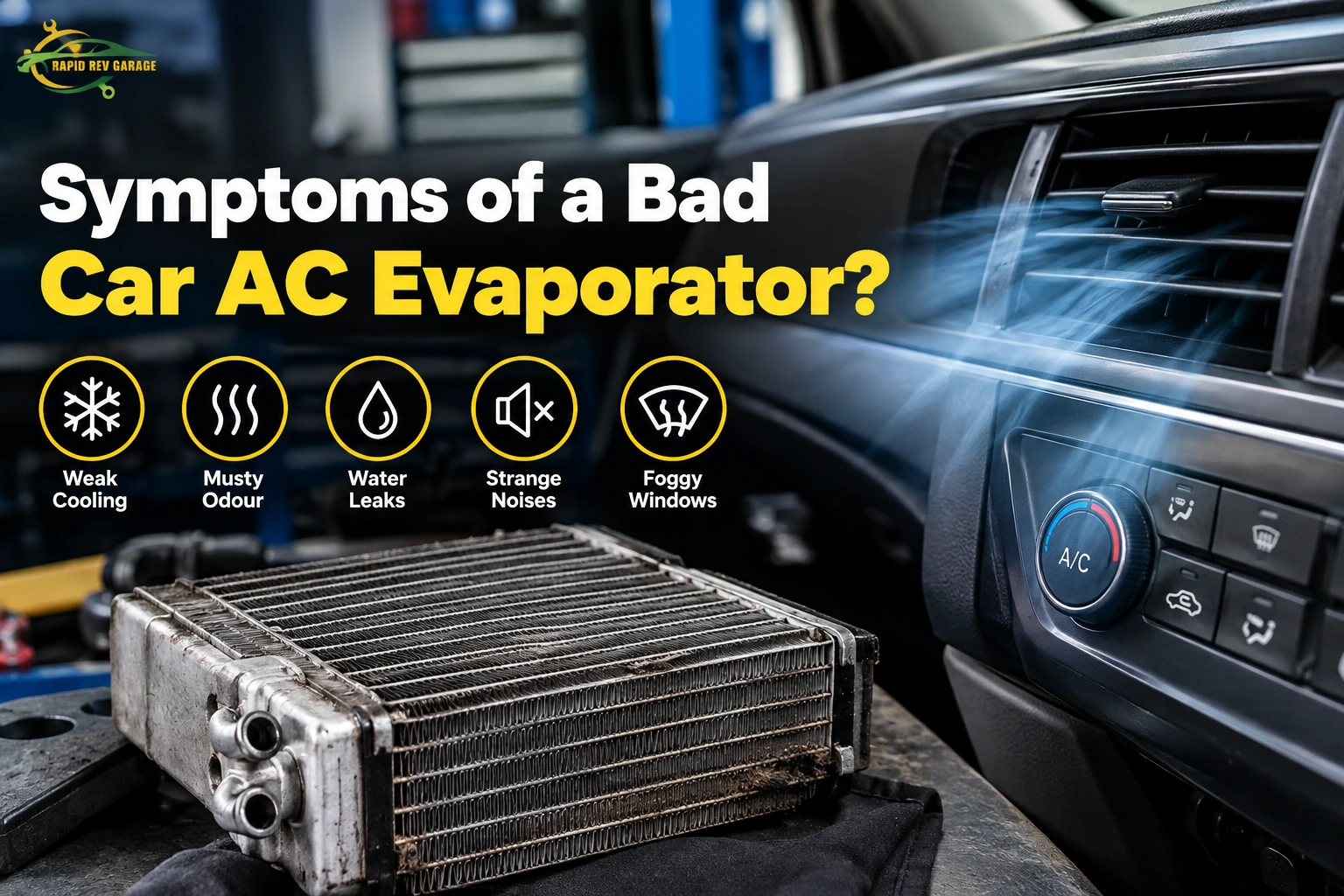
The main bad AC evaporator symptoms are weak or warm air from the vents, a musty or mouldy smell when the AC starts, AC gas that keeps running low, a wet carpet in the passenger footwell, reduced airflow, a sweet chemical smell inside the cabin and an AC compressor that will not switch on because the pressure is too low.
A Revol case study on a BMW 520i describes weak airflow, a musty smell and a wet footwell caused by a leaking evaporator core. A mechanic confirms an evaporator leak with UV dye, an electronic leak detector at the drain tube and pressure checks, after ruling out a blocked drain and a dirty cabin filter.
Table of Contents
- What the AC Evaporator Does
- Why Evaporators Fail Faster in Dubai
- Weak or Warm Air From the Vents
- Musty or Mouldy Smell When the AC Starts
- AC Gas That Keeps Running Low
- Wet Carpet in the Passenger Footwell
- Reduced Airflow From the Vents
- Sweet or Chemical Smell in the Cabin
- Compressor That Will Not Switch On
- Frozen or Iced Evaporator
- Faults That Look Like a Bad Evaporator
- How a Workshop Tests an AC Evaporator
- What Evaporator Replacement Involves
- Can an Evaporator Be Cleaned Instead of Replaced?
- Do AC Leak Sealers Fix Evaporator Leaks?
- How to Make the Evaporator Last Longer
- How Long Does an AC Evaporator Usually Last?
- FAQ
- Conclusion
What the AC Evaporator Does
The evaporator is a small heat exchanger made of thin aluminium tubes and fins. It sits inside the heating and AC box behind the dashboard, usually on the passenger side.
Cold, low pressure refrigerant from the expansion valve flows through the evaporator. The blower pushes cabin air across the fins, and the refrigerant absorbs heat from that air. The cooled air then flows to the vents.
Cooling the air also pulls moisture out of it. That moisture condenses on the cold fins and drips into a tray, then drains out under the car through a small tube. The puddle of water under a parked car with the AC on is this condensation, and it is normal.
Why Evaporators Fail Faster in Dubai
In Dubai, the AC runs almost all year, so the evaporator is wet and cold for many hours a day. Constant moisture on the aluminium fins, combined with dust and organic matter in the air, can lead to corrosion over the years. Small pinholes form and refrigerant escapes.
Humidity adds to it. On humid summer mornings, especially near the coast in areas such as Dubai Marina and Jumeirah, the evaporator pulls a lot of water from the air. Mould and bacteria grow in the damp, dark box when the car is parked.
Dust is another factor. Fine dust that gets past a worn cabin filter coats the evaporator fins, traps moisture and blocks airflow. Cars parked outside in dusty areas such as Al Quoz see this more often.
Weak or Warm Air From the Vents
Weak cooling is often the first sign. A leaking evaporator lets refrigerant escape, so the system gradually runs low and cools less. The Revol case study found the system was undercharged because refrigerant had been escaping from the evaporator core.
The AC may still blow cool air on mild days but struggle on a summer afternoon when the air passes 45°C. It often cools well right after a top up, then fades again over weeks or months.
Weak cooling has many possible causes, including a blocked condenser, a faulty expansion valve or a failing compressor. The guides on bad AC condenser symptoms and bad AC expansion valve symptoms explain those faults.
Musty or Mouldy Smell When the AC Starts
A musty smell is one of the most common evaporator complaints. The Revol case study lists a musty smell every time the AC ran among the symptoms of the failing core.
The smell comes from mould and bacteria growing on the damp evaporator fins and in the drain tray. It is usually strongest in the first minute after switching on the AC, then fades as air flows through.
A musty smell does not always mean the evaporator is leaking. It often means the evaporator is dirty or the drain is slow. A cleaning treatment and a new cabin filter often fix the smell. If the smell comes with weak cooling and repeated gas loss, a leak is more likely.
AC Gas That Keeps Running Low
If the AC needs a gas top up every few months, the refrigerant is going somewhere. The evaporator is a common leak point because it is hidden and corrodes from the outside.
Evaporator leaks are hard to find because you cannot see the part. Dye added to the system shows up at the drain tube under the car, and an electronic detector held at the drain or a vent can sense refrigerant.
SlashGear notes that simply adding more refrigerant will not fix the underlying problem. Repeated top ups also let moisture into the system, which can damage other parts such as the expansion valve.
Wet Carpet in the Passenger Footwell
A wet carpet under the dashboard on the passenger side is a sign of an evaporator problem. The Revol case study describes a wet patch on the passenger footwell carpet, where condensate was getting past a degraded seal at the heating and AC box.
The most common cause of a wet footwell is a blocked drain tube. Water from the evaporator cannot drain under the car, so it overflows the tray and soaks the carpet. In the Revol case, the drain was clear, which pointed to the box seal and the core.
A wet carpet can also come from a windscreen or door seal leak. Wet carpets in Dubai heat quickly smell and can grow mould, so the carpet may need drying and cleaning through a car upholstery service.
Reduced Airflow From the Vents
The Revol case study lists lost airflow at the vents as a symptom. A dirty, clogged or partly iced evaporator blocks the air the blower pushes through it.
The blower may sound normal, but less air comes out. Turning the fan to full makes more noise without much more air. A clogged cabin filter causes the same symptom, so it is checked first.
If the evaporator fins are packed with dust and debris, cleaning may restore airflow. If they are corroded and leaking, the evaporator needs replacing.
Sweet or Chemical Smell in the Cabin
A faint sweet or chemical smell in the cabin can come from refrigerant or AC oil leaking from the evaporator. It is often noticed when the car has been closed up and then started with the AC on.
A sweet smell can also come from a leaking heater core, which carries hot coolant inside the same box. In the UAE, the heater is rarely used, but coolant still flows through the heater core on many cars, and a leak can steam up the windscreen and smell sweet.
If you notice a chemical smell with fogging on the inside of the windscreen, have the heater core checked as well as the evaporator.
Compressor That Will Not Switch On
If enough refrigerant leaks out, the system pressure drops below the level the low pressure switch allows. The compressor then refuses to engage, to protect itself from running without enough refrigerant and oil.
The blower still blows, but the air is not cooled at all. You may notice the AC button light comes on but you do not hear the usual click from the engine bay as the compressor engages.
A mechanic checks the static pressure with the engine off. Very low pressure confirms a leak, and the next step is finding where it is.
Frozen or Iced Evaporator
An evaporator can ice over if airflow is too low or if a sensor fault lets it get too cold. SlashGear notes that an evaporator can freeze over when there is too much moisture in the system, and that frozen fins stop air flowing properly.
The AC may cool well at first, then lose airflow as ice builds up. After switching off for a while, the ice melts and the cooling returns, sometimes with water dripping more than usual.
A dirty cabin filter, a weak blower, a faulty evaporator temperature sensor or a stuck open expansion valve can all cause icing. The evaporator itself is often fine once the cause is fixed.
Faults That Look Like a Bad Evaporator
A blocked drain tube causes a wet footwell and musty smells without any leak. A dirty cabin filter causes weak airflow and smells. A failing blower motor causes weak airflow. Leaks at the condenser, hoses or compressor cause gas loss.
A faulty expansion valve causes frost and warm air. A blocked condenser causes weak cooling at idle. A heater core leak causes sweet smells and a wet carpet.
The guide on bad AC blower motor symptoms explains airflow faults. Finding the exact leak point with dye and a detector stops you paying for an evaporator when a cheaper part is at fault.
How a Workshop Tests an AC Evaporator
A proper test starts with the cabin filter and drain tube. The mechanic checks the filter for dirt and the drain for blockages, because both cause symptoms that look like an evaporator fault.
Next, the mechanic checks the system pressures with gauges and looks for leaks. UV dye in the refrigerant shows up under a UV lamp at the drain tube if the evaporator leaks. An electronic leak detector held at the drain outlet or the centre vent can pick up escaping refrigerant.
On some cars, a small camera can be passed into the heating and AC box through the blower opening to inspect the evaporator fins. Book these tests with an experienced car mechanic near you so the leak is confirmed before the dashboard comes apart.
What Evaporator Replacement Involves
Evaporator replacement is one of the bigger AC jobs. The Revol case study describes recovering the refrigerant, dropping the dashboard to reach the heating and AC box and removing the failed core. It notes that dashboard removal is the bulk of the labour on the job.
A new evaporator is fitted with new seals. The Revol case study also fitted a new expansion valve at the same time, which is common because the valve is in the same area and may have been damaged by the same moisture or debris. The receiver drier is usually replaced too.
The dashboard is reassembled, the system is vacuumed to remove moisture, and it is recharged with the correct amount of refrigerant. A new cabin filter is fitted, and vent temperature and airflow are checked.
Can an Evaporator Be Cleaned Instead of Replaced?
If the evaporator is dirty but not leaking, cleaning can fix musty smells and restore some airflow. Many workshops use a foam or spray cleaner applied through the drain tube or the blower opening, which kills mould and loosens dirt.
Cleaning does not fix a leak. If dye or a detector confirms the evaporator is leaking, it needs replacing. Cleaning products also cannot reach every part of a heavily clogged core.
Interior smells often linger in the carpets and headlining after an evaporator problem. A car detailing service can deep clean the cabin once the AC is fixed.
Do AC Leak Sealers Fix Evaporator Leaks?
Some AC recharge kits include a leak sealer that claims to plug small holes. These products can sometimes slow a tiny leak, but they can also clog the expansion valve, the orifice tube and the recovery machines workshops use.
Many workshops refuse to work on systems that contain sealer, or charge extra to clean their equipment afterwards. A sealer can turn a single part repair into a much larger job.
If you use a DIY recharge can, keep it away from the bodywork. Refrigerant oil and dye spilled on the paint around the bonnet can stain it and may need paint and panel repair.
Why Does Water Drip Under My Car With the AC On?
A small puddle of clear water under the front passenger side of the car is normal when the AC has been running. It is condensation from the evaporator, draining out through the drain tube. In humid weather, it can be a large puddle.
The water should be clear and have no smell or colour. Coloured, oily or sweet smelling fluid is not condensation and may be coolant or another fluid leaking.
If the AC has been running for a long time and there is no water under the car, the drain may be blocked. Water then backs up into the cabin, which can soak the carpet.
Is It Safe to Drive With a Bad Evaporator?
An evaporator leak does not affect how the car drives, so it is not usually a safety problem. The main issues are comfort, smells and mould in the cabin. In Dubai summer heat, though, a car with no AC can become dangerously hot for children, older passengers and anyone sensitive to heat.
If the inside of the windscreen fogs up because of a leak or blocked drain, pull over safely and clear it before continuing. Poor visibility is a real risk.
If the AC fault comes with engine overheating or a squealing belt, the problem may be the compressor rather than the evaporator. If that happens on a highway, reach the hard shoulder rather than stopping in a live lane, which brings a AED 1,000 fine and six black points under Article 98 of the UAE Federal Traffic Law, then call roadside assistance.
How to Make the Evaporator Last Longer
Replace the cabin filter on time, so dust does not reach the evaporator fins. A cabin filter change is quick and cheap. In dusty areas, change it more often than the service book suggests.
A few minutes before you arrive, switch the AC compressor off and leave the fan running. That dries the evaporator and reduces mould growth. Fix leaks properly instead of topping up again and again.
A regular car service in Dubai includes a check of the cabin filter and AC performance. If your AC smells or cools less, a mobile mechanic can check the filter and drain at home, and a car garage near you with leak detection equipment can confirm whether the evaporator is leaking.
How Long Does an AC Evaporator Usually Last?
There is no fixed life for an evaporator. Many last for the life of the car, while others start leaking after several years, especially in humid and dusty climates.
In Dubai, the evaporator is wet and cold for many hours a day, which gives corrosion more time to work. Cars with a clogged cabin filter or a slow drain stay damp for longer and tend to have more problems.
Keeping the cabin filter clean, drying the evaporator before switching off and fixing leaks early all help it last longer.
FAQ
Here are the questions Dubai drivers most often ask about AC evaporators.
How do I know my evaporator is bad?
Common signs are weak cooling, a musty smell, AC gas that keeps running low, a wet passenger footwell and reduced airflow. A mechanic confirms a leak with UV dye or an electronic detector at the drain tube.
Why does my car AC smell musty?
Mould and bacteria grow on the damp evaporator fins and in the drain tray. A dirty cabin filter makes it worse. A cleaning treatment and a new filter often fix it. A smell with weak cooling may point to a leak.
Can an evaporator leak cause a wet carpet?
Yes. Water can escape past a damaged seal on the AC box. The most common cause, though, is a blocked drain tube, so the drain is checked first. A heater core leak can also wet the carpet.
Is evaporator replacement a big job?
Yes, on most cars. The evaporator sits inside the dashboard, and the dashboard usually has to come out. Most of the labour is removing and refitting the dash. The expansion valve and receiver drier are often replaced at the same time.
Can an evaporator be cleaned?
Yes, if it is dirty but not leaking. Foam or spray cleaners applied through the drain or blower opening kill mould and loosen dirt. Cleaning cannot fix a leak. A leaking evaporator needs replacing.
Conclusion
A bad AC evaporator shows up as weak cooling, musty smells, gas that keeps running low, a wet passenger footwell, reduced airflow, sweet smells and a compressor that will not engage. In Dubai, constant AC use, humidity and dust make evaporator problems more common. Checking the filter and drain first, then using dye and leak detectors, confirms the fault before the dashboard comes out.
Rapid Rev Garage is a full workshop open 24 hours at Al Khail Gate, 12th Street, Al Quoz Industrial Area 2, serving passenger cars across Al Quoz, Business Bay, Jumeirah, Al Barsha, Satwa, Downtown and the Sheikh Zayed Road corridor. Visit https://rapidrevgarage.com, send your car model and AC symptoms on WhatsApp, or get directions on Google Maps.
Rapid Rev Garage | Bad AC Evaporator Symptoms | Al Quoz, Dubai