You are slowing for the lights on Al Wasl Road and the brake pedal feels like a block of wood. You push harder, and the car takes longer to stop than it should. Then you hear a faint hiss from under the dashboard each time you press the pedal. These are common bad brake booster symptoms, and they need attention quickly because they affect how well the car stops.
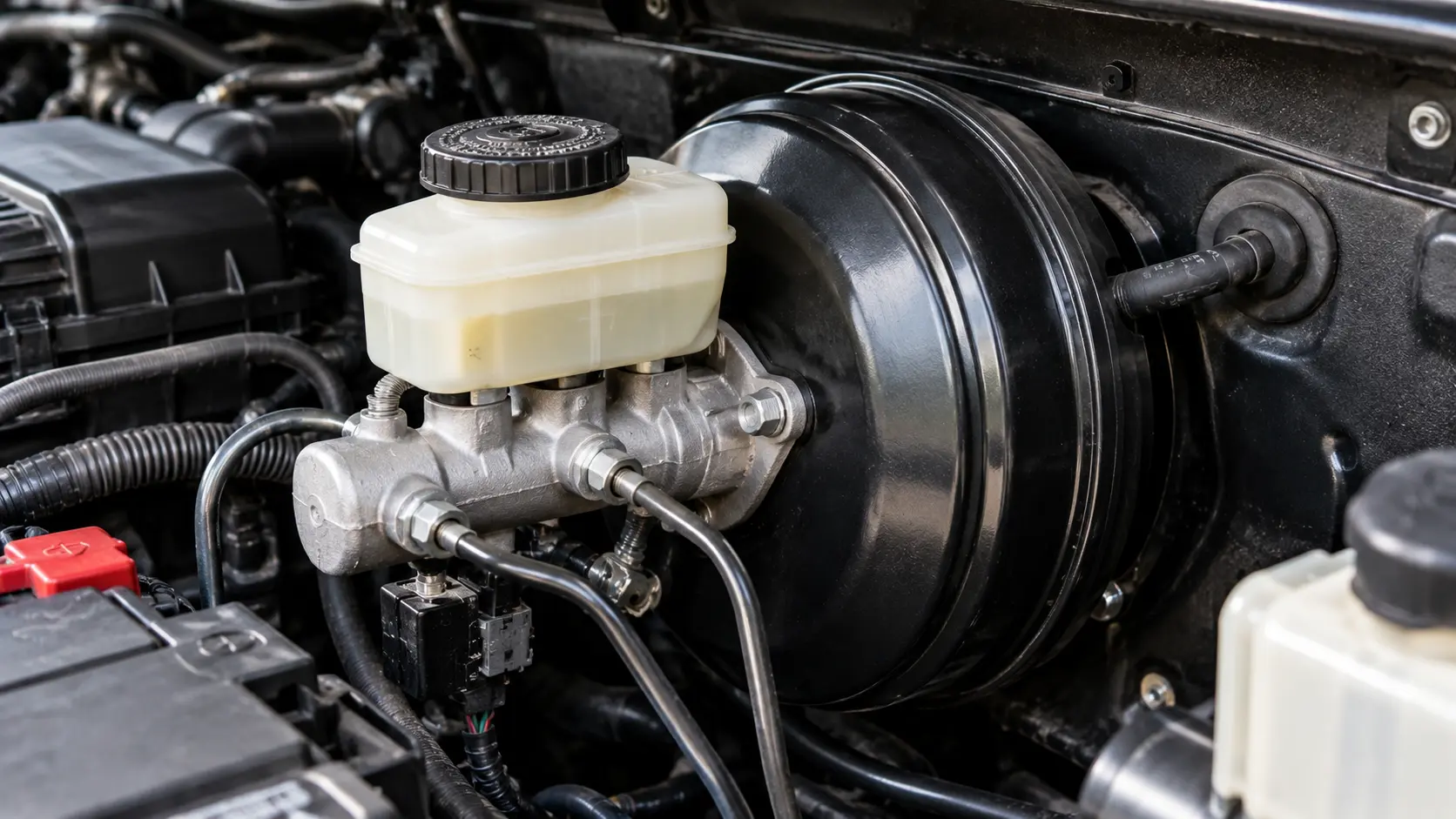
The brake booster is the round drum mounted between the brake pedal and the master cylinder, on the driver’s side of the engine bay. It uses engine vacuum, or a vacuum pump, to multiply the force from your foot. Without it, you would need to push the pedal far harder to stop the car. When the booster leaks or its valve fails, that extra help fades away.
This guide explains how the booster works, the signs it is failing, why Dubai driving can expose a weak booster, how to test it safely and what the repair involves. It also covers the faults that feel similar, so you can describe the problem clearly to a workshop.
Bad Brake Booster Symptoms: Quick Answer
The main bad brake booster symptoms are a hard brake pedal that needs much more force, longer stopping distances, a pedal that sits higher than usual, a hissing sound from under the dashboard, an engine that stumbles or stalls when braking and a brake warning light on some cars.
Rx Mechanic lists a rock hard pedal, longer stops, a hissing sound near the pedal and the engine stalling when braking among the main signs. A simple check is to press the brake pedal several times with the engine off, hold it down and start the engine. On a healthy booster, the pedal drops slightly as vacuum builds. A pedal that stays hard points to a booster or vacuum fault.
Table of Contents
- What the Brake Booster Does
- Vacuum, Pump and Electric Boosters
- Why Dubai Driving Exposes a Weak Booster
- Hard Brake Pedal
- Longer Stopping Distances
- Pedal Sits Higher or Feels Different
- Hissing Sound Under the Dashboard
- Engine Stumbles or Stalls When Braking
- Brake Warning Light
- Brake Fluid Leaks Near the Booster
- Faults That Feel Like a Bad Brake Booster
- How to Test a Brake Booster Safely
- How a Workshop Diagnoses a Booster Fault
- What Brake Booster Repair Involves
- Is It Safe to Drive With a Bad Brake Booster?
- What to Do if the Brakes Feel Hard on the Highway
- How Long Does a Brake Booster Last?
- Can a Bad Booster Affect ABS and Brake Assist?
- Does a Bad Booster Fail the Vehicle Inspection?
- How to Keep the Braking System Healthy
- FAQ
- Conclusion
What the Brake Booster Does
When you press the brake pedal, a pushrod moves into the booster. Inside the booster is a large rubber diaphragm that divides it into two chambers. With the engine running, both chambers hold vacuum.
As you press the pedal, a valve lets outside air into the rear chamber. The pressure difference across the diaphragm pushes it forward, adding force to the pushrod. That extra force goes into the master cylinder, which sends brake fluid to the calipers at each wheel.
The result is that a light push from your foot produces strong braking. The booster does not create braking on its own. It only adds force to what you apply.
A one way check valve sits where the vacuum hose enters the booster. It keeps vacuum stored inside the booster when the engine is off or when engine vacuum drops. That stored vacuum gives you one or two assisted stops even if the engine stalls.
Vacuum, Pump and Electric Boosters
Most petrol cars use engine vacuum from the intake manifold. A rubber hose runs from the manifold to the check valve on the booster.
Diesel engines and many modern turbocharged petrol engines do not make enough vacuum on their own. These cars use a mechanical or electric vacuum pump to supply the booster. A failing pump causes the same hard pedal as a failing booster.
Some heavy vehicles use a hydraulic booster, often called hydro boost, which uses pressure from the power steering pump instead of vacuum. Rx Mechanic notes that fluid loss in these systems is one cause of booster failure.
Hybrid and electric cars often use an electric booster or an electric vacuum pump, because the engine is not always running. These systems are monitored by the car’s computer and usually set a warning light when they fail.
Why Dubai Driving Exposes a Weak Booster
Heat ages rubber. The booster diaphragm, the check valve and the vacuum hose are all made of rubber, and engine bays in Dubai stay hot for months. On a summer afternoon when the air passes 45°C, the hose that feeds the booster runs close to hot engine parts and slowly hardens and cracks.
Stop and start traffic means constant braking. A commute along Sheikh Zayed Road or through Al Barsha can involve hundreds of stops. A booster that is slightly weak may feel fine on an open road and only show its weakness in heavy traffic, when you brake again and again.
Long downhill roads add another test. On the drive down from Jebel Jais or the Hatta mountain roads, repeated braking uses a lot of vacuum. A weak booster or leaking hose may let the pedal grow hard on the way down.
Engine vacuum leaks are common in older cars in the UAE heat. Any leak that lowers engine vacuum also lowers the help the booster can give.
Hard Brake Pedal
This is the most common sign. The pedal feels stiff and needs much more force than usual to slow the car. Rx Mechanic describes it as a rock hard pedal that is difficult to press down.
The hard feel happens because the booster is no longer adding force. Your foot is doing all the work against the master cylinder.
A hard pedal may appear suddenly if a hose splits, or slowly over weeks as a diaphragm or valve leaks more and more. It is often worse at the first press after starting the car, or after several stops in a row.
Longer Stopping Distances
When the booster fails, the car takes longer to stop for the same pedal effort. Rx Mechanic lists longer stops with a firm pedal as a sign of booster failure.
This symptom is dangerous in Dubai traffic, where gaps between cars on roads like Al Khail Road can close quickly. Many drivers notice it first when they have to brake harder than expected at a light or in a queue.
If you find yourself pressing harder and starting to brake earlier, have the brakes checked soon.
Pedal Sits Higher or Feels Different
Some drivers notice the pedal sitting higher than usual or feeling different under the foot. Rx Mechanic notes that the pedal may feel higher or stronger than normal.
The change can be subtle. A pedal that feels short and firm, with little travel before it stops, can point to a booster that is not giving assistance.
Any change in how the pedal feels is worth mentioning to a mechanic, even if the car still stops normally.
Hissing Sound Under the Dashboard
A leaking booster often makes a hissing sound. You hear it from under the dashboard near the pedal, usually when you press or release the brake.
Rx Mechanic links the hissing sound to a vacuum leak. The leak may be in the diaphragm, in the valve where the pushrod enters the booster or in the seal between the booster and the firewall.
A short hiss as you release the pedal can be normal on some cars. A hiss that continues while you hold the pedal down, or one that has grown louder, points to a leak.
Engine Stumbles or Stalls When Braking
A booster leak is also an engine vacuum leak. When you press the pedal, air rushes through the leaking booster into the intake manifold. The engine computer did not plan for that air, so the mixture goes lean.
Rx Mechanic lists the engine stalling when the brakes are applied as a symptom of a bad booster. More often, you notice the idle dipping or the engine running rough as you brake at a light.
A leaking booster can also set lean codes such as P0171 on some cars. A mechanic will check the booster when a lean code appears alongside a hard pedal.
Brake Warning Light
Rx Mechanic notes that the brake warning light can come on with booster problems. On many cars, the light is triggered by low brake fluid or by a fault in the ABS or brake assist system rather than the booster itself.
On cars with electric boosters or electric vacuum pumps, the computer monitors the system closely and lights a warning as soon as a fault appears. On older vacuum systems, the booster may fail without any light at all.
Never ignore a brake warning light. It can mean low fluid, a leak, worn pads or a system fault, and each of these affects your stopping power.
Brake Fluid Leaks Near the Booster
The booster itself does not hold brake fluid. But the master cylinder bolts to its front, and a leaking master cylinder seal can let fluid run into the booster.
Rx Mechanic lists fluid leaks, especially around the brake pedal area, among the signs of trouble. Brake fluid inside the booster damages the rubber diaphragm and leads to failure.
Wet patches around the base of the master cylinder, a falling fluid level in the reservoir or damp carpet near the pedal all need checking.
Faults That Feel Like a Bad Brake Booster
Several faults change the pedal feel. A careful mechanic checks them before replacing the booster:
- Split or loose vacuum hose. A cracked hose or loose clamp starves the booster. Rx Mechanic lists a leaking booster hose among the causes.
- Failed check valve. A valve that does not hold vacuum gives a hard pedal after the engine has been off.
- Weak vacuum pump. On diesel and turbo engines, a tired pump gives the same symptoms as a bad booster.
- Engine vacuum leak. A leak elsewhere lowers the vacuum the booster receives.
- Glazed or contaminated brake pads. These need more pedal pressure to stop the car, but the pedal travel stays normal.
- Seized calipers. A caliper that does not move freely reduces braking at that wheel.
- Air in the brake lines or a failing master cylinder. These usually cause a soft or sinking pedal rather than a hard one.
The difference between hard and soft is a useful clue. A hard pedal usually points to the booster side. A soft, spongy or sinking pedal usually points to the hydraulic side.
How to Test a Brake Booster Safely
There is a simple check you can do with the car parked on level ground with the handbrake on.
First, with the engine off, press the brake pedal firmly four or five times. This uses up the stored vacuum. The pedal should become firm and stop at a normal height.
Next, hold your foot on the pedal with steady pressure and start the engine. On a healthy booster, the pedal drops slightly under your foot as vacuum builds. Rx Mechanic describes a similar test and notes that a pedal that does not drop, or stays very hard, suggests a bad booster.
A second check tests whether the booster holds vacuum. Run the engine for a minute, switch it off and wait about a minute.
Then press the pedal. You should get one or two assisted presses before the pedal goes hard. If the first press is already hard, the booster or its check valve is leaking.
Do these tests only when the car is parked safely. Do not test the brakes in traffic.
How a Workshop Diagnoses a Booster Fault
A trained car mechanic near you starts with the pedal tests above, then looks closer at the vacuum supply.
The vacuum hose is checked for cracks, splits and loose clamps along its full length. The check valve is removed and tested to confirm it only lets air flow one way.
A vacuum gauge connected to the hose shows how much vacuum the engine or pump supplies. Low vacuum points to an engine problem or a failing pump rather than the booster itself.
The mechanic listens for a hiss at the booster and checks the firewall seal. A leaking diaphragm often hisses loudly when the pedal is pressed.
The master cylinder is inspected for leaks into the booster. The brake fluid level and condition are checked, along with the pads and calipers, to rule out other causes.
On cars with electric boosters or pumps, a scan tool reads fault codes and live data from the brake system computer.
What Brake Booster Repair Involves
If the fault is a split hose, a failed check valve or a loose clamp, the repair is quick and inexpensive.
If the booster itself has failed, it is usually replaced as a complete unit. The mechanic disconnects the pushrod from the pedal inside the cabin, unbolts the master cylinder from the front of the booster and removes the booster from the firewall. On many cars, the master cylinder can be moved aside without opening the brake lines.
If the brake lines are opened, or if the master cylinder is replaced at the same time, the brakes must be bled to remove air. The pedal feel and stopping power are then tested before the car leaves the workshop.
On diesel and turbo engines with a failed vacuum pump, the pump is replaced instead. On cars with electric boosters, the unit may need to be programmed or calibrated with a scan tool.
A complete brake repair service covers the booster, the hydraulic system, pads, discs and calipers, so the whole system works together after the repair.
Is It Safe to Drive With a Bad Brake Booster?
The car can still stop without the booster, but it needs much more pedal force and a longer distance. That makes it unsafe in heavy traffic, at high speed or in an emergency stop.
A booster that is slowly getting worse can fail suddenly if a hose splits or the diaphragm tears. Drive only as far as needed to reach a workshop, keep a large gap to the car ahead and avoid highways if you can.
If the pedal is very hard or the car is struggling to stop, do not drive it. A car with unreliable brakes should travel on a flatbed tow truck. If the car is at home, a mobile mechanic can check the vacuum hose and check valve on site, which may solve the problem before you drive it.
What to Do if the Brakes Feel Hard on the Highway
If the pedal suddenly turns hard on a highway, stay calm. The brakes still work, but you need to push much harder.
Press the pedal firmly and steadily. Lift off the accelerator and let the car slow. On an automatic, you can select a lower gear or use the manual mode to add engine braking. Use the handbrake gently only as a last resort, because pulling it hard at speed can lock the rear wheels.
Turn on your hazard lights and move to the hard shoulder as soon as it is safe. Stopping in a live lane because of a breakdown brings a AED 1,000 fine and six black points under Article 98 of the UAE Federal Traffic Law. Once safe, call roadside assistance.
If a longer stop led to a minor bump with the car ahead, Dubai Police need to issue a report before any garage can repair accident damage. Gulf News has reported that repairs to accident damage require a police report. Once the brakes are fixed, scratches and small dents can go to paint and panel repair.
How Long Does a Brake Booster Last?
Many boosters last for the life of the car. Others fail early because of heat, brake fluid leaks into the booster or a hose that cracked and let dirt in.
In Dubai, heat is the main enemy of the rubber parts. The vacuum hose and check valve usually fail before the booster itself, and they are cheap to replace.
A regular brake inspection is the best way to catch early signs, such as a slight hiss or a cracked hose, before the pedal turns hard.
Can a Bad Booster Affect ABS and Brake Assist?
The booster and the ABS are separate systems, but they work together. ABS stops the wheels from locking under hard braking. Brake assist, found on most modern cars, detects a panic stop and adds full braking force.
On many cars, brake assist relies on the booster to deliver that extra force. A weak booster means brake assist cannot do its job properly in an emergency.
On cars with electric boosters, the booster and stability systems are closely linked. A booster fault can set warnings for ABS, stability control or brake assist at the same time.
Does a Bad Booster Fail the Vehicle Inspection?
Brake performance is a key part of a vehicle inspection. A car with a weak booster may show poor braking force on the test equipment or a pedal that needs excessive effort.
Buyers of used cars in Dubai often book a vehicle inspection before paying. A hard pedal on the test drive is a clear warning sign for any buyer.
Fixing a booster fault before an inspection or a sale is far cheaper than failing the test and booking a return visit.
How to Keep the Braking System Healthy
Check the brake fluid level every few weeks. A falling level means a leak or worn pads, and both need attention.
Change the brake fluid at the interval in your owner’s manual. Brake fluid absorbs moisture over time, which lowers its boiling point and can corrode parts. In UAE heat, fresh fluid matters.
Fix engine vacuum leaks promptly. A leak that makes the engine run rough also weakens the booster.
Listen for new noises when you brake. A hiss from under the dashboard or a change in pedal feel is an early warning.
Book a regular car service in Dubai that includes a brake check. If you notice a hard pedal or longer stops, take the car to a car garage near you that tests the vacuum supply and check valve before replacing the booster.
FAQ
Here are the questions Dubai drivers most often ask about brake boosters.
What does a bad brake booster feel like?
The pedal feels hard and needs much more force to stop the car. Stops take longer, and the pedal may sit higher than usual. Some cars also hiss under the dashboard when you brake.
Can a brake booster cause engine stalling?
Yes. A leaking booster lets extra air into the intake manifold when you press the brake. That leans out the mixture, so the idle dips, runs rough or the engine stalls. Rx Mechanic lists stalling when braking as a symptom.
How do you test a brake booster?
With the engine off, pump the pedal four or five times, hold it down and start the engine. A healthy booster lets the pedal drop slightly as vacuum builds. A pedal that stays hard points to a fault.
Will a bad booster make brakes fail?
The brakes still work, but they need much more force and a longer distance to stop the car. That makes emergency stops far less effective, so the car should be checked before normal driving.
Does a hissing brake pedal mean a leak?
Usually, yes. A hiss that continues while you hold the pedal down points to a vacuum leak in the booster diaphragm, valve or seal. A short hiss on release can be normal on some cars.
Conclusion
A bad brake booster shows up as a hard pedal, longer stops, a hiss under the dashboard and an engine that stumbles when you brake. Heat ages the rubber hose, check valve and diaphragm faster in Dubai, and stop and start traffic exposes a weak booster quickly. A simple pedal test, a vacuum check and a close look at the hose and valve confirm the fault, and many repairs are smaller than drivers expect.
Rapid Rev Garage is a full workshop open 24 hours at Al Khail Gate, 12th Street, Al Quoz Industrial Area 2, serving passenger cars across Al Quoz, Business Bay, Jumeirah, Al Barsha, Satwa, Downtown and the Sheikh Zayed Road corridor. Visit https://rapidrevgarage.com, send your car model and a note on how the brake pedal feels on WhatsApp, or get directions on Google Maps.
Rapid Rev Garage | Bad Brake Booster Symptoms | Al Quoz, Dubai