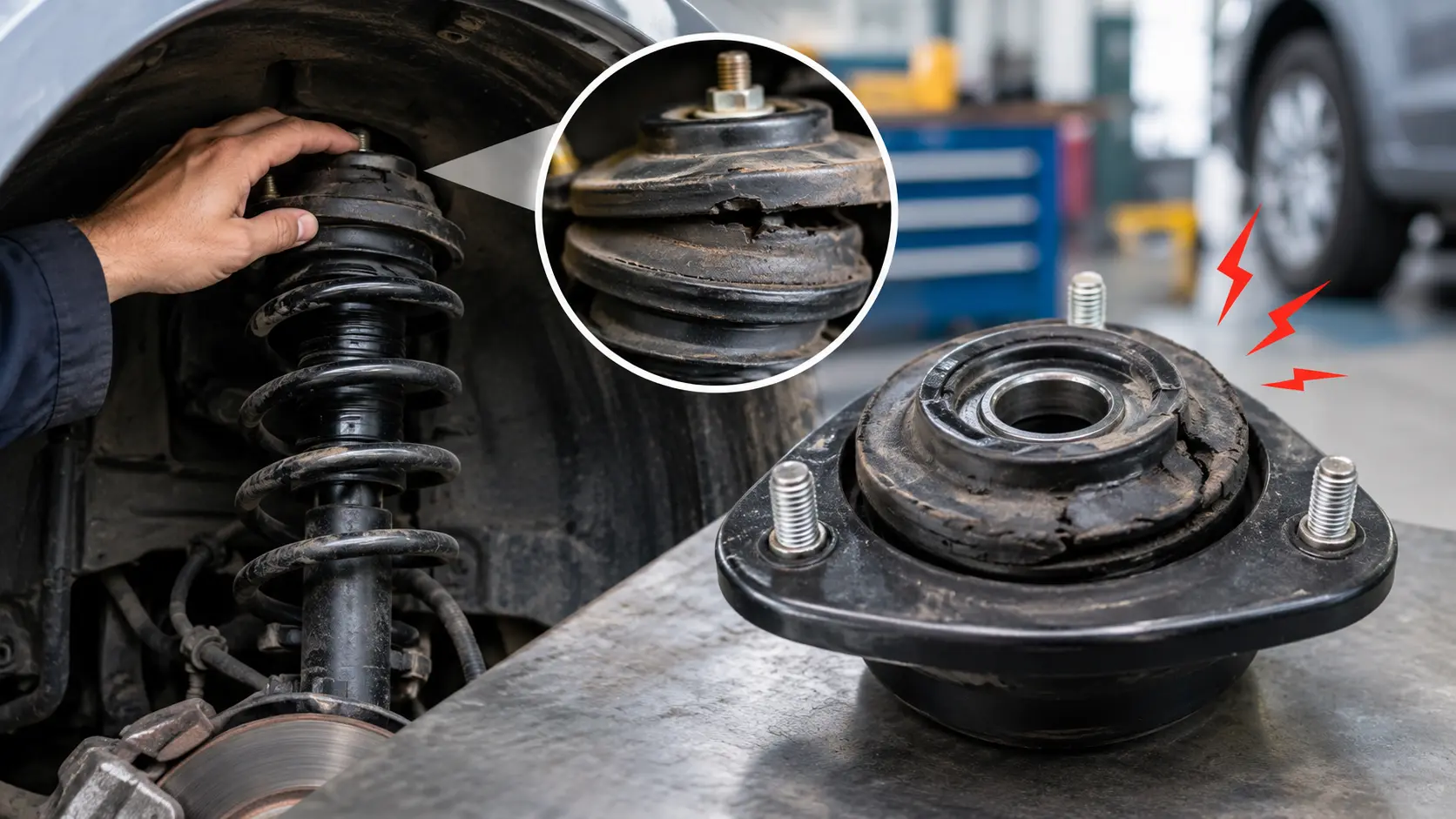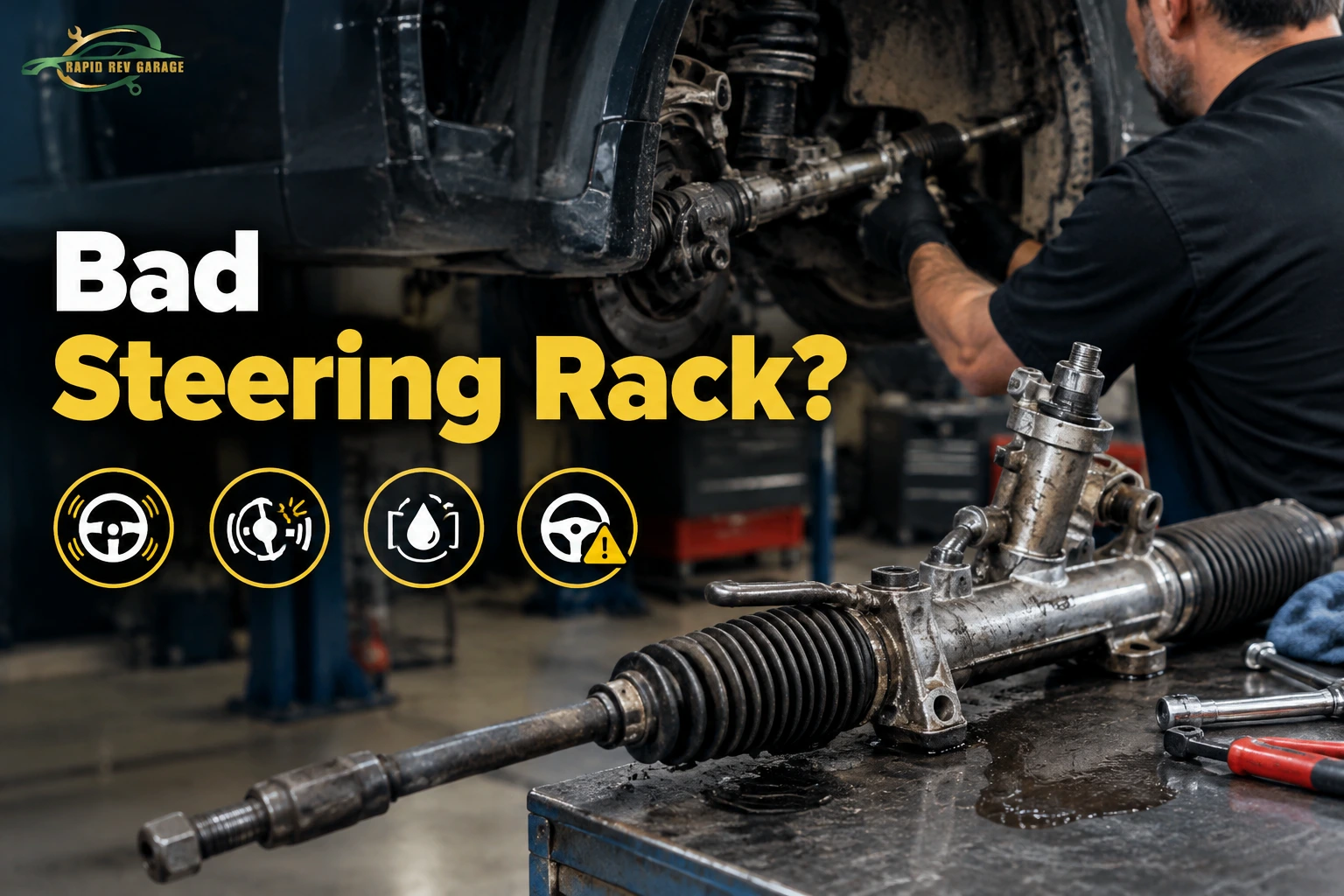
The most common symptoms of a bad steering rack are a heavy steering wheel, a clunk when you turn, and red or amber fluid under the front of the car. Steering may also feel loose, or the car may wander on the highway. Some cars make a grinding noise at full lock. Electric racks often show a steering warning light. In Dubai, heat dries out the rack’s rubber seals and boots. Once a boot tears, sand gets inside and wears the gears. A worn rack will not fix itself. Book a car steering service check within a few days. Stop driving if the wheel binds, jerks, or suddenly goes heavy.
Table of Contents
- What a Steering Rack Does and Why It Wears Out
- 8 Symptoms of a Bad Steering Rack You Can Feel, Hear or See
- Is It Really the Rack? A 5-Minute Check Before You Pay
- Symptom vs. Likely Cause: Quick Comparison Table
- Why Steering Racks Fail: The Root Causes
- How a Garage Tests for Steering Rack Failure
- How Steering Rack Repair Works: Service Options
- Questions to Ask Before You Approve a Rack Replacement
- What Happens If You Ignore Steering Rack Problems
- Can You Keep Driving With a Faulty Steering Rack?
- How Long Steering Rack Repair Takes
- What Steering Rack Repair Costs in Dubai
- How to Make Your Steering Rack Last Longer
- Dubai Driving Habits That Wear Out Steering Racks
- Why Choose Rapid Rev Garage for a Bad Steering Rack in Dubai
- FAQs
- Related Services
- Book a Steering Check Before It Gets Worse
What a Steering Rack Does and Why It Wears Out
The steering rack turns the round motion of your steering wheel into side-to-side motion at the front wheels. A small gear called the pinion sits at the bottom of the steering shaft. It meshes with a toothed bar called the rack. When you turn the wheel, the pinion slides the rack left or right. Tie rods on each end then push the wheels.
Most cars use one of two types. A hydraulic rack uses pressurized fluid to help you turn. An electric power steering (EPS) rack uses a motor and sensors instead. Both types have rubber boots at each end to keep dirt out. Hydraulic racks also have seals that hold the fluid in.
A bad steering rack rarely fails overnight. Seals harden, teeth wear, and mounting bushings go soft. Most drivers feel small changes for weeks before the steering turns unsafe.
8 Symptoms of a Bad Steering Rack You Can Feel, Hear or See
These are the symptoms of a failing steering rack that drivers report most. Each sign points to a different part of the rack. One sign alone can have other causes. Two or more together usually mean the rack is at fault.
1. Steering Feels Heavy When Parking
Heavy steering at low speed is the classic sign of a failing steering rack. On hydraulic systems, worn seals inside the rack let fluid slip past the piston. You lose the power assist. On electric racks, a weak motor or a faulty torque sensor causes the same heavy feel.
2. Clunk or Knock When You Turn
A dull clunk when you turn slowly or go over a speed bump often comes from worn rack bushings. Worn inner tie rod joints make a similar knock. Too much play between the rack and pinion teeth can also clunk as the load shifts.
3. Red or Amber Fluid Under the Front
Power steering fluid is usually red, amber, or clear. Drips under the front of the engine bay point to leaking rack seals. So do wet, oily boots at each end of the rack. A reservoir that needs topping up every few weeks tells the same story.
4. Loose Steering With a Dead Spot in the Center
You should not be able to turn the wheel more than a little before the car reacts. If there is a dead spot of a few centimeters, something has worn. Worn rack teeth and a loose rack adjuster are common causes. This is one of the clearest signs of a worn steering rack on older cars.
5. Car Wanders on the Highway
Some cars drift in their lane on Sheik Mohammed Bin Zayed Road. The driver keeps making small corrections to stay straight. Internal rack wear can cause this. Worn inner tie rods and poor wheel alignment can too, so the car needs testing before changing any parts.
6. Grinding or Whining at Full Lock
A grinding feel through the wheel while parking points to damaged rack teeth or grit inside the rack. A whine that rises as you turn often means the pump is struggling with low fluid. A leaking rack often causes that low fluid.
7. Wheel Will Not Return to Center
After a turn, the steering wheel should roll back toward straight on its own. If it stays turned or comes back slowly, the rack may be binding inside. Seized ball joints and low tire pressure can cause the same feel.
8. Steering Warning Light on Electric Racks
Electric power steering rack problems often show up as a warning light with heavy steering. The car’s computer has found a fault in the motor, the torque sensor, or the wiring. Reading the fault code is the first step.
Is It Really the Rack? A 5-Minute Check Before You Pay
Many drivers get a quote for a full rack when the real fault is a cheaper part. Tie rods, the pump, a steering column joint, or a ball joint can all mimic steering rack failure symptoms and bad rack-and-pinion symptoms. You can narrow it down in five minutes. Park on flat ground with the engine off.
- Look at the rubber boots behind each front wheel. Oily boots point to a leaking rack. A dry boot with a split means dirt is getting in.
- Gently rock the steering wheel left and right—a click from under the dashboard points to the column joint, not the rack.
- Check the power steering reservoir on hydraulic cars. Low, foamy, or dark fluid points to a leak or a pump issue.
- Note when the noise happens. A whine that changes with engine speed usually points to the pump. A clunk with bumps usually points to tie rods or mounts.
Take these notes to your garage. They help the mechanic test the right part first. They also stop you paying for a rack you may not need. Most guides skip this step, but it can save you a few thousand dirhams.
Symptom vs. Likely Cause: Quick Comparison Table
Use this table to match what you notice with the part most likely behind it. The last column shows the fix a garage usually starts with.
| What You Notice | Most Likely Cause | Usual Fix |
| Heavy steering when parking | Worn internal seals (hydraulic) or failed motor or sensor (electric) | Rack reseal or rack replacement |
| Clunk over bumps or when turning | Worn rack bushings or inner tie rods | Bushing or tie rod replacement |
| Oily rack boots or fluid on the floor | Leaking rack seals | Reseal or replace the rack |
| Loose steering with a dead spot | Worn rack teeth or loose adjuster | Adjust or replace the rack |
| Grinding at full lock | Damaged teeth or sand inside the rack | Rack replacement |
| Whine that rises with engine speed | Low fluid or a failing pump | Fix the leak, service the pump |
Why Steering Racks Fail: The Root Causes
Steering racks wear out for a handful of clear reasons. Dubai heat, dust, and driving habits make it worse.
Torn Boots Let Sand Inside
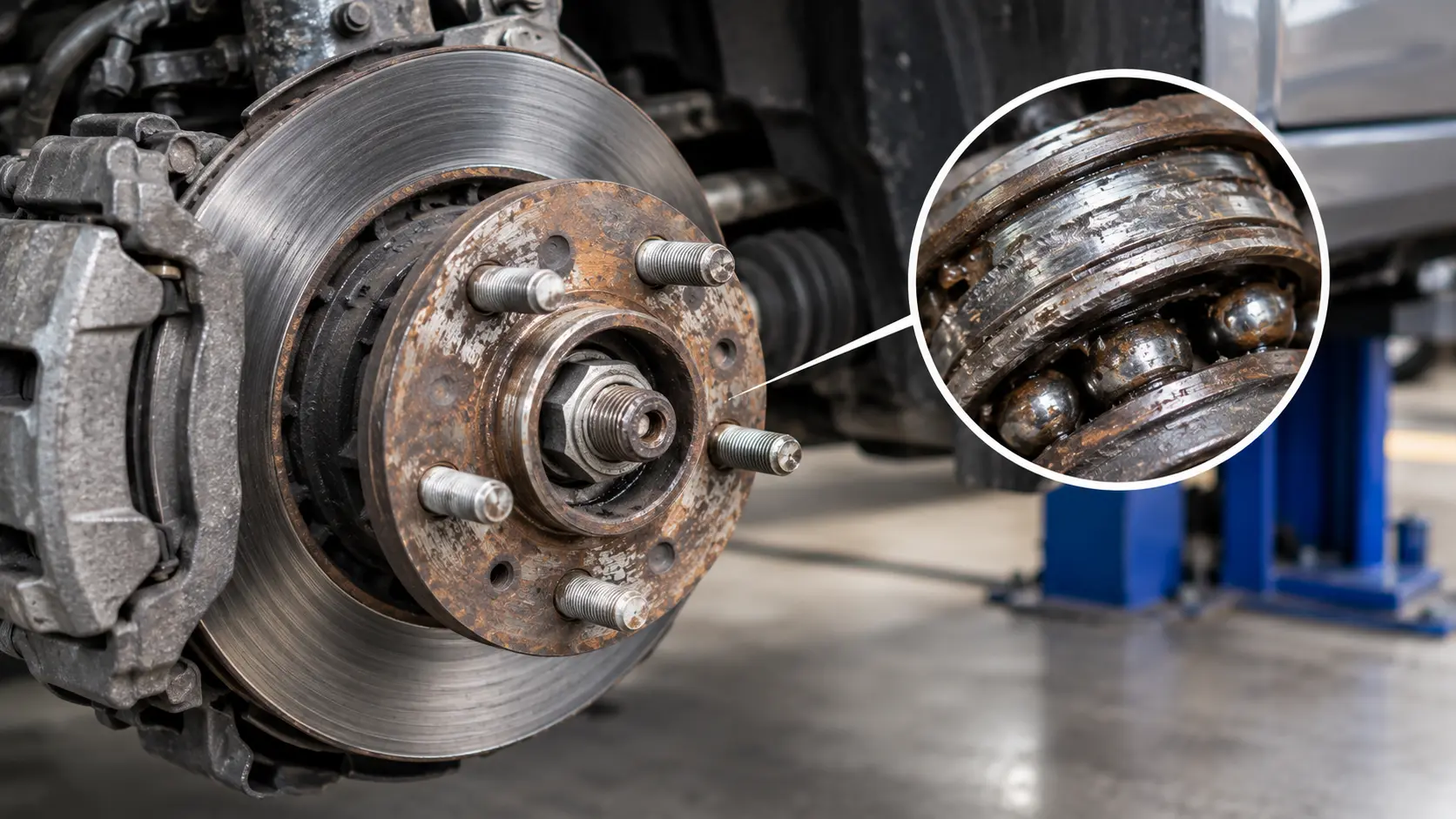
The rubber boots seal the two ends of the rack. Heat and age make them crack. Once a boot splits, fine sand gets in and acts like sandpaper on the teeth and seals. A split boot is often the very first step toward steering rack and pinion failure.
Heat Shrinks and Hardens the Seals
Hydraulic rack seals are made of rubber. Long summer days and slow traffic keep the engine bay hot for hours. The seals slowly shrink and harden, and fluid seeps past them. This is the most common source of hydraulic steering rack problems in older cars.
Old or Wrong Power Steering Fluid
Fluid breaks down with heat and time. Dark, burnt fluid no longer protects the seals well. Topping up with the wrong fluid type can make seals swell or shrink. Your owner’s manual names the correct type.
Holding the Wheel at Full Lock
On hydraulic systems, holding the wheel at full lock pushes pressure to its maximum. Doing this for several seconds in tight car parks strains the seals and the pump. Repeated over years, it speeds up power steering rack failure.
Kerb Strikes and Potholes
A hard hit on a curb or pothole sends a shock straight through the tie rods into the rack. It can bend a tie rod, crack a mount, or damage the teeth. Signs of a damaged steering rack often appear right after an impact like this.
Electrical Faults on Electric Racks
Electric racks depend on clean power and good wiring. A weak battery, a corroded plug, or water in a connector can trigger a fault. The system may then cut assist to protect itself.
How a Garage Tests for Steering Rack Failure
A proper diagnosis checks the whole steering system before anyone blames the rack. A good mechanic follows these steps.
- Road test. The mechanic drives the car to feel for heaviness, play, wander, and noise.
- Lift inspection. With the car raised, they check the boots, seals, mounts, and fluid lines for leaks or damage.
- Dry park test. One person turns the wheel while another watches the rack and tie rods. Any delay or knock shows where the play is.
- Tie rod and ball joint check. Move each joint by hand to feel for looseness.
- Fluid and pressure test. On hydraulic systems, they check fluid level and condition. A pressure gauge shows if the pump or the rack is losing pressure.
- Fault code scan. On electric racks, a scan tool reads stored codes and live sensor data.
- Alignment check. Measure wheel angles, since poor alignment can mimic rack wear.
Ask for these tests before you agree to any parts. A qualified car mechanic near me can confirm the fault on a lift.
How Steering Rack Repair Works: Service Options
The right car steering service depends on which part has failed. The main repairs are listed below, from smallest to largest.
Boot Replacement
If the boot is split but the rack is still dry and tight, a new boot is the fix. The mechanic cleans the area, checks for grit, and fits a new boot with fresh clamps. Catching it at this stage saves the rack.
Inner Tie Rod Replacement
Worn inner tie rods cause clunks and wander. They screw into the ends of the rack and can be changed without removing it. An alignment must follow.
Rack Reseal or Rebuild
Some hydraulic racks can be stripped and fitted with new seals. This works when the teeth and housing are still in good shape. Not every workshop does rebuilds, and parts are not available for every model.
Rack Replacement
Grinding, deep play,, and a cracked housing are the clearest signs you need a steering rack replacement. When the teeth are worn, or sand gets inside, the rack needs replacing. There are three part choices. OEM racks come from the car maker and cost the most. Aftermarket racks are new but made by another brand. Remanufactured racks are used units rebuilt with new seals and tested. Each choice changes the price and the warranty.
Fluid Flush and Bleed
After any hydraulic rack work, the system is refilled with the correct fluid. The mechanic then bleeds out the air by turning the steering wheel lock to the lock position. Air left in the system causes noise and foamy fluid.
Wheel Alignment and Sensor Calibration
Wheel alignment should be part of steering rack maintenance. If you don’t, your tires wear out rapidly, and the car pulls. Many electric racks also require the steering angle sensor to be calibrated with a scan tool .
Questions to Ask Before You Approve a Rack Replacement
A rack is one of the more costly steering parts. Ask these questions before you say yes.
- Which test showed the rack is the fault?
- Have you ruled out the tie rods, pump, and column joint?
- Is the new rack OEM, aftermarket, or remanufactured?
- Does the quote include fluid, alignment, and sensor calibration?
- What warranty comes with the rack, and for how long?
A good garage answers all five without trouble. If they cannot say which test pointed to the rack, get a second opinion.
What Happens If You Ignore Steering Rack Problems
A small leak or a light clunk can seem easy to live with. The damage grows quietly in the background.
A leaking rack drains the fluid the pump needs. If the pump runs low, it can burn out too, and you end up paying for two parts. Grit inside a torn boot keeps grinding the teeth until the steering binds. Loose steering also wears tires unevenly and makes the car harder to control in an emergency. Leaks and steering play can also cause a fail at the annual RTA vehicle test.
The biggest risk is sudden binding or loss of assist at speed. That is when a faulty steering rack turns into a crash risk.
Can You Keep Driving With a Faulty Steering Rack?
It depends on the symptom. A slow leak with normal steering feel is usually safe for short drives. Check the fluid level before each trip and drive straight to a garage near me for testing.
Stop driving right away if any of these happen:
- The wheel binds, sticks, or jerks while you turn.
- Steering suddenly goes very heavy.
- You hear loud grinding from the front when turning.
- A steering warning light comes on with heavy steering.
- Fluid is pouring out, not just dripping.
In these cases, do not try to reach the workshop yourself. Call roadside assistance and have the car moved safely.
How Long Steering Rack Repair Takes
Repair time depends on the job and the car. A boot or inner tie rod usually takes one to two hours, plus alignment. A full rack replacement usually takes four to eight hours. Some cars require lowering the subframe to reach the rack, which adds time. Electric racks may need extra time for calibration. If the rack is not in stock for your model, sourcing it can add one to three days.
What Steering Rack Repair Costs in Dubai
The prices below are typical ranges at independent workshops in Dubai. Your final price depends on the car and the parts you choose, so always ask for a written quote.
- Diagnosis and road test: around AED 100 to 250
- Boot replacement: around AED 200 to 500 per side
- Inner tie rod replacement: around AED 300 to 700, plus alignment
- Rack reseal or rebuild: around AED 800 to 2,000
- Remanufactured or aftermarket rack, common sedans: around AED 1,800 to 4,500 fitted
- OEM or electric rack, SUVs and luxury cars: around AED 5,000 to 12,000 or more
- Wheel alignment: around AED 150 to 300
Four things move the price most. These are the car make, hydraulic versus electric, the part type, and whether the pump or tie rods also need work. European SUVs with electric racks sit at the top of the range.
How to Make Your Steering Rack Last Longer
Most steering rack problems start small and can be slowed down with simple habits.
- Do not hold the wheel at full lock for more than a second or two.
- Ask for a boot and leak check at every service.
- Change power steering fluid at the interval in your owner’s manual.
- Slow right down for speed bumps and avoid hitting curbs when parking.
- Fix small leaks early, before the pump runs low.
- Keep your battery healthy if your car has an electric rack.
- Get an alignment check once a year or after any hard curb hit.
A regular car service in Dubai is the easiest time to catch a split boot or a damp seal.
Dubai Driving Habits That Wear Out Steering Racks
Dubai has smooth roads, yet local circumstances nonetheless wear racks faster than in milder regions. Rubber boots and seals stay heated for months in summer heat. Any split boot will pick up fine dust from places like Al Quoz and desert roads. Communities and car parks have plenty of speed bumps, and each one loads the rack and tie rods.
Underground and mall parking increase pressure. Drivers are often forced to crank the wheel to full lock on tight ramps and curves. Many drivers also park at curbs high enough to knock the wheels off.
Two local tips help. First, don’t pressure wash the engine bay, as water might seep into boots and electrical connectors. Second, have the boots checked for sand at your next service after a desert drive.
Why Choose Rapid Rev Garage for a Bad Steering Rack in Dubai
Rapid Rev Garage is a strong choice for drivers in Dubai dealing with a bad steering rack. The reasons below are specific to steering work.
Full Workshop Open 24 Hours
Rack work requires a lift, alignment equipment, and space to work beneath the automobile. A movable van is not a rack by the side of the road. This garage runs a well-equipped workshop open 24 hours. Instead of leaving it in the garage until morning, you can bring in a car that starts to steer heavy late at night.
Focused on Passenger Cars Only
The garage works only on passenger cars, not trucks or heavy vehicles. That means its lifts, alignment setup, and parts sourcing are geared toward sedans, hatchbacks, and SUVs, which are the cars most likely to come in with rack problems. Your car gets worked on by a team that handles the same kind of steering systems every day.
Easy-to-Reach Al Quoz Location
The workshop is located at Al Khail Gate, 12th Street, Al Quoz Industrial Area 2. It is close to Al Khail Road, which gives it access to most parts of the city. That’s important when your steering is growing difficult to control.
FAQs
Q1: Can a bad steering rack be repaired?
Yes, in some cases. Leaking seals on a hydraulic rack can sometimes be resealed. You can replace torn boots and worn inner tie rods yourself. If the teeth are worn or the housing is cracked, you need to replace the rack.
Q2: How long does a steering rack last?
Many racks last 120,000 to 160,000 km or more. Heat, sand, curb strikes, and old fluid can shorten that. Catching a split boot early adds years of life.
Q3: Is it safe to drive with a leaking rack?
A slow leak with normal steering is usually fine for short trips to a garage. Keep the fluid topped up. If the steering gets heavy or the leak worsens, stop and have the car towed.
Q4: What does a bad steering rack sound like?
A bad steering rack often makes a clunk over bumps or a grinding sound at full lock. A whine that rises with engine speed usually points to the pump instead.
Q5: Does a new rack need wheel alignment?
Yes. Replacing the rack or tie rods changes the wheel angles. Without an alignment, the car pulls, and the tires wear out early.
Q6: Why is my steering heavy when parking?
Heavy steering at low speed usually means low fluid, a weak pump, or worn seals inside the rack. On electric racks, check for a warning light and a weak battery.
Q7: Will a power steering stop leak fix a rack?
Additives may temporarily slow a small seal leak. They won’t patch up worn-out teeth or tattered boots. Think of them as a stop-gap, not a fix.
Related Services
Steering faults often show up alongside other front-end issues. If your car is stuck at home or the office, a mobile car mechanic can do a first inspection there. Kerb strikes that damage a rack often scrape the bumper and wheel arch too, which car painting near me can put right. Suspension, alignment and tire checks are also worth doing during any car steering service.
Book a Steering Check Before It Gets Worse
If your steering feels heavy, loose, or noisy, have it inspected before a small issue becomes a full rack and pump job. Rapid Rev Garage is the best place for steering rack diagnostics and repair in Dubai. Message on WhatsApp, call, get directions on Google Maps, or book online.