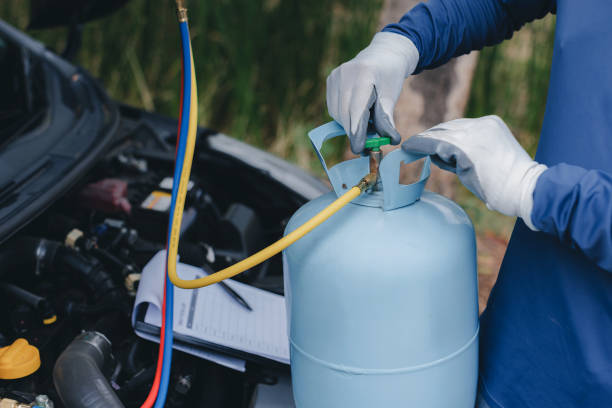
Dubai’s summer is not a season you can survive without a fully functioning air-conditioning system. When ambient temperatures climb past 48°C and road surface temperatures push even higher, your car’s AC isn’t a luxury accessory; it’s essential safety equipment. The single most common reason car AC systems underperform in the UAE is low or depleted car AC gas, also known as automotive AC refrigerant. Yet most drivers don’t recognize the signs until the system stops cooling entirely.
This guide walks you through the 10 clearest signs that your car AC gas level is low or depleted, explains what’s happening inside the system when each symptom appears, and tells you exactly what to do and where to go for a professional AC gas recharge in Dubai before the peak summer heat arrives.
What Is Car AC Gas and Why Does It Matter in Dubai?
Before diving into the symptoms, it helps to understand what car AC gas actually does inside your vehicle’s air conditioning system. Refrigerant, most commonly R-134a in vehicles manufactured before 2021, and R-1234yf in newer models, is the chemical compound that cycles through the AC system, absorbing heat from inside the cabin and releasing it outside. Without sufficient refrigerant, this heat exchange process breaks down, and no amount of fan speed or temperature setting adjustment will compensate.
In Dubai’s climate, car AC systems work significantly harder than they do in temperate markets. The system runs for longer periods, compresses refrigerant more frequently, and operates at higher ambient temperatures than it was typically designed around. This accelerates the natural micro-seepage that occurs even in sealed AC systems, and makes refrigerant leak symptoms appear faster and more dramatically than in cooler markets. A vehicle slowly losing refrigerant in London might not show symptoms for three or four years; in Dubai, the same leak rate can cause noticeable car AC cooling problems within a single summer season.
Understanding your car AC gas level and acting on early warning signs is one of the most cost-effective maintenance decisions a Dubai driver can make.
Sign 1: Weak Car AC Cooling That Gets Worse Over Time
The most straightforward symptom of low car AC gas is a gradual reduction in cooling effectiveness. Your AC feels cold enough in the morning but struggles to maintain a comfortable cabin temperature by afternoon. This progressive weakening is the hallmark pattern of refrigerant depletion the system still has enough gas to function partially, but not enough to handle Dubai’s peak heat loads.
Drivers often adapt to this symptom without recognizing it as a mechanical warning. If you find yourself turning the AC to maximum fan speed and lowest temperature just to achieve what used to be comfortable at a mid-level setting, that behavioral change is worth noticing. Weak car AC cooling that deteriorates over weeks or months is almost always a refrigerant issue, not a fan or thermostat fault.
Sign 2: Car AC Not Cooling Properly in Dubai Traffic
Stop-and-go traffic is a particular stress test for car AC systems. When the vehicle is stationary, airflow through the condenser drops significantly; the system relies on the electric condenser fan rather than vehicle movement to pull air across the coil. For a system running at correct car AC gas levels, this transition is manageable. For a system running low on refrigerant, stationary traffic often exposes the deficit completely: the AC blows warm or barely cool air while you’re stopped, then recovers slightly when the vehicle is moving again.
If your car’s AC isn’t cooling properly and it’s worse in traffic than on the open road, low refrigerant is the first thing to investigate. The second is the condition of the car AC condenser problems, such as fin blockage from Dubai’s dusty air, can significantly compound refrigerant issues.
Sign 3: Car AC Takes Long to Cool the Cabin
A properly charged AC system in a well-maintained vehicle should noticeably lower cabin temperature within 90 seconds to 3 minutes of activation in Dubai’s climate. When your car’s AC takes a long time to cool five minutes or more to produce genuinely cold air, or never fully reaching the set temperature this indicates the system is under-refrigerant.
This symptom is easy to dismiss as “just how summer is,” but it is a measurable deviation from how the system should perform. Rapid Rev Garage’s air conditioning system diagnosis begins by measuring system pressures, both high-side and low-side, to determine how much the current refrigerant charge deviates from the correct specification for your vehicle.
Sign 4: AC Compressor Not Engaging
The AC compressor is the pump at the heart of the refrigerant circuit. It is driven by the engine belt and engages through an electromagnetic clutch when the AC is activated. Most modern vehicles have a low-pressure safety switch that prevents the compressor from engaging if the refrigerant level drops below a threshold. This protection prevents the compressor from running dry and destroying itself.
If you activate the AC and hear the compressor clicking but not sustaining engagement, or if you notice the compressor clutch is simply not engaging at all, low car AC gas is the most common cause. The system has detected insufficient refrigerant pressure and locked out the compressor to protect it. This is a protective failure mode, not a compressor fault and a car AC gas recharge at the correct charge level will restore normal engagement in most cases.
Sign 5: AC Compressor Cycling On and Off Rapidly
Related to the above, AC compressor cycling on and off more frequently than normal, a pattern in which you can hear the compressor engage, disengage, and re-engage every few seconds, is a classic symptom of refrigerant depletion. The system pressure drops when the compressor runs, triggering the low-pressure cutout switch. The switch reopens once the pressure normalizes slightly, and the cycle repeats.
This rapid cycling is both a symptom and an accelerator of wear; the electromagnetic compressor clutch is not designed for rapid on-off cycles in quick succession, and extended cycling will significantly shorten clutch life if the underlying refrigerant deficit is not addressed.
Sign 6: Hissing Noise From Car AC System
A hissing noise from car AC components, particularly audible from the engine bay when the AC is running, or from the dashboard area inside the cabin, indicates refrigerant leaking under pressure from a joint, seal, hose, or component in the circuit. This is distinct from the normal operational sounds of the compressor engaging.
A hissing or bubbling sound from the AC system is one of the most direct signs of a refrigerant leak. It typically originates from the high-pressure side of the system, commonly at hose connections, at the compressor shaft seal, or at the condenser inlet fittings. Refrigerant under pressure escaping through even a small gap produces an audible hiss that most drivers notice during initial AC activation or when the system is under load in stationary traffic.
Never ignore a hissing noise from car AC components. Refrigerant leaks do not self-seal, and the gas loss rate typically accelerates as the leak point expands under repeated thermal cycling.
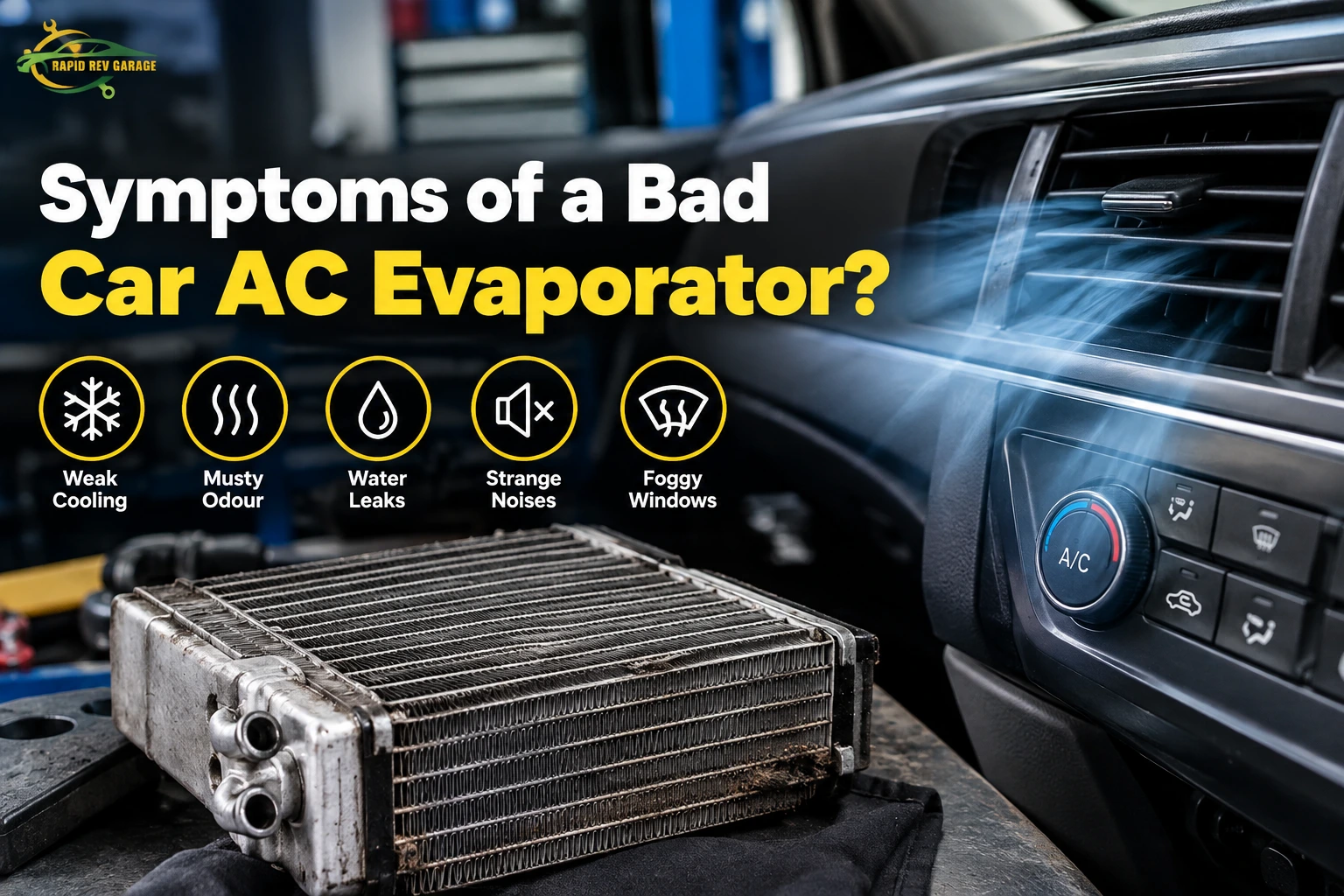
Sign 7: Ice on AC Pipes or Frozen AC Evaporator
This one surprises most drivers: if you see ice forming on the AC pipes in your engine bay, or if you notice reduced airflow from the vents and discover that the evaporator (the component behind your dashboard) has frozen solid, low refrigerant is a leading cause.
When refrigerant pressure drops below the correct level, the evaporator surface temperature falls below the designed operating range, causing condensation on the evaporator coil to freeze rather than drain away. A frozen AC evaporator blocks airflow through the core, which explains why ice formation often presents as dramatically reduced air output from the vents rather than warm air; the airflow path is physically blocked by ice.
Ice on AC pipes or a frozen AC evaporator is counterintuitive; cold is what you want, but it signals that the system is operating outside its engineered parameters and needs prompt attention.
Sign 8: Car AC Gas Leak Detected by Visible Oily Residue
Refrigerant in modern AC systems is mixed with a small amount of compressor oil that circulates through the refrigerant circuit to lubricate the compressor. When a car AC gas leak occurs at a specific point in the system, this oil escapes along with the refrigerant and deposits a visible oily or greasy residue at the leak site.
Checking the AC hose connections, the condenser fittings, and the compressor shaft area for oily streaks or buildup is one of the first physical inspection steps a qualified technician performs. This residue is often the most visible indicator of where a leak is occurring before an electronic leak detector is used to determine its precise location. If you see unusual greasy deposits around any AC component in the engine bay, this is a strong indicator that a car AC gas leak is actively occurring.
Sign 9: Car AC Condenser Problems and Poor Cooling Under Load
The condenser is the component at the front of the vehicle, typically mounted in front of the radiator, that releases the heat absorbed from the cabin into the outside air. Car AC condenser problems can reduce cooling performance regardless of the refrigerant level and significantly compound refrigerant-related issues.
In Dubai’s dusty environment, condenser fins become clogged with fine particulate matter and road debris. A partially blocked condenser increases system head pressure, reducing the efficiency of the refrigerant’s heat-exchange cycle. The result is that even a correctly charged system struggles when the condenser is compromised. A Rapid Rev Garage AC service includes condenser condition inspection alongside refrigerant level diagnosis because treating just one of these issues when both are present will not fully restore car AC performance.
Sign 10: Unusual Smells or Moisture Inside the Cabin
When refrigerant levels drop, the evaporator temperature and moisture management behavior of the AC system changes. An undercharged system that cycles between freezing and thawing more than it should creates excess moisture accumulation in the evaporator housing. This can lead to musty or mildew-like smells inside the cabin, a symptom many drivers attribute to the cabin air filter, when the actual cause is excessive moisture from an underperforming evaporator.
A persistent musty smell from the AC vents, particularly noticeable when the system first activates, combined with any of the other nine signs above, strongly indicates a need for a full air conditioning diagnosis and a car AC gas recharge.
Why Car AC Gas Recharge Matters More in Dubai Than Anywhere Else
Every sign above becomes more acute in Dubai’s operating environment. The combination of extreme ambient heat, long daily AC runtime, and the thermal stress placed on refrigerant hoses and seals by constant temperature extremes means that refrigerant management is not optional maintenance it is core vehicle upkeep in this market.
R-134a and R-1234yf refrigerants, the two most commonly found in vehicles on UAE roads, both require precise charge levels to function efficiently. Overcharging is as problematic as undercharging: too much refrigerant raises system pressure dangerously and can damage the compressor. This is why a professional car AC gas recharge, using calibrated recovery and recharge equipment and performed by technicians who understand the correct specifications for each vehicle, produces meaningfully better results than a quick top-up at an unqualified workshop.
Rapid Rev Garage in Al Quoz uses manufacturer-spec refrigerant quantities for each vehicle, performs a leak test before recharging to ensure the gas won’t simply escape again, and checks the full AC system compressor, condenser, expansion valve, and evaporator as part of every recharge service.
What the Car AC Gas Recharge Process Looks Like at Rapid Rev Garage
A professional car AC gas recharge at Rapid Rev Garage follows a consistent diagnostic process, not a simple top-up.
Why a Proper Car AC Gas Recharge Requires More Than a Top-Up
Skipping the diagnostic steps below and simply adding refrigerant without leak testing or vacuuming the system is the most common mistake made by unqualified workshops in Dubai. It produces short-term relief and long-term expense. Here is what the correct process looks like:
Step 1 — System pressure test. High-side and low-side pressure readings are taken with the system running to identify the current refrigerant charge level and confirm whether the compressor is engaging correctly.
Step 2 — Leak detection. An electronic refrigerant leak detector is used to locate any active leaks before recharging. There is no point recharging a leaking system without repairing the leak first — the refrigerant will escape again within weeks.
Step 3 — Refrigerant recovery. Any remaining refrigerant in the system is recovered into a certified recovery machine. This is an environmental and safety requirement, not optional.
Step 4 — Vacuum test. The system is pulled into a deep vacuum using a vacuum pump and held there for a minimum period to confirm the circuit holds pressure without atmospheric leaks.
Step 5 — Recharge to specification. The correct quantity of R-134a or R-1234yf refrigerant — determined by the manufacturer’s specification for that vehicle model — is introduced into the system by weight, not by estimate.
Step 6 — Performance verification. With the system recharged, vent temperatures are measured, and system pressures are rechecked to confirm the AC is operating within the correct range.
This process is what separates a professional car AC gas recharge from a roadside top-up that simply adds gas without confirming why it was low or whether the system can retain the new charge.
When to Search for a Garage Near Me for AC Service
If you recognize three or more of the ten signs above in your vehicle, don’t wait for the system to fail. Searching for a garage near me in Dubai for AC diagnosis early — before peak summer — means shorter wait times, better parts availability, and the ability to drive comfortably through the hottest months rather than scrambling for an emergency repair in July or August.
For drivers who cannot bring their vehicle to the workshop, a mobile car mechanic can attend the vehicle at its location for an initial diagnosis, and roadside assistance is available for vehicles that have broken down or when the driver suspects the AC fault is connected to a broader mechanical issue. Rapid Rev Garage’s car-service-dubai offering covers full AC service as a scheduled maintenance item, and the team at the car garage location in Al Quoz is equipped for same-day recharge appointments on most standard vehicles.
If you’re also looking for a full vehicle health check alongside the AC service, a car mechanic appointment at Rapid Rev Garage covers both in a single visit, along with any car painting near me or bodywork needs that may have accumulated.
Frequently Asked Questions About Car AC Gas Recharge in Dubai
Q1: How do I know if my car AC gas is low?
The clearest signs are weak or warm air from the vents, the compressor not engaging or cycling rapidly, a hissing noise from the AC system, or ice forming on the AC pipes. Any of these, individually or in combination, indicate a refrigerant issue requiring professional diagnosis.
Q2: How often does car AC gas need to be recharged in Dubai?
A sealed system with no leaks should not need regular recharging — refrigerant doesn’t get “used up” like oil. If your system regularly needs topping up, there is an active leak that needs to be found and repaired. In Dubai’s climate, an annual AC check is advisable regardless of symptoms, given the accelerated wear on seals and hoses.
Q3: What type of refrigerant does my car use — R-134a or R-1234yf?
Vehicles manufactured before approximately 2021 typically use R-134a. Newer vehicles, particularly European brands, use R-1234yf, which has lower global warming potential. The correct refrigerant type is specified on a sticker in your engine bay near the AC service ports; only that type must be used — mixing refrigerants damages the system.
Q4: Can I recharge my car AC gas myself?
DIY recharge kits are available in retail shops. Still, they carry significant risks: they do not identify or repair leaks, they cannot properly evacuate the old refrigerant, and they frequently overcharge the system — which is as damaging as undercharging. A professional recharge using calibrated equipment and manufacturer-spec quantities is always the correct approach.
Q5: Why is my car AC compressor not engaging after a recharge?
If the compressor won’t engage after a gas top-up, the most common causes are a faulty low-pressure switch, a damaged compressor clutch coil, an electrical fault in the AC control circuit, or an insufficient refrigerant level. A full air-conditioning system diagnosis using a scan tool is required to isolate the fault.
Q6: What causes a refrigerant leak in a car AC system?
The most common causes in Dubai are: deteriorated rubber hose connections from thermal cycling, a leaking compressor shaft seal, condenser damage from road debris, and corroded or cracked line fittings. High system pressures during extreme heat accelerate all of these failure modes.
Conclusion: Don’t Let Low Car AC Gas Ruin Your Dubai Summer
All ten signs above point to the same conclusion: low or depleted car AC gas is the most common and most actionable cause of AC underperformance in Dubai, and acting on the warning signs early saves both money and discomfort. Whether your system is showing weak cooling, a compressor that won’t engage, hissing sounds, ice on the pipes, or simply a cabin that takes too long to reach a comfortable temperature — these are all solvable problems with a professional recharge service performed correctly.
Rapid Rev Garage in Al Quoz is equipped for the complete car AC gas recharge process: leak detection, correct refrigerant type and quantity, vacuum testing, and full system performance verification. The team works across all vehicle categories — sedans, SUVs, luxury vehicles, and commercial vehicles — using manufacturer-spec quantities of R-134a and R-1234yf refrigerant.
Book your car AC gas recharge at Rapid Rev Garage right now via WhatsApp — message us here and get your AC performing the way Dubai’s summer demands, before the heat makes every drive unbearable, also Find us on Google Maps: https://maps.app.goo.gl/axPzrssQD8tA4b759